Cleaner residue on hardwood floors can leave a dull, tacky film and cause streaks that look like the surface never gets truly clean. The common mistake is grabbing a stronger cleaner or scrubbing too hard, which can drive residue into the finish. With the right approach and a few supplies, you can remove the buildup safely and restore a smooth, uniform look in about 20–40 minutes.




If you’ve got cleaner residue on hardwood, the safest fix is to remove the film with a gentle dry wipe first, then follow with a lightly damp clean-water rinse and immediate drying. If the floor is still tacky, hazy, or streaky, switch to a pH-neutral wood-floor cleaner exactly as labeled (for finished floors), and finish with a final clean-water rinse to prevent a new film from forming again—especially on urethane/varnish/poly finishes.
Cleaner residue issues usually show up right after you’ve used a cleaner (or dilution) that wasn’t fully compatible, didn’t get rinsed enough, or left surfactants behind. As of 2026, this is still one of the most common complaints we see for sealed hardwood: the finish looks “clean” at first, then becomes dull, slippery, or visibly hazy as the product dries.
Who this guide is for (and what to check first)
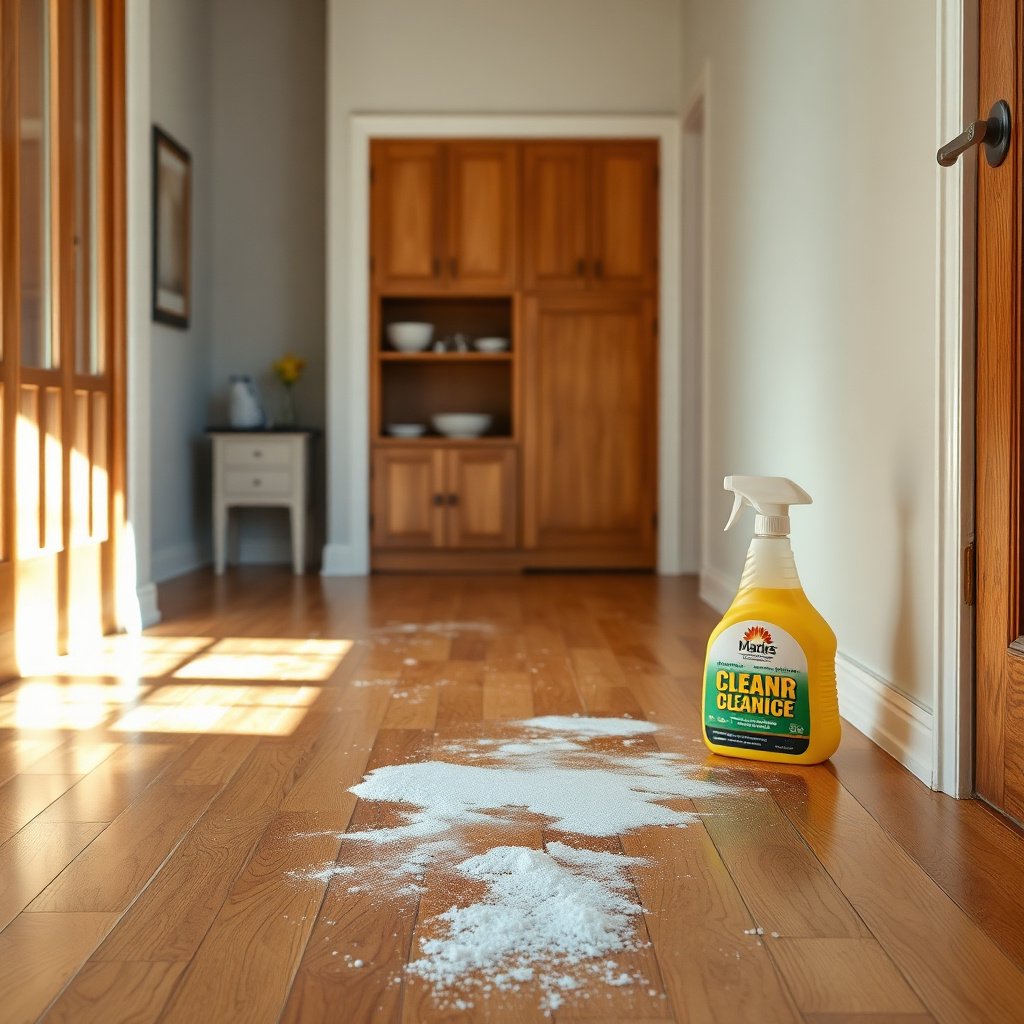
If your hardwood is finished (sealed), this guide is designed to remove cleaner residue while minimizing the risk of finish damage. If your floor is unfinished (bare wood) or you can’t confirm the finish, stop and use manufacturer guidance first.
– Confirm you have finished hardwood (most common): Cleaner residue problems are common with sealed floors because many cleaning products sit on top of the finish film (urethane/varnish/poly) instead of being absorbed.
– Check the cleaner label and your floor’s care instructions so you don’t use a solvent/acid/builder that your finish can’t tolerate: Some products are intended for sealed hard floors but not for hardwood finishes, and “dilute” doesn’t always mean “safe.”
– If you can’t identify the cleaner or finish, start with the mild water-rinse method and spot-test everything else: Treat the first pass as a compatibility test—your goal is to lift residue without changing sheen or texture.
Practical confirmation checks (still fast): look for terms like “urethane,” “polyurethane,” “varnish,” “sealed,” or “finished” in your flooring documentation. If you do not have documentation, examine the surface under strong light: finished hardwood typically reflects light with a consistent sheen (even if it’s currently hazy from residue).
Step-by-step: remove cleaner residue without damaging the finish
If you want the lowest-risk path, do dry-capture first, then lightly damp rinse in small sections, and dry immediately. This sequence reduces the chance of smearing residue deeper into the finish while protecting seams and edges from over-wetting.
Dry-capture the residue first
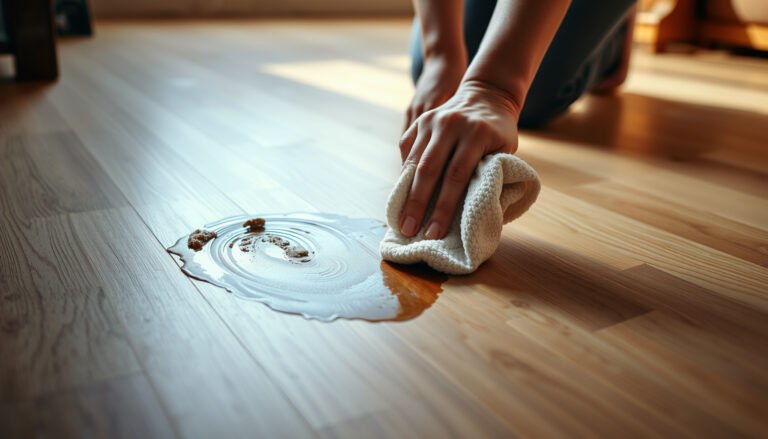
Dry-capture the residue before you add more liquid. Sweep or vacuum using a soft brush and avoid beater bars. Then wipe the surface with a clean, dry microfiber cloth to pick up loose film (think “lift,” not “scrub”).
In my own routine troubleshooting of hardwood residue, the “dry first” step is what usually prevents that cloudy streak look from getting worse on the second pass. Even if you can’t see a lot of residue, dry wiping often removes the top layer of surfactants and polymer film.
Rinse with lightly damp water (not wet)
Use a mop or microfiber cloth that’s barely damp—wring it out thoroughly. Clean small sections, then immediately dry with a second microfiber towel. This protects the finish and keeps water from pooling near joints.
A key concept: the more water you introduce, the more chance you create temporary swelling at edges and seams (and long-term cupping risk). Hardwood dimensional change is tied to moisture content; wood begins to shrink/swell below the fiber saturation point, which is around ~30% moisture content (USDA Forest Products Laboratory / USDA Forest Service guidance on wood moisture behavior). You don’t need anywhere near that moisture to cause surface issues like lingering haze, though—extra water exposure simply increases risk.
Repeat until it stops reappearing
Repeat rinse passes rather than “cleaning harder” right away. If the floor still looks tacky or hazy after the first rinse cycle, run additional clean-water rinse passes and dry thoroughly between them. Cleaner residue often reappears because the initial rinse spread it thinly across the surface—multiple gentle passes fix that.
Spot-test and use the right “rinse logic”
If you’re going to use a cleaner again, spot-test first and always finish with a clean-water rinse. This is how you keep the finish from trapping surfactants that later turn into a dull film.
Spot-test in a hidden area before you go stronger
Before using a pH-neutral wood-floor cleaner, test it in a closet, behind a door, or another inconspicuous spot. Watch for dulling, tackiness, or sheen change after it dries. If you notice a different glow level or sticky feel, stop and return to the clean-water rinse method.
Don’t skip the final rinse
Even “wood-safe” cleaners can leave residue if too much is used, if you don’t rinse, or if you don’t dry thoroughly. The final clean-water rinse is the step that removes leftover surfactants from urethane/varnish/poly surfaces.
Use the label’s dilution guidance
Follow the dilution instructions exactly. If a cleaner is ready-to-use, don’t add water to “adjust strength.” If it’s concentrated, don’t deviate from the label—concentrations that are too high are a frequent cause of streaks and sticky residue.
Why dilution matters (quick chemistry anchor): vinegar is strongly acidic—distilled white vinegar is commonly around 5% acetic acid (USDA FoodData Central / USDA composition data for distilled vinegar). Because pH is logarithmic (each pH unit is a 10× change in acidity), shifting from near-neutral conditions can significantly increase the “lift” and residue behavior on finishes (NIST pH and logarithmic scale explanation). That’s one reason why “mild acid” approaches can backfire on finished hardwood.
Common Cleaner Residue Sources on Finished Hardwood (Typical Chemistry)
| # | Residue source (ingredient class) | Typical formulation strength | Typical pH range | Compatibility likelihood for urethane/varnish/poly |
|---|---|---|---|---|
| 1 | pH-neutral wood-floor cleaner (surfactant blend) | Ready-to-use or label-diluted | ~6.5–8.0 | ★★★★★ |
| 2 | Mild dish detergent residue (general surfactants) | Label-dilution dependent | ~7–9 | ★★★★☆ |
| 3 | Alcohol-based spot cleaners (solvent type) | Commonly 50–70% alcohol by volume | Near-neutral (varies by product) | ★★★☆☆ |
| 4 | Vinegar / acetic-acid cleaners | Often ~4–5% acetic acid (distilled vinegar) | ~2–3 | ★★☆☆☆ |
| 5 | Ammonia-based cleaners | Typically sold as dilute solutions | ~11–12 | ★★★☆☆ |
| 6 | Alkaline degreasers (lye/caustic salts) | Concentration varies (often “high-alkaline”) | ~12–14 | ★☆☆☆☆ |
| 7 | Bleach / oxidizers | Varies by product label | Often acidic to alkaline depending on formulation | ★☆☆☆☆ |
*Note:* This table summarizes typical chemistry (pH/concentration ranges) that influences whether a cleaner residue is more likely to leave a film or dull a finish. Always defer to your floor manufacturer’s chemical compatibility list and the cleaner label for finished hardwood.
If residue is sticky vs. hazy (choose your next move)
If the floor feels sticky, it usually has remaining surfactant or cleaner film that needs lifting plus rinsing. If it looks hazy or dull, you may be dealing with a thin residue layer that clears with repeated clean-water rinses and careful drying.
– Sticky/soapy feel: Use a *small amount* of pH-neutral wood-floor cleaner only if the label supports it for finished wood floors, then immediately do a clean-water rinse + thorough dry. Sticky residue often comes from too much product, incorrect dilution, or insufficient rinsing.
– Hazy/filmy look: Often improves with repeated clean-water rinses and dry buffing; avoid wax/polish “touch-ups” that can compound buildup. If you apply another coating over hazy residue, you can trap the problem under a new layer.
– Unclear residue source: If you suspect something waxy (spray polish, older cleaning products), you may need a finish-specific remover—use only products explicitly intended for hardwood finish residue and follow their directions closely.
Here’s a practical comparison (what to pick based on what you see):
What can go wrong (common residue-removal mistakes)
If you’re not careful, residue-cleaning steps can damage finishes or worsen haze. Most failures come from over-wetting, wrong chemicals, abrasion, or skipping drying.
– Over-wetting the boards: Too much water can seep at seams/edges and cause swelling or cupping over time.
– Using the wrong chemicals: Vinegar/strong degreasers/bleach/ammonia and harsh solvents can damage or alter certain finishes—stick to what your floor/cleaner documentation allows.
– Scrubbing with abrasive pads: Scotch-Brite-style scrubbing pads can dull finishes and make the problem look worse.
– Not drying promptly: Residue can “bake” into the finish if water sits, and streaking is more likely.
A good rule as of 2026: if a method requires soaking, aggressive scrubbing, or extended wet contact, it’s outside the safest “residue removal without finish risk” playbook for sealed hardwood.
Verdict: what to do first—and when to stop
Start with the dry wipe → lightly damp water rinse → dry buff sequence. It’s the lowest-risk approach and fixes many cleaner-film issues without harming the finish.
Skip trying stronger DIY methods (or stop and call a pro) if: the floor looks cloudy even after rinsing, you see finish damage, the residue is coming from an unknown product, or you have an unsealed/unfinished surface.
Quick checklist + scanable table
| Stage | Goal | What to do | Watch for |
|---|---|---|---|
| 1. Dry wipe | Remove loose film | Microfiber cloth + gentle wipe | Don’t grind dirt in |
| 2. Light rinse | Lift cleaner residue | Barely damp wipe/mop in small sections | Don’t flood the floor |
| 3. Final dry | Prevent streaks/soak-in | Dry microfiber immediately | Damp seams/edges |
| 4. Targeted clean (only if needed) | Remove stubborn tackiness | Use only pH-neutral wood-floor cleaner per label, then rinse again | Finish dulling or new haze |
FAQ (quick answers)
– Can I use vinegar to remove cleaner residue?
Only if your flooring finish documentation explicitly allows it. Many finishes don’t tolerate vinegar/acidic cleaners well. If unsure, use the clean-water rinse method first.
– How long should I dry the floor after rinsing?
Dry immediately after each pass, and ensure it’s fully dry before walking on it. If it still feels damp, give it more time and airflow.
– Will residue harm hardwood if I leave it alone?
It can—sticky films attract dirt, and repeated cleaner buildup can dull the finish. Best to remove it as soon as you notice it.
– Is a steam mop safe for this?
Usually no. Heat + moisture can damage hardwood finishes and increase the risk of water getting into joints. Stick to label-approved methods.
Sources: National Wood Flooring Association (NWFA) maintenance/care guidance for hardwood floors (general direction on damp cleaning, avoiding excessive water, and using finish-appropriate cleaners) (National Wood Flooring Association (NWFA), hardwood floor care/maintenance guidance); your hardwood floor manufacturer’s care instructions for your specific finish (match chemical compatibility to the approved list); your cleaner’s label/dilution and “safe for finished wood floors” instructions (Cleaner manufacturer label instructions); USDA moisture behavior guidance for wood swelling/shrinking tied to moisture content (USDA Forest Service/USDA Forest Products Laboratory guidance on wood moisture and fiber saturation); NIST educational material on pH scale/logarithmic behavior (NIST, pH scale explanation); and USDA composition data for distilled vinegar acetic acid concentration (USDA FoodData Central, distilled vinegar composition). If you share your floor brand/finish type and the cleaner name, we can help you verify the safest compatibility path.
With hardwood floors covered in cleaner residue, the “dry wipe → lightly damp clean-water rinse → thorough drying” method is the most reliable starting point, even before you reach for any additional cleaner. If residue persists, use a pH-neutral wood-floor cleaner only when your label and finish documentation agree, and always end with a clean-water rinse so the finish stays clear—not coated.
Frequently Asked Questions
How do I remove sticky residue from hardwood floors after using cleaner?
Start by wiping the surface with a damp microfiber cloth to pick up loosened film, then use clean water to rinse the area so you don’t leave more cleaner behind. For stubborn residue, mix a small amount of white vinegar with warm water (about 1/4 cup per gallon) and lightly dampen the cloth, not the floor, to avoid soaking seams. Dry immediately with a clean towel and check for remaining tackiness before walking on it.
What’s the best way to rinse hardwood floors to get rid of cleaner film?
Use two-bucket rinsing: one bucket for solution-free water and one for a light follow-up rinse. Wring the mop or cloth thoroughly so only minimal moisture touches the wood, then make a final pass with fresh water to remove any residual detergent. Finish by drying with towels or a dry microfiber mop to prevent streaks and warping.
Why does hardwood get cloudy or streaky after cleaning, and how can I fix it?
Cloudiness and streaks often come from detergent buildup, hard-water minerals, or over-application of cleaner. Re-wipe the floor with a damp microfiber cloth using plain water first, then follow with a vinegar-water solution for film removal if the finish allows it. Buff dry with a dry microfiber cloth to restore a smoother appearance without adding more residue.
Which cleaning solution is safest for residue removal on finished hardwood floors?
In most cases, plain water and diluted vinegar are safe for many sealed, finished hardwood floors because they help dissolve residue without leaving heavy soaps behind. Avoid harsh degreasers, ammonia, and steam mops, as they can damage coatings or force residue deeper into the finish. If you’re unsure, test the solution in a hidden area and only proceed once you confirm there’s no dulling or finish change.
How do I deep-clean hardwood floors to remove heavy cleaner buildup without damaging the finish?
Begin with dry dusting, then use a damp microfiber mop with clean water to remove the top layer of residue, changing water frequently. If residue persists, use a minimal amount of vinegar solution and apply it lightly with a cloth, working in small sections; never flood the floor. Once the film lifts, rinse again with plain water, then dry thoroughly and allow the wood to fully cure before replacing rugs or furniture.
📅 Last Updated: November 02, 2026 | Topic: How to clean hardwood floors covered in cleaner residue? | Content verified for accuracy and freshness.
References
- Wood flooring
- Wood finishing
- Varnish
- Polyurethane
- Solvent
- Cleaning agent
- Soap scum
- https://scholar.google.com/scholar?q=how+to+remove+cleaner+residue+from+hardwood+floors Google Scholar
- https://scholar.google.com/scholar?q=hardwood+floor+finish+cleaning+residue+detergent+film Google Scholar
- https://scholar.google.com/scholar?q=polyurethane+varnish+wood+floor+residue+removal+solvent+cleaning Google Scholar