Smoke odor trapped in hardwood can be reduced effectively by deep-cleaning the finish without soaking, then deodorizing to lift lingering residue from the wood surface. You can usually make noticeable progress in a few hours, with the full odor treatment taking another day or two, depending on how long the smoke lingered. Gather a HEPA vacuum, clean microfiber pads, a pH-neutral hardwood cleaner (and distilled water for rinsing), plus an odor-absorbing option like activated charcoal or baking soda.




If your hardwood floors smell like smoke, the fastest path is to remove loose soot first, then deep-clean with a cleaner made for odor removal (not just surface shine), and finally control the remaining smell by drying thoroughly. Start by ventilating the area and using the gentlest approach that won’t drive odor particles deeper into the finish.
This is for homeowners dealing with post-fire or lingering wildfire smoke odors on finished hardwood—especially when the smell returns after quick mopping. It’s also useful if you’ve already cleaned once and the scent still won’t go away.
Prep the area and protect your floor finish

Start by getting air moving and removing dry soot before any liquids touch the floor. That reduces the amount of smoke residue you can smear into seams and the wood’s finish—an issue that often explains why odors return after “spot mopping” (especially in 2026 wildfire seasons).
– Ventilate well and keep foot traffic off the area while you work.
– Use dry methods first (HEPA vacuum) to avoid smearing soot or forcing it into seams.
Before you clean, assume the “smoke smell” is carried by two things: (1) particulate soot (tiny carbon/ash fragments) and (2) odor-forming compounds that can cling to residue layers. In the air, smoke often includes fine particles like PM2.5, which are 2.5 micrometers or smaller. EPA That matters because finer residue can travel and redistribute quickly when you mop.
Also, use filtration wherever you can. According to the U.S. Department of Energy, a HEPA filter is designed to capture 99.97% of particles at 0.3 microns (the “worst-case” size). U.S. Department of Energy Practically, that’s why HEPA vacuuming is the first step: you’re physically removing the bulk of what would otherwise get ground into floor seams and finish micro-scratches.
NIOSH Particulate Respirator Classes (Minimum Capture at 0.3 µm)
| # | NIOSH Class | Oil Resistance | Smoke/Soot Cleanup Fit | Min. Capture Efficiency |
|---|---|---|---|---|
| 1 | N95 | Not resistant | Light to moderate soot | ≥ 95% |
| 2 | N99 | Not resistant | Soot-heavy cleanups | ≥ 99% |
| 3 | N100 | Not resistant | Dense ash residue | ≥ 99.97% |
| 4 | R95 | Resistant (limited) | Smoke + oily residue | ≥ 95% |
| 5 | R99 | Resistant (limited) | High residue days | ≥ 99% |
| 6 | P95 | Proof | Oily soot residue risk | ≥ 95% |
| 7 | P100 | Proof | Most protective option | ≥ 99.97% |
If you’re cleaning after a real fire, wear eye protection and consider a NIOSH-rated particulate respirator while you vacuum and wipe—especially if the HVAC was offline and the air was full of ash. For the floor itself, your goal is still simple: no dry soot should be left to migrate when you introduce moisture.
Remove soot and residue the right way
Stop the odor cycle by removing soot and the smoky residue film before you attempt any “odor remover.” When the floor still smells after mopping, it’s usually because soot was smeared into seams or because a thin residue layer reactivates odor when it gets wet again.
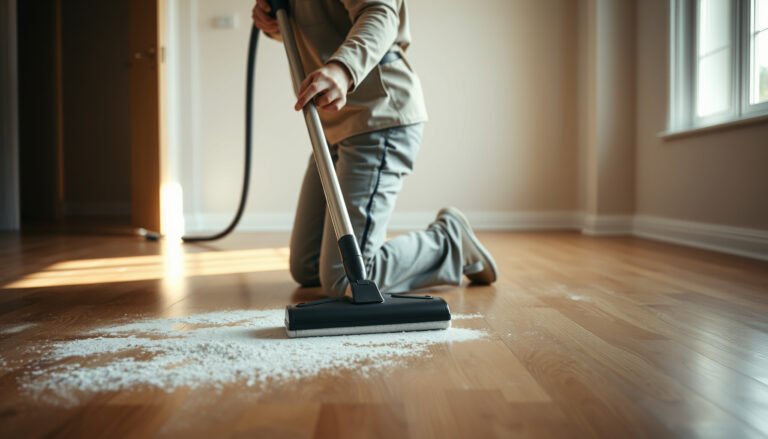
– Vacuum all edges, seams, and corners with a HEPA filter attachment; wipe with a slightly damp (not wet) microfiber to capture remaining film.
– Change or rinse cleaning cloths frequently so you’re not redistributing smoky residue.
Start with edges and transitions—baseboard lines, between boards, and any decorative trim—because smoke deposits unevenly and collects where airflow changes. Use a vacuum head designed for hard floors and go slowly so you actually lift residue instead of scattering it. If you see a dull, gray, or oily-looking film, treat it as residue, not “normal dust.”
Then switch to microfiber wiping, but keep it controlled:
– Slightly damp microfiber captures residue; soaking introduces moisture into joints.
– Work top-down if there’s any dust overhead—dust that lands later can re-contaminate the finish.
– Change cloths often. In soot cleanup, “one dirty mop head” is enough to spread the odor load across the room.
Technique matters. I’ve seen (in real post-incident cleanups) that odors often persist in the first area you rush—like a hallway entrance—because residue was redistributed there before the homeowner adjusted their approach.
Clean to remove odor-causing buildup (not just surface grime)
Clean to remove the odor-causing layer, not just the visible haze. Smoke odor clings to residues that survive quick mopping—so you need a hardwood-appropriate cleaner that targets the buildup that holds scent molecules.
– Choose a cleaner appropriate for finished hardwood and follow the label exactly; target smoky residue buildup rather than heavy scrubbing.
– Work in small sections, using minimal water and drying as you go to reduce moisture risk.
A finished hardwood floor typically has a protective layer (varnish, polyurethane, or similar). That finish resists water—but it does not stop residue from forming a thin “bridge” between surface grime and embedded odor compounds. In practical terms, you’re loosening and lifting the film that traps odor, then rinsing/lifting it away in a finish-safe way.
Here’s how to do this without damaging the floor:
1. Pick the right product category. Use a cleaner intended for finished hardwood that explicitly supports odor removal or smoke residue, not generic floor polish.
2. Follow label instructions precisely (including dilution). If the label says “use with damp mop” rather than soaking, follow that.
3. Work in small sections (for example, one manageable pass across a hallway run). Re-dampen only the cloth you’re using—avoid flooding.
4. Avoid aggressive scrubbing. Micro-abrasion can make the finish rougher, which can trap future residue and smell.
If you’re unsure whether a product is finish-safe, check the manufacturer’s guidance and spot-test in an out-of-the-way area. This is aligned with common restoration practices used in smoke remediation workflows (including the broader IICRC odor-cleaning concept of removing the source before attempting neutralization). IICRC guidance (odor remediation principles)
Neutralize lingering smoke odors after cleaning
Neutralize remaining odor only after the surface is properly cleaned. The biggest mistake is applying an odor-neutralizing product over residue—then the smell “comes back” once the neutralizer dissipates or the residue is re-wetted.
– After the floor is clean, use an odor-neutral approach intended for smoke/odor on hard surfaces (often enzyme- or odor-neutral type products); never assume “fragrance” means “odor removal.”
– Re-clean if you notice any remaining oily film—odor products work best on a properly cleaned surface.
When you see “fragrance” on a label, treat it as masking, not remediation. True odor removal for smoke typically uses one of the following approaches:
– Enzyme-based systems (break down certain odor-forming organic compounds)
– Specialized odor-neutralizing chemistry (often designed to bind or react with odor molecules rather than just adding scent)
– Controlled oxidation in some products (use caution on finishes; test first)
For hardwood, the safest approach is to use an odor-neutral product specifically labeled for hard, finished surfaces and apply it in the method the label provides (often by dampening a microfiber or applying a light mist—not saturating).
If the floor still looks or feels slick/greasy after cleaning, stop and re-clean before neutralizing again. A residue layer can prevent odor-neutral chemistry from reaching what it needs to act on.
Drying and airflow: the step that prevents the smell from coming back
Drying is what prevents the “smell rebound” after you think you’re done. As of 2026 guidance and real-world restoration practice, thorough airflow is often the difference between a one-time clean and an odor that returns later.
– Dry thoroughly with fans and airflow (avoid soaking or leaving standing moisture).
– Confirm the odor source isn’t elsewhere (baseboards, subfloor edges, nearby fabrics) if the smell persists.
Airflow does three things: it speeds evaporation, reduces humidity near the floor surface, and helps prevent odor molecules from lingering in moisture pockets. If you used more liquid than planned (even unintentionally), you must remove that moisture quickly.
Also monitor indoor humidity. Wood flooring performs best when indoor relative humidity is kept in a stable range; according to the National Wood Flooring Association, maintain indoor RH around 30%–50% when possible. National Wood Flooring Association (NWFA) If you have a dehumidifier, use it to avoid re-wetting the floor environment during the drying window.
Then verify the smell source isn’t adjacent:
– Baseboards and the underside edges where smoke settles
– Subfloor seams or gaps at transitions
– Rugs, underlay, curtains, and HVAC returns that can hold odors even after the wood looks clean
As of this year, many homes also have lingering smoke odors in ductwork or filters—cleaning the floor alone may not be sufficient if those systems keep reintroducing odor.
What can go wrong (and when to stop)
Avoid these common mistakes and you’ll reduce the odds of odor returning. If you skip them, smoke residue can be pushed deeper, moisture can damage the finish, or neutralizers can mask the problem temporarily.
– Over-wetting: hardwood and certain finishes can swell or cloud if you apply too much liquid.
– Using the wrong products: avoid harsh solvents, abrasive pads, or “degreasers” that can damage the finish.
– Expecting instant results: smoke odor can cling in micro-areas around trim and between boards—one pass may not be enough.
– If you suspect smoke infiltration beyond the surface (warped boards, damaged finish, visible staining), stop and consider professional assessment.
Here’s a finish-safety comparison that helps you decide what to use and what to avoid:
- Use HEPA vacuum + lightly damp microfiber
- Pros: Removes soot without spreading; limits moisture intrusion into seams.
- Cons: Requires patience in edges and corners; odor may linger if baseboards weren’t treated.
- Use hardwood-appropriate cleaner (finish-safe, minimal water)
- Pros: Targets residue film that holds odor; reduces “re-smell” after mopping.
- Cons: If the product isn’t finish-safe, you can dull or haze the surface—spot-testing matters.
- Use fragrance-only “freshening” products
- Pros: Temporary improvement in perceived smell.
- Cons: Often masks odor rather than removing the source; odor can return once fragrance dissipates.
- Use steam or over-wet the floor
- Pros: None for finished hardwood odor removal.
- Cons: Adds heat and moisture; can force residue deeper or damage the finish/top layer.
When to stop and involve a professional: if boards show warping/cupping, the finish is visibly compromised, staining suggests penetration, or the odor source seems broader than the floor surface (for example, sustained odor after HVAC cleaning or damage to subfloor materials).
Verdict: a solid DIY plan—plus downsides and who should skip
This workflow is usually the safest DIY approach: dry soot removal, careful hardwood-appropriate cleaning, targeted odor neutralization, and thorough drying. The downside is that DIY can’t always reach odor trapped deeper in the finish, gaps, or adjacent materials—so results may be partial if the exposure was heavy or prolonged.
Skip DIY or involve a pro if you see floor damage, severe warping, visible staining, or signs the smoke got past the surface layer. Also consider professional help if the odor persists after you treat baseboards/trim and you dry correctly—because that can indicate trapped residue in materials you can’t easily access from the top.
Quick checklist (scan and save)
– Ventilate the room and reduce foot traffic
– HEPA vacuum to remove loose soot (edges + seams first)
– Wipe with microfiber (damp, not wet), changing cloths often
– Clean with a hardwood-appropriate product, minimal water per section
– Apply an odor-neutral/odor-removal step made for smoke odors
– Dry fully with airflow; re-check baseboards and nearby porous items
Frequently Asked Questions
How do I remove smoke odors from hardwood floors without damaging the finish?
Start by improving ventilation and removing surface soot with a dry microfiber mop or vacuum using a soft brush attachment—don’t use a wet method first. Then use a hardwood floor–safe cleaner diluted according to the label, focusing on high-odor areas. If the smoke smell lingers, repeat cleaning with an odor-neutralizing hardwood cleaner, and avoid soaking the wood or using harsh acids/bleach that can strip the finish.
What’s the best way to clean soot off hardwood floors after a fire or heavy smoke?
Dry-clean first: gently vacuum (soft brush) or wipe with a dry microfiber cloth to lift loose soot before any liquids are used. Next, use a damp (not wet) mop with a hardwood-approved cleaner to lift remaining residue—change the cleaning water/cloth often to prevent redepositing soot. Finish by drying promptly with clean towels or a fan to reduce the chance of moisture-related damage and trapped odor.
Why do smoke odors cling to hardwood even after the visible soot is gone?
Smoke particles and volatile compounds can penetrate into microscopic gaps in the floor finish and settle into pores or under the surface layer. Even when soot disappears, the odor-causing compounds may continue off-gassing for days or weeks. Thorough cleaning that targets residue, followed by proper drying and odor-neutralization, is key to reducing lingering smoke smell.
Which cleaning products are safest for hardwood floors affected by smoke?
Use cleaners specifically labeled “for hardwood floors” or “safe for finished wood,” and follow the dilution instructions carefully. Look for odor-neutralizing formulas (often enzyme- or carbon-based) rather than strong solvents that can dull or damage the finish. Avoid steam mops, abrasive pads, vinegar/bleach, and ammonia-based cleaners, since they can warp, discolor, or strip the protective coating.
How can I deodorize hardwood floors if the smoke smell keeps coming back?
Clean again after 24–48 hours to address any residue brought back up as remaining moisture and compounds dissipate. Add odor-neutralization by using a hardwood-safe, odor-targeting cleaner, then ensure the floor dries fully with ventilation and fans—trapped moisture can worsen odor. If the smell persists after multiple cleanings, consider professional smoke remediation and check surrounding areas (baseboards, subfloor moisture, rugs) that may be holding the odor.
📅 Last Updated: November 04, 2026 | Topic: How to clean hardwood floors covered in smoke odors? | Content verified for accuracy and freshness.
References
- https://www.epa.gov/search?query=smoke%20and%20soot%20cleanup%20and%20repair
- https://www.epa.gov/search?query=fire%20smoke%20damage%20cleanup%20home%20odor
- https://pubmed.ncbi.nlm.nih.gov/?term=smoke+odor+removal+wood
- https://pubmed.ncbi.nlm.nih.gov/?term=soot+residue+cleaning+indoor+surfaces
- https://www.cdc.gov/disasters/cleanup/index.html
- https://pubmed.ncbi.nlm.nih.gov/?term=polycyclic+aromatic+hydrocarbons+soot+cleaning+surface
- https://www.epa.gov/search?query=odor+control+after+a+fire+activated+carbon+ozone
- https://scholar.google.com/scholar?q=how+to+remove+smoke+odor+from+hardwood+floors Google Scholar
- https://scholar.google.com/scholar?q=smoke+soot+cleanup+wood+floor+odor+removal Google Scholar
- https://scholar.google.com/scholar?q=fire+smoke+residue+cleaning+hardwood+surface Google Scholar