
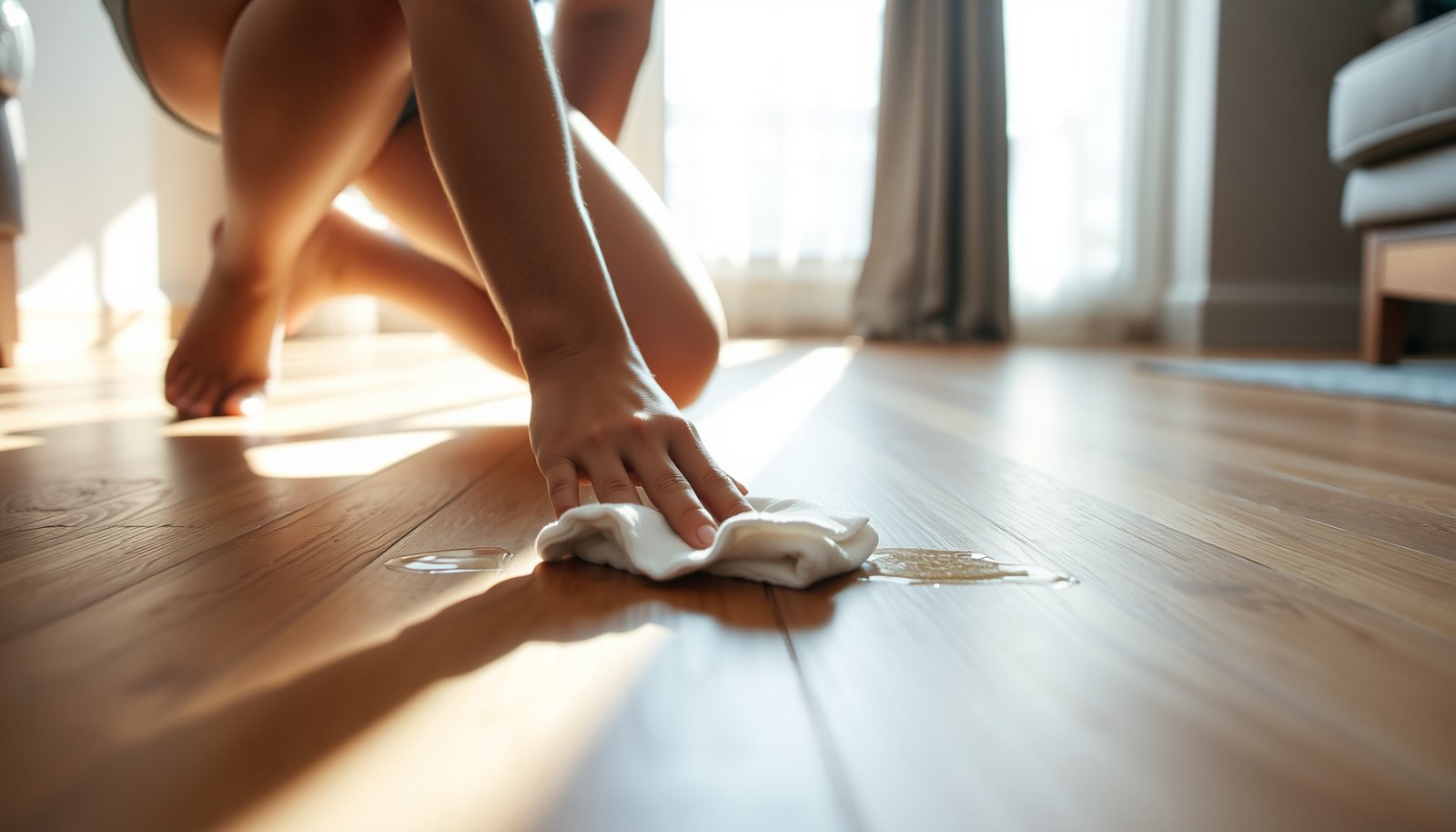

Pet accidents can leave brown or reddish marks and a lingering odor right on hardwood, and it is understandably upsetting to feel like the damage might be permanent. The good news is that, with the right cleaning supplies and careful technique, you can usually lift discoloration and eliminate smells without harming the floor’s finish. Most homeowners can complete the process in about an hour using simple items like clean water, pH-neutral cleaner, and a few soft cloths.




Blot up the mess fast, then clean the surface gently and treat the area with an enzyme cleaner to break down odor-causing residue. For older or set-in discoloration on sealed hardwood, you may need additional spot treatments—and if the stain has penetrated, refinishing might be the only real fix. If your pet’s stain is fresh, focus on extraction and enzyme treatment. If it’s dried or the floor looks permanently tinted, the best next step is figuring out whether the finish is still intact or the stain has soaked deeper.
What you need to know before you clean
Before you touch the stain, identify how your hardwood is finished and how the odor behaves on wood. This determines whether cleaning can solve the problem—or whether you’re really dealing with residue trapped under the clear coat.
– Hardwood stains depend on finish type: sealed/finished floors usually respond to surface cleaning, while unfinished or deeply penetrated areas often require refinishing.
– Urine and similar pet messes can leave both a visible stain and an odor source under the finish, so cleaning alone may not stop the smell.
– The safest first move is to avoid soaking—extra moisture is one of the fastest ways to cause cupping or finish damage.
A key reason this matters is moisture sensitivity. According to the National Wood Flooring Association (NWFA), indoor relative humidity should typically be kept around 35%–55% to reduce dimensional movement that contributes to gapping, cupping, and warping (National Wood Flooring Association (NWFA), wood flooring maintenance guidance). Also, many installation and maintenance recommendations emphasize keeping moisture content of the wood close to the subfloor/ambient—often within 2 percentage points—so the floor isn’t already moving while you’re trying to correct a spot (NWFA installation/conditioning guidance).
Gather supplies and prep the spot
If you prepare correctly, the first pass removes most of the stain without spreading it. The goal is “minimal moisture + controlled dwell time” before you decide on repeat treatments.
– Use a clean white cloth/paper towels, a pH-neutral hardwood cleaner or mild soap solution, and an enzyme cleaner labeled for pet urine/organic stains.
– Ventilate the area and clear the spot so nothing tracks back onto it while it dries.
– Test any cleaner on a hidden section first, especially if your hardwood is older, very glossy, or has an unknown finish.
Enzyme cleaners work because they include specific enzymes (biological catalysts) designed to break down organic residue that causes urine odor. If the surface is too wet or you use harsh chemicals (strong acids/bases), you can reduce enzyme effectiveness and increase the risk of finish haze.
Enzymes Used in Pet-Odor Cleaners: Typical Activity pH Windows
| # | Enzyme (found in many pet enzyme cleaners) | Primary target | Typical effective pH | pH tolerance score |
|---|---|---|---|---|
| 1 | Uricase | Uric acid | 7.5–9.0 | ★★★★★ |
| 2 | Urease | Urea | 6.0–8.0 | ★★★★☆ |
| 3 | Protease | Proteins/peptides | 7.0–9.0 | ★★★★☆ |
| 4 | Lipase | Fats/lipids | 7.0–8.5 | ★★★★☆ |
| 5 | Amylase | Carbohydrates/starches | 5.5–7.0 | ★★★☆☆ |
| 6 | Catalase | Hydrogen peroxide breakdown | 6.5–7.5 | ★★☆☆☆ |
| 7 | Phosphatase | Phosphate esters | 6.0–9.0 | ★★★★★ |
Note: the above enzyme activity windows are why “pH-neutral” is usually the safer choice on wood finishes. Household acids (like vinegar) can shift pH far below that range.
Remove fresh pet stains (step-by-step)
If the stain is fresh, you can usually prevent most odor recurrence by extracting liquid first, then enzymatically treating what remains. Do it gently—wood doesn’t need scrubbing, it needs controlled cleaning.
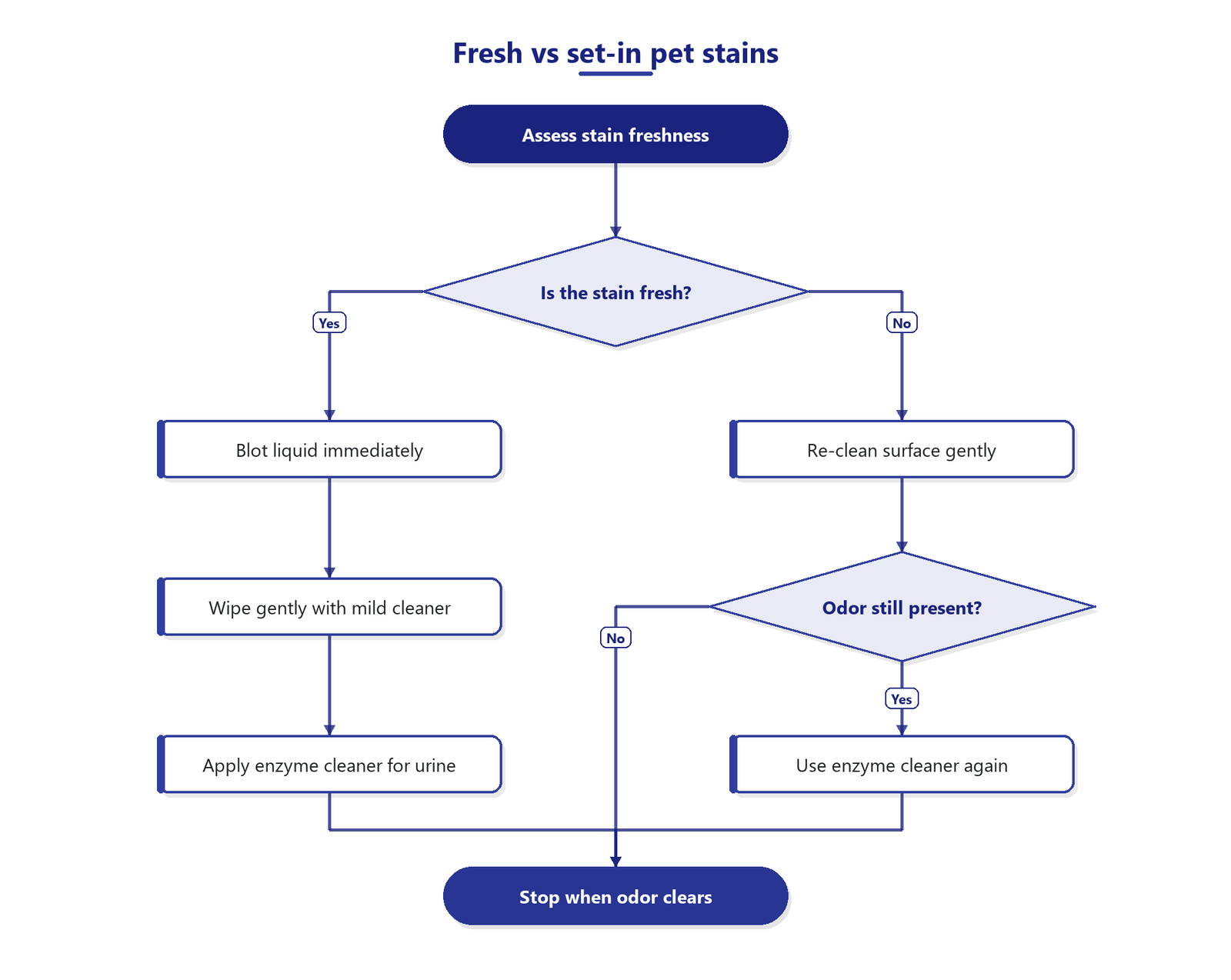
– Blot immediately: press firmly to lift liquid (don’t scrub in circles, which spreads the mess).
– Lightly clean the surface: wipe with a barely damp cloth using a mild cleaner, then wipe again with a cloth dampened with clean water to remove soap residue.
– Apply enzyme treatment: follow the product’s label directions for amount and contact time, then let it fully dry before walking on it.
H3 Blotting: extraction beats agitation
When you blot, you’re using capillary action to pull liquid upward into towels—not driving it deeper. Press firmly, and replace towels as they load up. From what I’ve seen in routine floor-care troubleshooting, the biggest “mystery” odor problems come from people scrubbing right away: the stain footprint widens, and the smell often becomes harder to localize.
H3 Clean carefully to avoid finish haze
Use a pH-neutral hardwood cleaner or a mild soap solution (the kind that’s made for wood floors, not a degreaser). Wipe with a barely damp cloth—think “damp wipe,” not “wet mop.” Follow up with a second cloth dampened with clean water to reduce any residue that could attract dirt later. This two-cloth method matters because soap film can leave a dull patch that looks like the pet stain even after odor is gone.
H3 Enzyme treatment: stay within label contact time
Enzyme cleaners need time to work. Apply as directed, and don’t rush to re-wipe while it’s still actively digesting residue. In practice, the difference between a quick dry-off and full dwell time is often visible: the area smells “clean” after one pass only to re-emerge after the floor is re-wetted by humidity or foot traffic.
Treat older or set-in stains and lingering odor
If the stain has dried, you’re often dealing with both a surface discoloration and residue that has bonded underneath the finish. The fastest way forward is to clean gently first, then reassess—don’t jump straight to stronger chemicals.
– Re-clean the surface first: remove any remaining surface film with the same gentle approach (mild cleaner, minimal water).
– Use enzyme cleaner again if odor remains: dried urine residue can reactivate with moisture and still need enzymatic breakdown—continue based on label guidance.
– If discoloration won’t lift after cleaning: the stain may be trapped under the finish, so further spot “bleach” attempts can damage wood color and clear coats—plan for professional assessment or refinishing if needed.
H3 Determine whether the finish is still doing its job
A sealed hardwood finish can trap urine components on or near the surface. When that happens, repeated gentle cleaning plus enzyme treatment usually reduces both tint and odor. If discoloration persists after the enzymatic step has dried fully, it’s a signal that the stain either soaked through early or the finish is compromised where the urine sat.
H3 Know when vinegar and “stronger” DIY steps become risky
Household vinegar typically contains acetic acid—often not less than 4% acetic acid by volume for vinegar sold as vinegar in the U.S. (FDA standard of identity for vinegar (21 CFR 517.2)). That acidity can shift wood-finish chemistry, especially on older polyurethanes, prefinished varnishes, or penetrating oils. Even if vinegar temporarily reduces odor, it may not break down the uric-acid-related residue that enzymatic products target.
What can go wrong (and how to avoid it)
Most failures are preventable and come down to moisture, abrasiveness, or skipping the odor-specific chemistry. If you stop those three error patterns early, you dramatically reduce repeat marking and permanent appearance changes.
– Over-wetting the floor: pooling liquid can seep at seams and edges—keep cloths damp, not dripping.
– Scrubbing stains into the finish: vigorous rubbing can enlarge the affected area and make it look worse.
– Skipping enzyme treatment: you may remove the surface stain but still leave odor sources behind, leading to repeat marking.
– Using harsh chemicals on wood: products like strong acids or aggressive solvents can dull finishes or cause uneven discoloration—check label compatibility for wood floors.
H3 Quick comparison: what to use based on what you’re seeing
When stain and odor don’t match, you need a different strategy than when they do. Use this decision frame to reduce trial-and-error.
| Situation | Best first action | Why it works |
|---|---|---|
| Visible stain + odor right now (fresh) | Blot → gentle wipe → enzyme cleaner | Removes liquid footprint and breaks down organic odor residue |
| Stain remains but smell is gone after drying | Stop cleaning; assess finish condition | The discoloration may be trapped tint rather than active odor |
| Stain is faint, odor returns when damp | Repeat enzyme treatment with correct contact time | Residue can re-activate with moisture even if it looks “clean” |
| Stain won’t lift after repeated enzyme cleaning | Avoid harsh bleaching; consider refinishing | The pigment may be under/within the finish layer |
Verdict and quick scan checklist
If the stain is recent and your hardwood is properly sealed, a gentle clean plus an enzyme cleaner is usually the most effective, least risky path. Skip DIY escalation (strong stain removers/bleaches, or repeated soaking) if the mess is old, the finish is compromised, or the discoloration keeps returning—those are signs you may need refinishing or a flooring pro.
Quick checklist (save this):
| Step | Do this | Don’t do |
|---|---|---|
| 1 | Blot fast with paper towels/cloth | Rub and spread the stain |
| 2 | Wipe with mild cleaner, then wipe with clean water | Soak or leave standing liquid |
| 3 | Use an enzyme cleaner for pet urine | Count on vinegar/soap alone for odor |
| 4 | Let it dry fully before judging | Re-wet repeatedly without results |
| 5 | If stain persists, reassess finish/penetration | Try harsh chemicals without compatibility info |
Frequently Asked Questions
How do I remove pet urine stains from hardwood floors without damaging the finish?
Blot up the moisture immediately with paper towels, then clean the area using a hardwood-safe cleaner designed for urine or enzymatic stain removers. For lingering discoloration, apply an enzyme cleaner to break down the urine salts, allow it to sit as directed, and then rinse with a barely damp cloth. Avoid soaking the wood or using ammonia-based cleaners, since excess moisture and harsh chemicals can warp or dull hardwood.
What is the best way to get rid of pet feces stains and odor on hardwood?
Scoop away solid waste carefully and blot up any liquids, then clean the surface with a pH-neutral hardwood cleaner. Follow with an enzymatic cleaner to eliminate odor that may have seeped into small gaps, and keep the area well-ventilated as it dries. Do not scrub aggressively with abrasive pads, because you can scratch the finish and make stains harder to remove.
Which enzyme cleaner works best for pet urine on hardwood floors?
Look for enzymatic pet urine removers that specifically mention urine odor and stain neutralization for sealed or finished hardwood. Products containing bacteria-based enzymes or “enzyme + neutralizer” formulas typically work well because they target the proteins and salts left behind by urine. Always test in a small, hidden spot first, and follow dwell-time directions—many stains require longer contact time to fully lift.
Why do pet stains keep coming back on hardwood, and how can I prevent it?
Pet urine can soak into the finish and penetrate tiny pores in unfinished or worn areas, so the discoloration and odor may return if the source isn’t fully neutralized. Prevention starts with immediate blotting and using an enzymatic cleaner rather than only surface cleaners. For ongoing protection, consider re-sealing or re-finishing high-risk sections and addressing repeat incidents with training and deterrents.
How do I remove old, dried pet stains from hardwood floors when regular cleaning doesn’t work?
Start by softening dried residue with a cleaner safe for hardwood and a slightly damp cloth, then gently wipe until the stain loosens. If the stain remains, use an enzymatic cleaner to treat the area and let it sit for the recommended time before wiping and drying thoroughly. For deep or persistent discoloration after cleaning, you may need light sanding and refinishing to restore the hardwood finish, especially if the stain has penetrated beyond the top coat.
📅 Last Updated: October 31, 2026 | Topic: How to clear pet stains from hardwood floors? | Content verified for accuracy and freshness.
References
- 404 Error
- https://www.armstrongflooring.com/flooring/installation-and-maintenance/hardwood-maintenance/pet-urine.html
- enzymatic cleaner urine odor removal – Search Results – PubMed
- https://www.epa.gov/indoor-air-quality-iaq/cleaning-and-disinfecting-your-home#odor
- https://scholar.google.com/scholar?q=pet+urine+hardwood+floor+stain+removal Google Scholar
- https://scholar.google.com/scholar?q=urine+odor+removal+enzymatic+cleaners+wood+surface Google Scholar
- https://scholar.google.com/scholar?q=pet+urine+wood+flooring+damage+ammonia+staining Google Scholar


[…] left it behind. You can clean the spot and reduce the odor safely by blotting up moisture, using a pH-neutral hardwood cleaner, and treating the stain with an enzyme product that targets urine residues. Plan for about an hour, […]