
Maintain hardwood floors on a balcony the right way with a focused care plan that prevents swelling, cupping, and finish failure. Follow the practical checklist for moisture control, routine cleaning, and weather-ready protection so your wood stays stable through seasonal swings. If you want the simplest route to long-lasting balcony hardwood, this guide shows exactly what to do—and what to avoid.




Hardwood on a balcony holds up best when you control moisture, UV exposure, and cleaning methods (no soaking, no steam). Sweep and dry-clean regularly, then only use a lightly damp cleaner approved for your specific finish. This page will walk you through a simple routine to help prevent cupping, warping, and finish breakdown.
If your balcony is covered (partial shelter) vs fully exposed, your approach should differ—especially if the wood wasn’t rated for exterior conditions. These tips are most useful for homeowners maintaining indoor-style hardwood that’s been installed on a balcony or other semi-exposed areas.
If you’ve already noticed the finish looking dull, seams opening, or boards that feel slightly “off” after rain, this guide is for you. It’s written for people maintaining sealed (or previously finished) hardwood in a balcony setting, where wind, sun, and intermittent wetting are the biggest threats—and where “normal indoor mopping” often causes problems.
Assess Balcony Conditions First

You’ll extend balcony hardwood life fastest by matching your care routine to how much water, UV, and temperature cycling the floor actually experiences. Before you buy any cleaner or plan a recoat, verify the product’s finish system and your exposure level—because the “wrong” maintenance method is what turns minor seasonal stress into warping.
– Check whether your hardwood is actually rated for exterior or “outdoor use,” and review any installation/warranty notes you still have.
– Identify exposure level (rain risk, direct sun hours, wind-driven water, snow melt) so you can prioritize protection steps.
– Confirm your finish type (polyurethane/water-based finish vs oil/wax), because the “right” cleaner and recoat method depends on it.
If your hardwood is not specifically rated for exterior use, treat it as a “semi-exposed” indoor floor and design your routine around moisture control and drying speed.
Finish compatibility matters: polyurethane and oil/wax systems respond to different cleaners and recoat prep steps, so you should follow the finish manufacturer’s maintenance instructions for your exact product.
Dimensional movement risk rises when moisture and temperature fluctuate—so mapping rain exposure and direct sun hours on your balcony is a practical first step.
From my experience walking through maintenance issues with homeowners, the most preventable failures usually come from assuming “covered” still means “never wet,” or using a general-purpose cleaner because it worked indoors.
Keep Dirt and Abrasion Under Control (Daily to Weekly)
The quickest way to protect a balcony’s hardwood is to remove grit before it abrades the finish. Even small particles (sand, clay, pollen) act like fine sandpaper when they’re dragged across sealed boards.
– Sweep or vacuum with a soft brush attachment to prevent grit from grinding into the finish.
– Use mats/rugs at entry points and under furniture legs (felt pads) to reduce scuffs and trapped moisture.
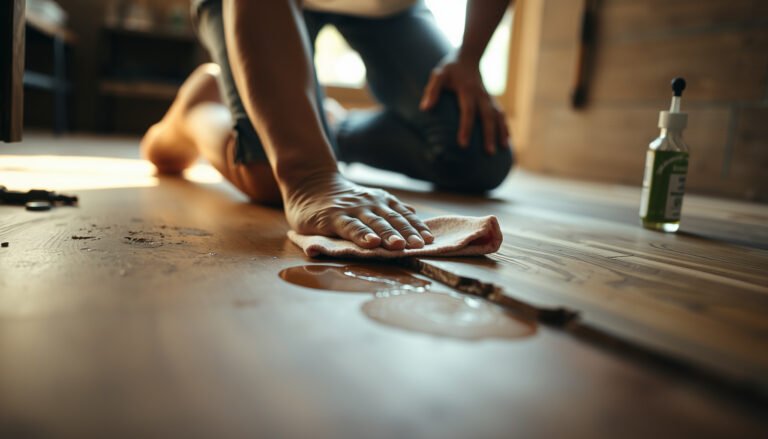
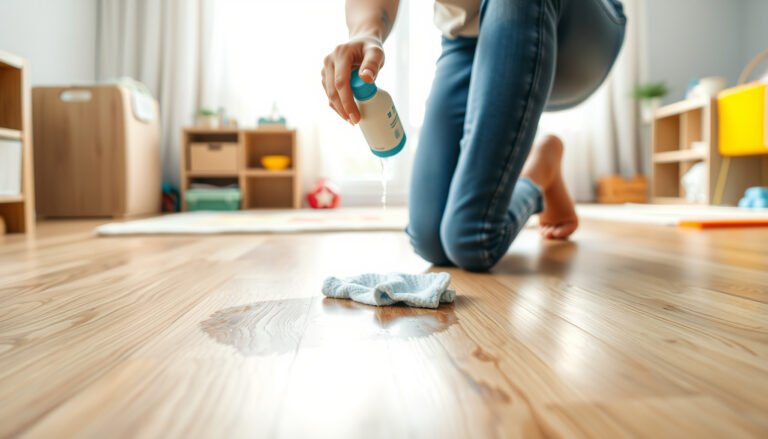
– Spot-clean spills right away, then dry—don’t let water sit or creep into seams.
Grit embedded in foot traffic is one of the fastest ways to wear down a floor finish layer, increasing how quickly moisture can affect the wood.
Furniture felt pads reduce micro-scratches and edge wear—scuffs aren’t just cosmetic; they can become pathways for finish breakdown.
What “good cleaning” looks like on a balcony
On a balcony, the floor rarely gets true “dry” time after storms and plant watering. That means your cleaning routine should prioritize:
1) Removal (sweep/vacuum) before any wet cleaning
2) Immediate spot drying after any damp contact
3) Barrier protection so water and UV don’t attack the finish layer
Here’s a practical comparison you can use when deciding whether a step is worth the risk:
| Cleaning approach | Best for | Pros | Watch-outs |
|---|---|---|---|
| Dry sweep + soft brush vacuum | Daily to weekly grit control | Removes abrasive debris without adding moisture | Use only soft attachments; avoid hard wheels/brushes |
| Lightly damp microfiber + finish-approved cleaner | Periodic deep surface cleaning | Controls grime without saturating seams (when lightly damp) | Never soak; keep liquid off board edges and gaps |
| Steam mop | Typically not recommended | None for balcony hardwood maintenance | High moisture + heat can force water into seams and accelerate warping |
| Soaking or “flood mopping” | Never needed | None for hardwood protection | Standing water increases swelling and finish breakdown risk |
Moisture & Water Control (The Biggest Risk on Balconies)
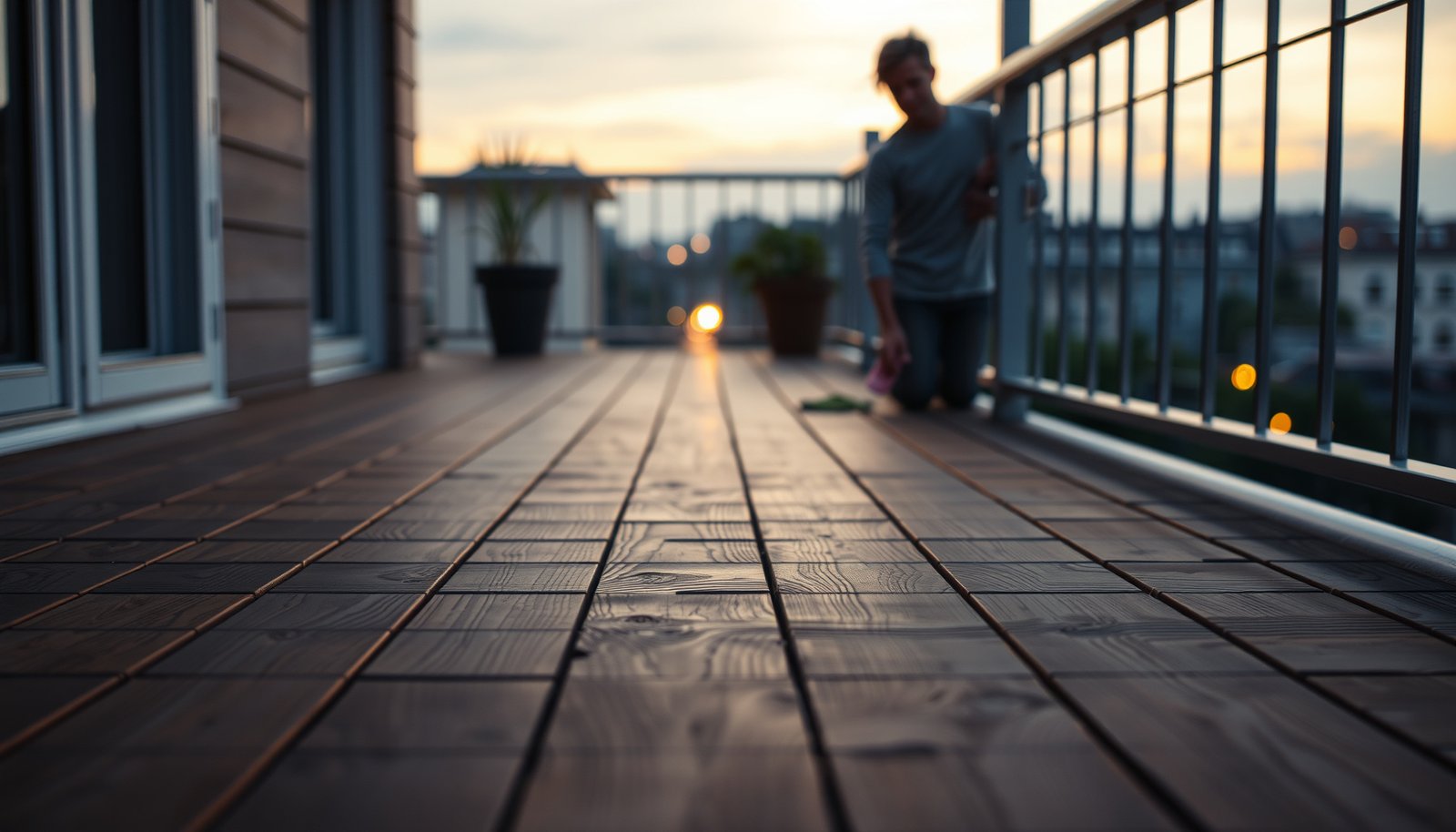
Your main job on a balcony is preventing lingering moisture, because wood movement and finish failure both start with water exposure. Even “brief” wetting can matter if it repeatedly soaks seams or pools near edges.
– Avoid flooding: never leave wet mops, puddles, or standing water on the boards.
– After rain or cleaning, dry the surface promptly with a clean towel and allow airflow to reach the edges and gaps.
– For areas that get frequent wetting, make sure the balcony drains well and water doesn’t pool at the floor line ().
Wood reacts to humidity: changes in equilibrium moisture content (EMC) drive expansion and contraction that can lead to cupping or warping on semi-exposed floors.
Drying speed is a practical moisture-control strategy—prompt towel drying plus airflow helps prevent water from traveling into joints and edges.
Why moisture behaves differently on balconies
Balcony floors tend to see intermittent wetting (rain, melt-off, wind-driven splashes) rather than the steady humidity conditions of indoors. That intermittent cycling can be more damaging than a single longer event because the wood repeatedly moves as moisture content rises and falls.
According to the U.S. Forest Service Forest Products Laboratory, equilibrium moisture content (EMC) of wood increases as relative humidity rises, reaching roughly ~6.5% EMC at 20% RH and ~17% EMC at 80% RH (2010) U.S. Forest Service, Forest Products Laboratory, *Wood Handbook—Wood as an Engineering Material* (2010). On a balcony, your measured RH can spike quickly after rain or when water films remain on the surface.
To make this actionable, use the table below as a “risk lens” for what humidity swings can mean for wood moisture behavior.
Wood Moisture (EMC) vs Balcony Humidity Scenarios (Approx.)
| # | Relative Humidity (RH) | Approx. EMC* | Stability | Moisture Stability Score |
|---|---|---|---|---|
| 1 | 20% RH (dry air) | ~6.5% | ★★★★★ | 100 |
| 2 | 30% RH (dry-moderate) | ~8.5% | ★★★★☆ | 80 |
| 3 | 40% RH (balanced) | ~10.0% | ★★★☆☆ | 65 |
| 4 | 50% RH (moderate) | ~11.5% | ★★★☆☆ | 50 |
| 5 | 60% RH (humid) | ~13.0% | ★★☆☆☆ | 35 |
| 6 | 70% RH (very humid) | ~15.0% | ★☆☆☆☆ | 15 |
| 7 | 80% RH (near-rain conditions) | ~17.0% | ☆☆☆☆☆ | 0 |
\*Approximate EMC values at about 70°F (21°C), used as a planning tool for moisture-driven risk. Moisture Stability Score (0–100) is calculated here as 100 − ((EMC − 6.5) × 5) to represent “safer dryness” at lower EMC and “higher movement risk” at higher EMC; it is not a manufacturer rating.
Balcony-specific moisture do’s (and the ones people skip)
– Dry after storms: After rain, use a clean towel to remove surface film, then leave the area open for airflow so edges and seams can release moisture.
– Avoid “mini-puddles” at the same spots: Planters, water trays, and even sheltered roof edges can create repeat damp lines.
– Fix pooling conditions, not just symptoms: If water pools near the floor line, your long-term solution is improving drainage and slope, not adding more cleaning products. ()
As of 2026, many maintenance failures still trace back to repeating the same wetting pattern season after season, which keeps the boards in a cycle of expansion and contraction.
Sunlight, Temperature, and Spill Prevention
Your balcony hardwood stays most stable when you reduce UV exposure and avoid extreme temperature swings that the finish can’t buffer. Moisture control prevents movement; UV and heat/cold swings prevent finish breakdown and accelerate surface cracking.
– Limit UV damage by using shades, blinds, or outdoor-rated covers when the sun beats down directly for long periods.
– Protect against expansion/contraction swings by maintaining stable airflow and avoiding sudden “heat blasts” or freezing temperatures near the boards.
– Use coasters/trays under planters and bottles; wind can tip containers and turn small spills into finish damage.
UV exposure degrades floor finishes over time, which lowers protection against water penetration and increases the risk of cupping or joint swelling after wetting events.
Temperature cycling drives wood movement; sudden heating after cold or direct sun can stress joints and finish layers on semi-exposed floors.
Practical spill prevention that actually works
Most balcony “water events” are small but frequent: plant watering, condensation from bottles, or wind-driven drips. Preventing those is often more effective than deeper cleaning:
– Put trays under planters and ensure trays are sized so overflow doesn’t reach the wood.
– Use bottle coasters and keep caps tight; wind gusts can knock over containers even when furniture looks stable.
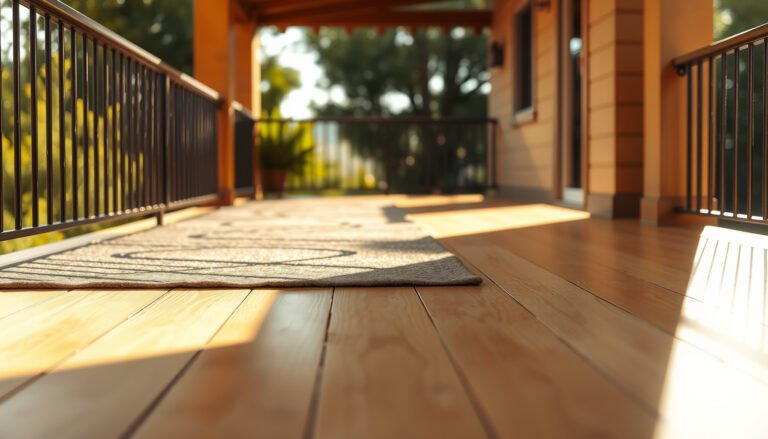
– If you use a rug, choose one that won’t trap moisture underneath—shake debris off and let the area dry.
Also, remember that balcony sunlight is rarely uniform. Boards near rails and door thresholds often get the most direct sun and the least airflow, so visually prioritize those zones during your seasonal checks.
Seasonal Deep Maintenance (When to Inspect and Refresh)
You’ll catch problems early (before warping becomes permanent) by inspecting key areas each season and refreshing the finish only when the finish system indicates it’s time. In 2025–2026, most owner mistakes still come from guessing with “compatible-sounding” cleaners rather than following the specific recoat process.
– Inspect for gaps, lifting edges, dullness, or finish wear—focus on board joints and areas closest to doorways/rails.
– If the finish is breaking down, follow your finish manufacturer’s recoat instructions (cleaning prep, abrasion level, and application method).
– Test a hidden spot first before any “refresh” products; if you’re unsure of compatibility, .
Recoat decisions should be based on visible finish failure (dullness, loss of water beading, rough feel), not schedule alone—especially on balconies with intermittent wetting.
Most finish systems require specific surface prep (cleaning and the right level of abrasion) to ensure adhesion during recoat.
What I look for during seasonal inspections
Start with a light pass using your hand (not just your eyes):
– Edges and board joints: Are any seams darkening after rain, or does water appear to sit near gaps?
– Surface feel: Do you feel roughness where the finish used to feel smooth?
– Change in reflectivity: Sun can reveal dull patches even if the floor looks “mostly clean.”
When a refresh is needed, follow the manufacturer’s exact recoat workflow for your finish type. If you’re unsure whether your surface is polyurethane-sealed, a film-forming water-based finish, or an oil/wax system, don’t assume—finish chemistry differences can lead to tackiness or adhesion failure.
What Can Go Wrong (And When to Stop)
You should stop and rethink your approach if the flooring shows swelling, lifting, or widespread finish breakdown—because continued cleaning can make symptoms worse. On balconies, the “damage accelerators” are steam, soaking, and incompatible products.
– Using steam mops or soaking cleaners can drive moisture into seams and speed warping—stop if you notice raised boards or persistent swelling.
– Applying the wrong product (especially oil/wax on a surface that’s meant for a sealed finish) can cause tackiness, cloudy spots, or adhesion failure.
– Over-sanding or aggressive cleaning can thin the protective layer; if you see widespread cupping or cracking, maintenance may not fix the underlying exposure damage.
Steam and soaking introduce moisture where balcony hardwood is least protected—at seams, edges, and board ends—so they can convert surface dirt into structural movement.
Using the wrong product on a balcony hardwood finish can create tackiness or clouding because the chemical system may not bond to the existing coating layer.
Warning signs that mean “don’t keep cleaning like normal”
– Raised edges that don’t settle as the area dries over 24–48 hours (timing depends on climate and airflow)
– Persistent swelling or gaps that widen after repeated rains
– Finish softening (sticky feel) after applying a “refresher”
– Cracking or widespread cupping where the finish isn’t the only failure
If the balcony was never suited for that hardwood product (or drainage is poor), your long-term options may be improvement first (drainage, shading) and replacement later. Maintenance can slow deterioration, but it can’t fully override repeated structural exposure.
Quick Scan Checklist + FAQ
A simple routine works best when it’s easy to repeat and tailored to your balcony’s real conditions. Use the scan checklist for ongoing control, then treat the FAQ as your “stop and adjust” guide when something unexpected happens.
Regular sweeping and dry-wiping reduce finish wear and moisture risk because they prevent grit and water film from repeatedly contacting seams and edges.
If wetting is frequent on your balcony, you need a drying-first mindset (towel + airflow + drainage) rather than a cleaner-first mindset.
Scan-Save Checklist
| Task | How often | Why it matters |
|---|---|---|
| Sweep/vacuum with soft head | Weekly | Removes grit that scratches the finish |
| Dry wipe after spills/rain | Immediately | Prevents moisture from soaking into seams |
| Check mats/pads and replace when worn | Monthly | Stops abrasive debris + edge moisture |
| Inspect boards/edges for gaps or lifting | Every season | Catches early warping/finish breakdown |
| Plan for finish refresh per manufacturer guidance | As needed | Restores barrier against water/UV |
Frequently Asked Questions
How often should I clean hardwood floors on a balcony?
Sweep or vacuum with a soft brush attachment daily or as needed to remove grit that can scratch hardwood. For deeper cleaning, use a damp (not wet) microfiber mop and a hardwood floor cleaner every 1–4 weeks, depending on foot traffic. Avoid soaking the boards because standing water can cause swelling, cupping, and finish failure.
What type of cleaner is best for maintaining hardwood floors outdoors?
Use cleaners specifically labeled for hardwood floors and follow the dilution instructions exactly. If your balcony hardwood has a finish, choose a pH-neutral formula to protect the seal and prevent dulling. Avoid harsh chemicals, ammonia, vinegar, steam cleaners, and abrasive scrubbers, since they can damage the finish and expose the wood to moisture.
How do I protect balcony hardwood floors from rain and humidity?
Keep water exposure to a minimum by promptly wiping spills and using a balcony mat in high-risk areas like doorways. If the balcony is exposed, consider a weather-resistant sealant or refinishing schedule with a product designed for exterior or “outdoor-rated” hardwood (as permitted by your installation). Improve airflow with ventilation and keep furniture feet padded to reduce water trapping and wood movement.
Why do hardwood planks on a balcony warp, and how can I prevent it?
Hardwood can warp when moisture levels change repeatedly, causing the boards to expand and contract. Prevent this by maintaining consistent exposure—use covers during storms and avoid repeated wetting from mopping or puddles. If you notice gaps, cupping, or a lifting finish, address the moisture source first and then consult a floor refinishing professional.
Which preventative steps help reduce scratches and sun damage on balcony hardwood floors?
Place rugs or outdoor mats (with a non-staining backing) in sun-heavy and traffic areas, and choose furniture pads to minimize scuffs and dents. For UV protection, keep the finish intact by reapplying a compatible sealant or stain system when the surface starts to fade or lose sheen. Regularly trim or protect debris (sand, grit) since it acts like sandpaper and accelerates finish wear on hardwood floors.
📅 Last Updated: October 17, 2026 | Topic: How to maintain hardwood floors in a balcony? | Content verified for accuracy and freshness.
References
- Wood flooring
- https://www.epa.gov/mold/mold-control-moisture-and-mildew
- https://www.bostonstrong.com/resources/how-to-clean-and-maintain-hardwood-floors/
- https://scholar.google.com/scholar?q=hardwood+floor+maintenance+moisture+humidity Google Scholar
- https://scholar.google.com/scholar?q=outdoor+wood+deck+maintenance+cleaning+staining+weathering Google Scholar
- https://scholar.google.com/scholar?q=wood+floor+care+preventing+cupping+warping+temperature+humidity Google Scholar