Wondering how to maintain hardwood floors in a warehouse without sacrificing appearance or wear resistance? The practical answer is a tight maintenance routine centered on moisture control, frequent grit removal, and the right high-traffic refinishing schedule. Follow these proven care steps and your hardwood stays stable, cleaner, and safer even under daily forklift activity and heavy footfall.




Hardwood floors in a warehouse last when you control three things: traffic (so you don’t grind grit in), moisture (so planks don’t swell/cup), and cleaning methods (so you don’t strip or over-wet the surface). Use a simple daily/weekly routine, protect high-wear zones with mats and equipment pads, and follow your flooring manufacturer’s humidity and cleaner recommendations—this is the most realistic way to keep warehouse hardwood stable and predictable for maintenance.
If your hardwood runs through loading areas, pedestrian routes, or near carts/racks, your risk is higher than in a typical home—especially from dirt tracking, wet spills, and large changes in humidity from HVAC cycling or outdoor exposure. This guide is built for facility managers, warehouse owners, and maintenance teams who want fewer scuffs, fewer board problems, and a more predictable refinishing timeline—without turning every cleaning day into a full-floor event.
Who this is for / when it applies: facility managers and maintenance teams managing warehouse-grade traffic
This plan applies when hardwood floors are exposed to repeated foot traffic, forklifts and pallet jacks, and frequent “dirty” events like loading/unloading, cart corrals, and seasonal demand spikes. As of 2026, many hardwood warranties and finish systems still assume controlled indoor climate and manufacturer-approved cleaning, so the operational discipline matters as much as the material itself—especially with warehouse humidity swings and tracked debris.
Protect high-traffic areas and control what gets tracked in

You protect warehouse hardwood floors by preventing grit from ever becoming an abrasive. The goal is simple: stop dirt at the door, stop equipment stress at the contact points, and don’t let temporary work zones become grinding lanes for years.
NWFA guidance emphasizes that wood floors need protection from abrasive dirt and moisture to preserve finish performance. National Wood Flooring Association (NWFA)
Using walk-off mats reduces the amount of particulate tracked onto the floor, which helps minimize finish abrasion on high-wear hardwood zones. NWFA
Equipment pads and non-marring wheels are a practical first line of defense against dents and micro-scratches that accelerate wear-through of warehouse floor finishes. Manufacturer care instructions (typical finish system requirements)
Walk-off mats and “walk zones” that actually work
– Put entry mats at every door and create a designated “walk zone” so debris can’t act like sandpaper under foot traffic.
– Use a two-stage mat strategy when possible: one scraper/grit-capture mat outside the entry path and one absorbent mat inside the route.
– Assign responsibility: if mats aren’t inspected weekly, they become a dirt reservoir instead of a safeguard.
Equipment protection: carts, pallet jacks, and hard-surface wear points
– Use floor protection under carts, pallet jacks, and heavy equipment (e.g., clean, non-marking pads; replace worn pads quickly).
– Verify wheel caster materials: “non-marking” is not the same as “non-abrasive.” For hardwood floors, the practical requirement is stable contact pressure plus a pad/caster designed for hard surfaces.
– Rotate or re-pad high-load equipment if pads develop grooves—grooves concentrate force and create the “rails” you often see across warehouse corridors.
Cover work areas during dust-generating operations
– Consider temporary coverings for remodels, seasonal load-in/out, or any work that can drop abrasive debris—don’t rely on “it’ll be fine.”
– In warehouses, the hardest-to-remove grit is often dried residue (from packaging dust, pallet wear, outdoor tracked soil). That residue can embed into the finish and behave like sandpaper during routine sweeping.
Clean the right way (daily sweep, weekly wash—no shortcuts)
Clean warehouse hardwood floors by removing grit daily and using only minimally wet, finish-approved methods when you mop. The fastest way to cause damage is not “dirty cleaning”—it’s over-wetting, aggressive chemicals, or equipment that grinds debris into the finish.
Daily sweeping or dust-mopping is a core approach because it removes abrasive particles before they wear down the finish layer. NWFA “Wood Floor Maintenance”
Many hardwood maintenance instructions warn against steam cleaning because high heat and moisture can contribute to swelling and finish failure. NWFA and typical finish manufacturer care guidance
If you use water-based cleaning, the safest workflow keeps microfiber mops barely damp rather than wet, to limit moisture reaching seams. Manufacturer-approved hardwood care instructions
Daily: lift grit, don’t grind it
– Sweep or dust-mop daily (or as needed) with a method that lifts grit instead of grinding it into the finish.
– If you use a vacuum, confirm the floor tool won’t scratch (use soft bristles or a felt strip where the head contacts the wood).
– Pay attention to corners of doorways and the edges of pedestrian routes—warehouse dirt patterns are consistent, and edges are where moisture damage often begins.
Weekly routine: barely-damp microfiber + approved cleaner
– For routine mopping, use a barely-damp microfiber approach and only the cleaner your manufacturer approves for your specific finish (avoid generic “floor shine” products).
– Pre-dilute concentrates as directed and keep the mop saturated with control (wring until it’s clearly damp, not dripping).
– Use a “two-pass” method: pass one removes residue; pass two lightly cleans with minimal water so the floor doesn’t sit wet near seams and end joints.
Avoid steam and soaking unless documentation explicitly allows it
– Don’t use steam cleaners or soaking methods unless your flooring documentation explicitly allows it—warehouse grime + water pressure is a common path to swelling and finish failure.
– Steam cleaning delivers water as vapor—at standard atmospheric pressure, steam corresponds to water’s 212°F / 100°C phase change temperature. NIST (water boiling point at 1 atm) In practice, that heat-and-moisture combination can be incompatible with many installed finishes and subfloor conditions.
Quick comparison: which cleaning method fits warehouse reality?
Below is a practical contrast you can align on with maintenance leadership—this is how we usually reduce “it seems safe” cleaning drift:
| Cleaning method | Main benefit in warehouses | Main risk to hardwood floors |
|---|---|---|
| Daily sweep / dust-mop | Removes grit before finish abrasion | Missed corners can still accumulate abrasive dust |
| Vacuum with hard-floor head | Fast debris pick-up without spreading moisture | Improper brush/nozzle can scratch finish |
| Microfiber damp mop (approved cleaner) | Controls residue while minimizing water exposure | Too-wet mopping can swell boards and open gaps |
| Spot cleaning with approved product | Targets spills without disturbing surrounding finish | Over-scrubbing can leave dull halos |
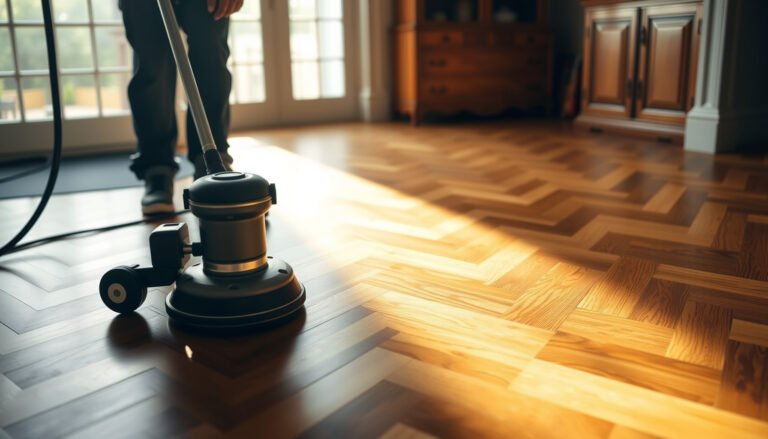
| Buffer/scrubber machines (only if permitted) | Uniform deep cleaning in controlled setups | Wrong pads/settings can prematurely wear finish |
| Steam cleaning | Removes soils quickly on some surfaces | High heat + moisture can increase swelling and finish failure risk |
| Best for warehouse hardwood floors | Daily grit control + manufacturer-approved, barely-damp microfiber cleaning | |
Maintain humidity and prevent moisture problems
Control moisture by managing indoor relative humidity and by treating every spill as an immediate moisture event. Hardwood floors in warehouses fail faster when moisture swings are large or when small wet events repeat in the same lanes.NWFA guidance recommends maintaining indoor relative humidity between 35% and 55% to reduce wood movement and cupping/crowning risk. NWFA “Wood Floor Maintenance”
NWFA guidance also aligns temperature control (commonly 60°F to 80°F) with humidity to stabilize wood-floor equilibrium conditions. NWFA “Wood Floor Maintenance”
Hardwood moisture damage often starts along edges and in recurring wet-traffic patterns, where water lingers or migrates. Manufacturer moisture-care guidance (typical recommendations)
Monitor humidity/temperature where hardwood floors actually live
– Track indoor relative humidity and temperature, and keep them within the range specified by your hardwood floor manufacturer or installer documents.
– Use data loggers where possible. Warehouse HVAC cycling can create fast swings that aren’t obvious without logging.
Manage spills fast—blot, remove moisture, and dry without flooding
– Manage spills fast: blot immediately, remove moisture from the surface, and dry the area thoroughly without flooding the floor.
– Assign a standard response kit: absorbent pads, clean towels, and fans/dehumidification if needed.
– Avoid “rinse and hope.” If you clean a spill by pushing water outward, you increase the footprint of moisture.
Reduce perimeter moisture sources
– Check for moisture sources around the perimeter (leaks, condensation, wet loading bays), because hardwood damage often starts at edges and under traffic patterns.
– Look specifically for: damaged door seals, roof leaks above loading routes, condensation from poorly insulated pipes, and water from frequent pallet wash-down areas.
Keep the finish working: spot care, recoat/refinish planning
Keep hardwood floors performing by protecting the finish layer from wear-through and dealing with damage early. In warehouses, scratches and dull lanes expand once abrasion and moisture reach the under-finish wood surface.
When the finish layer is worn down in traffic lanes, dirt and moisture penetrate faster, accelerating visible deterioration. NWFA “Wood Floor Maintenance”
Using the manufacturer-approved touch-up or spot repair approach helps maintain uniform finish behavior compared with aggressive cleaning in worn areas. Flooring manufacturer care instructions
Recoat or refinishing timing should follow system-specific abrasion limits and preparation methods, especially for coated hardwood finishes. Manufacturer specs for coating/sealer systems
Spot care beats “cleaning harder”
– Use the manufacturer-approved touch-up or spot repair approach for scratches/dull spots instead of aggressively cleaning in those areas.
– Avoid repeated “polish cycles” over damaged zones. If the protective topcoat is already compromised, cleaning won’t restore it—maintenance will instead spread wear.
Inspect traffic lanes on a schedule
– Inspect periodically for worn traffic lanes—once the protective surface is gone, dirt and moisture penetrate faster.
– Use a simple lane map: label pedestrian routes, forklift travel corridors (where permitted), and cart staging areas so your team inspects the same places consistently.
Plan recoat/refinish using your actual specs
– For refinishing, follow the timing and prep method in your flooring specs (especially abrasion limits and whether the floor can be screened vs. fully refinished).
– Coated systems vary: some allow screening and recoat; others require full sanding depending on finish buildup and adhesion requirements. Don’t guess—warehouse hardwood warranties often require documentation-based procedures.
Reduce damage from equipment, loads, and chemical exposure
Reduce damage by aligning equipment hardware (casters/wheels), protecting contact points (pads), and preventing chemical residues from degrading the finish. Hardwood floors in warehouses take a beating—your job is to make that wear predictable and slow.
Non-marring wheels and properly maintained pads reduce localized dents and micro-scratches that accelerate hardwood-floor finish wear. Manufacturer care guidance (typical)
Using only finish-approved cleaners matters because chemical residues can dull, haze, or compromise coating adhesion over time. Manufacturer finish maintenance instructions
Route planning reduces concentrated abrasion—when powered equipment moves through the same path repeatedly, that path becomes the earliest failure zone. NWFA guidance on preventing finish wear through traffic control
Hardware condition and load paths
– Prevent localized dents and board stress by ensuring casters, wheels, and pads are sized/conditioned for hard surfaces (and by redirecting heavy traffic where possible).
– Replace worn pads quickly. Grooved pads can create linear damage (the “rails” effect) even if they don’t visually look broken.
Avoid harsh chemicals—even when a cleaner “works”
– Avoid harsh chemicals: even if a spill “cleans,” residues can react with the finish or dull it over time—use products approved for your finish type.
– Train staff not to improvise with degreasers or “warehouse miracle cleaners.” Those products may clean oil, but they often leave surfactant or solvent residues that attract dust and create a hazy finish.
Powered equipment and debris on wheels
– If you use forklifts or other powered equipment nearby, confirm wheel type and route planning; abrasive debris on wheels can “drag” across the floor.
– Practical control: add wheel checks during shift change in the cleanest corridors, and keep door-to-warehouse routes consistent.
What can go wrong (common mistakes in warehouses)
Most warehouse hardwood problems come from “looks clean” behavior: too much water, the wrong products, and ignored humidity drift. The earlier these mistakes appear, the faster finish wear accelerates and the more your refinishing schedule becomes unpredictable.
Over-wetting during mopping can increase board swelling and contribute to cupping, especially where traffic lanes keep the moisture pattern consistent. NWFA and typical flooring manufacturer moisture precautions
Using the wrong cleaner (e.g., waxes, oil soaps, or degreasers not approved for your finish) can leave residues that attract dirt or interfere with coating performance. Manufacturer-approved cleaner requirements
Humidity swings drive wood dimensional movement; maintaining the manufacturer’s specified RH range is the most reliable way to reduce seasonal board movement. NWFA “Wood Floor Maintenance”
– Over-wetting during mopping: even when using a “safe” cleaner, too much water can swell boards or create cupping near traffic lanes.
– Using the wrong cleaner: waxes, oil soaps, and “degreasers” can leave residues that attract dirt or break down finishes.
– Ignoring humidity: warehouse HVAC cycles and seasonal changes can cause seasonal movement (gaps/cupping) if you don’t manage the indoor climate within the documented range.
– Waiting too long on spot repairs: small finish loss becomes a larger worn area once dirt and moisture start getting underneath the top layer.
Verdict: A maintenance plan that’s realistic—but not hands-off
If you can (1) keep grit off the floor, (2) respond quickly to moisture, and (3) follow the humidity/cleaner instructions from your hardwood flooring documentation, you’ll usually see fewer surface failures and a more stable floor long-term. The downside is that warehouses punish “set-and-forget” care—mats, pads, and cleaning routines have to be enforced consistently, and humidity control may require added monitoring or HVAC adjustments.
If your floor’s warranty is strict or your team can’t reliably control moisture/cleaning, . In 2026, that review is especially important because facilities often change cleaning contractors, equipment, and shift schedules—small operational changes can trigger big hardwood-floor outcomes.
Warehouse Hardwood Maintenance Cadence (Practical Routine for 2026)
| # | Maintenance action | Cadence in this plan | Primary warehouse risk addressed | Impact rating |
|---|---|---|---|---|
| 1 | Entry-mat condition check (clean/replace worn mats) | Daily during shift entry | Tracked grit and abrasion | ★★★★★ |
| 2 | Cart/pallet-jack pad inspection (non-marring contact points) | Weekly | Dents, micro-scratches, rail wear | ★★★★☆ |
| 3 | Daily dust-mop / sweep to lift grit | Daily (or per shift needs) | Finish abrasion from particulate | ★★★★★ |
| 4 | Spill response (blot, remove surface moisture, dry area) | Immediately (same event) | Swelling/cupping and edge damage | ★★★★★ |
| 5 | Weekly microfiber damp-mop using approved cleaner | Weekly | Residue buildup and haze | ★★★★☆ |
| 6 | Humidity/temperature logger review vs. spec range | Monthly | Seasonal movement (gaps/cupping) | ★★★☆☆ |
| 7 | Quarterly high-wear lane inspection + early touch-ups | Quarterly | Wear-through that triggers deeper damage | ★★☆☆☆ |
Quick warehouse hardwood maintenance checklist (scan/save)
– [ ] Entry mats in place at all exterior doors; clean/replace as needed
– [ ] Cart/pallet-jack equipment has non-marring pads; pads inspected regularly
– [ ] Daily sweep/dust-mop to remove abrasive grit
– [ ] Weekly cleaning uses only manufacturer-approved products and barely-damp microfiber
– [ ] Spills are blotted immediately; area dried properly (no flooding)
– [ ] Humidity/temperature kept within the manufacturer’s specified range
– [ ] Inspect high-wear lanes for finish wear; do spot touch-ups early
– [ ] Keep harsh chemicals and steam cleaning off the floor unless explicitly approved
Sources
– National Wood Flooring Association (NWFA) — “Wood Floor Maintenance” (humidity guidance and cleaning precautions)
– (e.g., polyurethane-coated, oil/urethane system, site-finished vs prefinished)
If you treat warehouse hardwood floors like a controlled asset—grit management daily, moisture response immediately, and spec-based cleaning always—you’ll typically trade “surprise repairs” for a planned refinishing timeline and fewer board issues.
Frequently Asked Questions
How often should I clean hardwood floors in a warehouse?
Sweep or dust-mop hardwood floors daily or as needed to prevent abrasive dirt from grinding into the finish. For routine cleaning, use a damp mop with a hardwood floor cleaner approved for sealed wood floors 1–3 times per week, depending on traffic. Avoid over-wetting—excess moisture can cause cupping, gaps, or finish breakdown over time.
What is the best way to protect hardwood floors from heavy warehouse traffic?
Use entry mats or grates at every exterior door to capture grit and moisture before it reaches the floor. Install protective pads under warehouse equipment, and place non-staining floor mats where pallet jacks, forklifts (where applicable), or carts travel. Regularly inspect and replace worn mats to reduce scratches and maintain the hardwood floor finish.
Which cleaning products are safe for maintaining hardwood floors in a warehouse?
Stick to pH-balanced, manufacturer-approved hardwood floor cleaners that are safe for the specific finish (such as polyurethane or penetrating oil sealer). Avoid harsh chemicals like bleach, ammonia, wax removers, and steam mops, as they can damage the finish or leave residue. If you’re unsure, test any product in a small, inconspicuous area and follow label dilution and dwell-time instructions.
How can I prevent water damage and humidity issues on hardwood floors in a warehouse?
Control humidity with HVAC dehumidification where needed, and maintain stable indoor conditions to reduce wood movement and cupping. Clean spills immediately and use absorbent towels or a dry mop—never let liquids sit on the floor. Seal or recoat the hardwood floor finish according to wear level, especially in areas near loading docks or high-moisture zones.
Why do hardwood floors in warehouses need periodic refinishing, and how do I know when?
Warehouse environments accelerate wear due to foot traffic, equipment movement, and dust abrasion, which slowly erodes the protective hardwood floor finish. Signs you need refinishing include dullness, visible wear through the finish, rough patches, or increased water absorption. When that happens, clean thoroughly, address any damaged areas, and refinish or recoat using the correct system to restore durability and help prevent future damage.
📅 Last Updated: October 17, 2026 | Topic: How to maintain hardwood floors in a warehouse? | Content verified for accuracy and freshness.
References
- Wood flooring
- https://www.fpl.fs.usda.gov/documnts/fplgtr/fplgtr190.pdf
- 1910.178 – Powered industrial trucks. | Occupational Safety and Health Administration
- https://historicengland.org.uk/advice/maintenance/wood-and-timber/
- https://www.britannica.com/art/wood-floor
- https://scholar.google.com/scholar?q=hardwood+floor+maintenance+warehouse Google Scholar
- https://scholar.google.com/scholar?q=commercial+wood+floor+care+relative+humidity Google Scholar
- https://scholar.google.com/scholar?q=wood+floor+maintenance+walk-off+mats+protective+pads Google Scholar