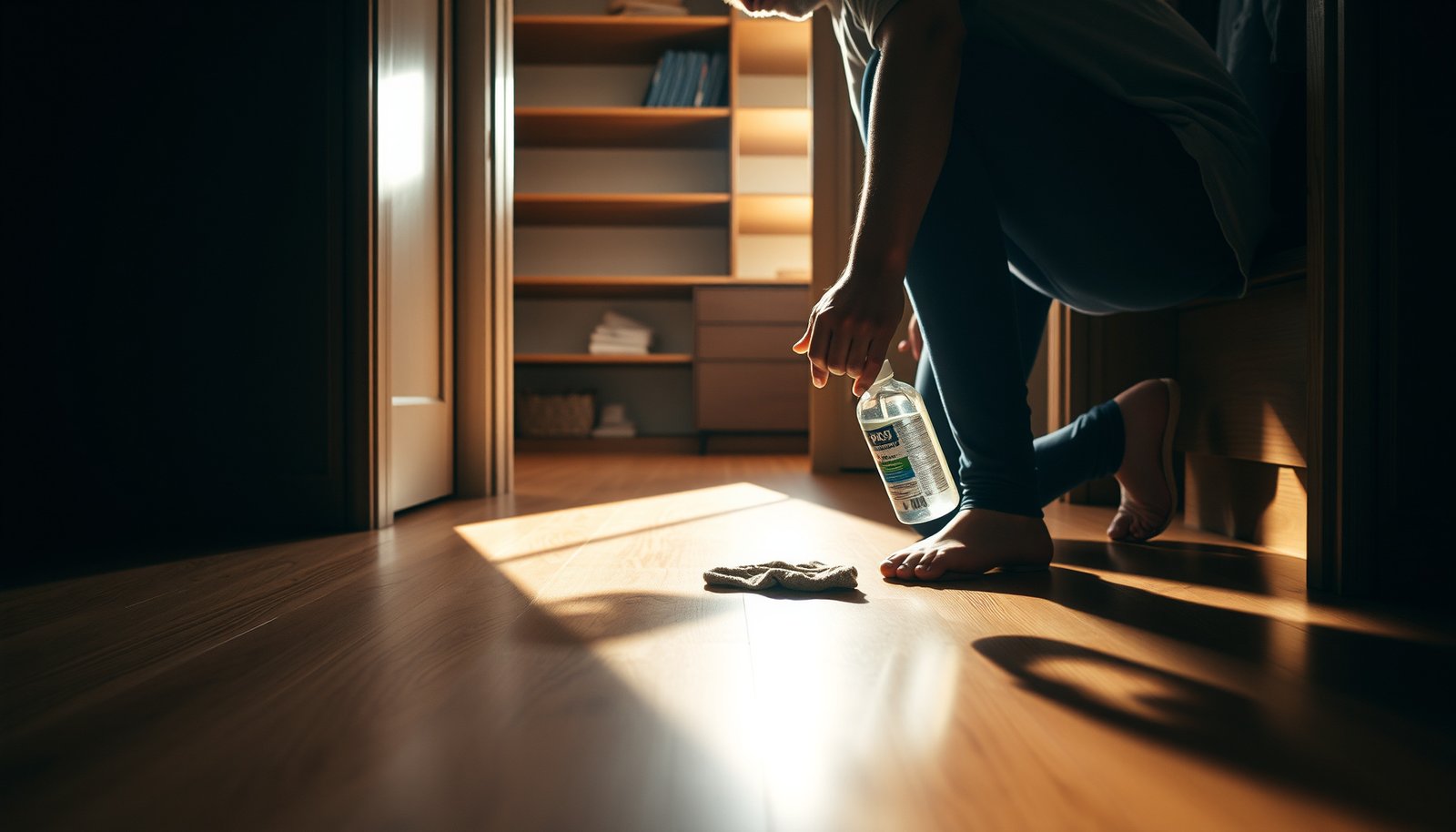

To remove stains from hardwood floors in a closet, you need the right cleaner and a careful method—so the fastest, safest results come from using the correct spot-cleaning routine instead of harsh scrubbing. This guide gives you quick, step-by-step actions to lift common stains from closet hardwood without damaging the finish. By the end, you’ll know exactly what to do for your specific stain and how to stop it from coming back.




Remove hardwood floor stains in a closet by first identifying the stain type, then cleaning with the gentlest finish-safe method possible—without soaking the wood. Treat in small sections, blot/dry immediately, and stop once the stain lightens; if the stain has penetrated the finish, you may need spot-refinishing.
Closets are especially prone to staining because moisture gets trapped: damp shoes, small spills, slow leaks, or mildew can set stains faster than they would in an open room. If you can’t find the moisture source, the same spot can reappear even after cleaning—so “stain removal” and “moisture control” have to go together in hardwood floors in a closet.
Who this is for / when it applies
This guidance is for homeowners and property managers dealing with common discoloration on finished hardwood floors in closets—especially water rings, dark moisture spots, rust-like marks from metal, or mildew-related gray/fuzzy growth. It’s intended for spot work on a closet floor area, not whole-floor refinishing.
Identify the stain type on your hardwood
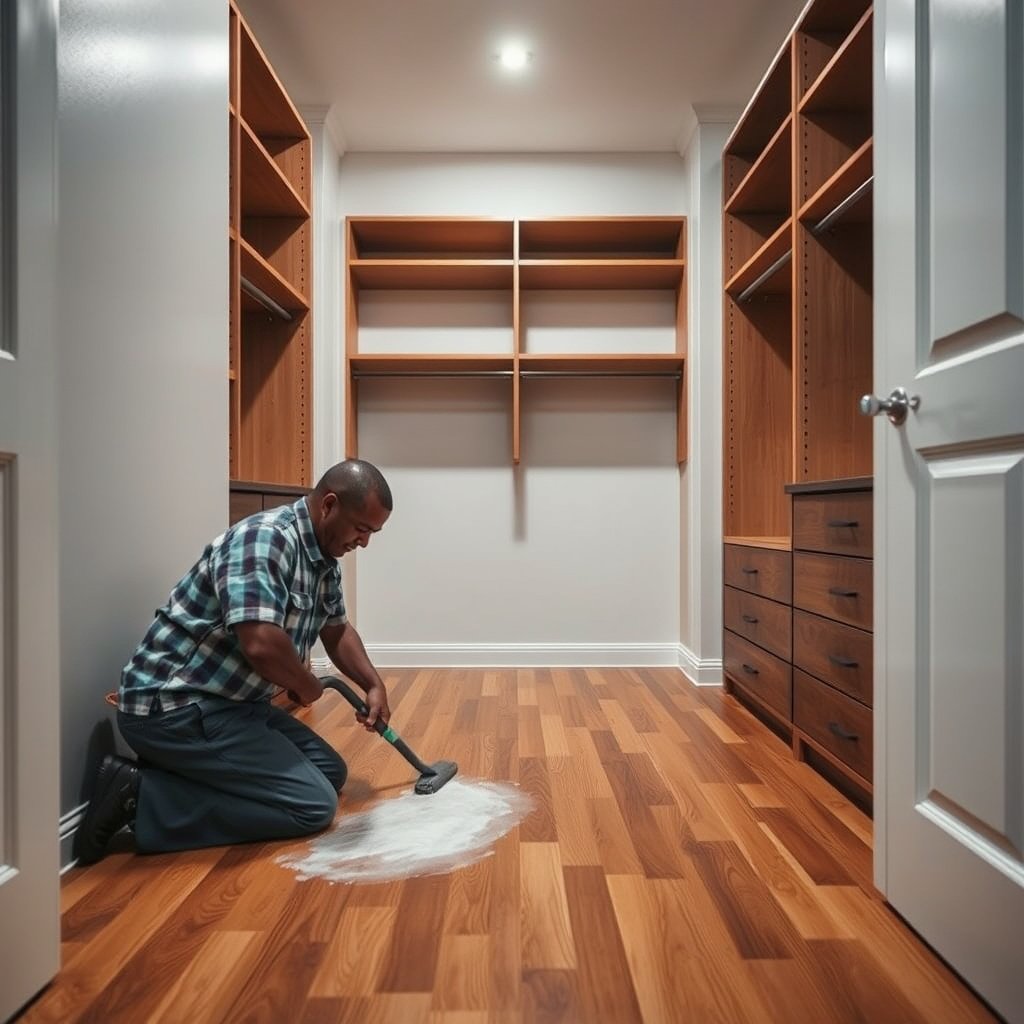
You’ll remove hardwood floor stains faster (and more safely) when you classify what you’re looking at before applying any cleaner. In hardwood floors in a closet, the “right first step” depends on whether the stain is tied to moisture, metal transfer, or biological growth.
According to the U.S. Environmental Protection Agency (EPA), mold can begin to grow within 24–48 hours after water damage, which is why closet stains related to dampness can set quickly. (EPA)
According to the EPA, mold growth is commonly associated with indoor relative humidity levels above 60%, so recurring closet discoloration often signals ongoing moisture. (EPA)
To identify hardwood floor stains in a closet, look for reliable visual and “feel” clues:
– Look for clues:
– Water rings / whitish haze: often indicate moisture that affected the surface or finish.
– Dark blotches: may be absorbed into the wood (more likely if the spot stays after drying).
– Rusty/orange marks: often point to iron/metal transfer (shoe hardware, a chair leg, a forgotten screw, etc.).
– Fuzzy/gray growth: strongly suggests mildew (surface mold colonies), which is a moisture issue as well as a stain issue.
– Check whether the stain is finish-only or penetrated:
– A surface/finish stain usually responds to gentle cleaning and immediate drying.
– A penetrated stain often remains after careful blotting, drying, and finish-safe cleaning.
– If you suspect an active moisture issue, pause the cleaning sequence:
– Soft spots, peeling finish, musty smell, recurring discoloration in the same exact square, or damp shoe tracks are all “stop and fix first” signals for hardwood floors in a closet.
If you’re not sure whether the discoloration is finish-related or wood-penetrated, treat it like penetrated until proven otherwise: use minimal water, test in an inconspicuous spot, and watch how the stain changes after each small step.
Start with the safest cleaners (before stronger chemicals)
Use a finish-safe, pH-neutral approach first so you don’t haze, dull, or further embed hardwood floor stains in a closet. The gentlest method is usually enough for moisture rings and many surface discolorations—especially when you never soak.
According to the National Institute of Standards and Technology (NIST), pH is a logarithmic scale and **7 is neutral**, which is why “pH-neutral” cleaners are often recommended for surfaces that can haze from overly acidic/alkaline chemistry. (NIST)
Using a barely damp (not wet) cloth prevents excess water from migrating through seams and into hardwood floors, which reduces the chance of swelling and deeper staining. (NWFA-style cleaning guidance; )
Start with these principles for hardwood floors in a closet:
– Choose the safest cleaner first:
– A pH-neutral wood-floor cleaner, or
– A very mild dish soap solution used sparingly on a cloth.
– Apply with microfiber and control the water:
– Cloth should be barely damp, not dripping.
– Work outward from the stain to avoid spreading.
– Test before treating:
– Closets often have fewer airflow conditions, so any haze from chemistry shows up more clearly.
– Test in a low-visibility spot (or under a baseboard/closet rail).
– Confirm whether your hardwood finish is sealed (polyurethane-type) or oiled (oiled floors behave differently with certain treatments).
If the stain lightens on the first pass, keep going in small sections—but don’t “chase” it with stronger chemicals. In hardwood floors in a closet, the fastest route to success is often repeated gentle passes with immediate drying.
Typical pH of Common “DIY” Solutions vs. Finish-Safety for Hardwood Floors in Closets
| # | Cleaner/solution | Typical pH (approx.) | Common reason people try it | Hardwood-finish safety score |
|---|---|---|---|---|
| 1 | pH-neutral wood-floor cleaner | 6.5–7.5 | Routine cleaning | ★★★★★ |
| 2 | Distilled water (on a cloth) | ~7.0 | Water-ring attempts | ★★★★☆ |
| 3 | Hydrogen peroxide (common 3% household) | ~3–6 | Mildew/whitening attempts | ★★★☆☆ |
| 4 | Baking soda solution | ~8.0–9.0 | Odor and spot “scrub” attempts | ★★☆☆☆ |
| 5 | Vinegar (diluted household) | ~2–3.5 | “Natural” stain removal | ★☆☆☆☆ |
| 6 | Household ammonia (diluted) | ~11–12.5 | Grease and grime “lift” attempts | ★☆☆☆☆ |
| 7 | Chlorine bleach solutions | ~11–13 | Discoloration/whitening attempts | ☆☆☆☆☆ |
Note: Exact pH can vary by brand, concentration, and dilution. For hardwood floors in a closet, follow your floor finish manufacturer’s approved cleaners first—chemistry is only one factor; finish compatibility and rinsing requirements matter as much as pH.
Treat common closet hardwood stains (step-by-step)
You’ll get the best outcomes on hardwood floor stains in a closet by treating the most likely stain types with controlled, minimal-moisture steps. The goal is to remove discoloration while protecting the finish—so you work in small sections and stop early.
According to the EPA, active moisture can drive mold growth within 24–48 hours after water damage, so mildew-related closet stains often require both cleaning and drying/moisture repair. (EPA)
If a stain remains after careful cleaning and drying, it often indicates deeper penetration into the wood or finish failure, which may require spot-refinishing rather than more scrubbing. (NWFA-style maintenance guidance; )
Water rings / light discoloration
1. Dampen a cloth with clean water (not a wet mop).
2. Gently rub the ring without over-wetting the surrounding boards.
3. Dry immediately with a second clean cloth.
4. Repeat in cycles until the ring fades.
In hardwood floors in a closet, this method usually works when the finish is intact and the moisture didn’t soak deeply.
Mildew or dark moisture spots
1. Clean first with a wood-floor-appropriate cleaner (pH-neutral, finish-safe) using microfiber.
2. Confirm whether you’re dealing with actual mildew growth:
– Fuzzy growth that returns suggests ongoing moisture, not just surface dirt.
3. Only choose mildew treatments after confirming finish compatibility:
– Some mildew/whitening chemistry can dull or haze finishes, especially in enclosed closet conditions with limited airflow.
If you’re considering peroxide or bleach-type options, verify compatibility with your floor finish system first (manufacturer docs matter here). For hardwood floors in a closet, “stronger” isn’t automatically better—finish damage can look worse than the original stain.
Rust/metal stains
Rust-like orange marks in hardwood floors in a closet typically come from iron contamination (shoe buckles, metal racks, fasteners, or tools). For these:
– Use an oxalic-acid rust remover made for wood/finish floors *per label directions*.
– Keep application controlled and limited to the stain area.
– Rinse/neutralize and dry exactly as the label specifies (controlled chemistry prevents residue haze).
Dry and protect the finish after stain removal
Drying isn’t optional if you want hardwood floor stains in a closet to stop returning—it’s the final step that prevents moisture migration and finish haze. After treatment, you’re protecting the finish system, not just “getting the stain out.”
For mold and mildew-prone situations, the EPA emphasizes addressing moisture sources and drying affected materials promptly—cleaning alone is often insufficient. (EPA)
In finished hardwood maintenance, excess water increases the risk of swelling and edge lifting, so drying immediately after each small cleaning pass is a key protective practice. (NWFA-style cleaning guidance; )
Do this after every stain-treatment cycle:
– Dry thoroughly:
– Use clean dry cloths.
– If possible, use gentle airflow (a fan) to speed evaporation in the closet.
– Avoid residue:
– If your cleaner requires rinsing, use the smallest amount needed for a light rinse—then dry again.
– Expect finish “sheen differences”:
– If the cleaned area looks dull or uneven, you may need spot-refinishing.
– Many “cleaned” stains don’t fully return, but the finish layer reflects light differently once it’s been chemically or mechanically altered.
In hardwood floors in a closet, this is where restraint pays off: stop once the stain lightens and the finish looks uniform, rather than repeatedly grinding the area.
What can go wrong (and how to avoid it)
The main failure modes are excess water, incompatible chemicals, and unresolved moisture—each can turn a manageable stain into a finish-damaging repair. If you prevent those three issues, hardwood floor stains in a closet are far more likely to stay gone.
The EPA links mold growth to moisture control, noting that mold can begin growing within 24–48 hours after water damage—so untreated moisture can make stains reappear. (EPA)
Neutralizing the right way matters: applying strong chemistry without following the product label can leave residue that causes haze or dull spots on sealed hardwood finishes. (Manufacturer label/finish instructions; )
Here are the common mistakes to avoid:
– Soaking the wood: Excess water can swell seams, lift edges, and spread the stain deeper.
– Using the wrong chemicals: Ammonia, bleach, and harsh solvents can discolor wood or haze finishes—especially in enclosed closets with limited ventilation.
– Skipping moisture-source fixes: If there’s a leak, wet shoes, high humidity, or poor airflow, the same spot can come back after cleaning.
Pros/cons quick comparison (so you choose the right “next action”)
- Gentle, finish-safe cleaning
- Pros: Lowest risk of haze; works well for water rings and surface discoloration.
- Cons: May not remove deeply penetrated stains or areas with compromised finish.
- Targeted chemical spot treatment (e.g., oxalic acid for rust)
- Pros: More effective for specific stain chemistry (rust/metal).
- Cons: Higher risk of uneven sheen or finish dulling if overused or incompatible.
Remedy logic: fix moisture first if needed, treat the stain type next, then dry and evaluate for finish uniformity. In hardwood floors in a closet, this sequence prevents the “cleaning loop” where discoloration returns.
Verdict: the most reliable approach (and who should skip DIY)
Start with gentle, finish-safe cleaning, then move to targeted treatments (oxalic acid for rust; mildew-specific methods only when compatible with your finish). Stop early if the stain doesn’t lift—scrubbing harder can spread it, and repeated chemical attempts can make later refinishing more complex.
Skip DIY and call a flooring pro if the spot is recurring, the wood is cupped/soft, you see peeling or failing finish, or the stain seems deeply embedded with no improvement after careful treatment.
| Quick checklist (scan/save) | Do this |
|---|---|
| Identify the stain | Water ring vs. rust vs. mildew vs. unknown dark spot |
| Use least-scrub-first | pH-neutral cleaner on a barely damp cloth |
| Target the type | Oxalic acid for rust (only per directions); mildew method only if finish-compatible |
| Keep water minimal | No soaking; blot and dry immediately |
| Fix the cause | Address leaks, humidity, or trapped moisture in the closet |
| Know when to stop | If it won’t lift, consider spot-refinishing/pro help |
FAQ
– Can I use vinegar or baking soda to remove hardwood stains? Often they’re not wood-finish-friendly; if you’re unsure of your finish, stick to pH-neutral, manufacturer-approved cleaners.
– How do I tell if the stain is in the finish or the wood? If it wipes off with light cleaning, it’s usually a surface/finish issue; if it remains after careful cleaning and drying, it may have penetrated.
– Will sanding always remove a stain? It can, but it also changes the floor’s surface level and finish; it should be done based on the floor’s thickness/finish type—.
– What if the stain comes back after cleaning? That usually points to a continuing moisture source (humidity, leaks, wet items, or inadequate drying). Fix the root cause first.
Sources
– National Wood Flooring Association (NWFA) cleaning/maintenance guidance: .
– Floor finish manufacturer cleaning instructions (e.g., your specific sealant/finish brand): .
– Oxalic-acid rust remover label directions and any wood/finish compatibility guidance: .
– U.S. Environmental Protection Agency (EPA): moisture control and mold growth timing/conditions ().
– NIST (National Institute of Standards and Technology): pH scale and neutral pH definition.
If you want hardwood floor stains in a closet to stay gone, treat the stain type carefully, keep water to a minimum, and don’t ignore moisture. In 2026, the most durable results still come from finishing-safe cleaning plus a moisture plan—because once the wood and finish stop being exposed to damp conditions, discoloration has far less chance to return.
Frequently Asked Questions
How do I remove water stains from hardwood floors in a closet?
Start by blotting the area with a clean, dry microfiber cloth to remove any excess moisture, then let the floor dry completely. If the stain remains, lightly rub the spot with a 1:1 mixture of white vinegar and water using a damp (not wet) cloth, then dry right away. For stubborn watermarks, use a small amount of hydrogen peroxide on a cloth and test in a hidden area first, since it can lighten some finishes.
What’s the best way to remove dark or oil-based stains from hardwood floors in a closet?
Oil-based stains often require a degreasing approach, so use a cleaner designed for hardwood or mix a few drops of dish soap into warm water and wipe gently with a damp cloth. Avoid soaking the wood or using harsh chemicals that can damage the finish. After cleaning, dry thoroughly and reassess—if the stain persists, you may need a targeted hardwood floor cleaner or refinishing for the affected layer.
Which household cleaners are safe for removing stains on finished hardwood floors?
For finished hardwood, stick to pH-neutral cleaners made for hardwood floors, or mild solutions like diluted dish soap with water and then immediate drying. Vinegar can help with some surface stains, but it should be used sparingly and never left to soak. Avoid abrasive pads, steam mops, and strong solvents (like acetone or bleach) because they can strip the finish or discolor the wood.
Why do closet hardwood stains keep coming back, even after cleaning?
Stains can reappear if the contaminant is still trapped in the finish or has penetrated into the wood grain. Poor drying, hidden moisture from plumbing, or frequent humidity in closets can also keep reactivating the stain. Check for ongoing moisture sources, use a proper hardwood stain remover for the specific type of stain, and consider sealing or refinishing if the discoloration is coming from below the surface.
How can I remove ink or marker stains from hardwood floors without damaging the finish?
Blot the ink with a clean cloth first—don’t rub, since it can spread the stain. Use rubbing alcohol very sparingly on a cotton swab or cloth (test in an inconspicuous area), then blot and wipe with a slightly damp cloth followed by drying. If the ink penetrated the finish, you may need a dedicated spot remover for hardwood or professional refinishing to restore the floor’s original appearance.
📅 Last Updated: October 17, 2026 | Topic: How to remove stains from hardwood floors in a closet? | Content verified for accuracy and freshness.
References
- 404 Error
- 404 Error
- Wood flooring
- Oxalic acid
- Water damage
- https://scholar.google.com/scholar?q=remove+water+stains+from+hardwood+floors Google Scholar
- https://scholar.google.com/scholar?q=remove+pet+urine+stains+hardwood+floor+cleaning Google Scholar
- https://scholar.google.com/scholar?q=oxalic+acid+wood+water+stain+removal Google Scholar