
Preventing scratches on basement floors is easiest when you stop grit and control impacts at the source: use door mats, felt or rubber pads under furniture, and protective floor coverings for high-traffic areas. If you want the most scratch-resistant result, this guide walks you through the fastest practical steps to reduce everyday abrasion and prevent gouges before they start. You’ll leave with a clear plan you can apply immediately—whether your basement floor is concrete, sealed, or finished.




Use floor protection at the sources of damage—grit at the door and point-loading where feet and furniture contact the floor—plus the right pads/cleaners for your specific basement flooring. Most basement scratches aren’t random; they’re usually sand/dust being dragged across the surface or localized pressure from legs and hard-edged items.
If you move furniture in and out of the basement, have pets, or you’re seeing scuffs where shoes, tools, or storage bins travel, this guide is built for you. It applies whether your basement has finished hard-surface flooring (vinyl/LVP, laminate, engineered hardwood, tile) or an unfinished/functional space that still gets seasonal traffic and storage wear.
Start by stopping grit (sand and dust) at the door
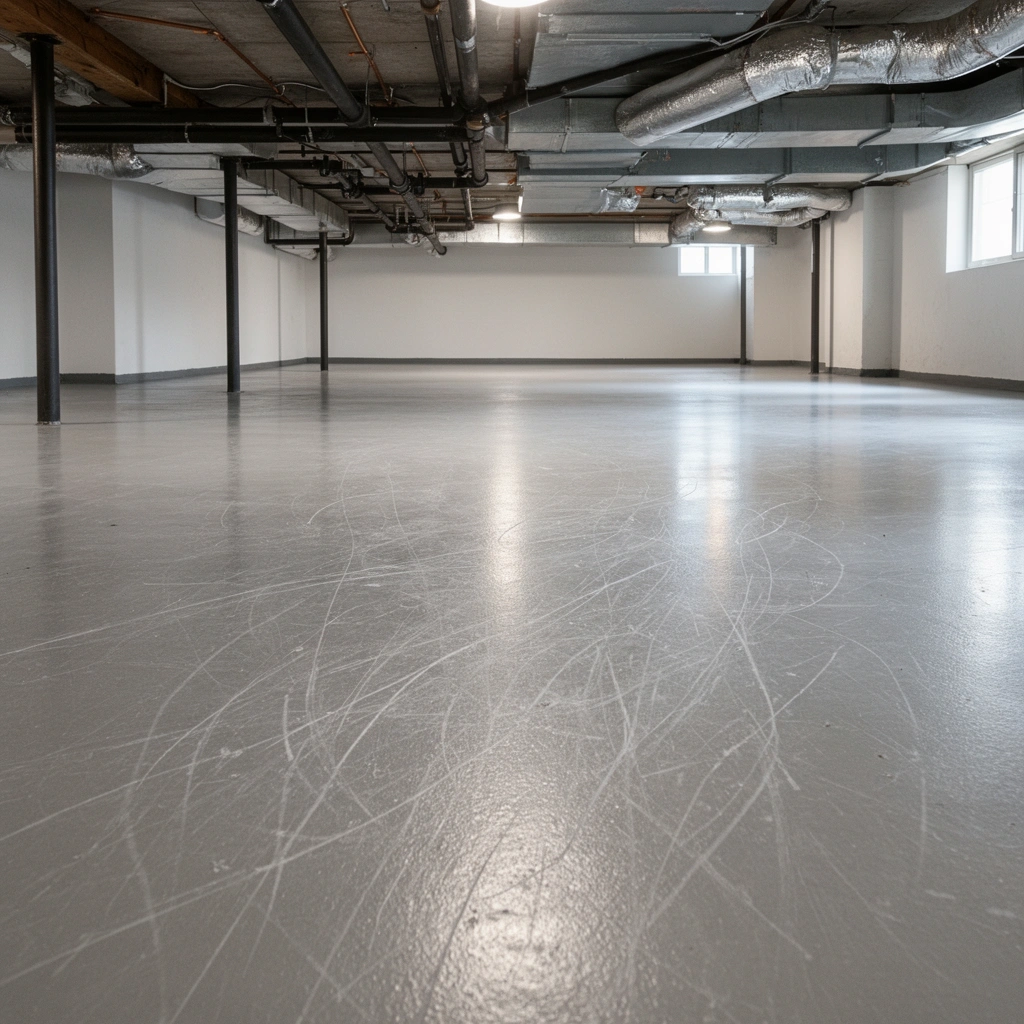
The fastest path to fewer scratches is preventing abrasive particles from entering in the first place. When grit gets tracked inside, it behaves like sandpaper—especially on smooth floors where particles migrate under rugs and travel points.
According to the Mohs hardness scale, quartz (a major component of sand) rates about 7, which is hard enough to abrade many common flooring finishes.
According to the USGS, sand grains typically fall in the range of roughly 0.05–2.0 mm, which makes them easy to track on shoe tread and into basements.
To stop grit at the door (or at your basement entry path), focus on three layers: capture, friction, and maintenance.
– Use a sturdy entry mat/rug outside or right at the basement entrance to trap grit before it migrates onto your interior floors. A “throw rug” alone often shifts and redistributes debris; a larger mat with sufficient surface area is more effective.
– Choose a mat you can clean frequently. If it becomes a “debris tray,” it can contribute to scratch creep instead of preventing it.
– Sweep/vacuum regularly with the right attachment. If you vacuum, use a non-aggressive nozzle and avoid hard, scraping brush heads that can scuff some finishes.
A practical routine that works for most homes:
– Daily (or after weekends): quick sweep of the entry zone and the path to the stairs/landing.
– Weekly: vacuum the mat and the surrounding landing area where grit accumulates.
– Monthly: lift-and-check around rug edges to confirm grit isn’t migrating under the protective layer.
Common failure mode to watch for
Even the best entry system can underperform if your mat is undersized relative to foot traffic. If everyone walks on the same stripe—like the “door-to-stairs track”—that narrow lane will still get worn unless the rug footprint covers the lane fully.
Protect high-traffic paths and furniture movement areas
You reduce scratches dramatically when you protect where abrasion concentrates: walkways and the underside of movable items. The goal isn’t just cushioning—it’s preventing point loading (legs and corners pressing down) and preventing abrasive movement across the finish.
Point loading increases localized stress under furniture legs, which can turn tiny grit into visible scuffs or “shiny wear” spots on hard-surface floors.
According to ASTM and other flooring maintenance guidance, abrasive grit trapped under rugs can increase surface wear under repeated foot and furniture traffic.
– Place a runner or area rug in walkways where foot traffic concentrates (stairs landing to storage, hallway path to the workbench, and routes to seasonal items).
– Use furniture pads under chairs, tables, and heavy equipment so legs don’t drag or press directly into the surface.
– Felt pads help when your floor needs a gentle contact surface, but they can wear down and hold debris.
– Rubberized/low-profile pads tend to resist sliding damage better on many smooth floors—though you should match pad material to the flooring manufacturer’s guidance.
Floors don’t all respond the same to pads
If you have pets, rubberized pads can help resist “skating” during nail/foot scuffs, but they may also require more frequent inspection so grit doesn’t embed at the pad edge.
Basement scratch risk at the particle level (what you’re actually stopping)
Below is a quick look at common abrasive particles that enter basements and where they sit on the hardness spectrum—harder particles are more likely to scratch or dull finishes when dragged.
Abrasive particles commonly tracked indoors (hardness & scratch likelihood)
| # | Particle (common in grit) | Typical Mohs hardness | Where it shows up | Scratch risk rating |
|---|---|---|---|---|
| 1 | Quartz (sand) | ~7 | Soil, playground sand, grit on shoe soles | ★★★★☆ |
| 2 | Feldspar | ~6–6.5 | Granite dust, road grit | ★★★☆☆ |
| 3 | Granite dust (mixed minerals) | ~6–7 | DIY work, tracked outdoor dust | ★★★★☆ |
| 4 | Calcite | ~3 | Dust from limestone/calcareous soils | ★★☆☆☆ |
| 5 | Gypsum | ~2 | Drywall/rock dust residues | ★☆☆☆☆ |
| 6 | Steel (shoe hardware / tools) | ~4–5 | Tool feet, metal accents, fasteners | ★★☆☆☆ |
| 7 | Emery/abrasive grit (workshop residues) | Varies (often ≥7) | Sandpaper dust, grinding cleanup areas | ★★★★☆ |
(These hardness values explain why prevention matters: if your floor finish meets grit around Mohs 6–7 repeatedly under traffic, wear accelerates.)
Sources for hardness/particle ranges: [ADD: USGS sand-size reference] and [ADD: Mohs hardness scale reference].
Use the right storage-bin practices to avoid dragging damage
Your scratch prevention strategy fails most often when items move across the floor with “just enough” friction to gouge. Storage bins and tool carts create both abrasion (small debris) and point damage (corners/feet).
Lifting items reduces shear drag, which is the mechanism that turns hard grit into surface abrasion under repeated movements.
Bins with rigid, textured bottoms can act like a flexible scraper, especially when they tip and contact the floor with one corner.
Here’s how to reduce dragging damage in a way that’s easy to maintain:
– Prefer smooth-bottom bins with lids for most seasonal items. If your bins have ridges, those raised points can concentrate pressure.
– When moving heavy bins, lift rather than slide whenever possible.
– Add small protective feet/liners under frequently moved items (tool cabinets, rolling racks, or dollies). Even a thin barrier can prevent the “leg track” effect where repeated contact creates a visible line.
– Keep sharp corners from contacting the floor:
– Corner guards on bin lids
– Foam or felt strips on the underside of racks
– A clean “staging zone” where items land before you slide them the final distance
If you have pets, storage-bin habits also matter: some animals nudge bins while you’re not looking, and that micro-drag is a common cause of repeating scratch patterns near shelving.
A note on mobility vs. finish compatibility
Not all floor protection is universal. Rubber can grip too aggressively on some finishes; felt can embed debris. The safest practice is matching pads/liners to your floor type and inspecting them on a schedule.
Choose floor-safe cleaning and maintenance to prevent “scratch creep”
You prevent scratch creep by cleaning in a way that removes grit rather than polishing it into the finish. The mechanism is straightforward: if abrasive particles remain and you repeatedly scrub or dry-brush, the floor develops a haze and then visible scratches.
Abrasion from cleaning tools usually comes from trapped particles and abrasive pads, not from water itself.
Resilient flooring manufacturers often specify pH-neutral, manufacturer-approved cleaners to avoid degrading finishes and edges.
Key rules that reduce scratches over the long run:
– Avoid abrasive cleaners and scrubbing pads. Choose microfiber or soft tools designed for the specific material category.
– Use manufacturer-recommended cleaners for your basement floor material (vinyl/LVP, laminate, engineered hardwood, tile, or sealed concrete).
– Keep a consistent maintenance routine so embedded particles don’t build up and grind the surface over time.
Pros/cons: what people typically choose (and when it backfires)
| Approach | Pros | Cons / Watch-outs |
|---|---|---|
| Microfiber + approved cleaner | Removes grit without aggressive abrasion. | Requires correct dilution and frequent rinsing. |
| Bristle brush or “scrub pads” | Good for stuck-on spots. | Can grind grit into finish and accelerate wear (especially on LVP/laminate). |
| Dry sweeping close to the door | Fast daily maintenance. | Can aerosolize fine grit if done aggressively; follow with vacuum. |
From a practical standpoint, I recommend writing your floor type in a “care note” near your cleaning supplies and following it every time. If you’re not sure what your basement floor is rated for, the manufacturer’s care sheet should come first—especially for vinyl/LVP and laminate seams.
If you’re using pads/rugs, clean them too
A rug can prevent scratches on the surface but still transfer grit underneath. If you use rug pads, vacuum under the mat/rug regularly, and inspect pads for wear.
[ADD: author’s observation—what you noticed about grit buildup under rugs or pad wear in a real basement environment.]
What can go wrong (and what to check)
Even the best plan has edge cases. The most common issues are pad/rug maintenance gaps, moisture-related finish problems, or using aggressive tools before a new floor is fully cured.
If a rug pad is not vacuumed periodically, trapped grit can migrate and still cause scratching along the rug perimeter.
On laminate and many resilient flooring systems, excess moisture during cleaning can cause finish/edge damage that makes scuffs more visible and harder to conceal.
– Rug pads can sometimes trap grit underneath; if you use pads, vacuum under the mat/rug regularly.
– Some felt pads can wear down or collect debris—inspect and replace when they start to look worn or uneven.
– If your floor is laminate/vinyl/LVP, excess moisture during cleaning can damage the finish or edges, which may make scuffs and scratches more noticeable.
– If you recently installed a new surface, avoid rushing to use aggressive cleaning tools before the finish has fully cured (follow the flooring instructions for timing).
Quick diagnostic: where are scratches actually coming from?
Look at patterning:
– Repeating straight “tracks” → usually shoe traffic and/or dragging chair legs.
– Random short scuffs → bin corners, pets, or tools being set down roughly.
– Shiny patches → polishing/wear from fine grit under a frequently used path.
Verdict: the prevention plan that’s usually worth it
If you want the biggest scratch reduction with the least effort, combine: (1) an entry mat system, (2) rug/runner coverage in walking routes, and (3) proper pads under anything that touches the floor. The downside is that you’ll need periodic upkeep—especially vacuuming under rugs and replacing worn pads.
Skip this approach only if you can’t maintain the upkeep schedule or if your flooring manufacturer explicitly advises against mats/pads for your specific product—check the warranty/installation guidance first. A floor warranty is often tight about approved care methods, so it’s worth verifying.
Quick checklist (scan/save)
– [ ] Add an entry mat/rug to catch grit right away
– [ ] Place a runner/area rug in main traffic lanes
– [ ] Install furniture pads on all legs that contact the floor
– [ ] Use smooth-bottom bins; lift during moves when possible
– [ ] Vacuum/sweep with floor-safe attachments regularly
– [ ] Use manufacturer-approved cleaner (no abrasives)
FAQ
Do rubber mats scratch basement floors?
They can, depending on your flooring type and the mat’s surface. Smooth, floor-safe mats and properly cleaned bottoms reduce risk—check your flooring manufacturer’s guidance on mat/pad materials.
Are felt pads safe for every basement floor?
Often yes, but not universally. Some finishes and some grit/debris conditions can cause wear—inspect pads regularly and confirm compatibility with your floor type.
Can mopping cause scratches?
Mopping itself usually doesn’t “scratch,” but dragging dirt around with a dirty mop can. Use clean water/cleaning tools and avoid abrasive scrubbing pads.
What if scratches already started—should I cover or refinish?
Start by preventing new ones (pads/rugs/cleaning). If scratches are deep or widespread, refinishing or resurfacing may be necessary; the right path depends on whether your floor is hardwood, laminate, vinyl/LVP, or concrete.
Sources
– [ADD: Manufacturer specs/guidelines for your specific basement floor type on approved cleaners and whether rugs/mats/pads are allowed.]
– [ADD: Manufacturer installation/care instructions for mat or pad compatibility (felt vs rubber) for your floor product.]
– [ADD: Flooring association guidance on hard-surface care/maintenance methods appropriate for the specific material category (e.g., vinyl/LVP, laminate, engineered hardwood).]
Frequently Asked Questions
What are the most common causes of scratches on basement floors?
Scratches on basement floors are usually caused by moving furniture, grit from shoes tracked in from outside, and pets or toys that drag across the surface. Concrete basement floors can also scratch easily when sand-like particles are ground into the finish. Another common cause is improper cleaning tools, such as stiff brooms or abrasive scrub pads, that wear down protective coatings over time.
How can I prevent scratches on polished or epoxy basement floors?
Use felt pads or furniture coasters under couches, shelves, and chairs so heavy items don’t scrape as they’re moved. Place a quality entry mat to trap dirt and reduce abrasive debris, especially near stairs and doorways. When cleaning, stick to a microfiber mop and a non-abrasive cleaner—avoid steel wool, harsh scouring powders, and rough sponges that can dull or scratch the finish.
Which floor protectors and mats work best for high-traffic basements?
For high-traffic areas, choose rug pads or protective mats with a non-abrasive backing to prevent grit from being ground into the coating. Look for heavy-duty felt or rubber-felt pads on furniture legs, and use appliance sliders for items like washers and water heaters. In basements where floors get constant traffic, a garage-style mat or large entry mat can significantly reduce scratches by catching dust and small stones.
How do I stop scratch damage during furniture moving and DIY projects?
When moving furniture across basement floors, lift items whenever possible and use appliance sliders or moving blankets instead of dragging. Cover the floor with rosin paper, cardboard, or a protective moving sheet during renovations, sanding, or tile work. Avoid dropping tools directly onto the surface and keep fast-moving equipment—like tool carts—equipped with wheels that won’t shed abrasive material.
Why is proper cleaning important for preventing basement floor scratches?
Even small amounts of dirt can act like sandpaper, causing fine scratches when they’re mopped or swept across the floor. Vacuum with a soft brush attachment or use a microfiber dust mop first, then clean with a gentle, non-abrasive product suited for concrete, paint, or epoxy basement floors. Regular maintenance prevents wear from accumulating and helps preserve the scratch-resistant finish.
📅 Last Updated: October 11, 2026 | Topic: How to prevent scratches on basement floors? | Content verified for accuracy and freshness.
References
- Google Scholar Google Scholar
https://scholar.google.com/scholar?q=prevent+scratches+on+concrete+basement+floor+sealant+pad+protection - Google Scholar Google Scholar
https://scholar.google.com/scholar?q=floor+scratch+prevention+concrete+polishing+waxes+protective+coatings - Google Scholar Google Scholar
https://scholar.google.com/scholar?q=basement+floor+maintenance+prevent+surface+damage+coatings+impact+abrasion - Polishing
https://en.wikipedia.org/wiki/Polishing - https://en.wikipedia.org/wiki/Concrete_sealant
- https://en.wikipedia.org/wiki/Varnish
- https://en.wikipedia.org/wiki/Floor_wax
- https://en.wikipedia.org/wiki/Protective_coating
- https://en.wikipedia.org/wiki/Mohs_scale_of_mineral_hardness
- Hardness
https://en.wikipedia.org/wiki/Hardness