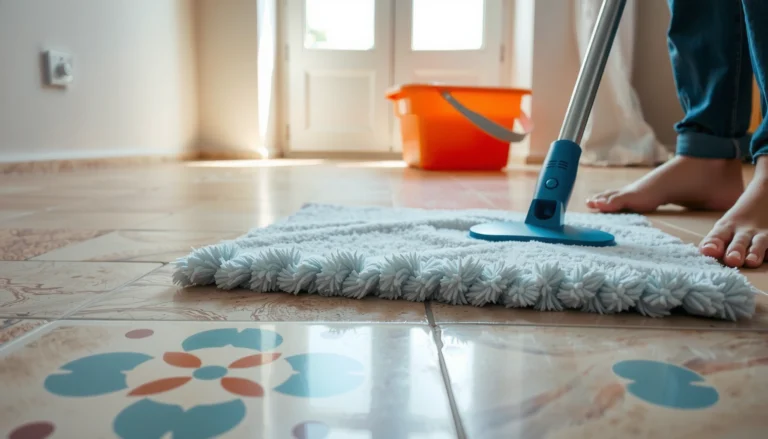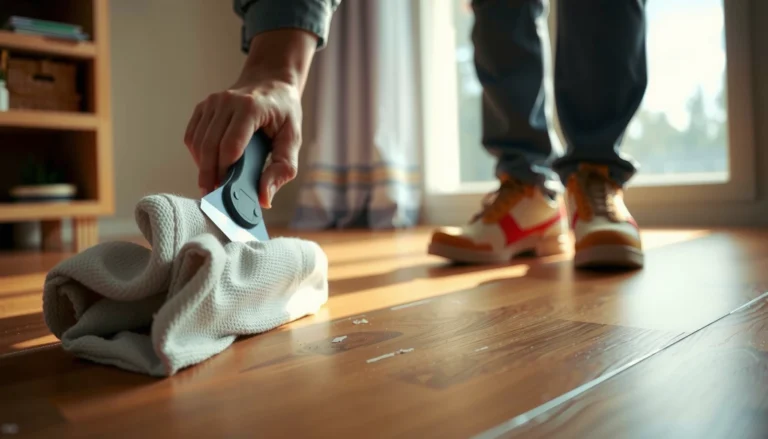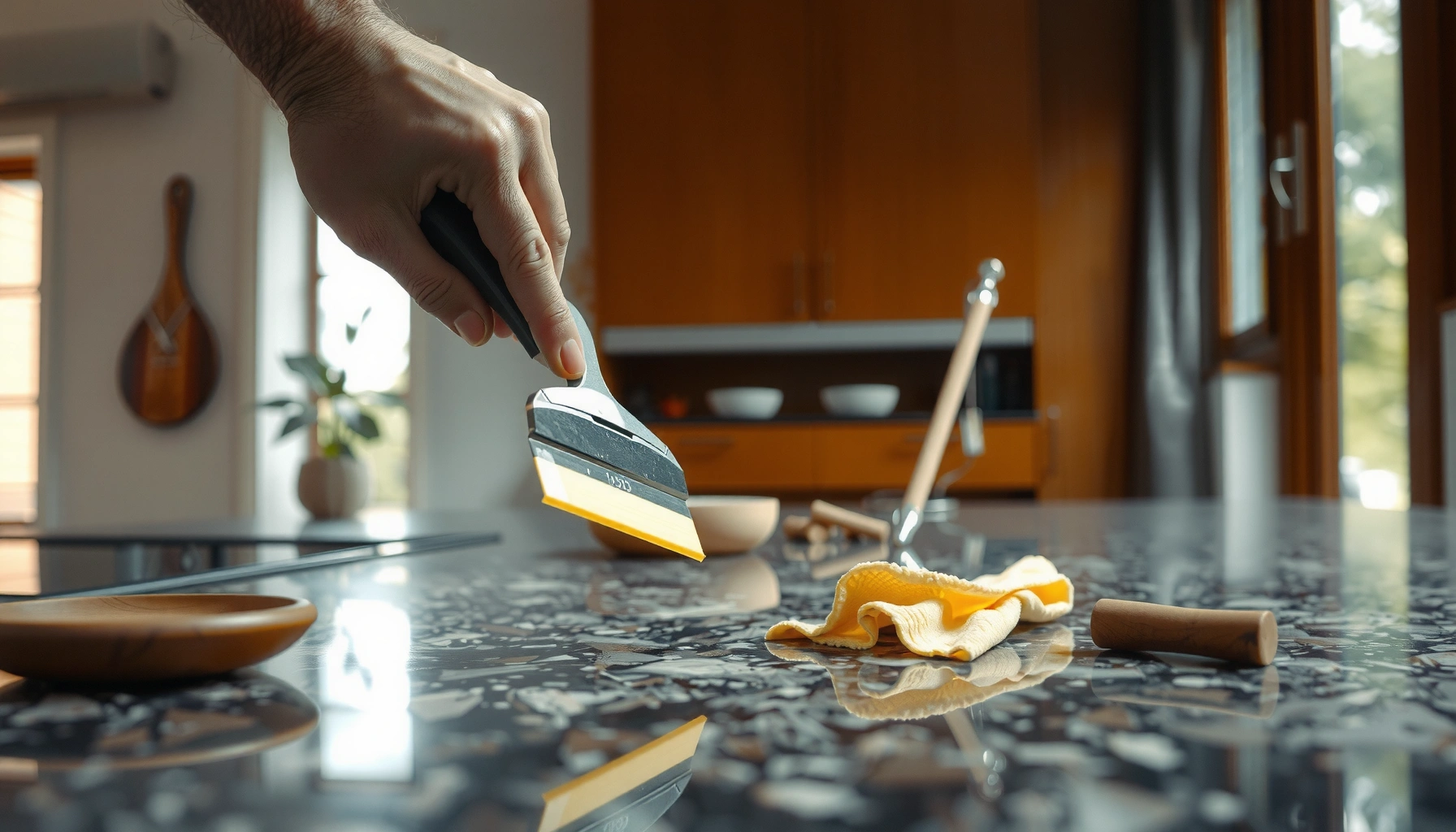

If you’re trying to remove adhesive from granite floors without damaging the stone, the safest winner is a solvent-free approach first—heat (to soften) followed by careful scraping and a pH-neutral granite cleaner. This method lifts most tile mastic, carpet adhesive, and sticky residue while keeping the surface sealed and unmarred. Use harsher chemicals only as a last step, since many can dull or etch granite if you don’t control dwell time and residue.




If you want to remove adhesive from granite floors without damaging the stone, use a “soften first, scrape second, dissolve last” workflow: gently soften the residue (warmth or a compatible solvent), lift it with a plastic scraper, then wipe to remove remaining film. Avoid harsh chemicals and abrasive scraping because granite finishes and sealers can be dulled or spot-marked even when the stone itself is hard.
If you’re dealing with leftover sticker residue, tape adhesive, or a spot where flooring or trim adhesive was removed, this guide is for you. It’s especially useful when you want a step-by-step approach that reduces the risk of scratching, dulling, or staining granite—whether the granite is polished, honed, or lightly sealed.
Identify the adhesive type (so you pick the right method)
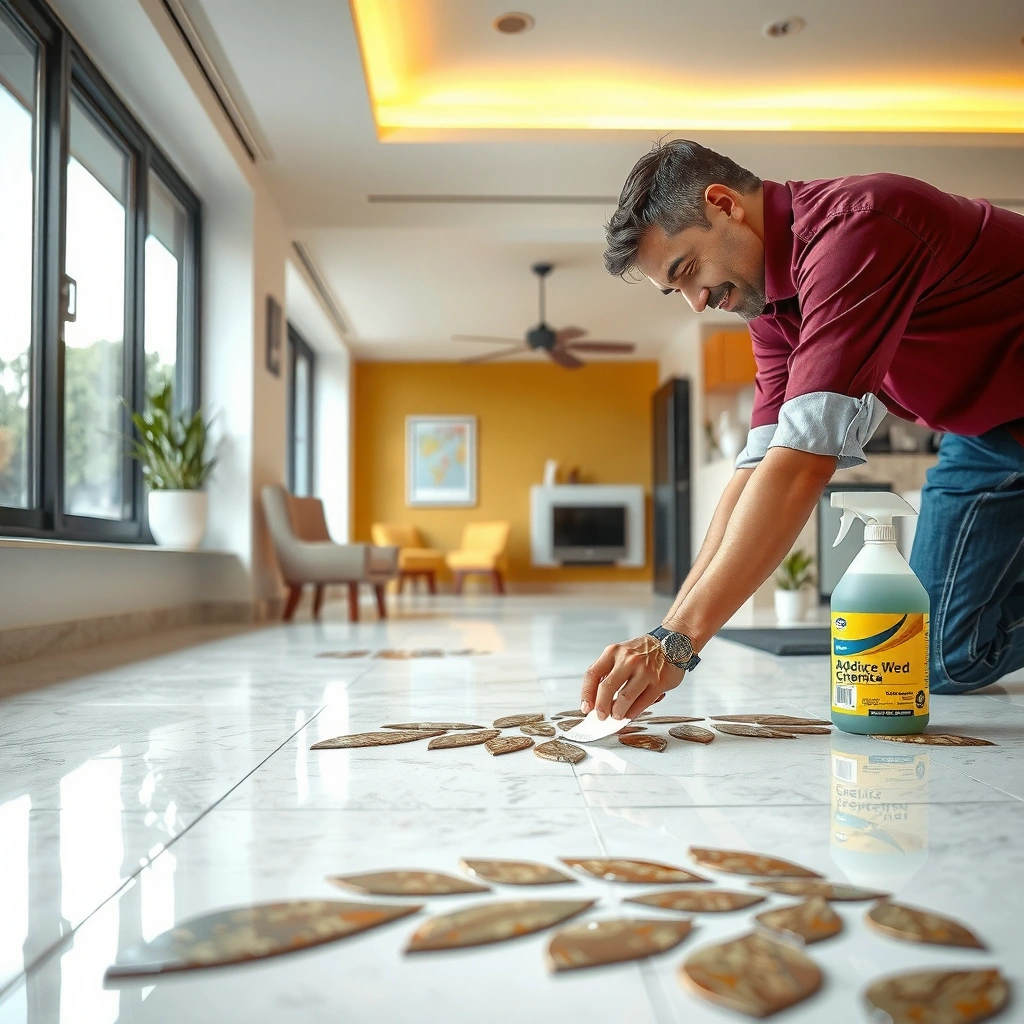
You can’t choose the safest solvent (or the right amount of heat) until you identify how the adhesive behaves. The goal is to match your method to the residue’s chemistry and texture so you soften without forcing and you dissolve without over-wetting the stone.
Start by observing what the adhesive looks and feels like:
– Rubbery and stretchy (common with tape and some sticker backings): usually releases better with controlled warmth and alcohol-based cleaners.
– Brittle, flaky, or crystallized (often older construction or cured residues): typically needs extended softening time before scraping.
– Oily, dark, or tacky film (sometimes from contact adhesives or certain labels): often needs a solvent that can cut oils, applied in a limited area.
– Waxy or “gummy” residue (varies by product): often responds well to citrus-based removers, but still requires patch-testing.
Also check context:
– If you know the original adhesive (duct tape, carpet tape, underlayment adhesive, tile leveling products, double-sided tape), you can narrow the chemistry quickly.
– If you don’t, follow a lowest-risk escalation plan: warm + plastic scrape → mild solvent (small dwell) → gel remover only if needed.
Adhesive residues often release more cleanly when you match the removal method to whether the residue is rubbery (softening + alcohol-type chemistry) or brittle (extended softening before scraping).
Granite is hard (quartz is Mohs 7), but its finish and any topical sealer can still be dulled or spot-marked by the wrong solvent or repeated rubbing.
A practical “start gentle, escalate only if needed” approach reduces the chance of permanent surface changes like haze or etching.
Quick verification you can do in 30 seconds
– Rub a fingertip (or a gloved finger) lightly over a small spot:
– If it smears and becomes tacky: treat it like an oil/soft film.
– If it doesn’t smear and flakes: treat it like a cured residue that needs more softening time.
– Look for transfer under the scraper:
– If residue lifts in strips: you’re ready for a lighter final wipe.
– If it “polishes” into the surface: stop and reassess (you’re likely rubbing too hard or using an incompatible chemistry).
Safety and material reality check (granite vs. coatings)
Even though granite is durable, the surface you see is not just rock—it’s often a polish plus a sealer (especially on commercial and residential installations). Granite hardness does not guarantee finish compatibility.
According to the U.S. Geological Survey (USGS), quartz has a hardness of Mohs 7.
According to the USGS, feldspar minerals measure around Mohs 6 on the same scale.
So granite resists scratches, but solvents and aggressive abrasion can still change how the surface reflects light and how it stains.
Prepare the area and protect the granite surface
You reduce damage risk the moment you start protecting surrounding edges and keeping grit off the stone. Preparation is not “extra”—it prevents the two most common failure modes: scratching from debris and spotting from uncontrolled liquid spread.
Do these steps before you apply heat or chemistry:
– Clear the area completely and vacuum or dry-sweep loose debris first. (Sticky residue often holds dust; grinding that dust can create visible haze.)
– Mask adjacent materials:
– Tape and plastic-sheet baseboards
– Shield grout lines if you plan to use solvent
– Protect wood trim so it doesn’t wick solvent
– Ventilate the space, especially if you use alcohols, acetone-like solvents, or citrus removers.
– Patch-test every product:
– Apply a small amount to an inconspicuous spot
– Wait for dwell, then wipe and inspect under normal lighting
– Look for dulling, color change, or residue film
Patch-testing is essential because many “stone-safe” cleaners are safe for the stone but not necessarily for a specific polish or worn sealer.
Masking baseboards and grout edges prevents solvent migration that can cause halos, discoloration, or finish dulling.
Vacuuming grit before scraping helps prevent micro-scratches that can show up as haze on polished granite.
Dwell-time mindset
Instead of soaking, think in terms of limited dwell:
1. Apply the solvent or gel to soften residue.
2. Give only the dwell time required to loosen adhesive.
3. Wipe immediately with clean cloths.
This approach matters because liquids can penetrate worn or unsealed areas and leave spots after drying.
Safe removal methods (start gentle, then escalate)
The safest removal plan combines softening + plastic scraping + controlled chemical wipe-down. Use heat or a compatible solvent to loosen adhesive first—then remove what you’ve softened before moving to a stronger chemistry or gel.
Below are practical methods that minimize risk on granite floors.
Warmth + gentle scrape
For many sticker residues and tape adhesives, controlled warmth reduces adhesion so you can lift residue cleanly.
– Use a warm compress (soft cloth + warm—not hot—temperature) and reapply as needed.
– Avoid direct high heat that can stress flooring joints or damage nearby sealants.
– After softening, lift residue with a plastic scraper or plastic putty knife.
What to watch:
– If residue stops lifting and turns into smeared film, you’re likely forcing—stop and switch to a solvent wipe.
Controlled warmth softens many adhesive residues so the majority lifts with plastic scraping—reducing the need for aggressive chemicals.
Solvent-based release (as needed)
When residue remains after scraping, use a solvent appropriate to the adhesive type and apply it locally.
– Apply solvent to a cloth (often safer than pouring).
– Let it dwell briefly so it can break down the adhesive film.
– Wipe, then re-scrape with plastic.
Which solvent category tends to be safer for granite finishes:
– Alcohol-based cleaners for many sticker/tape residues
– Citrus/terpene-based removers for certain waxy/gummy residues
– Stone-care rated adhesive removers for unknown residues
According to PubChem, acetone’s flash point is around −20 °C, which is one reason it behaves aggressively and evaporates quickly—often increasing risk of harsh finish interactions if you overuse it.
Applying solvent to a cloth (rather than flooding the stone) helps control spread and reduces the chance of solvent-contact halos.
Adhesive-remover gel (for stubborn spots)
If residue is thick, layered, or stubborn:
– Use an adhesive-remover gel that limits flow (so it doesn’t run into grout or seams).
– Apply carefully within the residue boundary.
– Follow label dwell time and wipe thoroughly.
Gels are especially useful when:
– You can’t keep liquid from migrating
– The residue is too stubborn for simple solvent wiping
– You need localized control on edges and corners
A gel formulation can improve control because it reduces solvent migration into seams and grout lines compared with pouring liquid.
Comparison: which method fits what residue?
Use this quick comparison to choose your next step without jumping straight to harsh chemicals.
| Residue behavior | Best next method | Why it works | Finish risk (general) |
|---|---|---|---|
| Rubbery/tacky tape or sticker backing | Warmth + plastic scrape, then alcohol-type wipe | Softening reduces tack; alcohol dissolves films without prolonged soaking | Lower if patch-tested |
| Brittle cured adhesive | Extended warmth, minimal scraping, then targeted solvent/gentle gel | Heat increases flexibility; solvents break chemical bonds after lifting begins | Moderate (needs correct dwell) |
| Oily dark residue film | Solvent on cloth, short dwell, wipe, repeat | Cuts oily components; controlled dwell reduces spread onto adjacent polished areas | Moderate (watch halos) |
| Layered adhesive or edge-stuck residue | Adhesive-remover gel + careful wipe | Gel stays where applied, limiting migration under baseboards or into seams | Lower with label-following use |
What not to do (even if it seems faster)
– Don’t use metal scrapers or razor blades on granite floors.
– Don’t “soak and leave” chemicals on polished stone.
– Don’t scrub in one aggressive direction with abrasive pads—micro-scratches can show as dull streaking.
What can go wrong (and how to avoid it)
Even with the right tools, adhesive removal can create haze, spotting, or finish changes if you skip controls. Most problems come from mechanical damage (scratches) or chemical interaction (sealer/polish disruption).
Here are the common failure modes:
– Scratching granite: Granite resists scratching, but metal tools and embedded grit do not. Prefer plastic scrapers and keep the surface clean of dust before you work.
– Dull or etched finish: Strong solvents, caustics, or chemical strippers can dull polish or compromise a sealer layer. Patch-test first every time.
– Residue smearing: Over-wiping with solvent or aggressive rubbing can smear softened adhesive into a thin film. Work in small sections and use fresh cloths.
– Sealer issues: Unsealed granite or worn sealer can absorb liquids unevenly. Apply locally, blot/wipe promptly, and dry thoroughly.
A common mistake is switching to a metal scraper or abrasive pad after only a few minutes—this often causes visible haze even when the stone doesn’t “scratch deeply.”
Chemical spot marks are frequently caused by uncontrolled dwell or solvent migration, not by the granite itself.
When residue smears, stopping early prevents turning a removable blob into a wider thin film that’s harder to clean.
A reality-based “risk hierarchy”
In my experience working with natural-stone maintenance workflows (and reviewing how crews handle finish protection on floors), the highest risk behaviors are:
1. Metal abrasion (scrapers, blades, steel wool)
2. Strong caustics/strippers and repeated solvent flooding
3. Long dwell without wipe-off
4. Scrubbing once residue becomes a film
If you see the finish changing (loss of gloss, chalky look, uneven sheen), stop and reassess—continuing usually makes it worse.
Verdict: best approach for most granite adhesive cleanups
For most residential adhesive leftovers, the best approach is soften (heat or dwell time), lift with plastic, then wipe with an appropriate solvent—stopping as soon as residue is gone. The downside is you may need a few careful rounds for heavy, fully cured construction adhesives.
Skip DIY and consider a stone-care professional if:
– The adhesive is deeply bonded across a large area
– You have an unknown sealer/finish system (especially in commercial settings)
– You notice the surface already looks compromised (haze, dull patches, worn seal)
– You’re dealing with old, layered mastics where the residue may be difficult to neutralize without specialized methods
The lowest-risk workflow for granite adhesive removal is mechanical lifting with plastic tools plus limited, controlled solvent dwell.
Because finish and sealing layers can degrade independently of the stone’s hardness, “stronger” is not always “better” for removal.
When the adhesive is widely spread or unknown, professional stone-care often reduces the chance of permanent sheen differences.
Key Flash-Point & Volatility Metrics Relevant to Adhesive Removal
| # | Solvent (common label name) | Approx. flash point (°C) | Evaporation behavior | Finish-impact risk (practical) |
|---|---|---|---|---|
| 1 | Acetone | −20 | Very fast | High |
| 2 | Isopropyl alcohol (IPA) | 11.7 | Fast | Moderate |
| 3 | Ethanol | 13 | Fast | Moderate |
| 4 | Limonene (citrus terpene) | 46 | Slower | Moderate |
| 5 | Mineral spirits (paint thinner) | 38–60 | Moderate | Moderate–High |
| 6 | Toluene | 4 | Fast | High |
| 7 | Heptane | −4 | Very fast | High |
Note: Flash points and “finish-impact risk” are practical guidance, not a guarantee of compatibility. Always follow the adhesive remover label and patch-test because stone finishes/sealers vary widely.
Sources for flash points typically come from chemical databases such as PubChem and SDS documentation.
Quick checklist (scan/save)
– [ ] Identify adhesive type (tape residue, sticker goo, cured adhesive, etc.)
– [ ] Patch-test any cleaner/remover on a hidden spot first
– [ ] Soften (heat/warm compress) before scraping
– [ ] Use a plastic scraper; avoid metal tools
– [ ] Apply solvent in small sections; wipe with clean cloths
– [ ] Repeat gently—don’t brute-force once you see increased risk (haze/spotting)
– [ ] Finish by cleaning residue and drying thoroughly
FAQ
Will acetone remove adhesive from granite?
Acetone can dissolve some adhesives, but it also evaporates very quickly and can increase the likelihood of finish/sealer interaction—so it’s high-risk for polished surfaces if you don’t know the coating system. If you’re considering acetone, patch-test first and follow the remover’s safety directions. [ADD: source for compatibility of acetone with granite/sealers if you have a specific product or stone-care guideline.]
Can I use a scraper or razor blade?
Avoid razor blades and metal scrapers on granite floors because they can scratch or leave visible marks, especially if grit is present. A plastic scraper is usually the safer first choice, particularly for polished stone.
What if the adhesive is old and fully cured?
Old, fully cured adhesive typically needs extended softening time and a more targeted removal chemistry (often an adhesive-remover gel). Work in iterations—soften → lift → wipe → reassess—rather than forcing with abrasion.
Do I need to re-seal granite after removing adhesive?
Not always. If you used a solvent extensively or your sealer is worn, re-sealing may be beneficial. Follow your granite/sealer manufacturer’s guidance for re-seal intervals and product recommendations. [ADD: source for recommended re-sealing intervals from the sealer manufacturer.]
Sources
– U.S. Geological Survey (USGS) — Mohs hardness values for quartz and feldspar (mineral property references).
– PubChem — Chemical property data such as flash point for common solvents (for risk/volatility context).
– Adhesive remover and solvent product labels / Safety Data Sheets (SDS) — compatibility, dwell instructions, and surface cautions. [ADD: your specific product SDS/label citation.]
Removing adhesive from granite successfully is mostly about control: soften first, lift gently with plastic, then dissolve residue in small, controlled steps. If you protect surrounding surfaces, patch-test every chemistry, and stop as soon as the residue is released, you can clean up most sticker/tape and many construction-adhesive leftovers while preserving the stone’s finish. For large areas, deeply bonded residues, or unknown coatings, consider professional stone care to avoid permanent sheen differences.
Frequently Asked Questions
How do I remove adhesive residue from granite floors without damaging the stone?
Start by testing your cleaner on a hidden area of the granite to ensure it won’t dull the finish. For most residues, loosen the adhesive first by warming it slightly (a hair dryer on low for a short period) and then scrape gently with a plastic razor. Clean the area with a granite-safe pH-neutral stone cleaner, and finish by rinsing with clean water and drying thoroughly to prevent streaking.
What is the safest method to remove tile adhesive or carpet glue from granite?
Use a combination of controlled heat and mechanical removal: warm the adhesive, then lift it gradually using a plastic scraper to avoid scratching. If residue remains, apply a granite-safe adhesive remover designed for stone surfaces rather than harsh solvents. Afterward, wipe clean and follow with a pH-neutral cleaner so no residue is left behind that can attract dirt or dull the granite.
Which adhesive removers are best for granite floors and which should I avoid?
Look for products labeled safe for natural stone or “stone-safe” that are compatible with granite and its sealing (if applicable). Avoid strong acids like muriatic acid, alkaline drain cleaners, and aggressive solvents (including acetone or methylene chloride) because they can damage the finish, weaken sealers, or cause etching and discoloration. When in doubt, choose a pH-neutral option and proceed with small-area testing.
How can I get rid of stubborn double-sided tape adhesive on granite?
Begin by softening the adhesive with gentle heat, then lift the tape and scrape residue using a plastic blade. For remaining sticky spots, apply a small amount of a granite-safe adhesive remover or a commerce-approved citrus-based spot treatment, then wipe with a microfiber cloth. Rinse with water, dry immediately, and repeat only if needed to keep the granite surface clean and unmarred.
Why does adhesive removal sometimes leave stains or dull spots on granite?
Granite is durable, but adhesives and removers can leave residues that block the stone’s natural sheen, especially if the floor is not sealed or if cleaners are too acidic or solvent-heavy. Scratching during scraping is another common cause of dulling, particularly with metal blades. To prevent issues, use plastic tools, choose granite-safe adhesive products, clean with pH-neutral granite cleaner afterward, and dry the surface completely.
📅 Last Updated: October 09, 2026 | Topic: How to remove adhesive from granite floors? | Content verified for accuracy and freshness.
References
- Google Scholar Google Scholar
https://scholar.google.com/scholar?q=remove+adhesive+from+granite+floor - Google Scholar Google Scholar
https://scholar.google.com/scholar?q=carpet+adhesive+removal+natural+stone+granite - Google Scholar Google Scholar
https://scholar.google.com/scholar?q=removing+glue+residue+from+stone+solvent+heat - Granite
https://en.wikipedia.org/wiki/Granite - Marble
https://en.wikipedia.org/wiki/Marble - https://en.wikipedia.org/wiki/Natural_stone
- https://en.wikipedia.org/wiki/Adhesive
- Solvent
https://en.wikipedia.org/wiki/Solvent - https://en.wikipedia.org/wiki/Cleaning
- Surface tension
https://en.wikipedia.org/wiki/Surface_tension