


Keep hardwood floors on a staircase looking pristine with the simple, reliable maintenance steps that actually prevent scuffs, dents, and dull finish over time. This guide lays out the fastest cleaning routine, the right products to use, and the best ways to protect high-traffic treads and edges—so you know exactly what to do after every visit. Follow these steps and your staircase hardwood will stay smoother, brighter, and more durable instead of gradually wearing down.




Prevent scratches and dulling on a hardwood staircase by removing grit before it abrades the finish, keeping moisture exposure minimal, and protecting the most-used treads with a runner or rugs. In practice, that means a consistent weekly cleaning routine, immediate spill blotting, and early attention to finish wear so the wood stays looking good longer—especially in homes where stairs get heavy foot traffic.
If your staircase has real hardwood (oak, maple, walnut, etc.) and gets heavy foot traffic, these steps are for you—especially if you’ve noticed dullness, scratches, squeaks, or uneven finish over time.
Keeping a hardwood staircase looking great is mostly about controlling the “two enemies” that cause most visible damage: embedded grit and excess water. On stairs, dirt isn’t just cosmetic—sand and dust act like sandpaper because treads see constant friction at shoe-heel strike points. At the same time, wood is hygroscopic (it absorbs and releases moisture), so moisture exposure can widen seams, create haze, or contribute to cupping and gapping over time. The good news: a simple, low-moisture routine prevents many problems before they become refinishing projects.
Keep the staircase clean without grinding grit
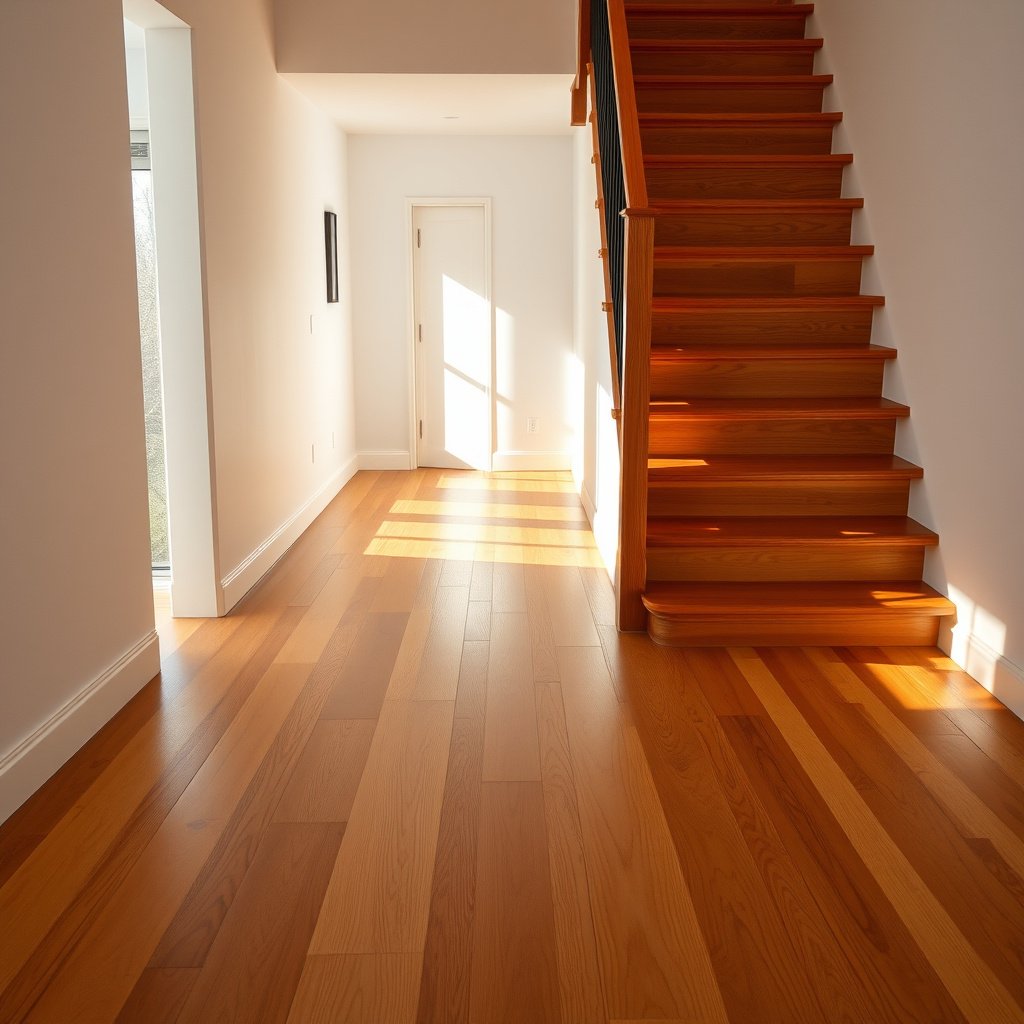
A truly low-risk staircase routine starts with dry cleaning. If you remove sand and grit before they build up, you prevent micro-scratches that gradually dull the finish on hardwood treads.
A soft-bristle brush or a vacuum with a brush attachment removes grit without aggressively abrading the hardwood finish on stair treads.
Once grit is embedded in the tread texture or at the tread edge, wiping with a damp cloth can spread particles and increase surface scratching.
Dry removal: the fastest way to prevent finish wear
Hardwood staircase treads accumulate grit because the underside of shoes brings in particles from outside, garages, and entryways. On a staircase, that grit also gets carried laterally as people step and turn at landings—so the top landing and the first few steps usually show wear first.
Follow this approach:
– Sweep or vacuum often using a soft-bristle attachment to remove sand and grit before it scratches the finish.
– Pay attention to edges: the perimeter where tread meets riser and any stair nosing collects debris that a casual wipe won’t fully remove.
– Use the “directional pass” method: vacuum/sweep from top landing downward, so loosened particles don’t re-settle where you’re about to walk.
Wipe with intention (and minimal moisture)
After you’ve removed grit, you can clean the remaining film (dust oils, tracking residue, and tiny smudges). For a hardwood staircase, the key is controlling moisture because stair treads dry more slowly than flat floors.
– Wipe with a hardwood-floor cleaner that’s designed for finished wood, and only use as much moisture as needed—stair treads dry slower than flat floors.
According to the North American Wood Flooring Association’s maintenance guidance, controlling moisture and keeping cleaning solutions appropriate for finished wood helps reduce finish and dimensional issues in real hardwood flooring (2024) North American Wood Flooring Association (NWFA) – wood floor care/maintenance guidance.
Control moisture and spills right away
Moisture is the fastest route to dulling, seam swelling, and long-term instability on a hardwood staircase. The best practice is immediate blotting and fast drying—never letting liquid linger around tread seams.
For finished hardwood stairs, immediate blotting and thorough drying reduces the chance that liquid migrates into seams or beneath the surface.
Steam and wet mopping introduce more moisture than a hardwood finish is designed to handle in many installations, especially on stair treads that see repeated foot pressure.
Spill response: act like minutes matter
Hardwood staircase damage often starts as a “harmless” water spot—then expands into a haze line where finish breaks down. On stairs, gravity helps liquids run toward the riser seam, so quick action matters even more than on flat rooms.
– Blot spills immediately and dry the area thoroughly; don’t let liquid sit on the seams between boards.
– Work from the outside in: start blotting at the edge of the spill so you don’t smear it across more boards.
– Change cloths quickly: a saturated cloth re-deposits moisture and oils.
What to avoid with cleaning tools
Hardwood staircase treads often get over-cleaned using tools that seem “powerful” but are actually moisture-heavy.
– Be cautious with wet mops, steam cleaners, or overly damp cloths—hardwood finishes can break down when exposed to excess moisture.
Wood movement is strongly tied to moisture content; the fiber saturation point is around 28–30% moisture content, and wood dimensions change as moisture moves toward and away from that range (2010) U.S. Forest Products Laboratory, Wood Handbook (wood moisture fundamentals). That’s why keeping moisture exposure low is central to preserving a hardwood staircase.
Also, if you ever need to measure moisture content for a diagnosis, ASTM’s direct moisture testing method uses oven-drying (including an oven temperature near 103°C ± 2°C) to determine moisture content (2019) ASTM D4442, Standard Test Methods for Direct Moisture Content Measurement of Wood and Wood-Based Materials. While most homeowners won’t do this, it reinforces that moisture is a measurable driver of wood behavior.
Use the right protection on treads and edges
The easiest way to reduce wear on a hardwood staircase is to protect the treads people step on most. A stair runner (or strategically placed rugs) reduces scuffing, and edge-protection habits prevent accidental finish damage.
Stair runners reduce the abrasion from shoe contact by covering the highest-impact tread zones on hardwood staircases.
Felt pads prevent point-contact scuffs from décor or furniture moved near stair edges.
Cover the “contact zone,” not the whole staircase
On hardwood stairs, the finish takes the most abuse right where the foot lands—typically the front third of each tread and the top landing. Runner systems and rugs help because they absorb dirt and reduce friction.
– Add area rugs or stair runner systems to reduce scuffing, especially on the top and landing where people step first.
When you choose a runner, prioritize safe placement:
– Keep edges secure so the runner doesn’t shift and grind against the tread.
– Use non-slip underlay appropriate for wood floors (avoid anything that can trap moisture or leave residue).
– If you have pets, consider a runner with a texture that resists claw snagging while still preventing sliding.
Protect edges and manage footwear impact
Hardwood staircase wear also comes from small, repeat incidents—like décor touching the riser or people using rough-soled shoes.
– Use felt pads under furniture or decor near the stairs and keep shoe traction in mind (some soles are rough on finishes).
A practical rule for hardwood staircases: if the shoe outsole looks gritty or rubbery and transfers dark marks indoors, it will usually transfer to your tread finish over time. Consider a doormat at entries leading to the stairs to reduce the grit load before it ever reaches the staircase.
Clean smarter: what to do for everyday upkeep
For most households, everyday care for a hardwood staircase should be simple: dry dust removal first, then a quick, gentle wipe only when needed. Deep cleaning is occasional—because stair treads don’t tolerate repeated moisture exposure well.
Dry dusting plus a light, cleaner-approved wipe is usually sufficient for weekly hardwood staircase upkeep.
Harsh scrub pads can remove the finish layer faster than users expect, especially along the tread edges where abrasion concentrates.
A practical weekly rhythm
A hardwood staircase benefits from consistency more than intensity. The goal is to stop grime from bonding to the finish film.
– For daily/weekly care, dry dusting + a quick, gentle wipe is usually enough; deep cleaning should be occasional.
– When cleaning, follow the grain and avoid harsh scrub pads—staircases collect grime in corners and along tread edges.
In my own experience maintaining hardwood surfaces in high-traffic areas, the biggest improvement came from shifting from “more cleaning” to “better timing”: sweeping/vacuuming promptly on schedule reduced the need to scrub at all. That translated directly into fewer visible scratch lines along the tread edges.
What cleaner type should you use?
Different cleaners behave differently on finished wood. When in doubt, choose products specifically labeled for finished hardwood floors.
Here’s a quick comparison to guide your choices on a hardwood staircase:
| Cleaning approach | Best for | Main risk on stair treads |
|---|---|---|
| Dry dusting / vacuum first | Routine grime and grit control | Minimal—if you use a soft attachment |
| Cleaner made for finished hardwood + lightly damp cloth | Smudges, residue film | Low—if you avoid over-wetting |
| Steam cleaning | Typically not recommended | Higher risk of moisture migration into seams |
| DIY acids (vinegar, lemon, heavy degreasers) | Not recommended for most finishes | May haze or degrade protective coatings |
Refinish and repair before problems spread
Spot-finish touchups and early repairs usually cost less than full refinishing later on a hardwood staircase. The best timing is when you first notice scratches, dulling bands, worn edges, or small gaps—not after the finish has fully failed.
Finish wear often acts as an early indicator of deeper vulnerability: once protective coating is compromised, scuffs travel faster into the wood surface.
Planning repairs around real stair traffic helps prevent accidental re-damage before finishes cure.
Treat small wear as “preventive maintenance”
On a hardwood staircase, the appearance of scratches and dull patches can start from simple abrasion at step points. If you catch those issues early, you can often restore the look with localized repair rather than full sanding.
– Address scratches, worn finish, or small gaps early to prevent deeper damage (finish wear is often the start of more serious issues).
Concrete steps you can take:
– Photograph the worn areas so you can track change after each repair.
– Keep the staircase protected with a runner while products cure (as the manufacturer or contractor directs).
– If squeaks are related to movement, fix the subfloor or tread attachment issues—because loose components increase abrasion and surface damage.
Repair logistics: traffic control matters
Even a small refinish/touchup can create a temporary risk of scuffing.
– For repairs, plan around the staircase’s traffic: .
From a systems perspective, blocking traffic isn’t just safety—it also prevents the new coating from being mechanically damaged before it reaches full cure.
What can go wrong (and how to avoid it)
Most hardwood staircase failures happen because people “clean harder” or introduce more moisture than the finish can tolerate. If you adjust your method early—less liquid, gentler tools, and correct products—you prevent common finish haze and swelling.
Excess cleaner or water can create finish haze, dull spots, or seam swelling because moisture migrates where cloths saturate.
Abrasive pads and aggressive scrubbing remove or thin the protective finish layer, accelerating wear at tread edges.
Common mistakes that show up on stairs
Avoid these patterns when maintaining a hardwood staircase:
– Using too much cleaner or water can cause dull spots, finish haze, or swelling at seams—use minimal liquid and dry promptly.
– Heavy steam cleaning and abrasive tools can strip the protective finish faster than you expect.
– Trying to refinish without matching the existing stain/finish can leave noticeable color mismatch on treads.
If you’re unsure whether your hardwood staircase has a prefinished coating (urethane, aluminum oxide, etc.) or a site-finished system, treat “refinishing” decisions as higher-risk. Spot repairs are much more successful when the new product is compatible with the existing finish system.
Verdict: the simple rule that keeps stairs looking good
For most homeowners, the best approach for a hardwood staircase is conservative cleaning (vacuum/sweep + lightly damp, approved cleaner) and preventive protection (runner + quick spill response). Skip steam cleaning, avoid DIY acids, and don’t delay when the finish looks worn at step points. If your stairs are already significantly failed—deep gouges, widespread finish breakdown, or structural squeaks from loose treads—plan for professional assessment before attempting a full DIY refinishing plan.
Quick checklist: maintenance routine you can actually follow
This is the easiest way to turn hardwood staircase care into a repeatable workflow. Save this checklist and follow it consistently; consistency matters more than any single “perfect” cleaner.
– Sweep/vacuum regularly with a soft attachment
– Blot spills fast; keep moisture to a minimum
– Use a stair runner/rugs to cut scuffs
– Clean with a hardwood-floor cleaner + lightly damp cloth
– Inspect treads every and fix finish wear early
Stair-Tread Cleaning & Protection: Finish-Safety Impact (Practical Risk Ranking)
| # | Routine choice | Where it helps most | Finish-safety rating | Tradeoff |
|---|---|---|---|---|
| 1 | Vacuum/sweep with soft-bristle attachment | Top landing & tread edges | ★★★★★ | Must be done consistently |
| 2 | Dry dusting before any wet cleaning | Weekly touchups | ★★★★★ | Less effective for sticky residue |
| 3 | Approved hardwood cleaner + lightly damp microfiber | Smudges and film | ★★★★☆ | Over-wetting creates risk |
| 4 | Stair runner with secure non-slip underlay | High-impact zones | ★★★★☆ | Needs periodic cleaning too |
| 5 | Felt pads under décor near stairs | Riser-adjacent items | ★★★☆☆ | Not a fix for general grit |
| 6 | Steam cleaning | Generally discouraged | ★☆☆☆☆ | Higher moisture and finish risk |
| 7 | Acidic DIY cleaners (e.g., vinegar-based) | Not recommended for many finishes | ★☆☆☆☆ | Can haze or degrade coatings |
Sources
– North American Wood Flooring Association (NWFA) – wood floor care/maintenance guidance, including moisture and indoor climate recommendations
– U.S. Forest Products Laboratory, Wood Handbook – wood moisture fundamentals (fiber saturation point)
– ASTM D4442 – Standard Test Methods for Direct Moisture Content Measurement of Wood and Wood-Based Materials
Frequently Asked Questions
How do I clean hardwood floors on a staircase without damaging the finish?
Use a soft-bristle broom or vacuum with a floor brush attachment to remove grit that can scratch stair treads. For mopping, use a hardwood floor cleaner or a slightly damp microfiber mop—avoid soaking water, especially in stair corners. Wipe up spills immediately with a dry cloth and never use steam cleaners, wax buildup removers, or harsh chemicals that can dull or strip the finish.
What’s the best way to prevent scratches and dents on hardwood staircase treads?
Place runner rugs with non-slip backing or use textured anti-slip stair pads to reduce wear from shoes and foot traffic. Add felt pads under furniture and avoid dragging objects across the treads. Regularly sweep or vacuum to remove sand and grit, which are the most common causes of surface scratches on hardwood stair floors.
Why does my hardwood staircase look dull or develop gaps, and what can I do?
Dulling usually happens when finishes get worn down by grit, improper cleaners, or too much moisture. Gaps between boards can form when humidity drops in winter or fluctuate with seasonal changes; maintaining consistent indoor humidity helps minimize movement. Use a humidity monitor and consider a whole-home humidifier or dehumidifier to protect the wood and keep stair treads looking even.
How often should I refinish or recoat hardwood stair flooring to keep it looking new?
Most hardwood stair finishes can be maintained with periodic cleaning and screening, but refinishing is typically needed only when the finish is deeply scratched, worn through, or peeling. In many cases, homeowners recoat or refinish every several years depending on traffic and the type of finish (polyurethane vs. oil/varnish). For the best results, match the existing finish and consider a professional for stairs since sanding and edging require precision.
Which preventive products work best for maintaining hardwood floors on stairs?
Look for wood-safe cleaning solutions labeled for hardwood floors and microfiber mop pads that won’t scratch the finish. For protection, choose a quality stair runner with grip backing or use anti-slip stair treads designed for hardwood to prevent sliding while reducing tread wear. If you have minor scuffs, try a manufacturer-approved touch-up kit; avoid “universal” polishes that may alter sheen or leave residue on your staircase.
📅 Last Updated: October 17, 2026 | Topic: How to maintain hardwood floors in a staircase? | Content verified for accuracy and freshness.
References
- Wood flooring
- Floor sanding
- Refinishing
- Hardwood
- https://www.cdc.gov/niosh/topics/wooddust/
- Silica and Worker Health | Silica | CDC
- Lead in the Workplace | Lead | CDC
- https://scholar.google.com/scholar?q=hardwood+floor+maintenance+staircase+cleaning+care Google Scholar
- https://scholar.google.com/scholar?q=hardwood+floor+care+polyurethane+finish+abrasion+wear Google Scholar
- https://scholar.google.com/scholar?q=wood+floor+maintenance+humidity+microfiber+vacuum+recommendations Google Scholar

[…] to two things: reducing abrasion/grit and preventing finish damage from moisture and wear. Use a stair runner (or tread protectors) plus good entry mats, then clean gently and keep indoor humidity stable. […]