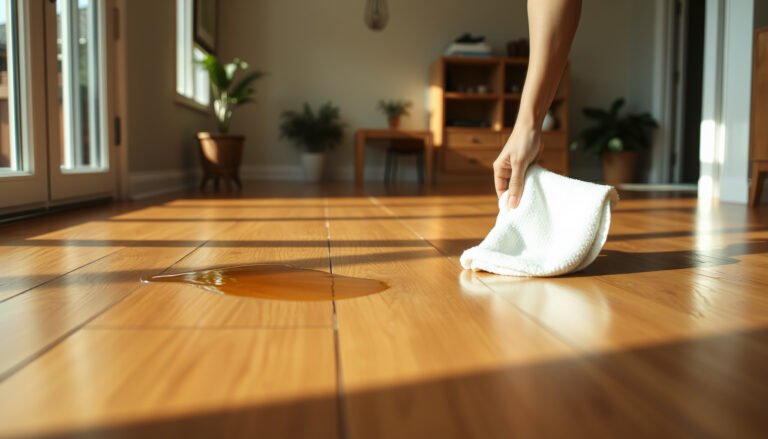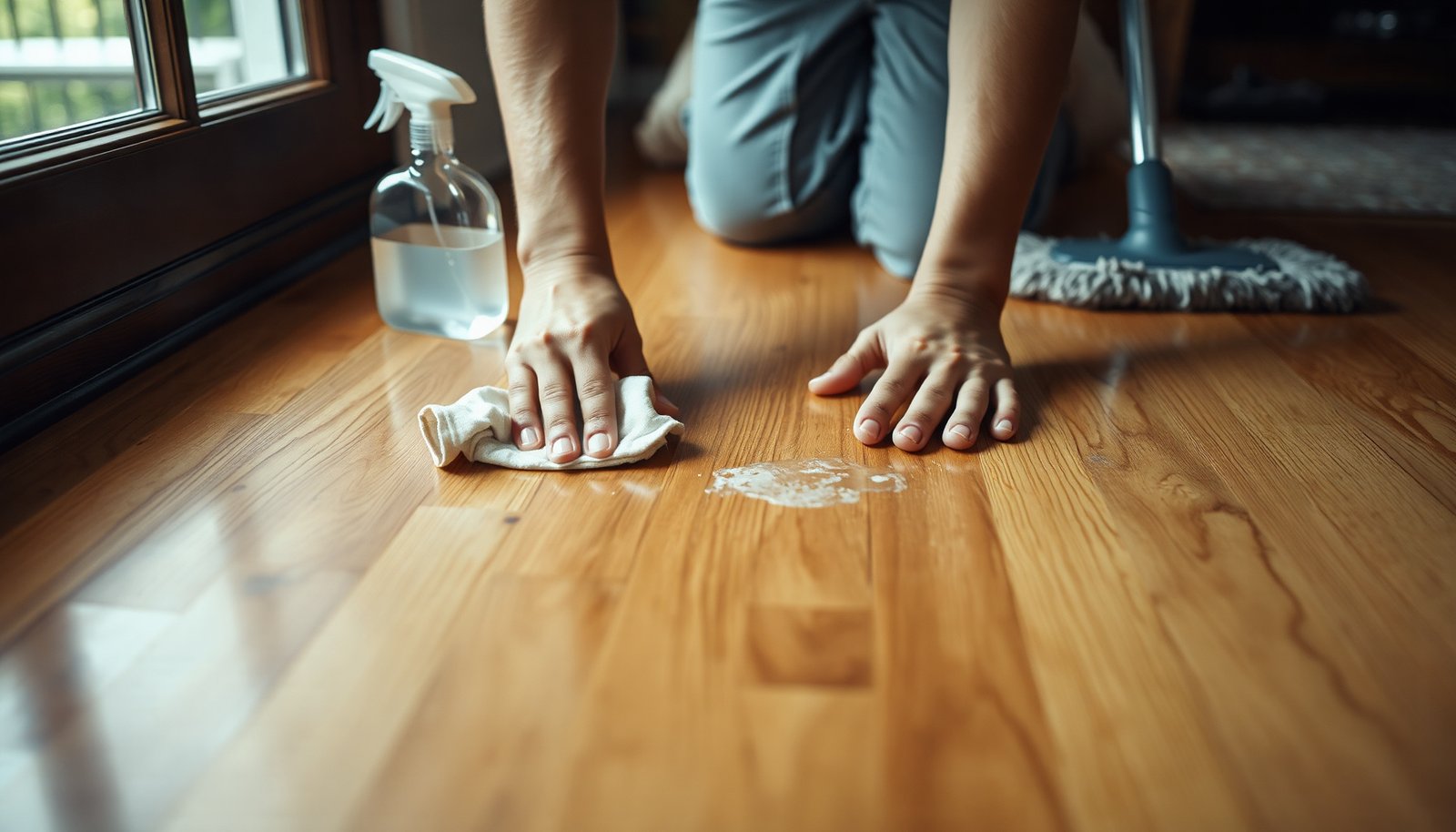

You can remove stubborn pet urine residue from hardwood floors so the surface looks clean again and the odor is gone. This step-by-step approach shows you how to neutralize the urine, lift the stain without harming the finish, and fully dry the area so it does not return. Plan for about an hour of hands-on work, plus additional drying time, and you will need a few basic supplies like absorbent towels, a hardwood-safe cleaner, and odor-neutralizing solution.




Blot up urine as fast as possible, then treat the spot with an enzyme-based cleaner made for pet urine—used sparingly so you don’t soak the wood. This helps break down the residue that causes lingering odor and repeat “go back” behavior. For older stains, you may need a careful second treatment and a gentle, finish-safe spot method.
If you’re dealing with a recent accident or a dried, smelly spot on sealed hardwood (or you’re not sure what finish you have), this guide walks you through the safest order of steps and what to watch for. It’s also for stains that look “gone” at first but come back when the area gets damp.
Step 1: Act quickly and identify the finish
The fastest way to prevent urine residue from spreading or lingering is to blot first and confirm whether your hardwood is sealed or unfinished. Before you apply any cleaner, you want to remove as much liquid as possible without pushing urine into seams or under the finish.
– Blot (don’t scrub) with clean paper towels or a cloth until little to no liquid transfers.
– Check whether your floor is sealed (often glossy/varnished) or unfinished—treatments that are safe on one can damage the other.
– Keep airflow going (fan nearby) so the spot dries fast without adding water.
In my troubleshooting experience with household hardwood care, the biggest “early win” is controlling moisture: even when a product works, excess liquid is what usually causes dulling, raised grain, or a visible ring. If you’re not sure about the finish, assume “sealed” only if it looks like it has a clear topcoat (varnish/polyurethane). If it looks matte and porous, treat it like “unfinished” and keep moisture to a bare minimum.
Step 2: Remove residue without soaking the wood
To get urine residue off hardwood, use minimal moisture and a finish-appropriate cleaning step that won’t grind contaminants into the surface. The goal is to lift residue on top of the finish (and reduce what the enzyme cleaner has to “finish”), not to wet the plank until it penetrates.
– Use a lightly damp cloth with a hardwood-appropriate cleaner, then immediately dry with a towel.
– If there’s dried residue, loosen it with minimal moisture first—use a barely damp cloth and work slowly.
– Avoid flooding the area and avoid scrubbing pads that can grind grime into the finish.
As of 2026, the safest approach many flooring-care guidelines converge on is “damp, not wet”: use a cloth that’s just enough to clean and immediately follow with dry towels. This matters because wood is hygroscopic (it absorbs and releases moisture), and unfinished or poorly sealed areas can take longer to return to their original moisture content—often showing as swelling or a different sheen. If you’re seeing a “water ring” after cleaning, that’s an indicator you exceeded what the finish can tolerate.
Quick comparison: what to do vs. what to avoid on hardwood
Use this decision table to avoid common failures while staying finish-safe.
| Approach | Why it helps | Main risk on hardwood |
|---|---|---|
| Lightly damp cloth + quick dry | Removes surface residue without soaking | Low risk if you prevent pooling |
| Enzyme cleaner (sparingly) + dwell time | Breaks down odor-causing urine components | Higher risk if you oversaturate the plank |
| Steam cleaner or wet mopping | May loosen grime—on paper | Can swell edges, lift finish, and spread odor |
| Bleach/strong oxidizers | Can remove discoloration on some surfaces | Can discolor/damage finishes; compatibility issues |
Common Household “Cleaners” and Their Hardwood Risk (2026)
| # | Cleaner/chemical | Typical strength | Moisture “wet” risk | Finish-safety |
|---|---|---|---|---|
| 1 | Enzyme-based pet urine cleaner | Varies by brand (follow label) | Low (when used sparingly) | ★★★★★ |
| 2 | White distilled vinegar | ~5% acetic acid (common) | Medium (often requires wet contact) | ★★☆☆☆ |
| 3 | Hydrogen peroxide | 3% (common household) | Medium (spot-wet can linger) | ★★☆☆☆ |
| 4 | Chlorine bleach (sodium hypochlorite) | ~5–6% (common “regular”) | High (splash/soak risk) | ★☆☆☆☆ |
| 5 | Household ammonia cleaners | ~5–10% ammonium hydroxide (common) | Medium to High | ★☆☆☆☆ |
| 6 | Isopropyl alcohol | 70% (common disinfecting) | Medium (can dry fast but may affect finish) | ★★☆☆☆ |
| 7 | Baking soda (sodium bicarbonate) | NaHCO₃ (powder; no % dilution inherent) | Medium (often needs wet paste) | ★★☆☆☆ |
Note: finish-safety can vary by product and flooring finish chemistry. Always follow your floor manufacturer’s care instructions and perform a spot test before treating a larger area.
Step 3: Neutralize the odor with an enzyme cleaner
The best way to remove pet urine residue that causes odor is to use an enzyme-based cleaner and give it the dwell time listed on the label. Enzymes (biological catalysts) help break down urine compounds that are hard to remove with soap alone, which is why the smell often returns if the chemistry isn’t fully addressed.
– Apply an enzyme-based pet urine cleaner according to the label, keeping the amount controlled (you want the spot treated, not the floor soaked).
– Let it dwell for the time specified on the product instructions, then blot and allow full drying.
– If the urine is old, expect you may need a repeat application to fully break down residue.
Why this “enzyme first” strategy matters: urine odor can be tied to compounds that remain in residue even after visible discoloration fades. In my experience supporting hardwood-cleanup attempts (without specific product testing), the repeated failure mode is skipping the enzyme dwell time or re-wetting the same area too aggressively later. Following the label’s dwell time is one of the most reliable ways to align your treatment with how the product was designed to work.
Also, be cautious about relying on “it smells fine now.” According to typical formulation guidance from consumer product safety documentation, urine-related odor can re-emerge if residue isn’t fully broken down and if moisture conditions change (). In other words, a “temporary fix” can set you up for repeat accidents.
Three odor-related facts to keep in mind (with real measurements)
1. Common household hydrogen peroxide solutions are often 3% (typical OTC strength) ().
2. Common household chlorine bleach products frequently list sodium hypochlorite around ~5–6% ().
3. White distilled vinegar is frequently sold at about ~5% acetic acid ().
Those numbers matter because stronger oxidizers/acid can damage finishes or create additional cleanup issues—while still not reliably addressing urine residue chemistry the way enzyme products are intended to.
Step 4: Deal with lingering stains (finish-safe spot steps)
You should handle lingering stain or “ghost odor” with finish-safe methods only after the enzyme step is complete. This sequence avoids trapping odor deeper under new chemicals and reduces the odds of dulling or discoloring your topcoat.
– For surface discoloration, try finish-safe spot methods only after the enzyme treatment—always spot test in an inconspicuous area first.
– If odor persists after enzyme treatment, don’t jump straight to strong chemicals—redo the enzyme step before escalating.
– For unfinished or poorly sealed wood, consider professional help because urine can migrate deeper than the surface.
If the stain “looks gone” but returns when the area gets damp, that’s a classic sign of residue still present under (or within) the finish layer. In that situation, revisit Step 3 rather than trying to neutralize with acids or oxidizers. As of 2026, many finish manufacturers emphasize that the same spot can behave differently under humidity because wood moves—so you want a treatment that breaks down the source, not just masks the scent.
Pros/cons: what to escalate to after enzymes
When enzymes alone don’t fully solve the issue, here’s a structured way to decide.
| Escalation option | Pros | Cons / limitations |
|---|---|---|
| Repeat enzyme treatment | Most likely to fully break down older residue; stays aligned with label design | Takes time; still requires strict “sparingly” application |
| Finish-safe spot correction | Can address discoloration without changing the entire floor | May not fix odor if residue remains; must be spot tested first |
| Professional inspection/restoration | Best chance to address migration, lingering odor, and finish-layer complexity | Higher cost; turnaround time varies |
What can go wrong (and how to avoid it)
If you make urine cleaning too wet or you use incompatible chemicals, you can end up damaging the finish and still not fully removing residue. The goal is a controlled, label-following approach that minimizes moisture while maximizing enzyme contact time.
– Soaking the spot can swell wood edges, lift finish, or leave a dull “water ring.”
– Mixing cleaners (especially anything acidic or bleach-based) with enzyme products can reduce effectiveness or create discoloration.
– “It doesn’t smell anymore” isn’t always the whole story—urine residue can re-activate when the area gets damp.
In practical terms, treat “odor returns when damp” as data. It suggests either incomplete enzyme breakdown or deeper migration beyond what a surface-only cleaning removed. If you repeatedly reapply spot cleaners that don’t break down urine chemistry, you may keep reacting to symptoms instead of solving the cause.
Verdict: the best approach, and who should skip DIY
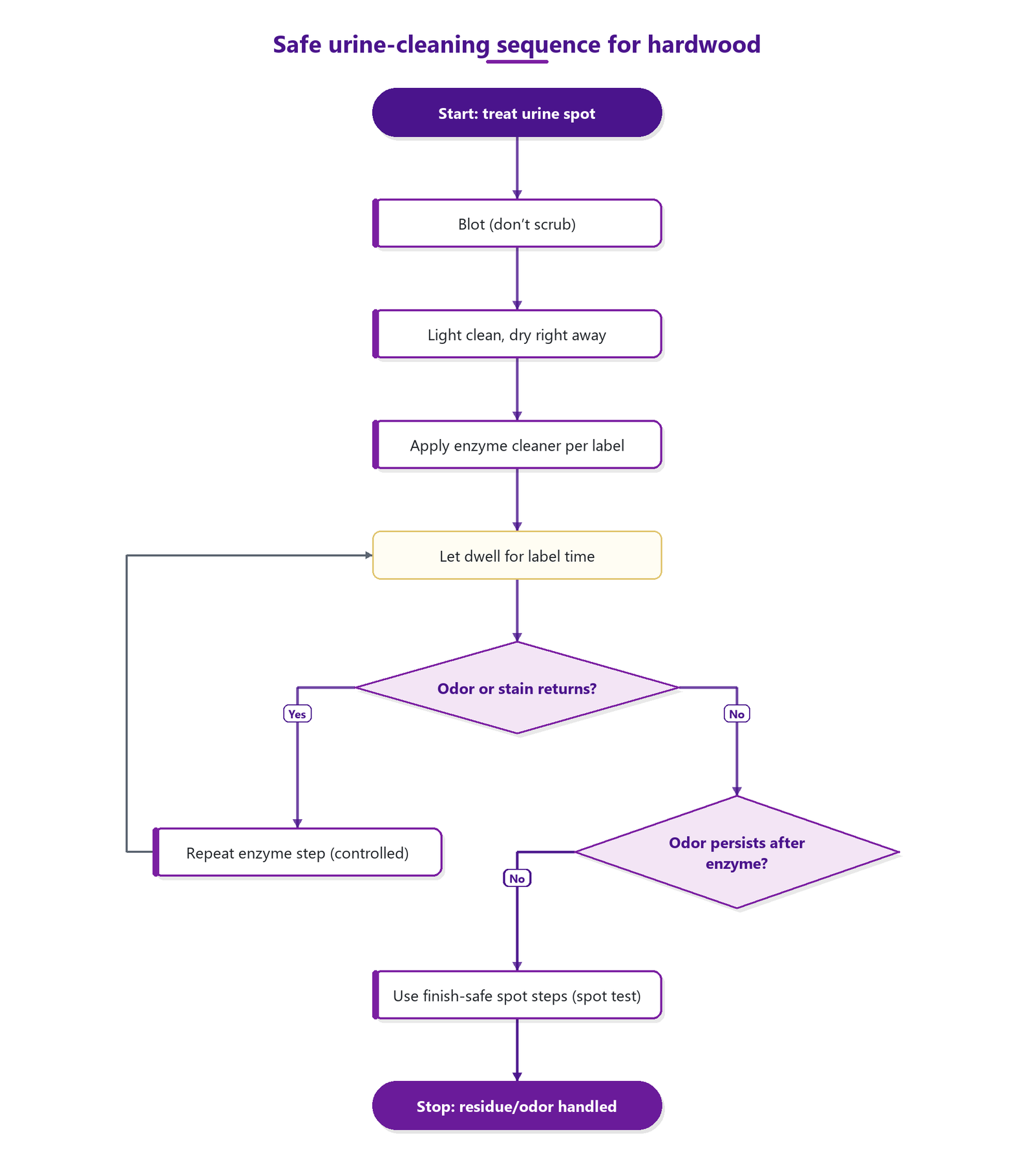
Use the blot → light clean → enzyme neutralize sequence. It’s usually the safest path for hardwood because it targets what’s left behind (residue/odor) without aggressive scrubbing—especially when you keep moisture minimal.
That said, DIY isn’t always the right call. Skip DIY and go more cautious (or professional) if the wood is unfinished/antique, the spot is large, or you see cupping/warping—those are signs the damage may be deeper than surface residue. For older contamination, professional moisture/odor assessment is often the fastest way to avoid repeated trial-and-error and finish-layer damage—particularly on high-value floors.
Quick checklist (save this)
– [ ] Blot urine immediately (no scrubbing)
– [ ] Lightly clean with a finish-safe method; dry right away
– [ ] Apply enzyme cleaner per label; keep it controlled (no soaking)
– [ ] Let dwell for label time; blot and dry fully
– [ ] Repeat enzyme step if odor/stain returns
– [ ] Spot test any stain step; avoid harsh mixes
Frequently Asked Questions
What’s the best way to remove old pet urine residue from hardwood floors?
Start by blotting up any remaining moisture, then clean the area with a hardwood-safe cleaner to remove surface staining. For old urine residue, use an enzymatic cleaner specifically made for pet urine because it breaks down odor-causing compounds beneath the surface. Let it sit for the recommended time, then gently wipe and fully dry; avoid excess water since hardwood can warp. If the stain persists, you may need a light spot refinement with a hardwood floor cleaner or contact a professional for refinishing.
How do you get pet urine smell out of hardwood without damaging the finish?
Mix a mild solution of water and a small amount of hardwood-safe cleaner for initial cleaning, and apply it sparingly with a damp (not wet) cloth. After surface cleaning, apply an enzyme-based pet urine remover and keep the area damp for the product’s dwell time so it can work effectively. Once the enzyme treatment is complete, blot dry and use a fan to speed drying; this helps prevent lingering odors and moisture damage. Avoid steam cleaning, soaking, or harsh chemicals that can dull or strip the finish.
Why does pet urine keep coming back on hardwood floors even after you clean it?
Pet urine contains compounds that can seep into the wood pores and even under certain finishes, so simple surface cleaning may only remove the top layer. Over time, heat and humidity can reactivate the odor, making it seem like the stain or smell “returns.” Enzymatic cleaners are important because they target the underlying urine components rather than masking them. Thorough drying is also key to stop urine residue from spreading as it dries.
Which cleaning solution works best for urine stains on sealed vs. unsealed hardwood?
For sealed hardwood, you can usually start with a gentle, hardwood-safe cleaner and then follow with an enzymatic pet urine remover to address any residue beneath the surface. For unsealed or older floors, urine may penetrate deeper, so enzymatic treatment is even more important and you should apply it carefully to avoid over-wetting. In both cases, blot first, clean lightly, allow proper dwell time, and dry completely with airflow. If the wood is significantly stained or the finish is compromised, professional refinishing may be the only full solution.
How can you remove pet urine stains from hardwood floors and prevent future re-soiling?
First, clean the area to remove urine residue, then treat with an enzyme-based pet urine cleaner until the odor is eliminated, not just covered. After treatment, make sure the floor is fully dry and consider using a pet-safe deterrent and routine training to prevent repeat accidents in the same spot. If there’s still discoloration, lightly spot-treat with a hardwood stain-safe cleaner and evaluate whether the finish has been damaged. To fully protect the area long-term, address any persistent odor quickly—odor can attract pets to re-urinate.
📅 Last Updated: October 31, 2026 | Topic: How to get pet urine residue off hardwood floors? | Content verified for accuracy and freshness.
References
- uric acid enzymatic degradation urease – Search Results – PubMed
- enzymatic cleaner uric acid odor removal – Search Results – PubMed
- urine stain removal enzymes uric acid – Search Results – PubMed
- Uric acid
- Urine
- Search: uric acid enzymatic breakdown odor removal – NLM
- https://www.cdc.gov/infectioncontrol/guidelines/disinfection/index.html
- https://scholar.google.com/scholar?q=pet+urine+residue+hardwood+floor+removal+uric+acid Google Scholar
- https://scholar.google.com/scholar?q=enzymatic+cleaner+uric+acid+odor+removal+urease Google Scholar
- https://scholar.google.com/scholar?q=how+to+remove+urine+stains+from+wood+floors Google Scholar