You can remove tea stains from engineered wood floors so the finish looks even again, without damaging the top layer. This process typically takes 20–40 minutes, and it is manageable if you have the right supplies: a soft cloth, mild cleaner, and a few careful cleaning steps tailored to engineered wood. Follow along to lift the stain, stop it from spreading, and finish with a clean, protective wipe that keeps your floor looking its best.




Blot the tea immediately, then clean with a barely-damp cloth using a drop of mild dish soap; if the ring doesn’t lift, treat the spot with a peroxide/oxygen-style cleaner applied to a cloth (not as a wet soak) and dry thoroughly to protect the engineered wood finish. Tea staining on engineered wood floors usually comes from water-soluble tannins that can oxidize into a brown ring—so your goal is to lift the residue fast while keeping moisture off the seams and edges.
If your engineered wood has a clear finish (polyurethane, aluminum-oxide, etc.), you can often remove tea discoloration without damaging the floor—as long as you avoid soaking and patch-test any spot treatment first. If the stain is older, the process becomes more targeted, but the core principles stay the same: lift gently, keep it dry, and prevent cleaners from pooling.
This guide is for homeowners, property managers, and facility teams maintaining engineered wood floors in real, high-traffic environments where spills happen. It’s written to help you choose the least risky cleaning method first and escalate only if the tea ring remains.
Before you start: protect the engineered wood finish

The safest way to remove tea stains from engineered wood floors is to reduce risk before you introduce any liquid. Engineered wood is dimensionally stable compared to solid hardwood, but liquid can still travel through seams, around edges, or under finish micro-defects—so preparation matters as much as the cleaner you choose.
– Check what’s safe for your floor: follow your floor manufacturer’s cleaning guidance first (especially anything about peroxide/bleach). If you’re unsure, look up your exact brand/model or use .
– Patch-test every treatment: apply your cleaner to a hidden area (like inside a closet) and wait until it fully dries before continuing.
– Prep for minimal moisture: grab microfiber cloths, a soft sponge, and a fan or dry towels—engineered wood can swell if liquid sits on top seams.
Why tea stains behave differently on engineered wood
Tea leaves behind more than color—brewed tea is mostly water, but the staining chemistry stays behind when the water evaporates. According to USDA FoodData Central, one cup of brewed black tea is about 99% water (USDA FoodData Central, brewed black tea nutrition data), so the spill looks like it “dries fast”… yet tannins and oxidized polyphenols can remain concentrated at the perimeter of the spill, forming a ring.
Wood movement is also moisture-dependent. According to the USDA Forest Service Forest Products Laboratory (Wood Handbook), dimensional changes generally become much more likely as wood moisture content rises above roughly the fiber saturation range (~28–30%) (USDA Forest Service, Wood Handbook—Wood as an Engineering Material). You usually won’t reach that level from a quick wipe, but pooled liquid on engineered wood floors can increase localized moisture long enough to cause visible swelling or edge lifting.
Tea Stain Contributors: Key Compounds and Molecular Mass
| # | Tea compound (common name) | Chemical formula | Molar mass (g/mol) | Stain relevance |
|---|---|---|---|---|
| 1 | Caffeine | C8H10N4O2 | 194.19 | Low |
| 2 | Gallic acid | C7H6O5 | 170.12 | Moderate |
| 3 | Chlorogenic acid | C16H18O9 | 354.31 | Moderate |
| 4 | Catechin | C15H14O6 | 290.27 | High |
| 5 | Epicatechin | C15H14O6 | 290.27 | High |
| 6 | Epigallocatechin | C15H14O7 | 306.32 | High |
| 7 | EGCG (epigallocatechin gallate) | C22H18O11 | 458.37 | Very high |
Step-by-step: lift fresh or surface tea stains
For fresh tea spills, the fastest win on engineered wood floors is to blot immediately and then clean with barely-damp, finish-safe soap cleaning. This approach removes tea tannins before they oxidize into that darker outer ring.
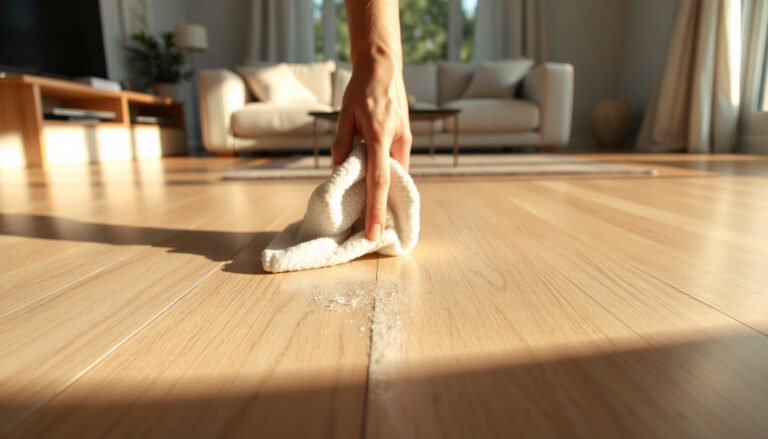
– Blot, don’t rub: use a clean dry cloth or paper towel to absorb as much tea as possible right away; rubbing spreads tannins.
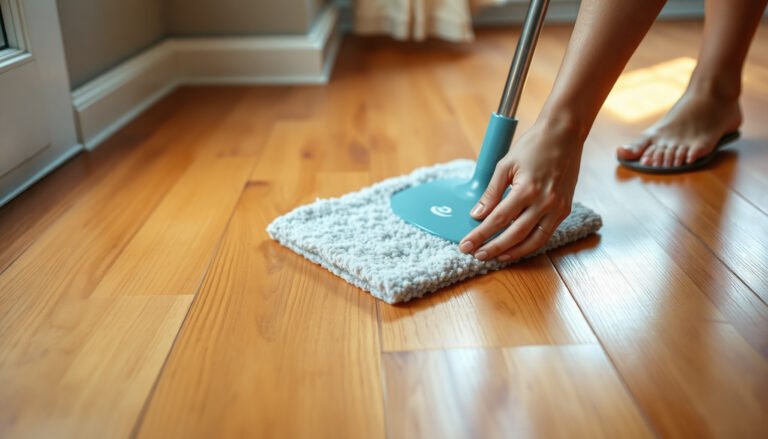
– Use mild soap + barely-damp cloth: mix a drop of mild dish soap into water, wring the cloth until it’s only lightly damp, then wipe in the direction of the grain.
– Dry immediately and fully: follow with a dry microfiber cloth; leave the area dry before walking on it.
Here’s the practical logic: dish soap helps lift oily residue and helps break down tea’s surface film, while low moisture reduces the risk of engineered wood swelling at seams. If you’re managing engineered wood floors for a workplace, set a quick-response routine (gloves, cloths, fan, and a labeled spray bottle of the mild-soap mix) so responders don’t improvise with extra liquid.
If the tea stain is set in: peroxide/oxygen spot treatment
When a tea ring is old, you need an oxidizing cleaner—used sparingly—to lighten the pigment trapped on or near the finish layer. The key is “on the cloth, not on the floor,” because engineered wood floors fail when liquid is allowed to pool.
– Use peroxide carefully (on the cloth): dampen a cloth with 3% hydrogen peroxide (or an oxygen-based cleaner formulated for stains), then lay it on the tea ring—don’t flood the floor.
– Why 3%: According to the CDC, 3% hydrogen peroxide is the common concentration used for wound cleaning (CDC guidance on hydrogen peroxide concentration), which is also why it’s widely used for household stain and odor tasks.
– Let it work briefly, covered: cover the cloth with light plastic wrap to prevent it from drying out too fast, then leave for a short time (start small—).
– Wipe, rinse lightly, and dry: remove the cloth, wipe with a clean cloth slightly dampened with plain water, then dry completely.
This is the “finish-aware” escalation path. Engineered wood floors often have a clear topcoat that resists normal household cleaners, but oxidizers can still react with certain finish chemistries—especially if left too long. That’s why patch-testing is non-negotiable.
Tough rings or cloudy spots: remove residue, then restore the look
If the stain is gone but the area looks cloudy, residue and finish interaction are usually the remaining issues on engineered wood floors. Your objective shifts from “bleaching pigment” to “removing film” and blending sheen.
– Treat residue (tea can leave sticky film): if the ring feels tacky, gently re-clean with the mild soap method first—this often improves the appearance even if the stain is deeper.
– Avoid harsh abrasives: don’t use scouring pads; they can burn through the finish and make the spot more noticeable.
– Finish with an approved polish/touch-up only: use the product your flooring recommends (or a finish-safe routine you already use) to blend sheen after the area is dry.
If you’re working in a managed property setting, keep a laminated “finish compatibility” note for your team. Some engineered wood floors have a UV-cured finish, others use aluminum-oxide systems, and others are hand-finished—so the approved touch-up product matters for consistency.
| Method | Best for | Pros | Cons / risk | Skip if… |
|---|---|---|---|---|
| Mild dish soap + barely-damp cloth | Fresh spills and light rings | Low risk to engineered wood finish; easy to control moisture | May not lift old oxidation | You’ve confirmed the tea ring is set and remains visible after drying |
| Peroxide/oxygen on a cloth | Set-in discoloration | More effective pigment-lightening than soap alone | Can lighten or cloud some finishes if overdwell occurs | The manufacturer warns against peroxide/oxidizers |
| Abrasive pads | None (generally) | — | Can permanently dull engineered wood finish | You want a blended appearance |
What can go wrong (and when to stop)
The most common failure mode is too much moisture—either from soaking or from multiple wet passes that leave engineered wood floors damp too long. The second most common failure mode is finish reaction when peroxide/oxygen is left on too long.
– Over-wetting can damage engineered wood: pooled liquid can seep into seams, edges, or the top veneer, causing swelling or lifting—especially with older installs.
– Peroxide can lighten or cloud some finishes: if you see whitening halos, stop immediately and wipe away any remaining chemical with a clean damp cloth and dry.
– Scrubbing can permanently mark the surface: even if the stain fades, abrasion can dull the finish around it.
– Stop and reassess if the stain won’t budge: if it looks like the tea penetrated deeper than the finish, further DIY attempts may do more harm than good.
As of 2026, best practices for engineered wood maintenance still emphasize “damp cleaning only” and “no saturation,” because the top layer may protect against everyday dirt but can be vulnerable to repeated liquid exposure over time. If your floor has an active warranty, aggressive chemical treatment can also complicate coverage—so stop early and switch to manufacturer-approved methods when the stain won’t respond.
Verdict: what to try first, and who should skip
The best order of operations for engineered wood floors is: blot + mild soap first, then escalate to peroxide/oxygen only if the ring persists and only after patch-testing. This minimizes finish risk while still giving you an effective way to lighten set-in tea discoloration.
– Try this DIY order if your finish is intact: start with blotting + mild soap, then move to a peroxide/oxygen spot treatment only after patch-testing.
– Skip DIY (or get help) if: the area already has scratches/wear-through, the finish is peeling, the floor is brand-new with warranty restrictions, or the stain is in a high-risk spot like near expansion gaps where moisture can travel.
– The downside of aggressive stain removal: treatments can change sheen/color, so the “best” result may be partial stain lift plus better blending—not perfect invisibility.
If you’re responsible for engineered wood floors in a commercial environment, consider a flooring professional when multiple tea events have occurred over the same plank area—repeated cleaning attempts can create a visible patch even if the discoloration eventually fades.
Quick checklist: tea-stain removal on engineered wood
| Step | What to do | Goal | Don’t |
|---|---|---|---|
| 1 | Blot immediately | Stop the stain from spreading | Don’t rub |
| 2 | Mild dish soap + barely-damp cloth | Lift surface tannins/film | Don’t soak or pool water |
| 3 | Dry thoroughly | Prevent moisture damage | Don’t leave it damp |
| 4 | Peroxide/oxygen on a cloth (not poured) | Break down set-in staining | Don’t flood the spot |
| 5 | Short covered dwell + wipe | Let treatment work safely | Don’t overtime without label guidance |
| 6 | Light rinse wipe + dry | Remove leftover cleaner | Don’t scrub the finish |
| 7 | Blend with approved polish/touch-up | Restore consistent appearance | Don’t use unknown solvents |
FAQ:
– Can I use vinegar to remove tea stains from engineered wood? Vinegar is acidic and can affect finishes, so it’s safer to stick with your floor’s approved cleaner first. If you want to try it, patch-test in a hidden area.
– What if the tea stain is from a long time ago? Use the same gentle cleaning first, then move to a peroxide/oxygen spot treatment on a cloth with careful timing and patch-testing—older stains may need more than one careful attempt.
– Will steam cleaners work? Usually no—steam can force moisture into seams and damage the finish or layers.
– Can I sand the stain out? Typically you should avoid DIY sanding on engineered floors because you can reduce the finish protection and make the spot worse unless you know the floor’s wear layer thickness and finish system.
Tea stains on engineered wood floors usually lift with low-moisture cleaning first—then a cautious peroxide/oxygen spot treatment if the ring is set. Start gentle, keep all liquids off the floor except tiny amounts applied to a cloth, and dry immediately after each step; if the finish reacts poorly or the stain doesn’t respond, stop and switch to manufacturer-recommended methods or a flooring professional.
Frequently Asked Questions
What’s the fastest way to remove fresh tea stains from engineered wood floors?
Blot the tea immediately with a clean, dry cloth to absorb as much liquid as possible—don’t wipe, which can spread the stain. If a stain remains, dampen a microfiber cloth with warm water and a small amount of mild, pH-neutral wood cleaner, then gently wipe the area. Dry the spot right away with a dry towel to prevent moisture from seeping into the seams.
How do you clear set-in tea stains from engineered wood without damaging the finish?
First, clean the surface with a slightly damp microfiber cloth using a pH-neutral cleaner to remove residue. For stubborn discoloration, try a gentle approach: apply a small amount of wood-safe cleaner or a manufacturer-recommended spot treatment on the stain using a soft cloth, then wipe and dry. Avoid soaking or using harsh solvents, since engineered wood can be sensitive to water intrusion and finish damage.
Why does tea stain engineered wood, and how can you prevent it from recurring?
Tea contains tannins that can discolor wood finishes when liquid penetrates or sits on the surface long enough. Engineered wood is more stable than solid wood, but spills can still affect the top veneer and protective coating. Prevention is best achieved by wiping spills quickly, using floor protectors under cups, and placing a mat or tray under frequently used items like tea kettles.
Which cleaning products are safest for tea stains on engineered hardwood floors?
Choose a pH-neutral cleaner designed for engineered hardwood or sealed wood floors, and always test it in an inconspicuous area first. Mild dish soap diluted in water may work for some finishes, but keep it minimal and never flood the floor. Avoid abrasive pads, vinegar, ammonia, bleach, and steam cleaning unless your floor manufacturer explicitly approves them.
What’s the best method if tea left a dark ring on your engineered wood floor?
Start by cleaning the area with a lightly damp microfiber cloth and pH-neutral cleaner, then dry thoroughly. If the dark ring persists, use a gentle “spot-clean and dry” routine, applying cleaner to a cloth rather than directly to the floor and working slowly. If discoloration remains after safe cleaning, consult the manufacturer for approved stain-removal options—over-the-counter “wood stain removers” can damage the finish and may require refinishing.
📅 Last Updated: November 14, 2026 | Topic: How to clear tea stains from engineered wood floors? | Content verified for accuracy and freshness.
References
- Engineered wood
- Wood flooring
- Wood stain
- Wood finishing
- https://en.wikipedia.org/wiki/Water_stain
- Tannin
- Oxalic acid
- https://scholar.google.com/scholar?q=how+to+remove+tea+stains+from+wood+floors Google Scholar
- https://scholar.google.com/scholar?q=water+ring+stains+hardwood+floor+cleaning Google Scholar
- https://scholar.google.com/scholar?q=oxalic+acid+remove+tannin+stains+wood Google Scholar