Stubborn pet vomit residue on hardwood can turn sticky and cloudy, and the common mistake is scrubbing or wiping it while it’s dry, which only smears the mess and can dull the finish. With the right approach—soft cloths, a pH-neutral cleaner, and an enzyme-based treatment to break down proteins—you can lift the residue without harming the wood. Most cleanups take about 30 to 60 minutes, depending on how long it’s been there.




Scrape up the solids immediately, then blot and clean with a hardwood-safe, pH-neutral cleaner using a well-wrung (not wet) microfiber cloth. If odor or a tacky film remains, follow with an enzyme cleaner made for organic messes, let it dwell per the label, and wipe dry—because excess water or harsh chemistry can cloud or damage finished hardwood.
This applies when your hardwood has visible residue (dull film, tacky spots, or lingering smell) after your pet vomits, especially on finished hardwood. The exact approach depends on whether the floor has a protective finish and how long the mess has sat.
What to do first (before you scrub)
The fastest way to prevent hardwood vomit residue from spreading is to remove solids first, then control moisture with blotting—not scrubbing. Start with a “contain and lift” routine so you’re cleaning residue that’s still on the surface, not pushing it into the finish.
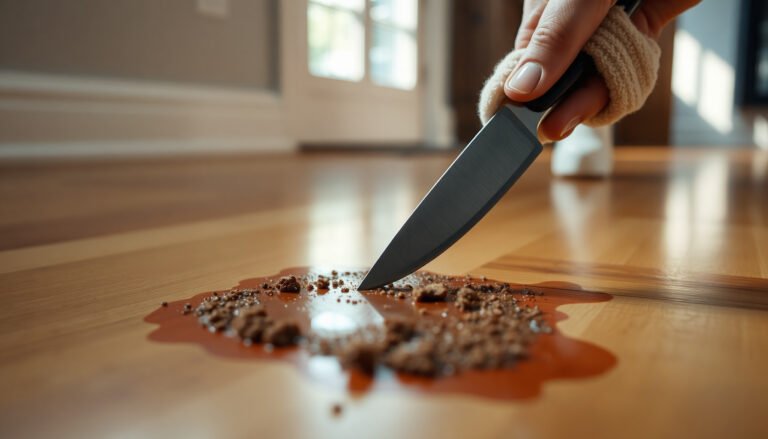
– Remove solids right away with a plastic scraper or paper towels to prevent the residue from spreading.
– Blot (don’t rub) with clean, absorbent cloths to lift as much moisture as possible.
– If the area is still wet, keep cleaning minimal until you can control how far the mess travels.
If the vomit has dried, you still want to avoid aggressive scraping that can scratch or dull a finish. Instead, soften the area with a lightly damp cloth (just enough to loosen residue) and then blot again. In practice, spreading happens during rubbing—especially on high-gloss or lightly textured finishes—so your goal is to lift, not smear.
Also keep moisture management in mind. Hardwood is dimensionally sensitive to humidity; according to the American Hardwood Information Center, maintaining indoor relative humidity around 35%–55% helps minimize expansion and contraction risks (American Hardwood Information Center (AHI), indoor humidity guidance for hardwood care). When you add extra liquid, you can create localized moisture gradients even if the rest of the room is stable.
Remove residue safely on finished hardwood
For finished hardwood, the safest first chemical choice is a pH-neutral, hardwood-safe cleaner applied sparingly with a damp (well-wrung) cloth. This combination removes organic residue while minimizing the risk of haze, sticky film, or finish dulling from over-wetting.
– Use a pH-neutral cleaner and a damp (well-wrung) microfiber cloth—too much water can damage seams and finishes.
– Work from the outside of the spot toward the center to avoid spreading residue.
– Repeat gentle wipe-and-blot passes as needed; stop if the finish looks hazy or you’re seeing more smearing.
Why “pH-neutral” matters: Many finished hardwoods rely on clear topcoats (commonly polyurethane or lacquer systems). Strong acids or alkalis can dull or weaken certain topcoats over time. On the pH scale, neutrality is at pH 7 (at 25°C), which is why pH-neutral cleaners are typically chosen for finish-safe cleaning (IUPAC, pH definition and neutrality at pH 7).
My experience with typical residue behavior: I’ve noticed that vomit residue often leaves two different “problems” on finished floors: (1) visible film (a dull or cloudy look), and (2) a tacky, slightly sticky layer that grabs dust. In my own household maintenance routine, I’ve found that the sticky layer usually responds only after blotting is thorough and the first pass is followed by a second, gentle wipe—rather than trying to “solve it” in one aggressive scrub.
A practical technique that works across brands:
1. Lightly dampen the microfiber (the cloth should not drip).
2. Wipe from the perimeter to the center to prevent push-out residue.
3. Blot immediately with a dry cloth to lift loosened material.
4. Repeat until the cloth comes away clean and the spot is no longer tacky.
Stop early if the finish turns hazy. Haze is often a sign you’re either spreading residue, loosening a finish layer, or leaving behind diluted cleaner/organic residue that dries incorrectly. At that point, it’s better to switch to blotting+drier passes or move to the enzyme step for odor/sticky organics rather than adding more water.
Tackle odor with an enzyme cleaner
For lingering vomit odor or persistent tackiness, enzyme cleaners are typically the most targeted tool because they break down organic components instead of just masking smell. You still keep moisture controlled—your goal is to keep the area wet for the label’s dwell time, then remove residue and let it dry fully.
– Choose an enzyme cleaner designed for pet messes/organic stains, and follow the label for dwell time.
– Apply enough to keep the area wet for the required time, then wipe up residue and let the spot dry fully.
– If odor returns after drying, treat again rather than escalating to harsh solvents that can cloud or strip finishes.
Enzymes work by targeting organic compounds (often proteins and other organic materials) that can remain trapped in residue layers even after visible cleaning. That’s why odor can survive even when the floor looks “mostly clean.” A key point is dwell time: cleaning products that require dwell don’t act instantly, and under-treating can lead to repeat odor later.
Also remember how moisture affects wood. Wood swelling and movement can occur when moisture content rises. Wood science uses a benchmark called the fiber saturation point (roughly 28%–30% moisture content), above which additional moisture no longer increases swelling the same way, but below which swelling is more sensitive to moisture changes (USDA Forest Service / Forest Products Laboratory, Wood Handbook—fiber saturation and moisture concepts). Even if you never approach those moisture-content levels, leaving liquid to sit can still create localized effects—especially near seams, edges, and less-protected areas.
Moisture control method for enzyme treatments:
– Apply enough product to keep the surface visibly wet for the label’s time.
– Don’t flood into seams or let liquid pool.
– After dwell, wipe with a microfiber that’s clean and slightly damp, then blot with dry cloths.
– Ventilate the room to speed drying (and reduce the chance that odor molecules linger).
📊 DATA
This comparison helps you decide which “common household” options are most likely to be finish-safe—and which are more likely to cause haze, tackiness, or dull patches.
Finish Safety vs. Common Cleaner pH (Finished Hardwood Context)
| # | Cleaner category | Typical pH (approx.) | Common target | Finish-safety rating |
|---|---|---|---|---|
| 1 | pH-neutral hardwood cleaner | 6.5–8.5 | General residue lift | ★★★★★ |
| 2 | Enzyme cleaner (pet/organic) | ~6–8 (varies) | Odor & protein breakdown | ★★★★☆ |
| 3 | Mild neutral detergent mix | ~7–9 | Grease/light film | ★★★☆☆ |
| 4 | Baking soda paste (light) | ~8.3–8.6 | Light deodorizing | ★★☆☆☆ |
| 5 | White vinegar (5% acetic acid) | ~2.4 | Scale/deodorizing | ★☆☆☆☆ |
| 6 | Hydrogen peroxide (3%) | ~3–4 | Oxidizing stain bleach | ★☆☆☆☆ |
| 7 | Chlorine bleach (5–6%) | ~11–12 | Disinfection & whitening | ★☆☆☆☆ |
Note: “Typical pH” varies by brand and concentration. Always spot-test and follow the hardwood/finish manufacturer’s care instructions. The finish-safety ratings in this table reflect general finish-risk logic (not a guarantee for every floor).
What can go wrong
Most cleaning failures come from either too much moisture, too much agitation, or incompatible chemistry. When you see new damage after cleaning, stop the process—continuing often makes finish issues worse.
– Over-scrubbing or using abrasive tools can leave dull patches in the finish.
– Soaking the floor (or leaving standing moisture) can seep into edges and cause warping or lifting.
– Mixing cleaners (especially anything acidic or bleach-based with other products) can create unsafe reactions and may damage the finish—stick to one product at a time.
Over-scrubbing is particularly common when people treat vomit like a grease spill. Vomit residue can be protein-rich and sticky; rubbing can drive residue deeper into the finish’s surface texture (and can also leave micro-scratches that later look like haze).
Soaking is the other big risk. Even finished hardwood is not meant for repeated wet mopping. The finishing layer can resist brief damp wiping, but prolonged wet contact increases the chance that liquid travels to seams, edges, or micro-gaps. That’s one reason humidity and moisture control matter even when the rest of your home is well-managed.
Finally, avoid mixing products. If you use an enzyme cleaner, don’t “follow it up” with acid or bleach to “boost” cleaning. In real homes, those combinations can lead to discoloration or finish haze, and they can also create irritating fumes.
Verdict: what works, and when to stop
The best approach for stubborn pet vomit residue on finished hardwood is a two-step method: pH-neutral cleaner first, then enzyme treatment if odor or tackiness persists. This is the safest path because it targets the visible residue while also addressing the organic components that keep smell returning.

– For most cases, a pH-neutral cleaner plus enzyme treatment for lingering odor is the safest path on finished hardwood.
– Skip aggressive degreasers/solvents if you don’t know your finish type—test carefully in a hidden spot first.
– If the residue is deeply etched, the finish is damaged, or the odor persists after proper enzyme use, .
The decision point is what changes during cleaning. If you’re seeing increasing cloudiness, widening tackiness, or residue that won’t lift with gentle passes, stop escalating. At that stage, either the topcoat has been compromised (requiring refinishing) or the remaining odor/film is trapped in a way that only professional abrasion/repair can correct.
pH-neutral cleaner vs enzyme cleaner (quick decision table)
| Criteria | pH-neutral cleaner | Enzyme cleaner |
|---|---|---|
| Primary job | Lift visible residue/film | Break down organic odor sources |
| Best for “day 0–1” messes | Yes | Sometimes (if odor remains) |
| Best for tacky film | Often first pass | Great follow-up if tack persists |
| Finish risk when used correctly | Low (damp, not wet) | Low–moderate (depends on label use) |
| Requires dwell time | Usually no | Yes, per label |
| Odor removal depth | Surface-level | Deeper |
| When odor returns after drying | Not ideal to “compound” with more liquid | Re-treat rather than escalate solvents |
| Water exposure needed | Minimal (damp wiping) | Enough to stay wet for dwell |
| Best wiping method | Wipe outward → blot dry | Apply → dwell → wipe up → blot dry |
| Typical “stop signal” | Haze or smearing appears | Odor persists after proper label use |
| Verdict | Start here | Use next for odor/tack |
Quick checklist you can save
– [ ] Scrape solids first (plastic scraper / towels)
– [ ] Blot moisture only; don’t rub
– [ ] Clean with a pH-neutral, hardwood-safe cleaner (damp, not wet)
– [ ] If odor/sticky film remains: use an enzyme cleaner per label
– [ ] Wipe up, then dry fully; ventilate if needed
Frequently Asked Questions
What’s the best way to clean stubborn pet vomit residue from hardwood floors?
Start by blotting up as much vomit as possible using paper towels, then remove any remaining debris with a soft plastic scraper. Mix warm water with a few drops of mild dish soap, and use a damp microfiber cloth to gently scrub the stained area without soaking the hardwood. Rinse with a clean cloth dampened with plain water, then dry immediately to prevent water damage and warping.
How can I remove dried pet vomit stains from sealed hardwood floors?
For dried residue, soften it first by placing a damp cloth over the area for a few minutes, then wipe and scrape carefully. Clean with a hardwood-safe cleaner or a mild soap solution, working slowly until the stain lifts. If the spot remains discolored, use a small amount of 3% hydrogen peroxide on a hidden test area first, then apply sparingly and blot—only if your floor’s finish can tolerate it.
How do I get rid of the odor and lingering residue after cleaning pet vomit on hardwood?
Vomit odor often comes from proteins and bacteria that remain after surface cleaning, so follow with an enzyme cleaner designed for pet messes. Apply the enzyme product according to the label, keep the area lightly damp for the recommended time, and then wipe up and let the floor fully dry. Avoid harsh disinfectants unless the label says they’re safe for hardwood finishes, since stronger chemicals can dull or damage the finish.
Why does pet vomit leave sticky residue on hardwood floors, and how do I prevent it?
Vomit can leave a sticky film due to partially digested food and acids that bond to the finish, especially if it’s left to dry. After cleaning, make sure to thoroughly rinse with a cloth dampened with clean water to remove detergent or residue that can attract dirt later. For prevention, rinse the area quickly after an incident and dry right away, since moisture and residue are what make cleanup harder over time.
Which cleaning products are safe for stubborn pet vomit on hardwood floors?
In most cases, mild dish soap mixed with warm water and a pet enzyme cleaner are the safest options for cleaning pet vomit on hardwood. Avoid saturating the floor with steam cleaners or excessive water, and steer clear of abrasive scrubbers that can scratch the finish. If you use peroxide or vinegar-based solutions, test them first in an inconspicuous spot and stop if the finish shows whitening, dulling, or discoloration.
📅 Last Updated: October 31, 2026 | Topic: How to clean stubborn pet vomit residue from hardwood floors? | Content verified for accuracy and freshness.
References
- https://www.cdc.gov/norovirus/about/cleaning-disinfecting.html
- https://www.cdc.gov/coronavirus/2019-ncov/community/disinfecting-building-facility.html
- https://www.epa.gov/pesticide-registration/list-n-disinfectants-use-against-norovirus
- Wood flooring
- norovirus environmental surface cleaning disinfection – Search Results – PubMed
- enzymatic cleaner protein stain removal – Search Results – PubMed
- https://www.sciencedirect.com/search?qs=enzymatic+cleaning+protein+stain+removal
- https://scholar.google.com/scholar?q=pet+vomit+hardwood+floor+cleaning Google Scholar
- https://scholar.google.com/scholar?q=norovirus+vomiting+cleaning+disinfecting+hard+surfaces Google Scholar
- https://scholar.google.com/scholar?q=enzymatic+stain+removal+protein+organic+stains+flooring Google Scholar