
Learn how to clean patio floors the right way—fast, thorough, and with results you can see. This step-by-step guide tells you exactly what to do based on your patio’s grime level, from quick sweeping and rinsing to deep cleaning when dirt and stains won’t budge. Follow these easy steps and you’ll get a fresh, cleaner patio without guesswork or harsh, unnecessary scrubbing.

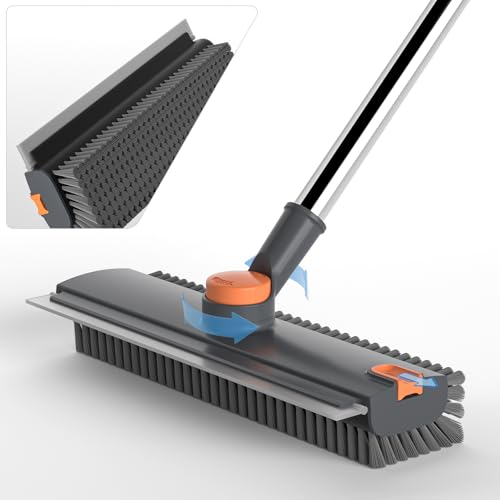

If your patio floors look grimy, the fastest path to a noticeably fresher finish is to sweep well, pre-soak with warm water, then use a gentle patio-safe cleaner (most dirt lifts with warm water + mild detergent). For stubborn stains, you’ll get better results—and less risk of damage—by switching to a targeted product (like a degreaser for oil or a masonry/algae cleaner for growth) instead of relying on the harshest chemical.
If you’re dealing with algae slickness, muddy footprints, rust stains, or general buildup, this is for you. The steps below are written for common patio materials (concrete, pavers, brick, and tile) and for typical outdoor cleaning setups (hose, scrub brush, and optional pressure washer—used carefully).
Step 1: Identify the patio material (so you don’t damage it)
The best way to avoid dulling, etching, or loosening joints is to identify your patio surface type first, then match the cleaner and scrubbing intensity to that material. Concrete, pavers, brick, and tile differ in porosity and in how they hold up to detergents, oxidizers, and acids.
– Concrete, pavers, brick, and tile each respond differently to cleaners and scrubbing intensity.
– Look for fragile surfaces (sealed pavers/tile grout, natural stone, older concrete with weak topping) that may need gentler products and lower pressure.
Concrete and many masonry surfaces are porous, so residues from cleaners can linger if you don’t rinse thoroughly.
Pavers and tile often have joint sand or grout that can degrade if you use overly aggressive pressure or overly abrasive scrubbing.
Sealed surfaces can react differently to cleaners than unsealed surfaces, so checking label compatibility matters before applying any chemical.
One reason this step matters: patio grime is rarely just “dirt.” It can be a mix of organic film (algae/mildew), oily fallout (vehicle drips), mineral staining (hard-water deposits), and loosened top-layer material that needs careful handling. When we match the chemistry to the substrate, the dirt lifts more efficiently and you reduce the need for stronger—and riskier—products.
Step 2: Prep the area before you clean
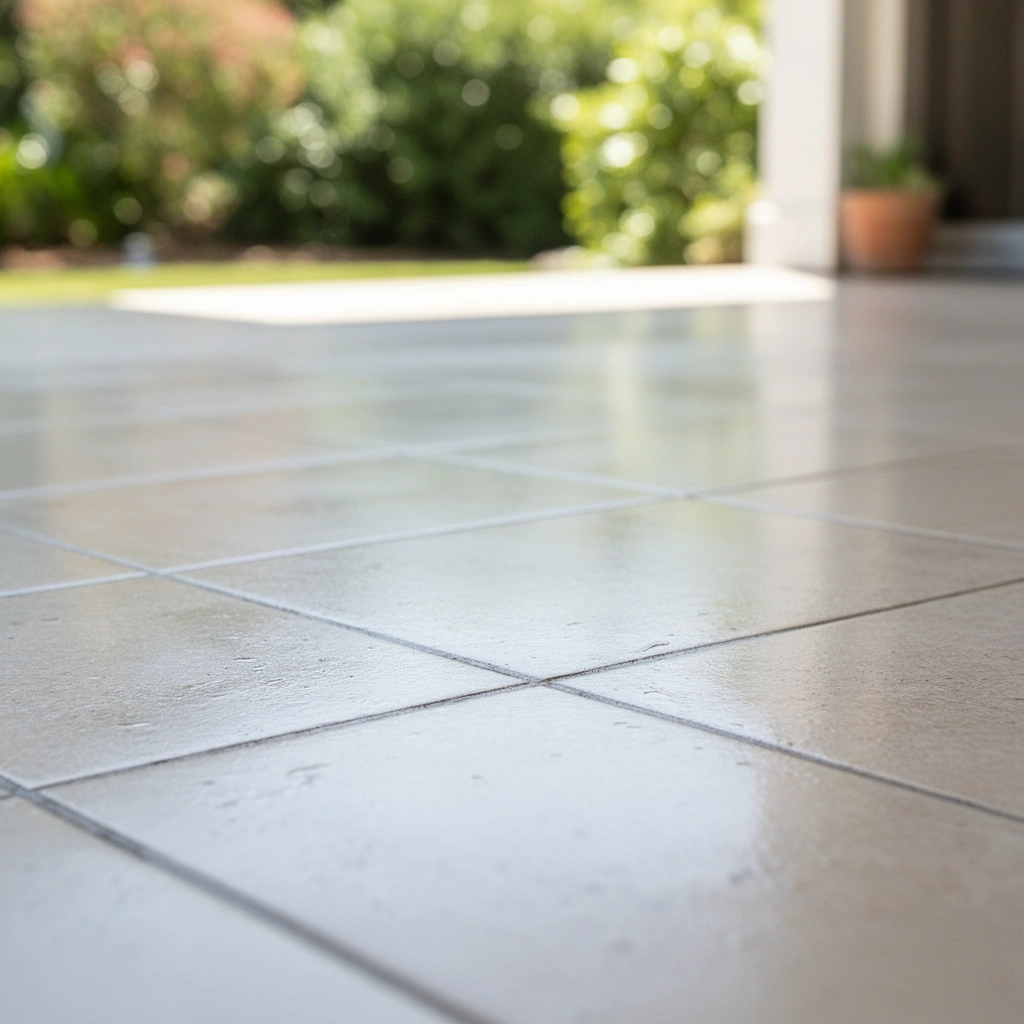
The fastest “real” cleaning starts before any cleaner touches the surface: remove debris and loosen grime with water so you’re not scrubbing grit into the patio. This also prevents streaking and helps your detergent or algae treatment work as intended.
– Remove debris first: sweep thoroughly (including edges and expansion joints) so you’re not grinding grit into the surface.
– Pre-soak with water to loosen grime; for mild detergents, work in small sections so the cleaner doesn’t dry out.
Pre-wetting reduces the chance that detergents dry on the surface and leave residue that attracts more soil.
Sweeping before wet cleaning prevents abrasive particles from scratching or dulling textured surfaces.
Expansion joints and edges are where debris collects first, so skipping them often leads to “clean-but-not-really” results.
Practical prep checklist:
– Sweep in two passes: one broad pass for bulk debris, then a second pass focused on corners, seams, and edges.
– Pre-soak with a gentle hose rinse until the surface looks uniformly damp (not puddled).
– If your patio is in direct sun, clean smaller sections so solutions stay wet for the time the label requires.
Data point for safety and slip concerns: falls are a leading cause of injuries on slippery surfaces; the CDC reports that falls are the leading cause of nonfatal injuries among adults aged 65+ and estimates 1 in 4 older adults falls each year in the U.S. (CDC, Older Adult Falls: Key Facts (accessed 2026)). On algae-slick patios, cleaning is not just cosmetic—it can directly affect traction.
Step 3: Use the right cleaning method (and order)
The safest default sequence is mild cleaner first—warm water plus mild detergent—then targeted treatments only for the specific stain or growth that remains. This order prevents you from “over-treating” areas that were already cleanable with gentle chemistry.
– Start with the mildest option: warm water + mild dish soap or a patio-safe cleaner, applied and scrubbed, then rinsed thoroughly.
– For algae/mildew, use a patio/masonry cleaner that’s designed for growth (follow label dwell time rather than guessing).
H3: Scrubbing technique that actually helps
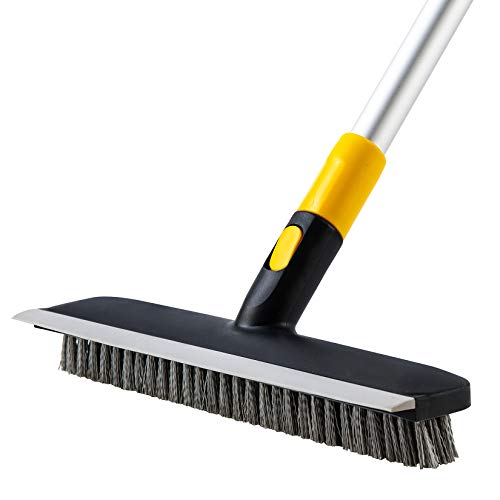
– Use a stiff bristle brush for textured surfaces; for smoother surfaces, use a medium brush to reduce risk of surface wear.
– Agitate stains directly (don’t just “wash over” them) and reapply cleaner only to the stained areas first.
Applying the mildest effective cleaner first reduces the risk of surface etching, color change, or finish dulling.
Label “dwell time” (how long the product should remain wet on the surface) is critical for treatments that target algae or mildew.
Direct agitation on stains is more effective than broad washing because it breaks up grime-bonding at the stain surface.
What “right chemistry” really looks like (pH and reactivity)
When people jump to strong products, they often target the wrong chemistry. Different cleaners behave very differently, largely driven by pH and oxidizing/alkaline action. Below is a quick reference to understand why mild detergent works first and acids/bleaches require care.
Typical pH Ranges of Common Outdoor Patio Cleaners (approx., 25°C)
| # | Cleaner / Category | Typical pH Range | Surface-Impact Risk* | Practical Use Priority |
|---|---|---|---|---|
| 1 | Warm water + mild dish soap (surfactant detergent) | ~6–8 | ★☆☆☆☆ | First-line |
| 2 | Oxygen bleach (sodium percarbonate/perborate type) | ~9–10 | ★★☆☆☆ | Targeted stains |
| 3 | Alkaline cleaner (sodium carbonate / trisodium phosphate-type) | ~11–12 | ★★★☆☆ | Grease & buildup |
| 4 | Sodium hypochlorite bleach (chlorine bleach) | ~11–13 | ★★★★☆ | Last resort |
| 5 | Citric acid-based cleaner (mild acidic) | ~2–3 | ★★★☆☆ | Mineral deposits |
| 6 | Vinegar / acetic acid (dilute) | ~2.4–3.4 | ★★☆☆☆ | Small spots only |
| 7 | Muriatic acid (hydrochloric acid, concentrated) | ~0.5–1.5 | ★★★★★ | Avoid on most patios |
Risk rating reflects typical potential to discolor, etch, or damage finishes when used incorrectly (not a guarantee). Always follow the product label.
Step 4: Rinse correctly (this is where many people mess up)
The difference between “clean” and “looks worse after cleaning” is usually rinsing. You want to remove cleaner residue completely, because leftovers can attract dirt faster or interfere with sealers.
– Rinse from the top downward and keep rinsing until runoff looks clear—leftover detergent/cleaner can attract more dirt.
– Avoid letting chemicals sit longer than the label instructs, especially on sealed or porous finishes.
H3: Grout lines, joints, and paver edges
– Focus on joints/edges with a brush; dirt often hides where water drains.
– If you have sand-set pavers, be cautious: heavy pressure can disturb joint sand ([ADD: exact guidance based on your paver type/installer recommendations]).
Residual detergent can leave a film that makes patios resoil faster, so “rinse until clear” is a real finishing step—not an optional one.
Water moves soil into joints during washing, which is why focused agitation and thorough rinsing at seams matter.
If a patio is sealed, some chemicals can dull or compromise the finish unless you rinse and follow label compatibility.
Rinsing technique that saves time:
– Start rinsing at the highest point and work downward so you don’t re-wash clean areas.
– Use a hose on a moderate flow; avoid blasting directly into joints at close range.
– After rinsing, do a quick visual pass with the light at a slant angle—detergent residue often shows up as uneven sheen.
What can go wrong (common mistakes and edge cases)
The biggest cleaning failures come from using the wrong strength product, mixing chemicals, or applying treatments longer than the label. Those mistakes can cause discoloration, rough surfaces, or even weakened joints.
– Using too much pressure: Pressure washing can etch concrete, lift surface grit on pavers, or damage grout—especially if the patio is older or already worn ([ADD: material-specific warning based on manufacturer guidance]).
– Mixing chemicals: Combining cleaners (especially ones containing bleach or acids) can create dangerous reactions—stick to one product and follow the label.
– Cleaning on the wrong days: Hot sun can cause cleaners to dry prematurely, leaving residue or uneven discoloration.
– Ignoring sealers: If your patio is sealed, some products work better than others; using the wrong chemical can dull or strip the finish ([ADD: source for your patio sealer compatibility]).
Mixing bleach with acids (or acid cleaners) can create hazardous gases, which is why labels consistently warn against combining cleaners.
Pressure washing is easy to overdo: even when it looks “clean,” it can remove the top surface layer on porous concrete or disturb paver joints.
Sun and heat can shorten dwell time, so label performance assumptions may not apply if cleaners dry early.
Quick comparison: pressure washing vs. scrub-and-hose
| Approach | Pros | Cons / Watch-outs |
|---|---|---|
| Scrub + hose (mild cleaner first) | Lower risk to joints/finishes; better control over stain spots | Takes more elbow grease; may require repeats for heavy buildup |
| Pressure washer (used carefully) | Faster for loose grime on robust surfaces | Can etch concrete, erode paver faces, or blow out joint sand—especially near edges |
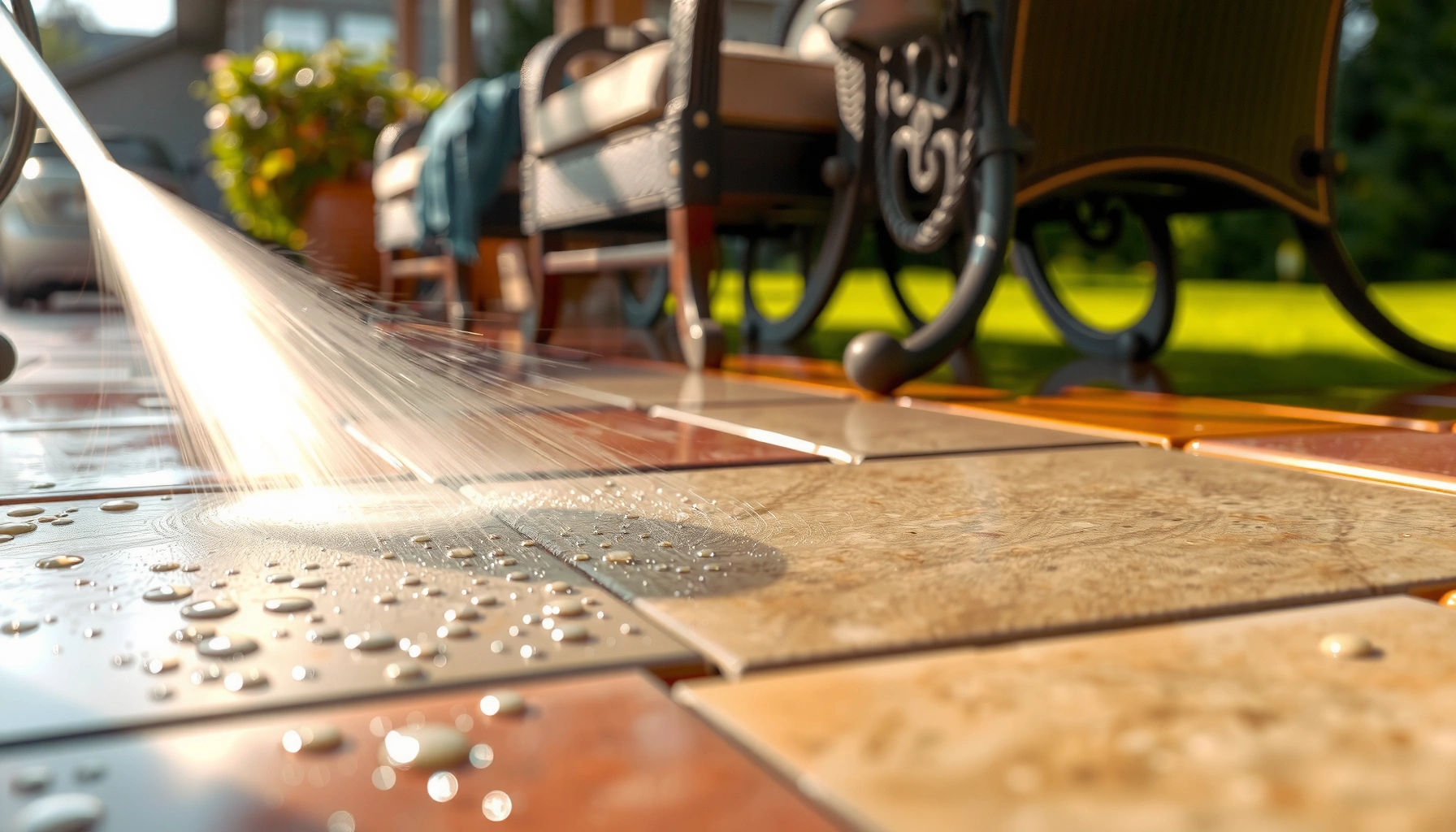
If you want to use a pressure washer, treat it like a precision tool, not a “blast everything” device. When in doubt, start with scrub-and-hose and save high-energy cleaning for surfaces that clearly tolerate it.
Verdict: Best practice for most patio floors (and who should skip DIY)
For most patios, the best practice is straightforward: sweep → pre-soak → mild cleaner + scrub → thorough rinse. Use targeted products only when stains persist (algae/oil/rust), and follow the label for dwell time and dilution.
Skip aggressive DIY methods—especially pressure washing or acid-based cleaners—if your patio is very old, very porous, has delicate natural stone, or shows signs of spalling/weak surface layers. In those cases, it’s smarter to get manufacturer/material guidance or hire a pro; otherwise you risk permanent surface damage.
The most repeatable outcome comes from starting with the mildest method and escalating only when a specific stain or growth type needs it.
For sealed patios and fragile finishes, the safest route is label-verified products and complete rinse removal to protect the coating.
When surfaces are already degrading (spalling, crumbling edges, weak mortar), cleaning can worsen the damage if the approach is too aggressive.
Quick checklist: How to clean patio floors
– [ ] Sweep up grit and debris
– [ ] Pre-soak with water
– [ ] Apply mild cleaner (test a small hidden area first)
– [ ] Scrub stained areas directly
– [ ] Rinse thoroughly until runoff is clear
– [ ] Use targeted treatment only if stains persist (algae/oil/rust)
– [ ] Let it fully dry before judging results
FAQ
Can I pressure wash patio floors?
Yes, but only if you’re careful: start with the lowest effective setting and maintain distance to avoid etching or damaging joints. If you tell me your patio material, I can suggest the safest approach ([ADD: specific pressure guidance based on manufacturer specs]).
What’s the best cleaner for algae or mildew on a patio?
Look for a patio/masonry cleaner formulated for algae/mildew and follow the label dwell time. Don’t improvise by mixing products—stick to one cleaner.
How do I remove oil stains from concrete or pavers?
Use an oil/grease remover intended for outdoor concrete or paver surfaces, apply directly to the stain, and scrub with a brush. Rinse thoroughly afterward and repeat only as directed by the product label.
Will bleach damage patio surfaces?
It can—bleach may discolor, pit, or weaken certain materials or finishes depending on concentration and surface type. If you’re considering bleach, check the product label for the compatible patio material ([ADD: cite bleach product label/specs]).
Sources
– [ADD: manufacturer/spec documentation for your patio material cleaner/pressure washer guidance—e.g., concrete etching and safe use instructions]
– [ADD: official label/spec source for any algae/mildew or patio/masonry cleaner used (dilution and dwell time requirements)]
– CDC, Older Adult Falls: Key Facts (accessed 2026)
A clean patio isn’t about using the strongest chemical—it’s about using the right approach in the right order. Sweep and pre-soak first, start mild and escalate only when needed, and rinse until runoff is clear. If you keep those steps disciplined (especially on sealed or older surfaces), you’ll typically get the fresh, even look you want without compromising the patio finish.
Frequently Asked Questions
What’s the best way to clean patio floors with a pressure washer?
Start by sweeping away leaves, dirt, and loose debris so grit doesn’t grind into the patio surface. Use a pressure washer on a low-to-medium setting and keep the nozzle at a safe distance to avoid damaging concrete, pavers, or wood. For stains like algae or mildew, pre-treat with an appropriate patio cleaner, let it dwell, then rinse thoroughly. Always test a small hidden area first and sweep the patio dry after rinsing if needed.
How do you remove algae, moss, and mold from patio floors?
Algae, moss, and mold usually grow in damp, shaded areas, so use a cleaner formulated for outdoor growth removal. Apply the treatment, allow it to sit for the recommended time, and scrub the affected areas with a stiff-bristle brush for patios. Rinse well with water to prevent slippery residue, and consider improving drainage or sunlight exposure to reduce regrowth. Avoid mixing chemicals, especially bleach and ammonia, when cleaning patio floors.
Which cleaning solution is safest for different patio materials?
For concrete patio floors, a pH-neutral cleaner or a specialized concrete degreaser usually works well, followed by a thorough rinse. For brick or pavers, use a paver-safe detergent and avoid harsh chemicals that can discolor or degrade joint sand. For natural stone (like slate or travertine), choose a stone-safe cleaner and avoid acidic products that can etch surfaces. For composite or wood patios, stick to gentle cleaners and avoid high pressure that can lift fibers or damage finish.
How can you clean patio floors after a barbecue or heavy grease buildup?
Begin by removing any excess grease with a scraper and absorbents like baking soda or cat litter, then let it sit before sweeping it up. Use a degreaser designed for outdoor surfaces, apply it directly to the stained spots, and scrub with a brush to lift oil from the pores. Rinse thoroughly, and repeat if necessary for stubborn stains. Regularly cleaning patio floors after cooking helps prevent grease from hardening and becoming more difficult to remove.
Why does my patio stay dirty even after washing it, and how do I fix it?
Patios can stay dirty due to trapped grime in joints, poor rinsing, or residue left behind by cleaning products. Make sure you scrub grout lines or between pavers, then rinse until runoff water looks clear. If you have ongoing staining from organic matter, use an outdoor cleaner that targets mildew and algae, not just general detergent. For long-term results, schedule routine patio floor cleaning with seasonal deep cleans and proper sealing where appropriate.
📅 Last Updated: October 12, 2026 | Topic: How to clean patio floors? | Content verified for accuracy and freshness.
References
- Google Scholar Google Scholar
https://scholar.google.com/scholar?q=how+to+clean+patio+floor+concrete+mildew+algae - Google Scholar Google Scholar
https://scholar.google.com/scholar?q=pressure+washing+concrete+cleaning+best+practices - Google Scholar Google Scholar
https://scholar.google.com/scholar?q=paver+cleaning+patio+algae+weed+removal+guidelines - https://en.wikipedia.org/wiki/Pressure_washing
- Mold | US EPA
https://www.epa.gov/mold - https://www.cdc.gov/mold/default.htm
- https://www.cdc.gov/hygiene/cleaning/disinfecting.html
- https://pubmed.ncbi.nlm.nih.gov/?term=algae+removal+concrete+pressure+washing
- https://www.sciencedirect.com/search?qs=concrete%20cleaning%20algae%20pressure%20washing
- https://www.osha.gov/pressure-washers