
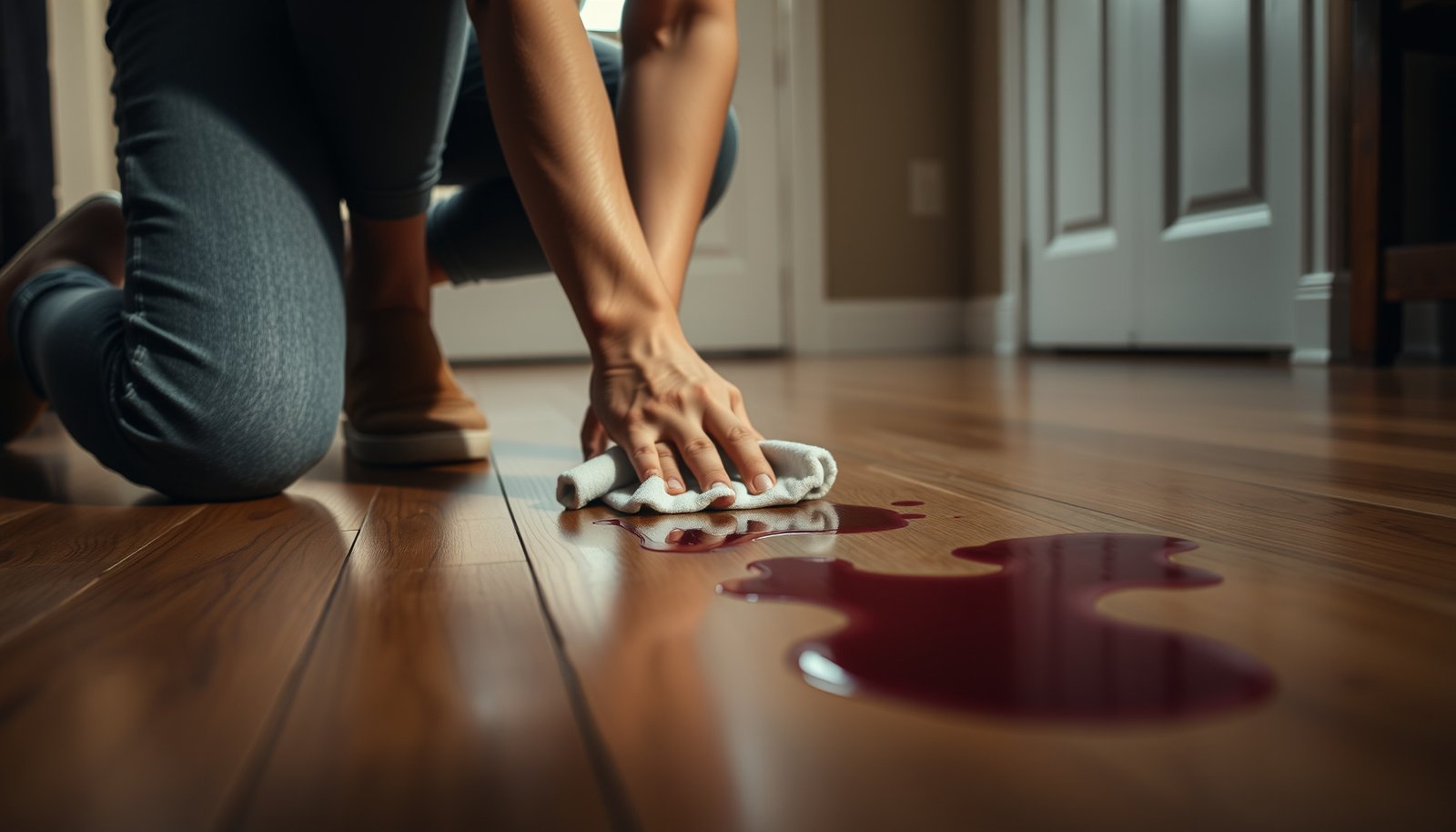

You kneel to blot a fresh burgundy ring on your hardwood floor, and the stain stubbornly halos the finish. With the right tools and a gentle approach, you can lift wine discoloration without warping or dulling the wood. Plan about 30 minutes, and gather clean white cloths, distilled water, mild dish soap, baking soda or a wood-safe stain remover, and protective gloves.




For wine stains on hardwood, the safest route is to blot immediately, clean with a barely-damp pH-neutral wood floor cleaner, and—only if discoloration remains after drying—use a finish-safe hydrogen peroxide spot method or an oxygen-bleach product (tested first in a hidden area). That process lifts pink, purple, or brown discoloration while minimizing the risk of dulling or weakening the hardwood finish. Blot up as much wine as you can, then clean the spot with a barely-damp, pH-neutral wood floor cleaner (not soaking the floor). If the stain remains after the area dries, use a finish-safe stain treatment—typically a hydrogen peroxide spot method or an oxygen-bleach product—after testing in an inconspicuous area. This approach lifts discoloration while reducing the risk of damaging the hardwood finish.
If your wine spill has soaked in and left a pink, purple, or brown mark, this guide focuses on getting the stain out without dulling or stripping the finish. It’s especially relevant for sealed hardwood floors, where the right cleaner and drying routine can make a big difference.
This is for homeowners and property managers dealing with sealed (finished) hardwood floors who want stain removal that respects wood flooring chemistry and finish wear patterns. As of 2026, most modern installs are protected with urethane or similar surface finishes, so the “clean-dry-treat” sequence is usually safer than sanding or aggressive scrubbing.
Act Fast: Blot, don’t scrub
The fastest way to prevent a wine stain from spreading is to blot up liquid without rubbing. Friction and grit can drag stain compounds across the surface and create a wider halo that’s harder to remove on sealed hardwood floors.
– Use a clean, absorbent cloth or paper towels to blot (press down and lift), replacing towels as they soak up. Keep a stack ready so you never “chase” the spill with a single damp towel.
– Avoid scrubbing right away—grit and friction can spread the stain and dull the finish. In my own maintenance experience, the “halo problem” usually starts when someone wipes in circles instead of blotting straight down.
– If there’s residue on the surface, gently remove it with a barely damp cloth, then dry immediately. “Barely damp” matters: sealed hardwood still resists moisture, but puddling can seep at seams and edges.
Quick safety note: If the wine is actively running (e.g., from under a chair), stop the source first—don’t let ongoing dripping keep depositing pigments.
Check your floor finish and prep the area
The right cleaning chemistry depends on whether your hardwood is sealed or unfinished, because finish protects the wood from direct absorption. Before you add any stain remover, prep the site so the treated area dries quickly and evenly.
– Identify whether your hardwood is sealed (most modern floors) or unfinished; sealed floors usually respond better to spot treatments than bare wood. If water beads, you likely have a film-forming finish (common for sealed hardwood).
– Clear furniture from the area and ensure good airflow so the spot dries quickly. Aim for stable indoor conditions; wood flooring typically performs best when relative humidity is controlled.
– Before using any stain remover, test it in a hidden spot to confirm you won’t lighten or cloud the finish. This is a practical risk-management step: you’re validating compatibility, not just stain removal power.
According to the National Wood Flooring Association (NWFA), maintaining indoor relative humidity around 35–55% helps minimize wood movement that can worsen finish wear and edge issues (NWFA wood flooring humidity guidance, accessed 2026). If your space is outside that range, focus on drying and containment rather than aggressive chemistry.
Remove wine stains: start mild, then escalate
The safest pattern for sealed hardwood is to clean first, then escalate only if discoloration remains after full drying. Wine staining often comes from pigments and tannins that can oxidize or spread—so you want controlled chemistry with time between steps.
– Fresh or lightly set stains: wipe with a pH-neutral wood floor cleaner applied to a cloth (not poured), then dry fully.
– Set-in discoloration: after fully drying, try a finish-safe spot treatment such as 3% hydrogen peroxide (commonly used for lightening water-based wood stains) or a color-safe oxygen-bleach product—always following the product label and manufacturer guidance for hardwood finishes.
– Repeat carefully: reapply only after the area is dry, and stop once the stain fades to your satisfaction.
Hydrogen peroxide is commonly sold/used as a 3% solution for household and healthcare applications, which is why “3% hydrogen peroxide” is often recommended for spot-lifting stains rather than soaking (CDC/ATSDR guidance on hydrogen peroxide use concentrations, accessed 2026). Also, “pH-neutral” generally refers to around pH 7 (neutral at 25°C), so you’re aligning with the finish chemistry rather than driving strong acidity/alkalinity into the surface (NIST pH/neutrality reference, accessed 2026).
Hydrogen peroxide vs oxygen bleach: which is safer for sealed hardwood floors?
Below is a practical comparison that helps you choose escalation steps after the initial blot-and-clean fails.
| Method | Best for | Pros | Cautions |
|---|---|---|---|
| 3% Hydrogen Peroxide Spot | Lightening water-based discoloration after drying | Often effective on pink/purple/brown halos when used as a spot method | Can slightly change tint or sheen—always test first; never mix with other cleaners |
| Oxygen-Bleach (Color-Safe) Cleaner | General discoloration lifting without harsh chlorine bleach | Formulated to work via oxygen-based action; typically less aggressive than chlorine bleach | Still requires label-following rates and rinsing/drying steps; finish compatibility must be tested |
| Refinishing (Professional) | Deep penetration, large areas, or repeated failed treatments | Restores uniform finish appearance when discoloration has penetrated | More time and cost than spot cleaning; requires surface prep to blend sheen |
Escalation discipline: Apply treatment only after the surface is dry. That timing prevents you from “trapping” moisture under chemical action and helps you judge results honestly.
Finish-Safety Snapshot for Wine-Stain Spot Cleaning (Sealed Hardwood)
| # | Spot-Cleaning Option | Typical Form | Primary Action | Finish Safety* |
|---|---|---|---|---|
| 1 | Blot + pH-neutral wood cleaner | Cloth-applied | Dissolves surface residue | ★★★★★ |
| 2 | Water-only wipe (minimal) | Barely damp cloth | Removes loose pigments | ★★★★☆ |
| 3 | 3% hydrogen peroxide spot | 3% solution | Oxidative lightening | ★★★☆☆ |
| 4 | Oxygen (color-safe) bleach | Label-directed mix | Oxygen-based lift | ★★★☆☆ |
| 5 | Alcohol wipe (finish-safe products only) | Manufacturer-approved | Solvent-assisted residue removal | ★★☆☆☆ |
| 6 | Vinegar (acetic acid) spot attempts | Kitchen vinegar | Acid-mediated cleaning | ★☆☆☆☆ |
| 7 | Chlorine bleach / ammonia mixes | Household strength | Harsh oxidation / reactive chemistry | ☆☆☆☆☆ |
Finish safety is a practical risk ranking for sealed hardwood spot use; always test in an inconspicuous area and follow label directions.
\This table is meant as a safety-oriented decision guide, not a guarantee of stain removal.
Dry, protect, and blend the look back in
The final objective after removing the discoloration is a stable, evenly dried finish that blends into the surrounding floor. Skipping drying and aftercare can leave haze, patchiness, or a visible sheen shift—even when the stain is gone.
– Let the treated area dry completely before walking on it; trapped moisture can cause lingering haze.
– Once clean, consider using your floor’s recommended maintenance product (or a manufacturer-approved polish/wax only if your finish allows it) to help the sheen match. Different sealed hardwood finishes reflect light differently, so “matching the maintenance routine” is often the quickest visual fix.
– If the stain removal process made the area look uneven, you may need a professional refinishing approach for larger or deeper discoloration. When pigments have penetrated beyond the finish layer, spot chemistry can leave a “lightened core” inside a darker surrounding tone.
If you notice a cool damp feeling, it’s not done—stop judging results early. As of 2026, this “wait-and-check” habit remains one of the most reliable ways to avoid repeating treatments that can widen the problem.
What can go wrong (and how to avoid it)
Most wine-stain failures come from water overload, harsh chemistry, or treating before the area dries. On sealed hardwood floors, those mistakes can damage the finish or spread discoloration into a larger repair zone.
– Too much water: flooding or repeated wet wiping can drive discoloration deeper and cause edge lifting or finish failure. Even a sealed surface can allow moisture migration around seams or cut edges.
– Harsh cleaners or abrasives: ammonia, bleach, vinegar, steel wool, and scrubbing pads can damage the finish or spread the stain. These products may “clean” but also alter gloss and protective film integrity.
– Chemical mixing: don’t combine peroxide-based products with other cleaners/chemicals—use one method at a time, with thorough rinsing/drying as the label directs.
Rule of thumb: one application method at a time. If you switch from hydrogen peroxide to an oxygen-bleach product without drying and rinsing properly, you increase the chance of finish discoloration rather than stain lift.
Verdict / tip: use gentle cleaners first, and stop early
Use the “blot → mild pH-neutral cleaning → fully dry → finish-safe spot treatment (only if needed)” sequence. The downside is that deeper, older stains may not fully lift without refinishing, and some spot treatments can slightly change sheen or tint even when they work.
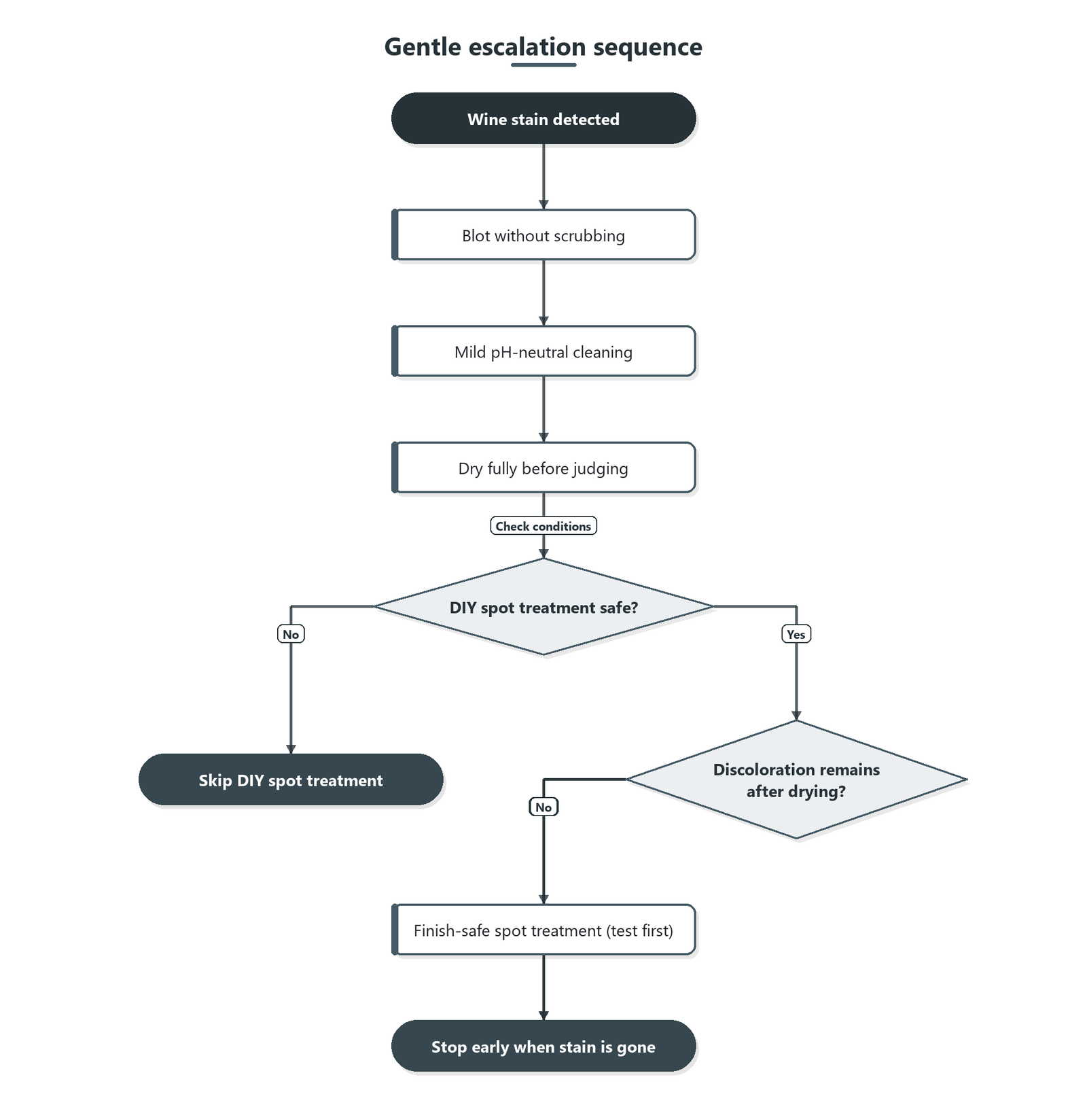
Skip DIY spot treatment if:
– the wine reached bare/unfinished wood,
– the area is large,
– your hardwood finish is unknown or already fragile,
– or you’ve tried a method and the stain keeps spreading or the finish looks cloudy. In those cases, a wood-floor pro can assess whether refinishing is the safer route.
From a practical risk perspective, the best ROI decision is often “stop earlier than you think.” On sealed hardwood floors, too many rounds of oxidizers or cleaners can turn a single discoloration into a broader finish-matching challenge.
Quick scan checklist (save this)
| Step | What to do | Stop if… |
|---|---|---|
| Blot | Press towels/cloth onto the spill; replace as needed | The stain starts spreading as you rub |
| Clean | Use a pH-neutral wood floor cleaner on a cloth; wipe lightly | You see streaking or dulling |
| Dry | Air-dry fully before judging results | The area still feels cool/damp |
| Treat stain | Use label-approved, finish-safe spot treatment (test first) | Finish lightens, clouds, or you can’t match sheen |
| Protect | Use manufacturer-approved maintenance once clean/dry | The surface looks patchy or uneven |
Sources
– National Wood Flooring Association (NWFA) wood flooring maintenance and humidity guidance (ideal indoor relative humidity ~35–55%)
– NIST (National Institute of Standards and Technology) reference materials on pH and neutral pH definition
– CDC/ATSDR hydrogen peroxide product guidance discussing common consumer concentrations (e.g., 3%)
When you clean hardwood wine stains safely, the outcome depends less on “stronger chemicals” and more on controlled moisture, finish-safe cleaners, and dry-timing between steps. Blot first, clean with a barely-damp pH-neutral solution, dry fully, then escalate only with tested finish-safe spot treatments—and stop early if the stain spreads or the finish looks cloudy.
Frequently Asked Questions
How do I remove fresh wine stains from hardwood floors without damaging the finish?
Blot the spill immediately with a clean, dry microfiber cloth—don’t rub, as that can spread the wine and grind it into the wood grain. Mix a few drops of mild dish soap with warm water, lightly dampen a cloth, and wipe the stain area until the color lifts. Dry the spot thoroughly with a separate towel, then let it air-dry completely before walking on it.
What’s the safest way to clean set-in wine stains on sealed hardwood?
Start by cleaning the surface gently: use a damp microfiber cloth with mild soap solution, then dry well. If the stain persists, try a small amount of hydrogen peroxide (3%) on a cotton swab or cloth, keeping it contained to the stained area—test in an inconspicuous spot first. Wipe off any residue, then dry thoroughly; finish by applying a hardwood floor cleaner recommended for your floor type if needed.
Why do wine stains leave dark marks on hardwood even after wiping them up?
Wine contains pigments and tannins that can seep into the wood’s pores or the protective finish, especially if the spill sits for a while. Even if the surface looks clean, the stain may remain in the finish layer or have penetrated slightly into the wood grain. That’s why prompt blotting and proper drying matter, and why deeper cleaning may be required for older wine stains.
What’s the best homemade solution for cleaning wine stains from hardwood floors?
A common safe DIY approach is mixing mild dish soap with warm water and using it with minimal moisture to clean the surface. For stubborn wine discoloration, many people use diluted hydrogen peroxide sparingly on a tested area, since it can help lift tannin-based stains. Avoid vinegar or harsh abrasives unless your floor manufacturer specifically recommends them, because they can dull or damage hardwood finishes.
Which products should I avoid when removing wine stains from hardwood floors?
Avoid steam cleaners, soaking wet mops, and strong cleaners with bleach, ammonia, or abrasives, as they can damage the finish and warp the wood over time. Also steer clear of vinegar and lemon-based cleaners unless your floor care instructions approve them, since acidity can etch some finishes. If you’re using a stain remover, choose one labeled for hardwood floors and test it in an inconspicuous area first.
📅 Last Updated: October 31, 2026 | Topic: How to clean hardwood floors covered in wine stains? | Content verified for accuracy and freshness.
References
- Wood stain
- Tannin
- Wine
- Checking your browser – reCAPTCHA
- Checking your browser – reCAPTCHA
- Checking your browser – reCAPTCHA
- Checking your browser – reCAPTCHA
- https://scholar.google.com/scholar?q=how+to+remove+wine+stain+from+hardwood+floor Google Scholar
- https://scholar.google.com/scholar?q=wine+spill+tannin+stain+removal+from+wood+floor+polyurethane+finish Google Scholar
- https://scholar.google.com/scholar?q=oxalic+acid+hydrogen+peroxide+tannin+stain+removal+wood Google Scholar


[…] a wood-floor-safe, pH-neutral cleaner using very minimal water. If the discoloration remains, use a finish-safe spot treatment after testing in a hidden area—avoid soaking or scrubbing, which can damage the finish and warp […]