
You can clean hardwood floors covered in construction dust effectively, but the right method depends on whether the dust is dry and loose or caked and gritty. This guide delivers the clear, safest win: start with proper vacuuming and dry dust control to avoid grinding, then follow with a minimal-moisture wash using the correct cleaner. You’ll also get the exact steps to prevent haze, scratches, and lingering grit after the cleanup.
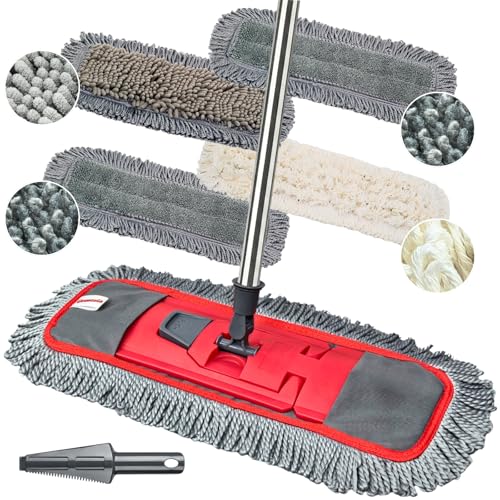



Use a two-phase approach: dry-remove construction dust first, then damp-mop with a hardwood-safe cleaner using barely-damp microfiber. Construction dust behaves like fine abrasive grit, so the goal on hardwood floors is to lift it off without grinding it into the finish or spreading the haze across the boards.
If your hardwood is newly refinished, newly installed, or still showing a dull, dusty film after renovation, this is the safest general process to follow. It’s also a good fit if you don’t want to risk swirls from using the wrong pad or too-wet water during cleaning. Below is a step-by-step approach that keeps your finish safe while still getting the haze and debris up.
Start With Dry Removal (Don’t “Wet-Sweep” Dust)
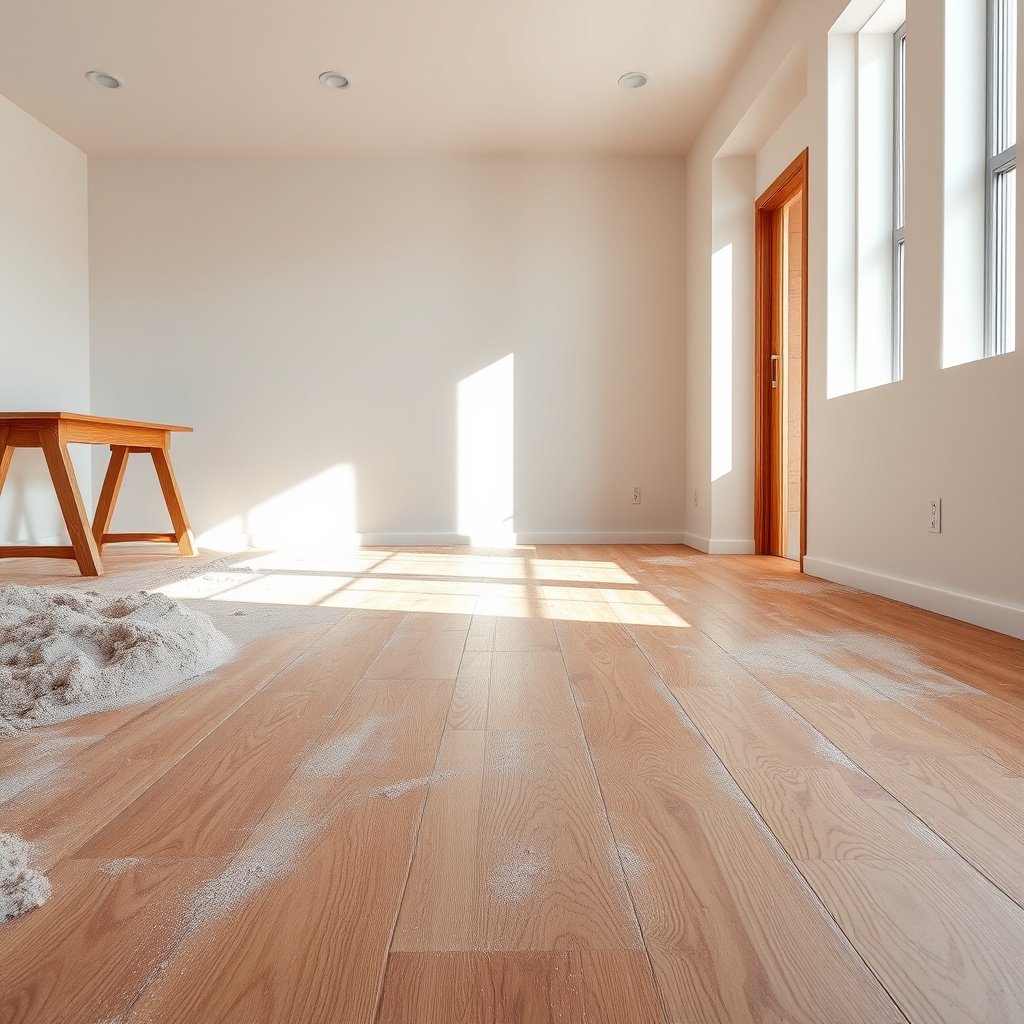
Dry remove first because construction dust is often made of very fine particles that scratch finishes when you drag them around. Before any moisture touches your hardwood floors, you want the grit out of the way—especially along edges and board seams where dust hides.
U.S. EPA explains that HEPA (High-Efficiency Particulate Air) filters are designed to capture 99.97% of particles at about 0.3 micrometers, which matches the “fine haze” range common in construction dust. U.S. Environmental Protection Agency (HEPA filter definition)
OSHA sets an 8-hour time-weighted average Permissible Exposure Limit (PEL) for respirable crystalline silica at 50 µg/m³, reflecting how hazardous—and respirable—fine construction dust can be. U.S. Occupational Safety and Health Administration (Silica PEL)
U.S. EPA defines PM10 as particles with diameters of 10 micrometers or less, which overlaps with the types of airborne particles that settle as gritty dust on hardwood floors after renovation. U.S. Environmental Protection Agency (PM standards/definitions)
– Sweep lightly with a soft broom or use a dust mop to lift the bulk of particles. Keep pressure low; your job is to collect dust, not “polish” it.
– Vacuum with a brush attachment (avoid rough wheels/beaters) to remove grit before any moisture touches the floor.
– Change vacuum bags/filters if they’re clogged—restricted airflow can leave construction dust behind, which then gets reworked into the finish during mopping.
Why this matters for hardwood floors covered in construction dust: finishing layers (polyurethane, aluminum-oxide coatings, or oil/varnish systems) are designed to resist regular wear, but micro-scratches happen when abrasive dust is trapped in motion. Dry removal first breaks the cycle of “dust → abrasion → haze.”
Where to focus first (so the grit doesn’t come back)
Start in the area that gets most foot traffic during the job—typically the path from the doorway to the work area—and then work outward. When you vacuum, overlap passes by about half the tool width so you don’t leave a dust ridge that later shows up as a streak after damp cleaning.
Also, pay attention to board joints and the “shadow lines” between planks. Construction dust tends to settle there, and mopping over it can drag residue into the creases where haze becomes hard to remove.
Mop Safely: Use the Right Tools and a Barely-Damp Method
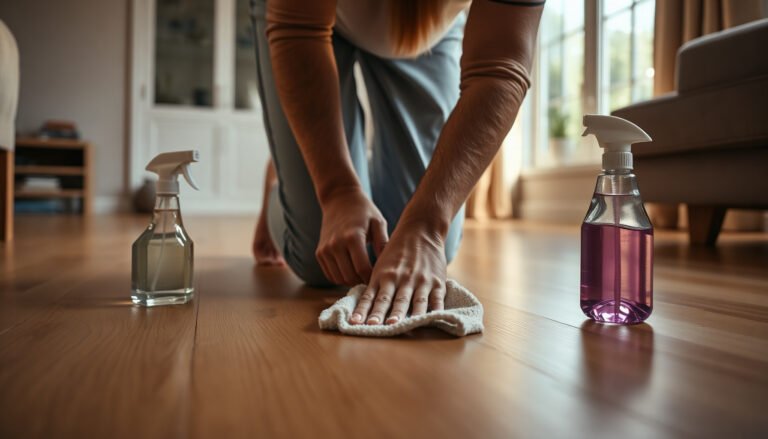
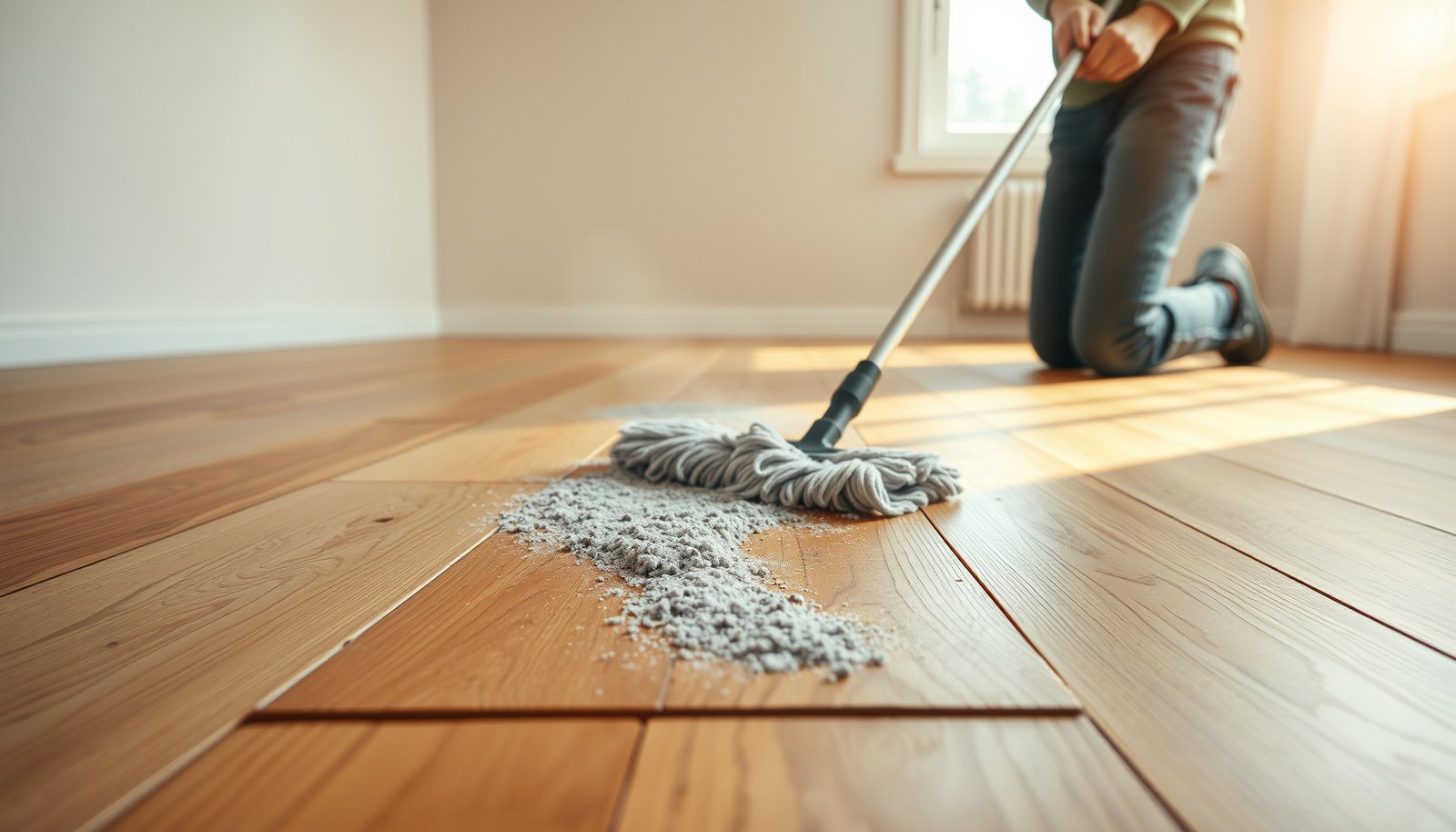
Mop safely with a barely-damp microfiber mop to remove the remaining construction dust and any film without swelling vulnerable areas. For hardwood floors, too much water is the fastest way to dull the finish, compromise seams, or create cloudy spots.
Microfiber mops work by trapping and holding particles in their fibers, which helps reduce the chance of pushing construction dust around compared with pads that smear residue.
Barely-damp cleaning reduces the risk that liquid cleaner pools along seams and edges—an issue that can dull finishes and weaken vulnerable transitions on hardwood floors.
Cleaning in smaller sections keeps the cleaner from drying unevenly, which lowers the odds of leaving streaks or a “flash-dried” residue film on hardwood floors.
– Use a microfiber mop and wring it out until it’s barely damp (no puddles, no visible dripping).
– Clean in small sections so the cleaner doesn’t sit and dry unevenly.
– Rinse if your hardwood manufacturer recommends it for the specific product you use (some leave film if not).
The “barely-damp” wringing method (practical)
After you load your mop, wring it over a sink or bucket until water stops dripping in steady streams. If you can squeeze out a small amount during wringing, that’s fine—what you’re avoiding is visible wetness on the surface of hardwood floors. The finish should look slightly “warmed” by moisture, not glossy-wet.
Microfiber management: keep it clean while you clean
Construction dust can load quickly into the mop head. If you drag a loaded microfiber head across hardwood floors, you may redeposit grit. Swap or rinse the pad/mop head as soon as it begins to feel gritty, looks dark with dust, or leaves a faint haze line behind.
Choose a Hardwood-Safe Cleaner for Dust and Film
Choose a hardwood-safe cleaner labeled for finished floors to dissolve residue without stripping or chemically dulling the finish. For construction dust cleanup, the right cleaner removes the haze and film—without turning your hardwood floor finish into something that’s more scratch-prone.
Many hardwood care guides warn against ammonia, abrasive degreasers, and “stripper” products because they can weaken coatings and alter sheen.
For a uniform gray haze, you typically need a residue/film remover designed for finished hardwood floors rather than a stripper meant to remove an entire coating layer.
Using an alkaline or strongly acidic cleaner outside manufacturer guidance can change how finishes bind to wood, increasing the risk of dulling or long-term unevenness on hardwood floors.
– Use a cleaner labeled safe for finished hardwood floors (avoid ammonia, harsh degreasers, and all-purpose “strip” cleaners).
– If you’re dealing with a uniform gray haze, use a product intended for floor film/residue, not a stripper.
Cleaner selection by finish type (how to think about it)
Hardwood floors after renovation often have two issues at once: (1) grit that scratches, and (2) residue that dulls. Polyurethane or similar film finishes usually respond well to hardwood-approved, pH-balanced cleaners used sparingly. Oiled finishes can require cleaners that don’t strip oils; using the wrong chemistry may leave an uneven sheen or accelerate oil draw-out.
If you’re unsure what finish your hardwood has, start conservative: dry remove thoroughly, then use the mildest hardwood-labeled cleaner you can find, applied with a barely-damp mop.
Cleaner comparison (quick AI-friendly view)
| Cleaner type | What it does well for construction dust | Main risk for hardwood floors | Best use case |
|---|---|---|---|
| Hardwood-approved pH-balanced cleaner | Removes film and haze left after dust settles | Low when used sparingly; higher if left to dry | Most post-renovation cleanups |
| Residue/film remover (non-stripping) | Targets gray haze and buildup | Can leave film if over-applied or not rinsed (if required) | Uniform discoloration after renovation |
| All-purpose degreasers | Helps with spots from tracked grime | May be too strong or leave residue on finish systems | Only for spot tests and only with manufacturer approval |
| Strippers / caustic cleaners | Removes coating—rarely what you want | High risk: dulling, coating damage, uneven re-finish needs | Only when refinishing plans call for stripping |
Deal With Edges, Baseboards, and Corners
Deal with edges and corners separately because construction dust packs into trim lines and then gets redistributed when you mop. Treat baseboards, corners, and gaps around trim as “dust zones” that need targeted wiping rather than floor-wide spreading.
Dust commonly migrates into gaps at baseboards and trim; wiping those areas separately reduces the chance of re-depositing construction dust onto hardwood floors during mopping.
Using a soft cloth in corners is safer than aggressive scrubbing pads because abrasion in tight joints can create visible dulling on hardwood floors.
Dry grit left near transitions (stairs, door thresholds, or between planks) often shows up as lingering haze after cleaning, because it’s still being dragged with foot traffic.
– Use a soft cloth or microfiber pad for corners where dust collects.
– For baseboards, wipe dust separately rather than pushing it back onto the floor.
– Take care around trim gaps: dust can pack in there and re-spread later when you mop.
A practical workflow for edges (so you don’t re-contaminate the floor)
1. Vacuum the edges first with the crevice tool and soft brush head.
2. Dry-wipe baseboards and trim with a microfiber cloth.
3. Only then mop your main floor areas—again using a barely-damp microfiber mop—so you don’t chase haze that was actually introduced by your trim dust.
Construction dust loves re-deposition. If you see new haze appearing right after mopping, it’s often because an edge area was missed.
What Can Go Wrong (Common Mistakes)
Avoid these errors because each one turns construction dust into a scratch pathway or leaves chemical residue that dulls hardwood floors. The most expensive “cleanup” is usually the one that forces refinishing or re-coating due to finish damage.
Skipping vacuuming before damp mopping increases the likelihood that abrasive construction dust gets ground into the finish, creating persistent hazing on hardwood floors.
Mopping too wet can leave liquid in seams and can dull or damage some finishes, especially if cleaner residue is not removed according to the product’s directions.
Using abrasive pads or dirty microfiber increases the chance of micro-scratches and streaking because they reintroduce grit and friction.
– Using a dry broom aggressively: it can scratch if gritty dust remains.
– Mopping too wet: standing moisture can dull or damage finishes and swell vulnerable seams.
– Using the wrong pad: abrasive scrubbers or dirty/rough microfibers leave scratches and streaks.
– Skipping the vacuum step: “mopping over grit” is the most common way people end up with permanent hazing.
Edge cases to respect
– Unfinished bare wood: Many hardwood cleaning methods assume a finished surface. If the floor is unfinished, you need finish-specific instruction (often different from “finished hardwood” care).
– Visible damage or swelling: If boards are cupped, splitting, or lifting, construction dust cleanup becomes secondary to repair planning.
– Large areas with ongoing construction: If dust is still actively settling, clean in phases (dry remove daily during active work), then do a full damp clean after the dust source stops.
Verdict / Tip: Follow the Two-Phase Method (Dry Remove → Damp Clean)
If you do only one thing, it should be this sequence: vacuum/dust-mop first, then a barely-damp microfiber mop with a hardwood-approved cleaner. This is the best balance between removing construction dust thoroughly and protecting hardwood floors from abrasion and finish haze.
A two-step approach (dry removal, then minimal moisture cleaning) prevents abrasive dust from being dragged across wood finishes, which is the central mechanism behind construction-dust scratching.
Cleaning in small sections and preventing the cleaner from sitting reduces streaking and residue film on finished hardwood floors.
If you don’t know your finish system, conservative cleaning using labeled hardwood-safe products and barely-damp mopping is safer than guessing with stronger chemicals or steam.
The downside is it takes a bit longer than grabbing a bucket and mopping immediately—because it’s meant to prevent scratching. Skip this approach (or pause to check finish guidance) if your floor is unfinished bare wood, has damaged/splitting boards, or you’re unsure what finish was used—those cases often need manufacturer-specific instructions.
A quick “decision rule”
– If you can feel grit underfoot: repeat dry removal before any damp mopping.
– If the floor looks hazy but feels smooth: focus on the right hardwood-safe cleaner and proper rinsing/section work.
– If you see water-related clouding or new dull spots: stop, dry-check, and follow the finish system’s repair/restore steps.
Construction dust particle sizes that commonly drive “grit” risk
| # | Dust/particle size category | Upper cutoff | Why it matters on hardwood cleanup | Primary reference context | Cutoff (µm) |
|---|---|---|---|---|---|
| 1 | Ultrafine particles (UFP) | Less than 0.1 µm | Settle into haze; hard to “sweep out” completely | EPA air monitoring terminology | 0.1 |
| 2 | HEPA test particle size | 0.3 µm | Matches the hardest size for HEPA to capture | HEPA performance certification reference | 0.3 |
| 3 | Respirable fraction | ≤ 4 µm | Stays airborne longer; settles as fine grit | ISO inhalation fraction framework | 4 |
| 4 | PM2.5 | ≤ 2.5 µm | Common driver of “haze” after renovation dust settles | EPA particulate matter definition | 2.5 |
| 5 | PM10 | ≤ 10 µm | Deposits readily; can be re-scratched during damp mopping | EPA particulate matter definition | 10 |
| 6 | Thoracic fraction | ≤ 10 µm | Settles alongside PM10; contributes to visible dust film | ISO inhalation fraction framework | 10 |
| 7 | Inhalable / TSP (total suspended particles) | ≤ 100 µm | More “sand-like”; easier to sweep but still tracks into joints | ISO / air monitoring definitions | 100 |
(These size definitions help explain why construction dust cleanup on hardwood floors benefits from dry removal + HEPA-capable vacuuming, because particles across multiple size fractions settle as both grit and haze. See U.S. EPA and OSHA and ISO 7708 in Sources.)
Quick Checklist for Construction-Dust Cleanup
Use this checklist as your fast “plan, don’t guess” workflow. If you stick to it, you’ll reduce scratch risk while still clearing the haze from hardwood floors covered in construction dust.
– [ ] Dust-mop/sweep gently first (soft tools)
– [ ] Vacuum thoroughly with a soft brush attachment
– [ ] Mop only with a barely-damp microfiber mop
– [ ] Use a cleaner labeled safe for hardwood (avoid harsh chemicals)
– [ ] Work in small sections; don’t let cleaner sit too long
– [ ] Spot-check corners and edges; wipe separately
Sources
– U.S. Environmental Protection Agency (HEPA filter definition and particulate matter definitions such as PM10/PM2.5)
– U.S. Occupational Safety and Health Administration (OSHA) – Respirable crystalline silica PEL (50 µg/m³, 8-hour TWA)
– ISO 7708 – Inhalation-related particle size fractions (inhalable/thoracic/respirable cutoffs)
By following the two-phase method—dry remove first, then barely-damp microfiber cleaning with a hardwood-approved product—you protect your hardwood floors from abrasion while still clearing haze left by construction dust. If you notice grit underfoot or edges that weren’t wiped, pause and repeat dry removal and targeted edge cleaning before doing another damp pass; that’s the difference between a clean finish and a long-term hazed surface.
Frequently Asked Questions
What’s the safest way to clean hardwood floors after construction dust settles?
Start by removing loose construction dust with a vacuum that has a soft brush attachment to avoid scratching the hardwood. Then use microfiber mops or damp cloths (not soaking wet) to pick up fine particles without pushing debris into the grain. Finish with a hardwood floor cleaner recommended for sealed floors, and let the surface fully dry to prevent haze and streaking.
How do I remove stubborn drywall dust and grit from hardwood without scratching?
First, do a dry pass with a vacuum and a slightly damp microfiber cloth to capture grit before it’s ground in. For stubborn spots, lightly dampen a cloth with clean water and gently blot the area rather than scrubbing hard. If grit remains, re-vacuum and repeat with fresh cloths—avoid abrasive pads, since construction dust often contains tiny particles that can damage the finish.
Why does construction dust leave a haze on hardwood, and how can I prevent it?
Construction dust can contain fine minerals that form a dull film when mixed with moisture, especially if the floor isn’t cleaned promptly. To prevent haze, clean in stages: vacuum first, then use a properly diluted hardwood floor cleaner and minimal water. Use clean mop heads and rinse lightly if your cleaner requires it, and dry the floor well to avoid residue.
What’s the best cleaning method for hardwood floors covered in fine sanding or plaster dust?
Use a two-step approach: vacuum thoroughly, then damp-mop with a microfiber mop and a cleaner formulated for hardwood floors. Work in small sections and change the mop pad frequently to avoid redistributing dust. If the dust is extremely fine, a tack cloth or a lightly damp microfiber wipe can lift remaining particles before you apply any cleaner.
Which products should I use—or avoid—when cleaning construction dust off hardwood floors?
Use a pH-neutral hardwood floor cleaner (or a manufacturer-recommended product) and microfiber tools to safely lift construction dust from sealed hardwood surfaces. Avoid harsh all-purpose cleaners, ammonia, vinegar solutions, and oil-based products unless your floor manufacturer explicitly approves them, as they can dull the finish or leave sticky residue. Also avoid steam mops and soaking methods, since excess moisture can seep into seams and cause warping.
📅 Last Updated: October 29, 2026 | Topic: How to clean hardwood floors covered in construction dust? | Content verified for accuracy and freshness.
References
- Wood flooring
- Silica, Crystalline – Overview | Occupational Safety and Health Administration
- https://www.cdc.gov/niosh/topics/silica/default.html
- https://www.epa.gov/lead/renovate-right-lead-based-paint-activities
- https://www.cdc.gov/lead/prevention/how-to-prevent-lead-exposure.htm
- https://www.hud.gov/program_offices/healthy_homes/lead
- 404 Error
- https://scholar.google.com/scholar?q=hardwood+floor+cleaning+construction+dust+hepa+vacuum Google Scholar
- https://scholar.google.com/scholar?q=construction+silica+dust+cleanup+hepa+vacuum+wet+mopping Google Scholar
- https://scholar.google.com/scholar?q=wood+floor+care+after+construction+dust+dry+vacuum+microfiber Google Scholar