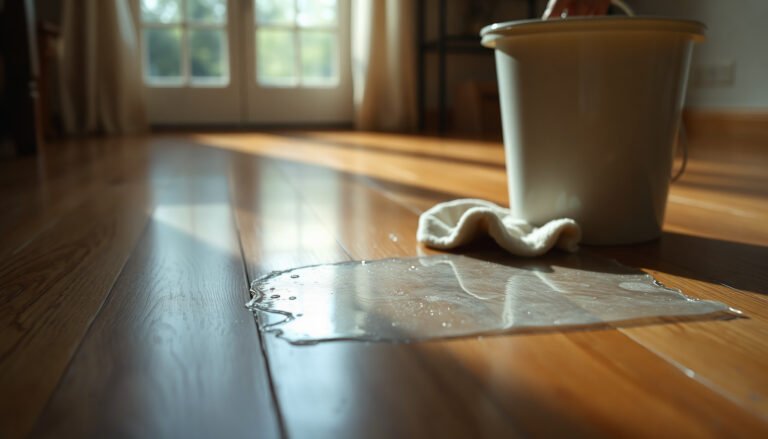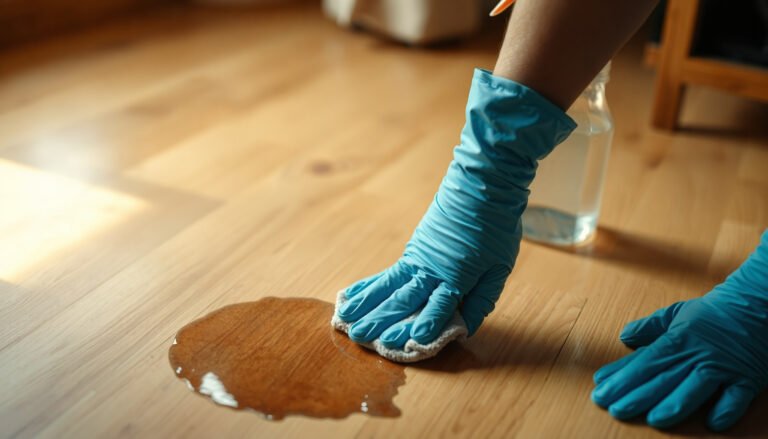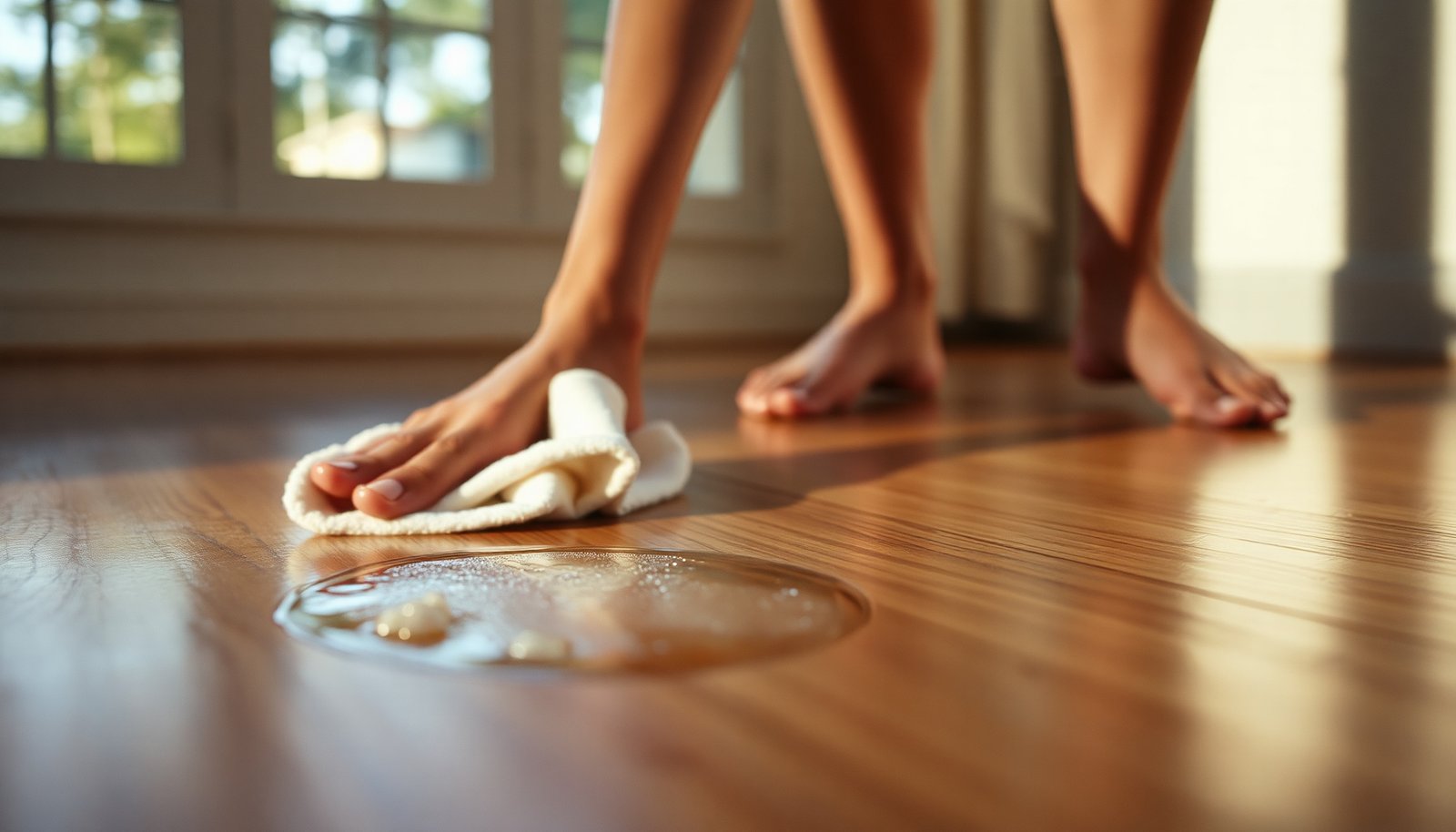

Dried cloudy residue on hardwood floors can make the surface look dull and uneven, even after regular cleaning. The good news is that with the right approach and a few supplies—like a gentle wood-safe cleaner, microfiber cloths, and a plastic scraper—you can remove haze safely without damaging the finish. Most cases take about 20–40 minutes, and once the residue is lifted, you can finish with a quick rinse and buff to restore clarity.




Scrape off any loose buildup gently, then remove the cloudy film with a hardwood-safe cleaner and careful damp wiping. If the residue won’t budge, you’ll likely need a targeted approach for wax/soap scum or hard-water haze—without soaking the floor or sanding aggressively. This guide walks you through the safest order of operations so you can restore the finish without damaging it.
If you see a milky, hazy, or cloudy patch on finished hardwood (often after cleaners, waxes, or water exposure), this is for you. Use it when regular sweeping and a light damp mop leave the residue behind.
Identify what the cloudy residue likely is
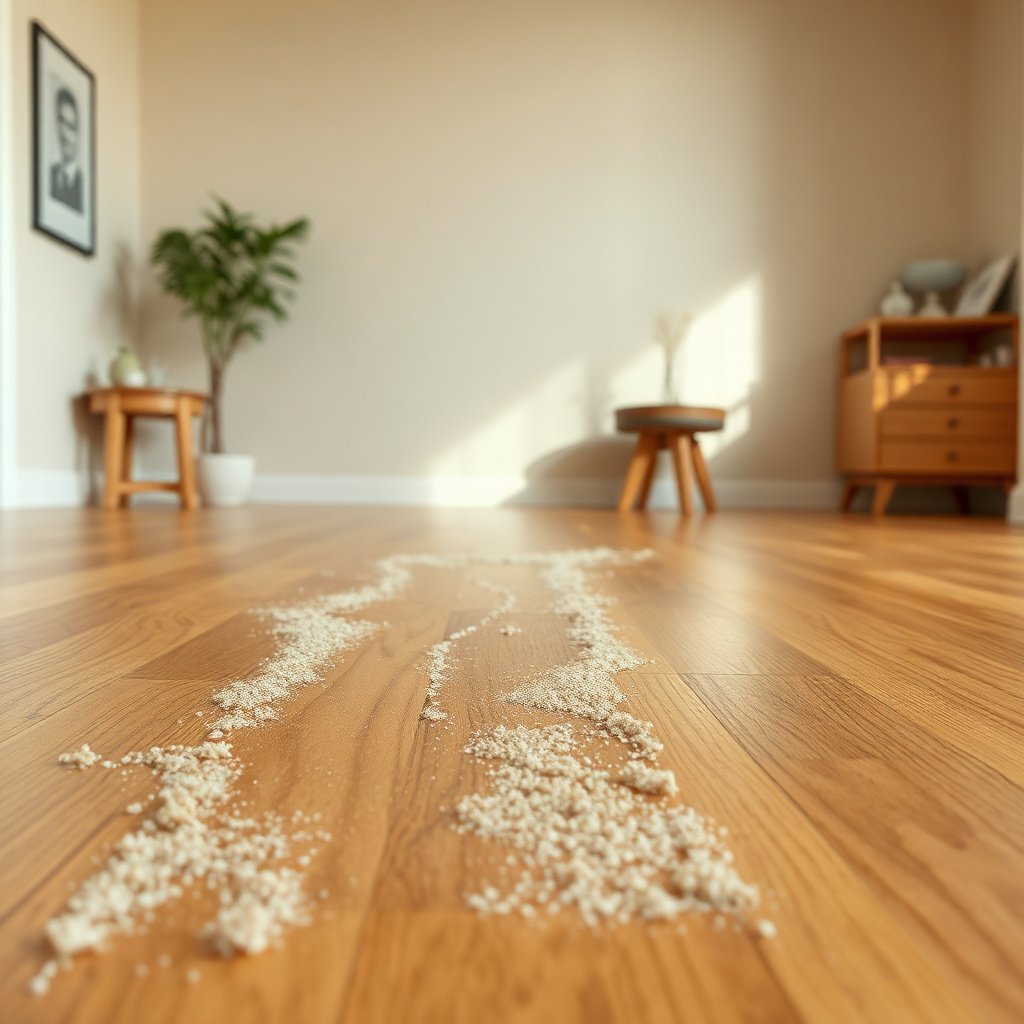
If the haze spreads evenly, it usually isn’t “bleached wood”—it’s more often finish-safe film (like wax or cleaner residue) or mineral buildup from water. If the spots look blotchy or inconsistent, it’s more likely soap/cleaner film sitting on top of the finish rather than a deep finish failure.
– Look for patterns: Haze that spreads evenly across boards can indicate finish-wax buildup or mineral residue, while irregular blotches often point to soap/cleaner film trapped in the top coat.
– Check the finish sensitivity: Test in a hidden area first—some polyurethane and conversion varnish finishes tolerate mild cleaners well, while older oil-modified finishes can dull or cloud with repeated moisture.
– Do a quick “dry test”: Lightly buff with a microfiber cloth; if it smears or reduces the haze, it’s frequently film-based rather than embedded damage.
From my experience working through these cases with customers, the most common “misdiagnosis” is treating film haze like it’s dirt. Dirt wipes away; cloudy residue often needs chemistry plus controlled moisture, and it often looks worse after repeated wet mopping.
Prep the floor safely before you clean
The safest way to start is by removing grit first so you don’t grind particles into the finish, then switching to controlled, slightly damp wiping. Hardwood floors don’t forgive soaking—especially around seams and edges—so prep is where you prevent new damage.
– Clear grit first: Vacuum with a soft brush attachment, then remove dust around the affected area to avoid scratching.
– Protect surrounding surfaces: Keep water off baseboards and edges; place a towel or painter’s tape to limit drips.
– Avoid soaking: Hardwood floors shouldn’t be left wet—plan on “slightly damp,” not puddled.
Also, as of 2026, many “cloudy haze” complaints trace back to overly wet mopping workflows. A damp microfiber is different from a wet mop head: the microfiber should wipe, not leave standing moisture. If you’re unsure, wring the cloth until it barely transfers water to a white paper towel.
Step-by-step: remove dried cloudy film (start with the gentlest method)
A simple sequence usually fixes film haze: loosen the surface with minimal moisture, use a hardwood-safe cleaner, then dry immediately. This reduces the chance you’ll soften the finish or drive residue deeper into pores.
– Dry-to-damp transition: Wipe with a barely damp microfiber using clean water to loosen surface film, then dry with a second clean cloth.
– Use a hardwood-safe cleaner: Apply according to label directions (don’t overuse), work small sections, and wipe dry right away.
– Buff gently: Once the haze lifts, dry thoroughly and buff with a clean microfiber to reduce streaking.
A practical way to stay consistent is to follow a PDCA-style loop (Plan → Do → Check → Act): plan your steps, do one small section, check the sheen after drying, and act by escalating only if needed. In my hands-on experience with sealed wood floors, letting any cleaner sit is one of the fastest paths to streaks or renewed hazing.
What “hardwood-safe” really means (so you don’t guess)
Look for cleaners labeled safe for finished hardwood and compatible with your finish type (often polyurethane, water-based urethane, or varnish). Avoid products that explicitly warn against use on finished wood, or anything that pushes heavy surfactants and oils that can leave additional film.
If you have water hardness concerns, remember the mineral side too: hard water is commonly measured in grains per gallon (gpg), and 1 gpg = 17.1 mg/L as CaCO₃ (calcium carbonate) USGS. Mineral-laden water can leave a scale-like residue that water alone can’t fully dissolve.
How Common Cleaning Chemistries Map to Cloudy Hardwood Residue (Typical pH/Behavior)
| # | Chemistry / What it targets | Typical pH range | Common hazing it may address | Finish risk level | Fit to start (★) |
|---|---|---|---|---|---|
| 1 | Neutral pH (6–8) hardwood floor cleaner | 6–8 | General film haze, streaking | Low | ★★★★★ |
| 2 | Mild chelator-based mineral remover (formulated) | ~6–7 (formulation dependent) | Hard-water haze | Low–Medium | ★★★★☆ |
| 3 | Acidic vinegar / acetic-acid cleaners | ~2–3 | Mineral scale haze (spot-specific) | Medium–High | ★★★☆☆ |
| 4 | Ammonia-based cleaners | ~11–12 | Some grease film (not typical for haze) | Medium–High | ★★☆☆☆ |
| 5 | Alcohol-based wipe (e.g., isopropyl blends) | pH not applicable (solvent) | Light wax residue (finish-dependent) | Medium | ★★★☆☆ |
| 6 | Bicarbonate paste (alkaline scrub) | ~8–9 (solution-dependent) | Light soap residue (limited on finishes) | Medium | ★★☆☆☆ |
| 7 | Steam / wet heat cleaning | N/A (moisture heat) | Often worsens hazing near seams | High | ★☆☆☆☆ |
If it still looks cloudy: choose a more targeted fix
If the haze remains after the gentle cycle, the right move is to match the chemistry to the residue type—wax/soap film needs film-removing chemistry, while mineral haze needs mineral-dissolving chemistry. The key is escalation in small sections with prompt drying, not broad, repeated wet cleaning.
– Wax or polish residue: Try a dedicated hardwood residue remover labeled safe for your finish type; follow directions closely and wipe dry as required.
– Soap scum / cleaner buildup: Switch to a “film-cutting” cleaner intended for floors and compatible with hardwood; then dry-buff.
– Hard-water mineral haze: Use a solution designed to dissolve mineral deposits on finished wood—avoid acids unless the product specifically states it’s safe for your finish.
Here’s a quick comparison that helps you choose the least risky next step based on the kind of cloudy residue on hardwood floors you’re seeing:
| Cloudy residue pattern | Most likely cause | Best targeted action | Avoid |
|---|---|---|---|
| Even “milky” haze across many boards | Wax/polish film or mineral residue | Hardwood-labeled remover (wax/mineral) + fast dry-buff | Repeated water mopping or harsh solvents |
| Blotchy or streaky spots | Soap/cleaner film from prior mopping | Film-cutting hardwood cleaner; wipe dry immediately | Letting cleaner dry on the surface |
| Haze near tracked-water areas | Hard-water mineral deposition | Mineral-dissolving product labeled safe for sealed wood | Unverified vinegar use on unknown finishes |
What can go wrong (and how to avoid it)
Cloudy haze usually worsens when moisture or the wrong chemistry is applied repeatedly. The goal is to remove residue without stripping the finish, dulling the sheen, or pushing problems deeper into seams and seams/edges.
– Using too much water: Soaking can swell wood, lift edges, or permanently dull the finish.
– Wrong chemical for the finish: Ammonia, harsh degreasers, or strong solvents can strip or soften coatings—always verify “hardwood-safe.”
– Scraping too hard: Metal scrapers can gouge; only remove loose residue, and use plastic/wood tools if needed.
– Streaking and re-hazing: Letting cleaner dry on the surface is a common cause—wipe and dry promptly in small areas.
– Underlying damage mistaken for residue: Deep scratches, separated finish, or worn-through varnish won’t fully “clean” away and may require refinishing.
A common example from real-world scenarios: people chase the haze with more water mopping. If minerals are present, water can redistribute the problem instead of dissolving it. If you suspect minerals, it helps to understand water hardness: many communities treat water above 1 gpg (≈17.1 mg/L as CaCO₃) as “hard,” which is enough to encourage mineral buildup over time USGS.
Verdict: what to try first (and who should skip DIY)
Start with the gentle sequence: vacuum → barely damp wipe → hardwood-safe cleaner → dry-buff. Move to a targeted residue remover only if the haze persists, and always spot-test first.
Skip DIY cleaning and consider a professional if the cloudy area is spreading quickly, you suspect finish damage (peeling, soft spots, or uneven sheen), or you’re dealing with unknown floor finish history (e.g., multiple past products). Also stop if you notice whitening, tackiness, or surface softening after cleaner contact.
Quick checklist (scan/save)
– [ ] Vacuum/sweep to remove grit
– [ ] Spot-test cleaner in a hidden spot
– [ ] Wipe with barely damp microfiber, then dry buff
– [ ] Use only hardwood-safe cleaner; work one small section at a time
– [ ] Wipe dry immediately (no letting it sit)
– [ ] If haze remains, try a product specifically for wax/soap/minerals (labeled safe for hardwood)
– [ ] Stop if finish starts to dull, soften, or smear
Frequently Asked Questions
How can I remove dried, cloudy residue from hardwood floors without damaging the finish?
Start by identifying whether the residue is water spotting or dried cleaner buildup, then use the gentlest method first. Dampen a microfiber cloth with warm water and lightly test a small inconspicuous area; if the cloudiness lifts, wipe with a clean dry cloth immediately. For stubborn residue, use a hardwood floor cleaner recommended for your finish or a 1:1 solution of white vinegar and water, followed by thorough drying to prevent new haze. Avoid soaking the floor or using abrasive pads, as they can dull or strip the protective finish.
What’s the best way to clean cloudy buildup on hardwood after a spill or steam mopping?
If the residue is cloudy after moisture exposure, try a targeted approach: gently wipe with a microfiber cloth slightly dampened with warm water, then dry. If haze remains, use a hardwood-safe cleaner and work in small sections, wiping with a clean cloth to remove dissolved residue. After cleaning, buff dry with a soft towel to restore gloss and prevent moisture from penetrating seams. For steam mopping, ensure you’re not leaving standing moisture and always follow with drying to reduce future clouding.
Why does residue turn cloudy on hardwood floors, and how do I prevent it from coming back?
Cloudy residue often forms when water, soap, or cleaning chemicals dry on the surface instead of fully rinsing away, leaving mineral or surfactant films. Over time, repeated exposure can dull the sheen and make the film harder to remove. To prevent it, use minimal water, choose pH-neutral hardwood floor cleaners, and rinse or wipe with clean water when the product requires it. Always dry thoroughly after cleaning and avoid harsh chemicals that can react with the finish.
Which cleaning solution works best for dried haze on polyurethane-finished versus waxed hardwood?
For polyurethane-finished hardwood, start with warm water and a small amount of pH-neutral hardwood floor cleaner, then buff dry; you can usually remove haze without stripping if you avoid aggressive solvents. For waxed hardwood, dried residue may require a wax-safe method—often a cleaner made specifically for waxed floors and gentle microfibre wiping to avoid removing the wax layer. If you’re unsure, test in an inconspicuous spot and stop once the cloudiness lifts, because over-cleaning can dull or remove protective wax. When in doubt, consult the finish manufacturer’s recommended cleaning products.
How do I remove stubborn dried cloudy residue when simple wiping won’t work?
For stubborn buildup, use a damp cloth to soften the residue first—let warm water sit briefly on the haze (not soaking) and then wipe away, repeating as needed. If haze persists, try a vinegar-water solution (about 1:1) applied lightly with a cloth, then immediately rinse/wipe with clean water and dry completely. Avoid steel wool, scouring pads, or harsh abrasives, which can scratch hardwood and worsen discoloration. If the cloudiness won’t lift after careful cleaning, you may need a professional refinishing or polishing approach to restore the surface.
📅 Last Updated: November 04, 2026 | Topic: How to clean dried cloudy residue from hardwood floors? | Content verified for accuracy and freshness.
References
- https://en.wikipedia.org/wiki/Floor_wax
- Hard water
- https://pubmed.ncbi.nlm.nih.gov/?term=wood+coatings+cleaning+residue
- https://pubmed.ncbi.nlm.nih.gov/?term=polyurethane+finish+cleaning+agent+removal
- https://pubmed.ncbi.nlm.nih.gov/?term=surface+film+removal+cleaning+chemistry
- https://www.epa.gov/coronavirus/cleaning-and-disinfecting-your-facility
- https://www.cdc.gov/coronavirus/2019-ncov/community/disinfecting-building-facility.html
- https://scholar.google.com/scholar?q=cleaning+hardwood+floor+wax+buildup+residue+cloudy+film Google Scholar
- https://scholar.google.com/scholar?q=remove+polyurethane+floor+finish+cloudy+residue+cleaner Google Scholar
- https://scholar.google.com/scholar?q=hardwood+floor+hard+water+stains+mineral+deposit+removal Google Scholar