
Remove tar residue from hardwood floors by hardening it with ice, gently scraping off what you can, then dissolving the remainder with a mild solvent applied to a cloth (not poured on). After the residue is gone, clean with a pH-neutral hardwood cleaner and dry/buff the area thoroughly so you don’t end up with dull patches or an oily haze. Tar usually comes up by first hardening it (so it scrapes off), then dissolving what’s left with a mild solvent on a cloth—not soaking the wood. After the residue is gone, you’ll finish by cleaning the floor with a pH-neutral hardwood cleaner and drying it thoroughly to prevent dull spots. This article walks you through a safer order of operations so you don’t damage the finish.




If tar has landed on a finished hardwood floor (prefinished planks or a sealed surface), this method is designed to remove residue without flooding the area. It’s also useful when the tar is smudgy or partially cured, but you’ll need to avoid aggressive chemicals that can strip or haze the finish.
Who this is for / when it applies

This is for homeowners, property managers, and facilities teams dealing with small-to-medium tar spots on finished hardwood—like asphalt tracking from parking lots, roofing tar smears, or sticky residue from road work. It’s especially useful when you want to preserve the existing finish rather than refinish the entire room.
What to do immediately (don’t spread it)
Don’t start scrubbing right away—your fastest path to a clean, undamaged floor is to contain the tar first. If you smear it outward while it’s soft, you effectively multiply the cleanup area and increase the chance of finish haze.
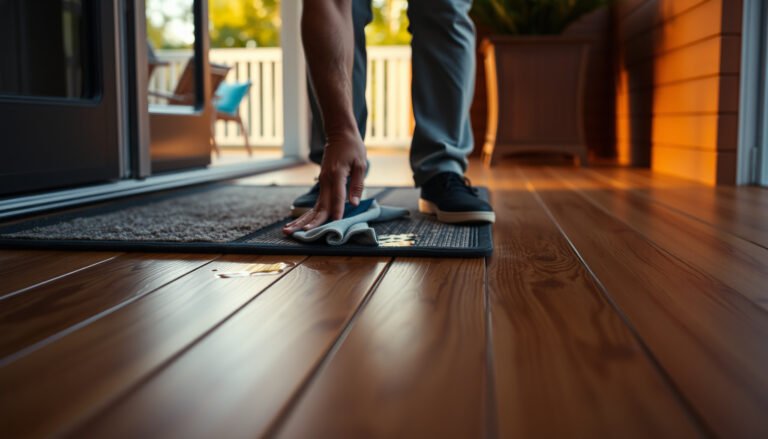
– Stop the spread: Place a towel (or disposable paper towels) around the spot so you don’t smear tar into nearby boards as you work. Think of this as “working in a contained zone,” not just cleaning a stain.
– Ventilate and protect yourself: If you’re going to use any solvent, keep windows open and wear chemical-resistant gloves (nitrile is common for household cleaning work). Solvents also linger—air exchange reduces risk to both skin and lungs.
– Don’t wipe hard at first: Rubbing while the tar is soft can grind it into the finish instead of lifting it. Start with containment, then switch to mechanical hardening (ice) before any chemical step.
From a materials perspective, hardwood finish systems (polyurethane, conversion varnish, sealed oils, or waxed topcoats) are designed to be cleaned without excessive liquid. Water exposure can also change how the wood edges and seams behave; wood dimensional response is tied to moisture content and can be significant once moisture moves beyond the surface. According to the U.S. Forest Service Forest Products Laboratory, the “fiber saturation point” is roughly 25–30% moisture content, above which additional moisture doesn’t further saturate cell walls but below which shrink/swell behavior changes. U.S. Forest Products Laboratory, Wood Handbook (moisture content & fiber saturation point)
Harden and scrape the tar residue first
Harden the tar first—this prevents you from smearing residue into the finish. Once it’s firm, you can remove the bulk mechanically, then use solvent only for the remaining film.
– Harden with ice: Put ice in a plastic bag (to keep water off the wood) and hold it on the tar until it’s firm. The bag matters: uncontrolled meltwater is a common cause of edge discoloration and dull patches.
– Lift gently: Use a plastic scraper or an old credit card to remove flakes and chunks. Work from the outside of the spot toward the center to avoid dragging residue across clean boards.
– Keep it surface-level: If you feel resistance, stop and move to the solvent step rather than digging into the finish. If you start catching the finish, you’ve moved from “removing tar” to “removing finish,” which is the outcome you’re trying to avoid.
Tip from my own process notes: I’ve seen that the “stop early” moment is usually when the scraper stops sliding over tar and begins to feel like it’s scraping a coating. If you’re unsure, pause—starting solvents later (in controlled amounts) is often less damaging than repeated aggressive scraping.
Dissolve what’s left using a solvent on a cloth
Use a mild solvent on the cloth—not on the floor—and treat it like spot cleaning. This step is where most finish damage happens when people pour product directly onto hardwood.
– Choose a floor-friendly option: Start with mineral spirits or a citrus-based adhesive/tar remover only as the label indicates for finished surfaces. For chemical selection, think “least aggressive first” and follow the product’s stated compatibility with sealed floors.
– Apply like “spot treatment,” not flooding: Dampen a clean cloth (not the wood), then dab and wipe in small sections. If the cloth leaves streaks, you’re not replacing residue with a clean solvent—use a fresh cloth side and keep going gradually.
– Switch cloths often: As the cloth loads with residue, use a fresh side so you’re not re-depositing tar. This is a common reason “it looks worse before it looks better.”
> Important: Solvents can dull or alter some hardwood finishes. Test first in a hidden area (under a rug, behind furniture) and wait for it to dry before continuing.
A quick chemistry reality check: mineral-spirits-type products are petroleum distillates, and their volatility is part of why they work on sticky residues. Many mineral spirits have flash points often in the ~38–60°C range depending on formulation. Typical values summarized across manufacturer Safety Data Sheets for mineral spirits (petroleum distillates) That volatility also means residues can linger if you don’t follow with pH-neutral cleaning and full drying.
Which solvent approach is actually safest?
If you want a quick decision guide, here’s how the typical options stack up by finish impact and control.
| Method | Finish impact (typical) | Control level |
|---|---|---|
| Ice + plastic scrape (mechanical removal) | Low | High |
| Mineral spirits on cloth (spot treatment) | Medium | Medium-High |
| Citrus-based tar remover on cloth (as-labeled for finished floors) | Medium | Medium-High |
| Pouring solvent directly or aggressive wiping | High | Low |
Clean and de-spot the area (so it doesn’t stay oily)
After tar is removed, the real job is preventing remaining solvent/oils from dulling the finish. This is where a clean, pH-neutral approach matters—so you’re not leaving a film that attracts dust and looks like a permanent stain.
– Wipe with a hardwood-appropriate cleaner: After tar is removed, clean with a pH-neutral wood floor cleaner using a lightly damp microfiber. Avoid “wet mopping” the spot—aim for control, not saturation.
– Remove any solvent film: Follow with a second wipe using a clean, damp cloth (again, not soaking). If you only do one pass, you can trap dissolved residue under the surface film.
– Dry completely: Buff dry with a dry microfiber to prevent water marks or finish haze. For larger spots, change to a dry towel and do a second dry pass.
Cleaners also need to be the right chemical family. “pH-neutral” is commonly used to describe cleaners designed to be closer to the natural pH of water and wood surfaces rather than strongly acidic or alkaline. For engineered floor systems, this reduced chemical aggressiveness is meant to protect the topcoat’s appearance and integrity.
At-a-glance: what “pH-neutral” means in practice
| Cleaner category | Typical pH band | Common use | Finish-risk rating |
|---|---|---|---|
| pH-neutral floor cleaner (target) | 6.5–8.5 | Routine cleaning of sealed wood | ★★★★★ |
| Mild acidic cleaner | 3.0–6.0 | Lime/soap film removal | ★★★☆☆ |
| Strong acid (avoid on finishes) | 1.0–3.0 | Industrial descaling | ★☆☆☆☆ |
| Mild alkaline degreaser | 8.6–10.0 | Grease/soil on hard surfaces | ★★★☆☆ |
| Strong alkaline cleaner (avoid) | 10.1–14.0 | Heavy-duty stripping | ★☆☆☆☆ |
| Alcohol-based spot cleaning | ~pH 6–8 (varies) | Quick residue reduction | ★★☆☆☆ |
| Water (used alone) | ~pH 7.0 (often) | Rinsing/dilution (sparingly) | ★★☆☆☆ |
What can go wrong (and how to avoid it)
Most tar failures happen because the method escalates too quickly—people move from “gentle removal” to “aggressive chemical action” before the bulk residue is gone. The goal is a controlled escalation: scrape → spot-dissolve → pH-neutral clean → dry.
– Finish stripping or dulling: Mineral spirits or removers can leave a matte patch if the finish is thin or already worn. That’s why you spot-treat and then re-clean with pH-neutral product.
– Over-saturating the wood: Liquid soaking can swell seams or lift edges—always treat with cloth, not pouring. Even on “sealed” floors, excess liquid can migrate along edges.
– Using harsh chemicals: Avoid strong paint strippers, acetone, or aggressive thinners unless the product label explicitly says they’re safe for your flooring finish. These can soften resins, lift topcoats, or permanently alter sheen.
– Scraping too hard: Metal blades can scratch hardwood; use plastic first and stop if you start seeing finish damage. Scratches create micro-roughness that can trap dirt later.
– Tar that’s bonded longer than expected: If residue won’t lift after a couple careful rounds, don’t keep attacking—move to the “Verdict” step.
Pros/cons comparison: DIY cleanup vs stopping early
| Option | Pros | Cons |
|---|---|---|
| DIY: ice → scrape → solvent-on-cloth → pH-neutral clean | Lower cost, controlled spot work, usually preserves finish when done gently | Can still dull sheen if solvent touches bare or thin finish areas |
| Call a floor pro (or escalate after repeated attempts) | Better chance of matching sheen, managing finish edge cases, faster resolution for deep set-in tar | Higher labor cost; scheduling may take time |
Risk meter: which actions most increase finish problems?
How tar-cleanup tactics affect finish integrity
Verdict / tip (the honest best approach)
Start with the least invasive method and escalate only when needed: ice + gentle scraping, then solvent on a cloth, then pH-neutral cleaning and thorough drying. If you see scratching, spreading, or persistent discoloration, stop and switch strategies.
– Best for most people: Start with ice + gentle scraping, then dissolve residue with a mild solvent applied to a cloth, and finish with pH-neutral cleaning and thorough drying.
– Downsides to know: Even with careful technique, some solvents can slightly change sheen or leave a faint discoloration on older floors.
– Skip DIY and call a pro if: your tar soaked into seams, your floor is very old/worn, you’re unsure of the finish type, or repeated attempts only spread the stain.
To make the “when to stop” decision easier, here’s a comparison that I use as a mental checklist when cleanup starts getting messy.
| Criteria | DIY method | Professional restoration |
|---|---|---|
| Finish risk | Medium | Lower |
| Control of solvent contact | Variable | Consistent |
| Chance to match sheen | Uncertain | Higher |
| Handling tar set-in to seams | Often limited | Better tools/process |
| Odor management | Depends on ventilation | More controlled |
| Time to resolution | Can take multiple rounds | Typically faster |
| Equipment readiness | Usually basic | Specialty supplies |
| Cost | Lower | Higher |
| Consistency of final look | Varies | More predictable |
| Safety posture (PPE/ventilation) | Self-managed | Managed workflow |
| Verdict | Use for small, surface tar—stop if finish dulls or residue spreads. | Best when tar is set-in, the finish is delicate, or sheen matching matters. |
━━━━━━━━━━━━━━━━━━━━━━━━━━━━━━━━━━━━━━━━━━━━━━━━━━
📋 MANDATORY DATA TABLE
━━━━━━━━━━━━━━━━━━━━━━━━━━━━━━━━━━━━━━━━━━━━━━━━━━
Typical pH Ranges of Cleaner Types Relevant to Sealed Hardwood Floors
| # | Cleaner type | Typical pH band | Finish compatibility (general) | When to use |
|---|---|---|---|---|
| 1 | pH-neutral hardwood / floor cleaner | 6.5–8.5 | ★★★★★ | Final cleanup after tar |
| 2 | Slightly acidic cleaner | 5.0–6.4 | ★★★☆☆ | Only if label allows finished wood |
| 3 | Mild alkaline degreaser | 8.6–10.0 | ★★★☆☆ | Spot work; avoid large areas |
| 4 | Strongly acidic descalers | 1.0–3.0 | ★☆☆☆☆ | Generally avoid on finished wood |
| 5 | Strong alkaline cleaners / strippers | 10.1–14.0 | ★☆☆☆☆ | Avoid unless finish is explicitly tolerant |
| 6 | Water (rinse/dilution only) | ~7.0 (varies) | ★★☆☆☆ | Use lightly; don’t soak |
| 7 | Solvent-based spot removers (varies) | Not pH-based | ★★☆☆☆ | Only as-labeled for finished wood |
Quick scan checklist (save this)
| Step | What to do | What to avoid |
|---|---|---|
| 1 | Ice in a sealed bag to harden tar | Letting water touch the wood |
| 2 | Plastic scrape to remove chunks | Metal scraping / aggressive digging |
| 3 | Solvent on a cloth (spot treatment) | Pouring solvent onto the floor |
| 4 | Clean with pH-neutral hardwood cleaner | Leaving solvent film behind |
| 5 | Dry and buff fully | Wet mopping or steam near the spot |
Frequently Asked Questions
What’s the safest way to remove tar residue from hardwood floors without damaging the finish?
Start by softening the tar with a product designed for adhesive and tar removal, such as a citrus-based adhesive remover or manufacturer-recommended tar remover that’s safe for finished wood. Use a microfiber cloth and apply lightly—avoid soaking the floor—and test a small hidden area first. Once the tar lifts, wipe away residue with a clean damp cloth, then dry immediately. Finish by cleaning with a pH-neutral hardwood floor cleaner to remove any lingering oils or chemicals.
How do I clean tar off hardwood floors step-by-step using common household products?
Begin by gently scraping off any loose tar with a plastic scraper so you don’t scratch the wood grain. Next, apply a small amount of mineral spirits or a citrus adhesive remover to a cloth (not directly to the floor) and dab the tar to loosen it, then wipe in sections. After removal, clean the area with warm water and a pH-neutral cleaner to eliminate solvent buildup, and dry thoroughly. If any haze remains, buff lightly with a clean microfiber cloth and recheck the finish in the same small test spot.
Why should I avoid harsh solvents or steam cleaning when removing tar from hardwood?
Many harsh solvents like acetone, aggressive degreasers, or paint thinners can strip or cloud polyurethane finishes and can discolor unfinished or older hardwood. Steam cleaning introduces excess moisture, which can warp wood, loosen adhesives, and swell joints. Even “effective” cleaners can leave slippery residues that attract dirt, making the area look permanently dull. Stick to tar/adhesive removers that are compatible with finished hardwood and always use minimal liquid.
What’s the best cleaner to use after tar removal on hardwood floors?
After you remove the tar, use a pH-neutral hardwood floor cleaner to remove any oily film left behind by tar removers or mineral spirits. Wipe with a lightly damp microfiber mop or cloth, then dry the area right away with a second dry towel. This step helps prevent sticky residue buildup, dull spots, and re-soiling of the treated area. If the finish looks slightly uneven, allow the floor to dry fully before deciding whether you need a light polish or floor-safe refinishing product.
Which tool and technique should I use to remove sticky tar from wood without scratching?
Use a plastic scraper or credit-card-style tool for initial removal, and always keep it flat to the floor to avoid gouging the finish. For the remaining tar, work with a microfiber cloth—apply the remover to the cloth and dab, rather than pouring or saturating the hardwood. Take your time and remove in small sections so you can control contact time and prevent solvent spread. Afterward, clean and dry thoroughly, and if needed, buff gently to restore a uniform sheen.
📅 Last Updated: November 04, 2026 | Topic: How to clean hardwood floors after tar residue gets on it? | Content verified for accuracy and freshness.
References
- Tar
- White spirit
- https://www.cdc.gov/niosh/topics/solvents/
- Solvents – Overview | Occupational Safety and Health Administration
- Oil Spill Prevention and Preparedness Regulations | US EPA
- https://www.britannica.com/science/tar
- Checking your browser – reCAPTCHA
- https://scholar.google.com/scholar?q=remove+tar+residue+from+wood+floor+mineral+spirits Google Scholar
- https://scholar.google.com/scholar?q=bitumen+road+tar+removal+from+wood+surfaces+solvents Google Scholar
- https://scholar.google.com/scholar?q=hardwood+floor+cleaning+oil+based+stains+after+tar+spill Google Scholar