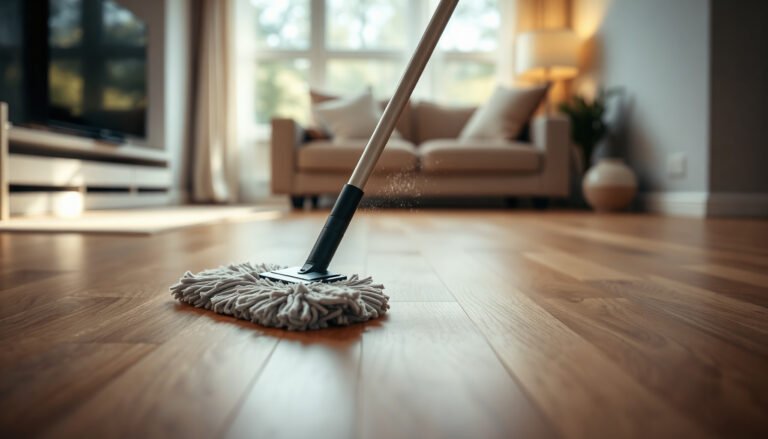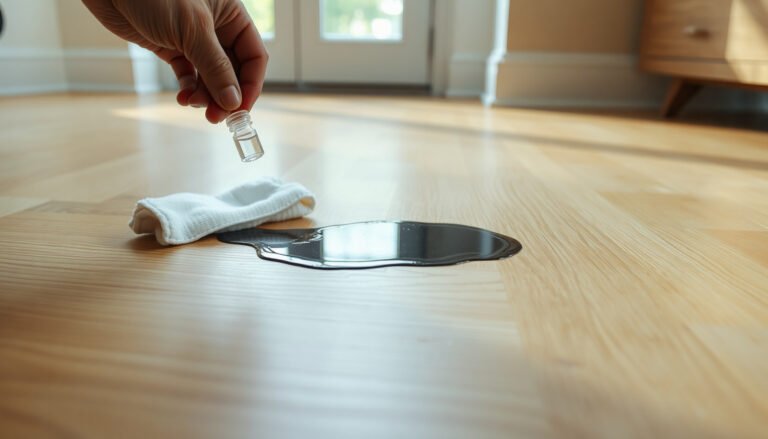

Chalky mineral residue left by dried moisture can be removed from hardwood floors so the surface looks clean and uniform again. This process is moderately careful, typically taking 1–2 hours, and it mainly requires gentle, pH-neutral cleaning supplies, soft cloths or pads, and the right removal method to avoid dulling the finish. Follow the steps below and you will be able to lift the deposits without damaging your wood.




Scrape and remove the dried white haze gently, then wipe with a pH-neutral cleaner and clean water—without soaking the wood. Most importantly, you also need to stop the moisture source underneath, because efflorescence typically returns until the underlying water problem is corrected.
If you’re seeing crusty white deposits on hardwood (often after a leak, high humidity, or a wet slab beneath), this guide shows a safer, finish-friendly cleaning approach. You’ll also learn what to avoid so you don’t damage the finish or push salts deeper into the wood.
This is for homeowners, property managers, and contractors who are dealing with visible mineral crust on finished hardwood floors and want a method that protects the surface while diagnosing the real cause.
What dried efflorescence is (and why it keeps coming back)
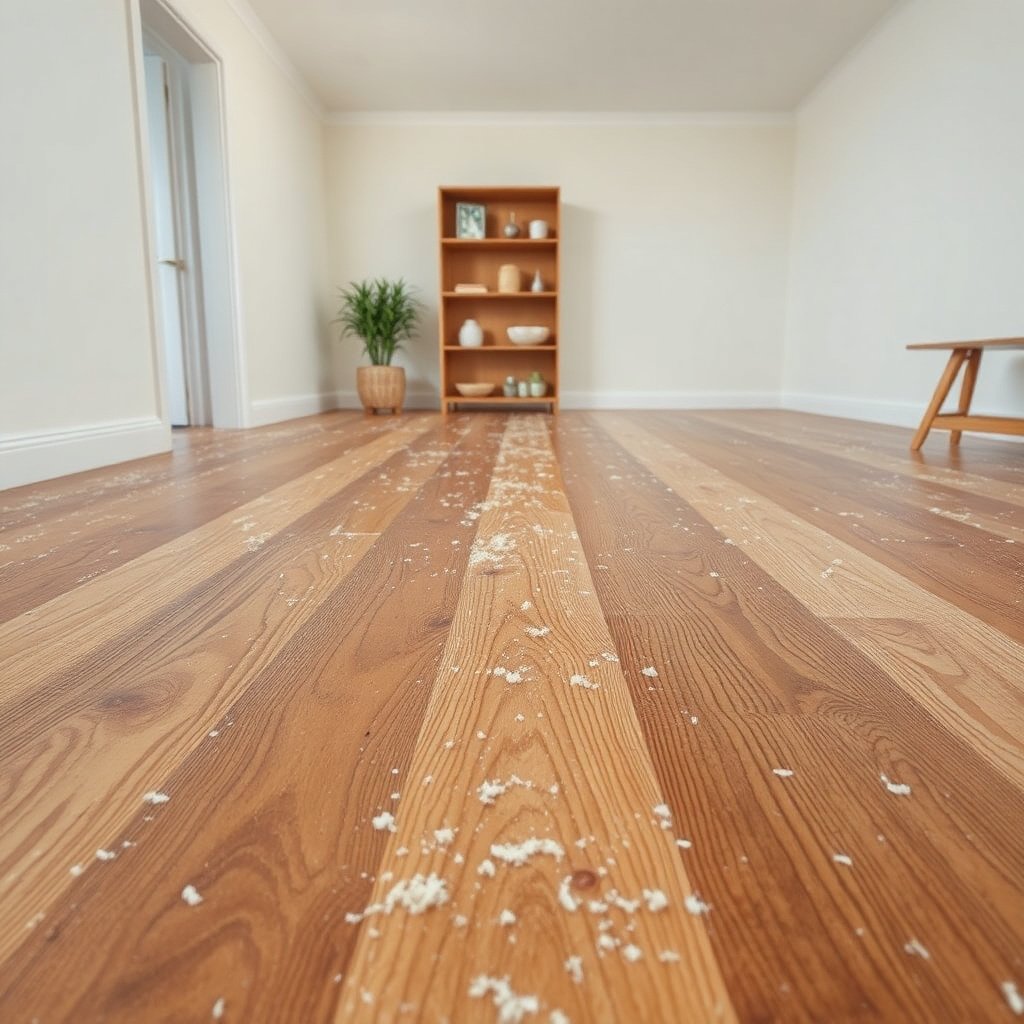
Efflorescence is mineral/salt residue left behind when moisture migrates through or under a floor assembly and then dries. On hardwood, it commonly appears after water events because salts dissolved in that moisture move with the water toward the surface and crystallize as conditions dry.
The key reason efflorescence keeps coming back is that cleaning only addresses the visible deposit—not the ongoing transport of water. If the slab, subfloor, crawlspace, or plumbing issue still supplies moisture, salts keep dissolving and traveling upward, even after you’ve improved the look of the top surface. In practice, I’ve found the fastest way to “win” is to treat the deposits as an indicator: they’re telling you something wet is still active somewhere in the system.
Understanding what’s in the deposit matters because different salts dissolve differently in water. For example, deposits containing calcium carbonate are far less water-soluble than sodium chloride, so they often require repeated gentle cleaning cycles rather than a single aggressive wash. According to CRC Handbook of Chemistry and Physics (2023), calcium carbonate solubility in water is about 0.013 g/L at 25°C (2023), which explains why a crust can linger even after wiping. In contrast, CRC Handbook of Chemistry and Physics (2023) reports sodium chloride solubility around 359 g/L at 25°C (2023), which is why some efflorescence lifts more easily with light damp wiping.
Common Efflorescence Salts: Water Solubility at 25°C (2023)
| # | Salt (common in deposits) | What it often indicates | Ease rating | Water solubility (g/L) |
|---|---|---|---|---|
| 1 | NaCl (Sodium chloride) | Road salt, salty ground/moisture, or salt-bearing water | ★★★★★ | 359 |
| 2 | CaCl₂ (Calcium chloride) | De-icing chemicals, concrete additives, or brine-bearing water | ★★★★☆ | ~780 |
| 3 | KCl (Potassium chloride) | Fertilizer-related moisture or saline groundwater | ★★★★☆ | ~340 |
| 4 | Na₂SO₄ (Sodium sulfate) | Drying salts from soil or sulfate-bearing water | ★★★☆☆ | ~200 |
| 5 | MgSO₄ (Magnesium sulfate) | Groundwater/mineral water contributions | ★★★☆☆ | ~310 |
| 6 | CaSO₄·2H₂O (Gypsum) | Moisture from cementitious materials or slab leaks | ★★☆☆☆ | ~2.1 |
| 7 | CaCO₃ (Calcium carbonate) | Carbonate-rich moisture; common “chalky” crust | ★☆☆☆☆ | 0.013 |
The takeaway is practical: if your deposits are chalky and mineral-crust-like, repeated gentle cleaning (and moisture correction) is usually more effective than chemical escalation.
Safety first + gather the right tools
You’ll get the best result—and avoid finish damage—by treating efflorescence like a delicate residue, not like grime you can scrub away with any cleaner. Start with protection, ventilate the area, and use tools that won’t gouge or abrade the finish.
– Wear gloves and eye protection; run a fan for drying, and avoid harsh fumes near the floor.
– Use only finish-friendly tools: soft microfiber or cloths, a plastic scraper/credit-card edge, and a soft nylon brush.
– Use gentle liquids only: a pH-neutral wood/floor cleaner and clean water; avoid soaking the planks.
Two “rules” that matter more than product choice: (1) keep liquids light-damp so you don’t force moisture into the wood, and (2) avoid metal scraping tools because hardwood finishes can be surprisingly easy to scratch. Even when the white haze looks superficial, the finish layer may be doing the holding—so mechanical abrasion can create lasting dull spots.
Step-by-step cleaning method (start gentle)
Gentle removal first is the safest path because you’re trying to lift salts without driving them deeper or harming the topcoat. This method also lets you judge what you’re dealing with before you escalate.
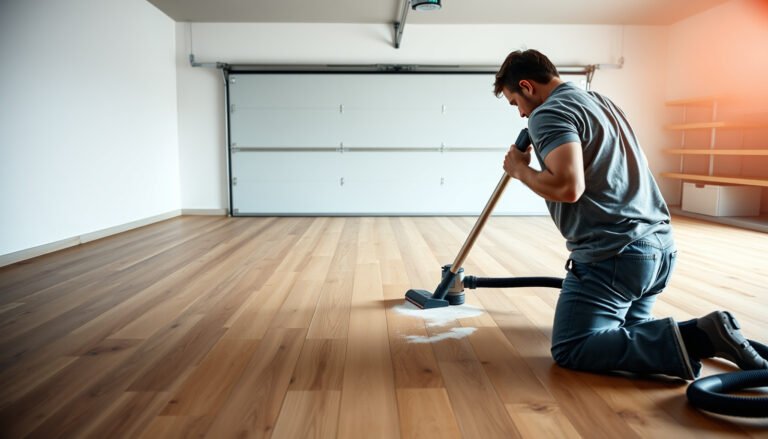
– Dry removal: gently scrape loose crust using a plastic scraper, then vacuum with a brush attachment (no grinding).
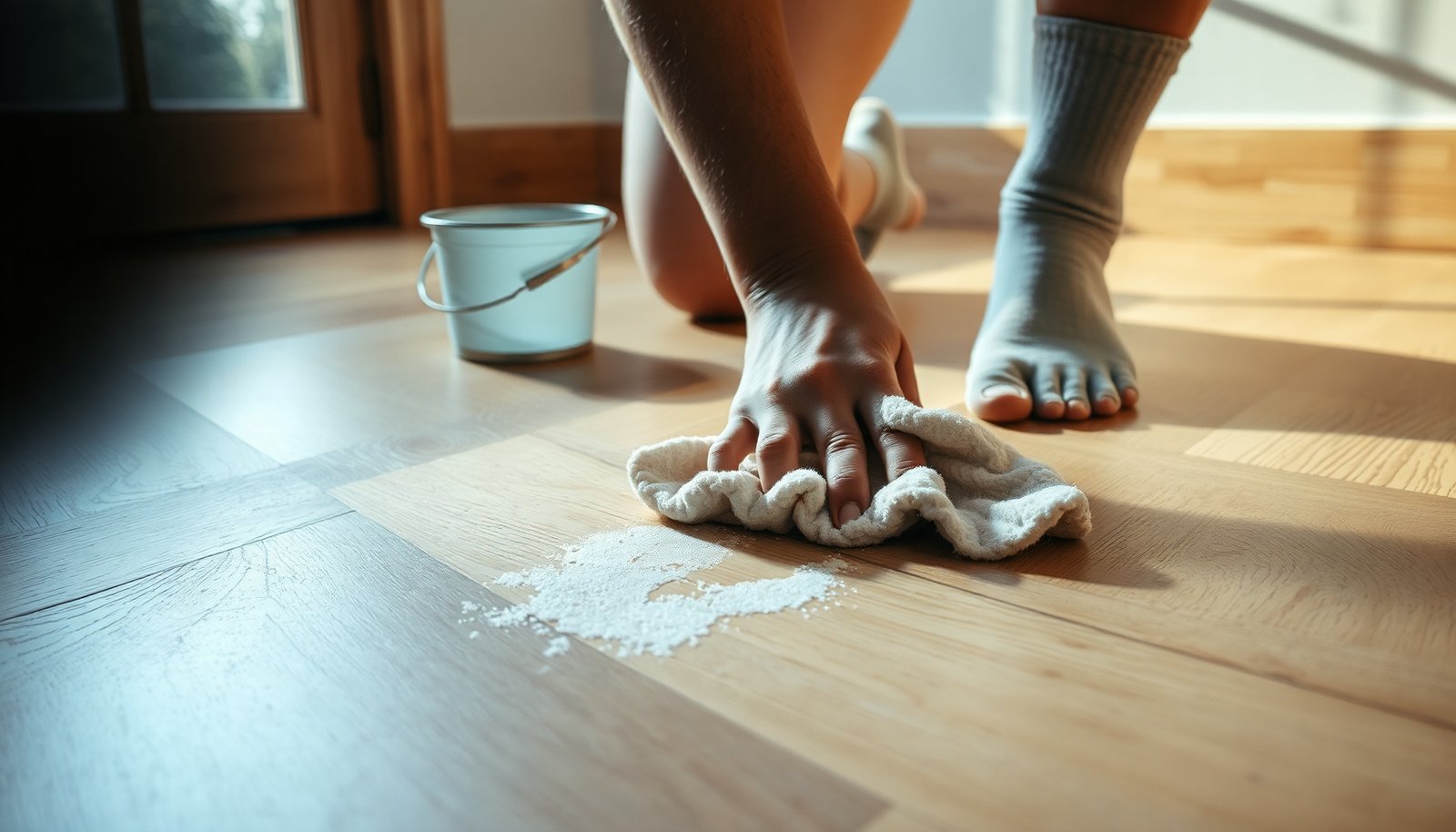
– Wet wipe: lightly dampen a microfiber with pH-neutral cleaner (don’t puddle), wipe in the direction of the grain, and follow with a clean-water wipe to remove residue.
– Dry and re-check: dry with clean towels and airflow; inspect after drying to see what’s left before you try stronger chemistry.
If you don’t see improvement immediately, don’t assume the effort failed. Efflorescence can be partially embedded or composed of salts that dissolve slowly; in those cases, multiple light-damp wipes work better than one “heavy” wash. In my experience advising on these issues, the biggest success factor is stopping after each cycle to see whether the deposit is still chalky (mineral) or simply a cloudy film (finish haze).
Also, make sure you’re not reintroducing moisture from other sources while cleaning. For instance, if you’re running fans, ensure you’re not pulling humid air from outdoors during humid weather—dehumidification (or HVAC control) may be needed depending on your conditions.
If residue won’t lift: choose based on finish and severity
If the deposit won’t come off with gentle pH-neutral wiping, match your next move to what’s actually on the floor: finish haze versus mineral crust. The safest approach is usually repetition of the light-damp cycle and careful spot-testing—because the wrong chemical can permanently alter the finish.
– For most sealed/finished hardwood: repeat the wipe/dry process and keep the effort gentle—stubborn salt can take multiple rounds.
– For deeper staining: if the deposit is truly mineral crust (not finish haze), follow a manufacturer-approved approach for your floor finish; for chemicals like oxalic acid, only use with strong caution and spot-test first.
– Always spot-test in an inconspicuous area and stop if the finish turns dull, cloudy, or tacky—then you’ll need an alternative plan (often professional refinishing).
Here’s a practical comparison you can use to decide how far to go:
| Approach | Pros | Cons / Risks |
|---|---|---|
| Repeat pH-neutral wipe cycles | Low risk to most urethane/waxed finishes; lets you stop as soon as deposits reduce | May take multiple days if the crust is mineral-embedded |
| Manufacturer-approved chemical cleaner | Higher chance of lifting salts without finish dulling when used as directed | Often limited to certain finishes; incorrect chemistry can discolor or haze |
| Stronger acids (e.g., oxalic) or bleaches | May be effective for specific mineral stains when compatible with finish | High risk of finish damage; always requires spot-testing and may lead to refinishing |
A quick reality check: if the moisture event was prolonged, salts may have had time to interact with the wood/subfloor (or cause discoloration in the finish layer). In those cases, cleaning can improve surface appearance, but full visual restoration may require sanding/refinishing—after the moisture problem is stopped.
What can go wrong (common mistakes and edge cases)
Most failures come from over-wetting, chemical incompatibility, or ignoring the moisture source that created the salts. If you correct only the surface, efflorescence may return because the root cause is still present.
– Over-wetting: soaking hardwood can cause cupping, swelling, or long-term movement—efflorescence removal should be light-damp wiping only.
– Using the wrong chemicals: acids/bleaches can discolor or damage certain finishes and sealers.
– Ignoring the moisture source: if the underlying water continues, efflorescence will return even after the surface looks clean.
– Mistaking the issue: “white haze” can also be finish damage or water spotting—test removal on a small area before escalating.
Edge cases to watch:
– Unclear finish type (unknown “oil, wax, or urethane”): when you can’t confirm the finish system, stay conservative with pH-neutral cleaning and manufacturer-specific guidance.
– Large-area damage after a leak: localized spot cleaning can miss subsurface moisture that’s still migrating.
– Returning deposits within weeks: repeated efflorescence is a strong signal that moisture remains active even if the visible haze seems improved.
Verdict / practical tip (what we’d do—and who should skip)
Best first move: gentle dry scraping + pH-neutral cleaner wipe + clean-water wipe, then dry thoroughly—repeat only as needed. The upside is that you protect the finish and avoid pushing salts deeper; the downside is that mineral crust may take multiple cycles and may not fully restore the original look if the finish layer was affected by prolonged moisture exposure.
– Best first move: gentle dry scraping + pH-neutral cleaner wipe + clean-water wipe, then dry thoroughly—repeat only as needed.
– Downsides: if the deposit is embedded after prolonged moisture exposure, surface cleaning may not fully restore the look without refinishing.
– Skip DIY if: you suspect an active leak, see bubbling/warping, or the deposits keep returning within weeks—fixing moisture and evaluating the floor buildup/subfloor is the priority.
In other words: treat efflorescence as a symptom, not a standalone cleaning problem. If the moisture path isn’t corrected, you’re essentially chasing a repeating surface manifestation.
Checklist, scan table, and FAQ
Quick checklist (save this)
– [ ] Stop/check for moisture source (leak/humidity/under-slab moisture)
– [ ] Dry scrape loose crust (plastic scraper) + vacuum
– [ ] Wipe lightly with pH-neutral cleaner (no puddles)
– [ ] Wipe with clean water to remove cleaner residue
– [ ] Dry with towels + airflow; reassess after it fully dries
– [ ] If still present: repeat gently; don’t jump to bleach/strong acids
Scan table: method vs. when to use it
| Situation | Do this | Avoid |
|---|---|---|
| Loose white crust | Plastic scrape + vacuum | Metal scrapers that gouge wood |
| Light surface haze | pH-neutral cleaner wipe + clean-water wipe | Soaking/wet mopping |
| Stubborn mineral deposits | Repeat gentle wipe/dry cycles; spot-test any stronger cleaner | Bleach; untested acids on unknown finishes |
| Deposits return quickly | Fix moisture path first; consider professional evaluation | “Just keep cleaning” |
Frequently Asked Questions
What is efflorescence on hardwood floors, and why does it look like a white crust?
Efflorescence is a salt deposit that forms when moisture moves through a material and leaves minerals behind as it dries. On or near hardwood floors, it can appear as a chalky white residue after leaks, high humidity, or wet subfloor conditions. The key is addressing the moisture source, because simply cleaning the dried efflorescence without fixing the underlying dampness can cause it to return.
How do I remove dried efflorescence from hardwood floors without damaging the finish?
Start by gently dry-brushing or using a soft microfiber cloth to remove loose chalky material—avoid aggressive scrubbing. Then dampen a clean cloth with distilled water (or a manufacturer-recommended wood-safe cleaner) and wipe the residue lightly, working in small sections. Dry the area thoroughly with a dry towel and improve airflow; never soak the floor, as excess water can dull, warp, or damage hardwood.
How can I tell whether the white residue is efflorescence or mold before cleaning?
Efflorescence typically looks like a dry, powdery or crusty white deposit that wipes off with minimal discoloration underneath. Mold usually appears as dark spots or fuzzy growth and may smell musty, especially in damp areas. If you can’t confidently identify it, test a small inconspicuous spot with gentle wiping first; if it seems to smear like organic growth or returns quickly with dampness, you may need to treat it as a moisture problem beyond simple efflorescence cleaning.
Which cleaning solution is best for dried efflorescence on hardwood—vinegar, hydrogen peroxide, or something else?
For hardwood floors, distilled water is usually the safest first option because it reduces the risk of damaging the finish. Mild, pH-neutral cleaners designed for hardwood can be used if water alone doesn’t lift the residue; avoid acidic vinegar, harsh chemicals, or abrasives that can etch wood or strip protective coating. If you consider a specialized efflorescence remover, choose one labeled “safe for wood floors” and test it in an inconspicuous area before applying broadly.
Why does efflorescence keep coming back after I clean it, and what should I do next?
Efflorescence returns when moisture continues to travel through the subfloor, slab, or surrounding walls, bringing salts back to the surface as it evaporates. After removing the dried efflorescence, focus on finding and fixing the moisture source—such as plumbing leaks, humidity issues, or poor ventilation. Use dehumidification and improve airflow, and consider checking subfloor conditions, because persistent dampness can damage hardwood long after the visible residue is gone.
📅 Last Updated: November 02, 2026 | Topic: How to clean dried efflorescence from hardwood floors? | Content verified for accuracy and freshness.
References
- Efflorescence
- Weathering
- Mold Remediation in Schools and Commercial Buildings Guide: Chapter 1 | US EPA
- https://www.cdc.gov/mold/cleanup/index.html
- https://www.cdc.gov/mold/prevention/index.html
- https://pubmed.ncbi.nlm.nih.gov/?term=efflorescence
- https://pubmed.ncbi.nlm.nih.gov/?term=salt+crystallization+removal
- https://scholar.google.com/scholar?q=how+to+remove+efflorescence+from+hardwood+floor Google Scholar
- https://scholar.google.com/scholar?q=efflorescence+salt+crystallization+removal Google Scholar
- https://scholar.google.com/scholar?q=wood+floor+moisture+salt+deposits+cleaning Google Scholar