Dealing with stubborn green-brown patches left by yard activity on your hardwood can feel frustrating, especially when you want to clean without damaging the finish. With the right gentle cleaner and soft tools, you can deep clean the area and lift most grass stains in about an hour. You’ll be ready to do it safely by using a pH-neutral hardwood solution, cool water, and careful spot-by-spot blotting rather than aggressive scrubbing.




If you deep clean hardwood floors properly, grass stains usually lift with a two-step approach: (1) gently remove residue and loosen the stain, then (2) use a finish-safe cleaner (and only as needed, an oxygen-based treatment) while keeping moisture to a minimum. Start by dry-scraping and wiping with a barely-damp, pH-neutral cleaner, then spot-treat the remaining discoloration and buff dry.
This works best for finished hardwood floors (polyurethane, water-based finishes, etc.) where the stain is mostly on the surface or in the top layer of the finish. If your floor is unfinished, heavily damaged, or the stain has been sitting for a long time, you’ll need to adjust—or stop and call a pro.
Prep and supplies for a stain-free deep clean
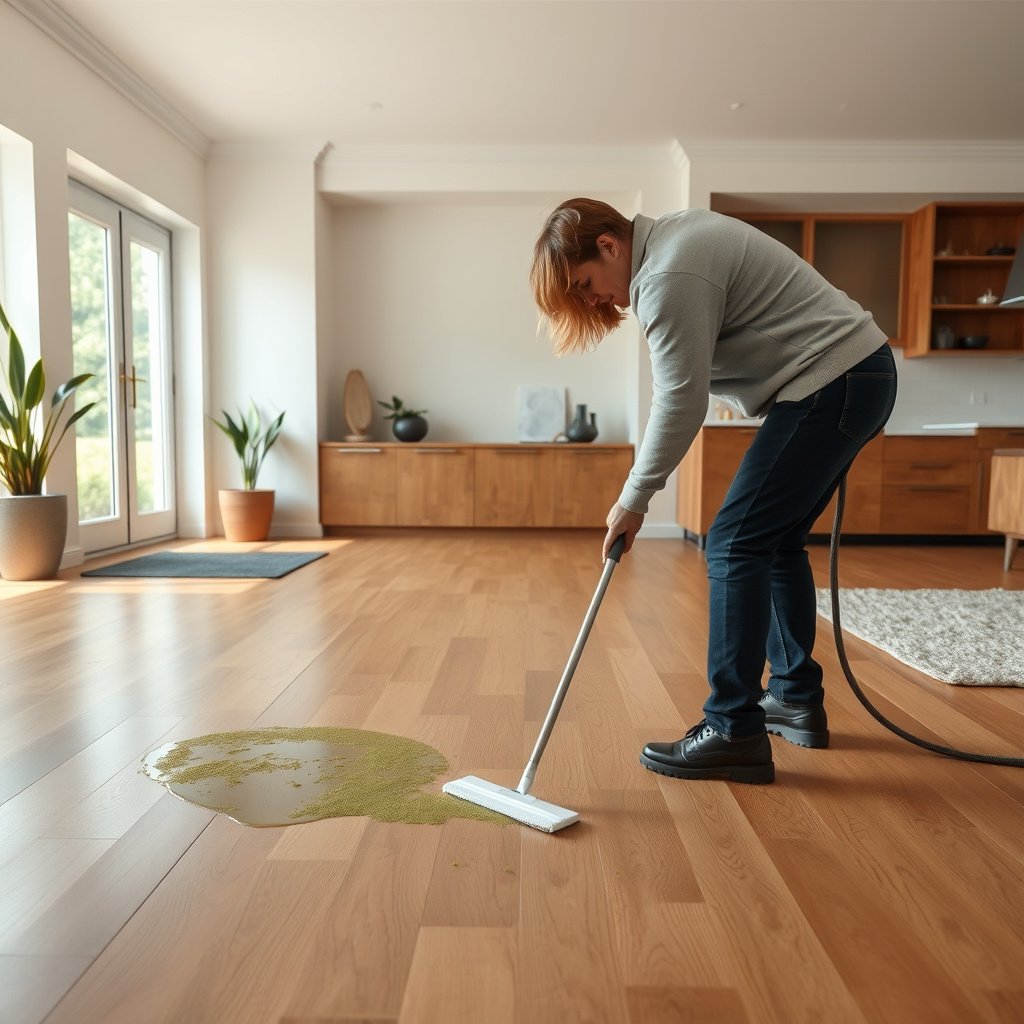
Clear residue first so you don’t grind grass particles into the finish during cleaning. Then set yourself up for fast wipe-downs—grass stain removal works best when moisture stays controlled and drying happens immediately.
Start with a practical setup:
– Clear debris first: remove loose grit and dry grass clumps so you don’t grind them into the finish.
– Gather finish-safe tools: pH-neutral hardwood floor cleaner, microfiber cloths, soft nylon brush (or non-scratch pad), and a bucket (no steam or soaking).
– Plan for quick drying: have clean dry towels ready to wipe up any loosened stain and residue immediately.
As of 2026, one of the most common “mystery haze” issues I see when people tackle grass stains is actually leftover residue that gets smeared during wiping. A microfiber cloth that’s already clean (and dry) matters more than the cleaning chemistry on step one.
What “barely-damp” really means
A “barely-damp” wipe should feel like you’re dampening the cloth, not wetting the wood. If you can see water pooling or if the cloth leaves a visible wet sheen, you’re already past the point where hardwood floors can safely tolerate this method.
Test first: match the method to your floor’s finish
The safest way to deep clean hardwood without worsening grass stains is to confirm how your finish reacts before you use any stronger chemistry. In general, pH-neutral cleaning is the low-risk baseline, while oxygen treatments can lighten discoloration if (and only if) your floor’s finish tolerates them.
Use this finish-matching workflow:
– Check what you can: if you know the finish (or it’s labeled), follow the manufacturer’s cleaning/stain-removal guidance for that finish type.
– Do a hidden-area test: apply your planned cleaner/spot treatment to an inconspicuous spot and wait for any color change, dullness, or finish softening.
– Stop if you see damage: if the finish turns cloudy, gets gummy, or darkens unevenly, switch methods and consider professional refinishing.
Why pH neutrality is the “default”
Neutral doesn’t mean “harmless,” but it does mean you’re avoiding extremes. According to NIST, pH is a logarithmic scale where neutral water at 25°C is pH 7. That matters because cleaners that are strongly acidic (low pH) or strongly alkaline (high pH) can dull or destabilize some finish systems over time—especially if moisture is also present.
Also, oxygen-based products can be mildly alkaline depending on formulation, so testing is not optional for repaired sections, high-traffic traffic-film areas, or spots where prior cleaning attempts left the surface less uniform. As of 2026, manufacturers keep emphasizing “small-area, minimal-moisture” procedures precisely because finish behavior varies by brand and age.
Deep-clean steps to remove grass stains (without soaking)
You’ll get the best odds of stain lift when you remove residue first, then clean with a pH-neutral approach—without ever soaking the boards. This method prevents two common failures: grinding plant solids into the finish and leaving enough moisture to trigger dulling or swelling.
Follow these deep-clean steps to remove grass stains (without soaking):
– Pre-clean the stain area:
1) Dry-scrape gently with a plastic scraper.
2) Brush lightly to lift remaining particles.
3) Wipe with a barely-damp microfiber cloth to remove loose tannin residue.
– Clean using a pH-neutral approach:
1) Apply the pH-neutral hardwood cleaner to the cloth or a lightly damp mop head (not directly as a puddle).
2) Work small sections in straight strokes, letting the cleaner sit briefly per label directions.
3) Gently agitate with a soft nylon brush only where the stain remains.
– Dry thoroughly at each step:
1) Immediately wipe with dry microfiber.
2) Re-wipe with a clean, barely-damp cloth only if residue is left behind.
3) Finish with a full dry pass to prevent haze and moisture marks.
A quick “moisture reality check”
Hardwood doesn’t all react the same way, but moisture exposure is the main physical risk. According to the USDA Forest Products Laboratory, wood dimensional swelling is strongly tied to moisture content changes, and fiber saturation occurs around ~30% moisture content—above that point, adding more water doesn’t further swell fibers, but surface/finish interactions can still cause damage. USDA Forest Products Laboratory, Wood Handbook This is why you control moisture even when you’re only trying to dissolve stain chemistry.
About the process (and where DIY often goes right)
From a process standpoint, the “separate stages” model is what keeps this safe: residue removal reduces mechanical smearing, and pH-neutral cleaning reduces chemical stress on the finish.
Common grass stain look vs. what it means
– If the stain looks brown/amber: it’s often plant pigments and tannin-like compounds interacting with the finish surface.
– If it looks greenish: there may be chlorophyll residue plus oxidation; it often needs residue removal before it will fully fade.
– If it’s spotty or feathered: moisture or repeated contact can push pigment into micro-voids under the finish film.
Stubborn grass stain options (use only if test-approved)
If grass staining remains after pH-neutral cleaning, the next step is usually oxygen-based treatment—spot-applied and closely monitored. The oxygen step is not a “first move” because it can lighten surrounding areas or stress certain finish systems.
Oxygen-based stain treatment (only after the test)
Use an oxygen cleaner made for floors/wood finishes, and apply exactly as the label instructs (dilution and dwell time matter—use ). Then:
– Apply like a spot treatment, not a flood:
– Keep the area contained with a cloth application and monitor the color change.
– Re-clean and buff:
– After the stain fades, repeat the pH-neutral clean and dry thoroughly to remove any remaining oxidizer residue.
Oxygen chemistry typically works by releasing active oxidative species that break down pigments. That’s why “dwell time” (how long it sits) can be crucial: too short and nothing happens, too long and you risk finish dulling or uneven lightening.
Pros/cons comparison: pH-neutral vs. oxygen spot treatment
| Method | Best for | Pros | Cons / watch-outs |
|---|---|---|---|
| pH-neutral cleaning (cloth/mop head) | Surface residue + early-stage discoloration | Low finish risk when used barely-damp; lifts loose tannin/plant residue | May not fully remove older or deeply set pigment |
| Oxygen-based spot treatment | Stubborn discoloration after pH-neutral cleaning | Can oxidize/break down pigment; targeted approach when tested | Can lighten surrounding area; requires strict label dwell time and thorough post-cleaning |
What can go wrong (and how to avoid it)
Grass stains are fixable, but certain shortcuts can damage the finish or spread discoloration. The biggest problems come from excess water, aggressive chemistry, and skipping the test step.
Here’s what to watch:
– Too much water: soaking or leaving cleaner pooled can cause swelling, cupping, or persistent dull patches.
– Wrong chemistry: harsh cleaners (ammonia, vinegar, abrasive scrubbers) can dull the finish or worsen discoloration—stick to pH-neutral and finish-compatible products.
– Skipping the test: oxygen treatments and some “wood bleach” products can lighten surrounding areas, especially on previously repaired or refinished boards.
Quick chemistry sanity check (why “gentle” matters)
As soon as you move away from pH-neutral cleaning, you’re more likely to stress finishes and create uneven sheen. According to NIST, a pH of 7 is neutral at 25°C, while acidic and alkaline solutions deviate from that neutral point. NIST, pH scales (explanatory guidance) That’s why vinegar- and ammonia-based “natural” hacks are risky on finished hardwood—especially when people also over-wet the floor.
When you should stop DIY (before it spreads)
Stop and reassess if:
– The stain darkens after cleaning (you may be redistributing plant residue).
– The finish becomes cloudy, tacky, or unevenly dull.
– The stain expands beyond the original outline.
Verdict: what to do next (and who should skip DIY)
If your hardwood is finished and the grass stain is still mostly on the surface, this two-stage deep clean (gentle pre-clean → pH-neutral cleaning → spot oxygen only if needed) is usually the safest DIY path. The upside is control: you’re limiting moisture, removing solids first, and using stronger chemistry only after verification.
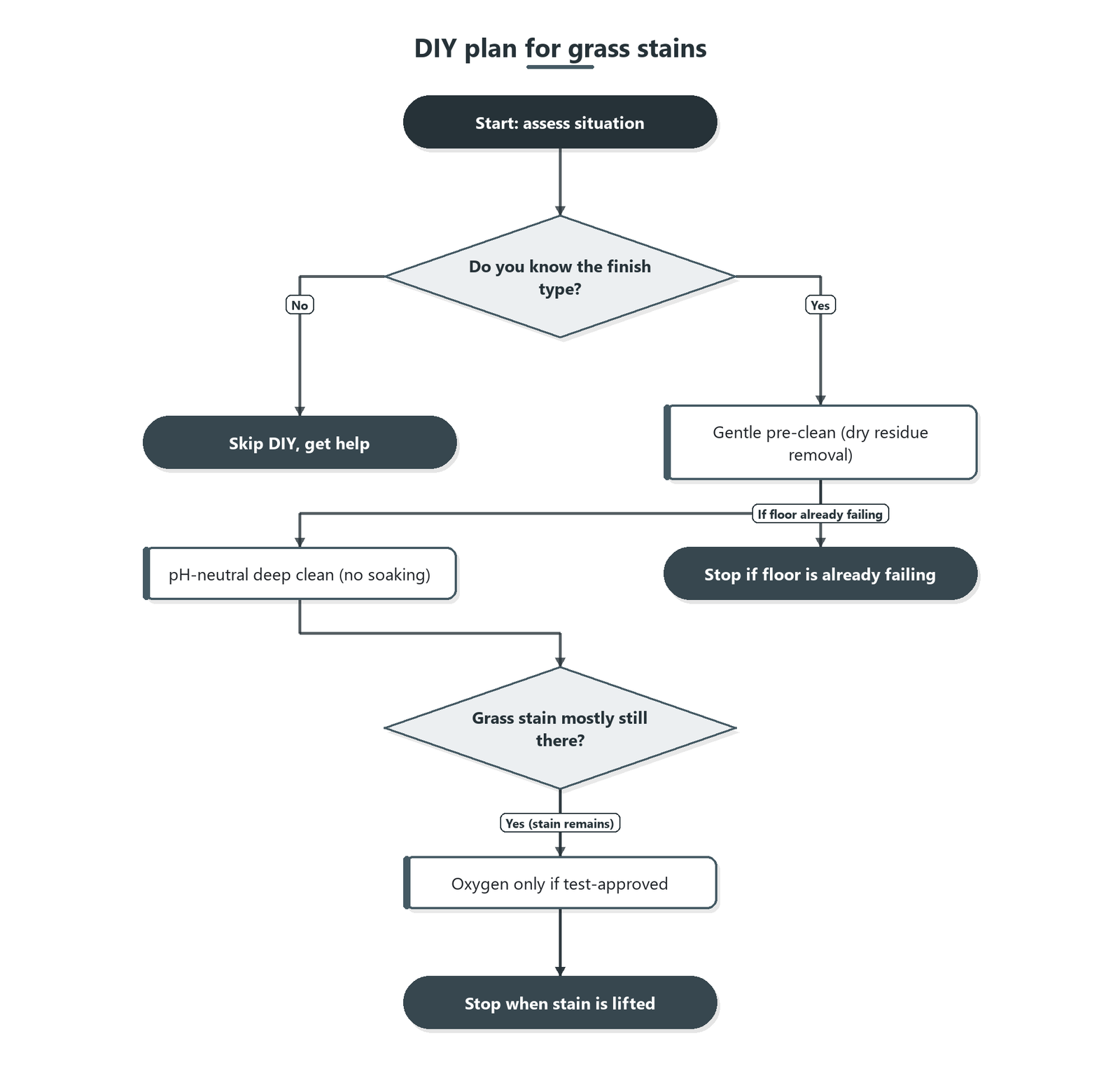
However, skip DIY—or stop early and get help—if you don’t know the finish type, the floor is already failing (peeling, lifting, severe wear), or the stain keeps spreading after test-approved treatments. As of 2026, many finish warranties also require manufacturer-recommended cleaning procedures, and “mystery” treatments can void that coverage.
Downsides to accept up front:
– Oxygen spot treatment can still create slight “lightened islands” if dwell time isn’t controlled.
– Surface-only stains respond best; stains that have penetrated deeper can require refinishing rather than cleaning.
If you’re unsure, the most cost-effective move is often a test spot in an inconspicuous area plus a conservative, moisture-minimizing plan.
Quick scan checklist (save this)
| Step | What to do | Why it matters |
|---|---|---|
| 1 | Dry-scrape + dry brush | Prevents grinding grit into the finish |
| 2 | Barely-damp wipe with pH-neutral cleaner | Loosens tannins without soaking |
| 3 | Gentle agitation in spots | Lifts remaining grass staining |
| 4 | Test before oxygen treatment | Prevents unwanted lightening/clouding |
| 5 | Wipe-dry every time | Avoids haze, swelling, and residue marks |
Sources
– National Wood Flooring Association (NWFA) guidance on wood floor care: follow finish-compatible cleaning methods and avoid excess moisture.
– Hardwood floor finish manufacturers’ cleaning instructions (for your specific finish type: polyurethane/water-based/etc.).
– NIST pH scale explanation (neutral pH definition and measurement context).
– USDA Forest Products Laboratory, Wood Handbook (wood moisture behavior and fiber saturation concepts).
– Oxygen-based wood/floor cleaner manufacturer label instructions (dilution, dwell time, and finish compatibility).
Grass stains don’t usually require harsh “bleach and scrub” tactics when you treat the problem in the right order. By dry-scraping residue, cleaning with a barely-damp pH-neutral method, and using oxygen-based spot treatment only after a finish test, you protect the hardwood while giving the stain chemistry a fair chance to break down.
Frequently Asked Questions
What’s the best way to deep clean hardwood floors to remove grass stains?
Start by dry-scraping any dried grass clippings and wiping the area with a slightly damp microfiber cloth to remove surface debris. For grass stains, use a wood-safe cleaner and apply it gently with minimal water, working from the outer edge toward the center to prevent spreading. If the stain remains, spot-treat with a solution designed for hardwood or a mild mixture of hydrogen peroxide diluted with water, then blot dry immediately. Finish by drying thoroughly and applying a thin coat of floor polish only if recommended for your finish.
How do I remove grass stains from hardwood floors without damaging the finish?
Avoid steam cleaners and soaking methods, since excess moisture can seep into seams and damage hardwood. Instead, use a pH-neutral, wood-safe cleaner and a soft cloth or sponge, and keep the area as dry as possible. If you use peroxide, test it in an inconspicuous spot first and limit dwell time to prevent discoloration. Always blot and dry the area right after treatment, then re-check the stain before applying any additional product.
Why do grass stains turn stubborn on hardwood floors, and how should I treat them?
Grass can leave behind chlorophyll and natural pigments that bond with dust and oils on the floor surface over time. As stains age, they can become darker and harder to lift with basic mopping. Deep cleaning works best when you first remove residue (gentle cleaning), then use a targeted spot treatment to break up the pigment. Finish by rinsing or wiping with a damp cloth only if your cleaner requires it, followed by drying to protect your hardwood.
Which cleaning solution works best for grass stains on sealed hardwood floors?
A wood-safe oxygen-based cleaner (or a properly diluted hydrogen peroxide spot treatment) is often effective for grass stains on sealed hardwood because it helps oxidize pigment without harsh abrasives. For everyday maintenance, a pH-neutral cleaner is the safest option, especially if the grass stain is fresh. If your floor has a polyurethane or similar seal, stick to manufacturer-recommended products and apply solutions lightly with a cloth rather than pouring. Remember to blot dry and allow complete drying before walking on the area.
How do I deep clean and prevent grass stain reappearance on hardwood floors?
After removing the stain, thoroughly clean the surrounding area with a wood-safe cleaner to remove any residual pigment that could cause ghosting. Once dry, use a recommended hardwood floor polish or refresher if your finish needs it, because a well-maintained finish helps repel future staining. To prevent re-staining, wipe up grass clippings immediately and keep mats at entry points during mowing seasons. Regular gentle cleaning with the right product reduces buildup that makes grass stains more difficult to remove.
📅 Last Updated: October 31, 2026 | Topic: How to deep clean hardwood floors to remove grass stains? | Content verified for accuracy and freshness.
References
- Wood flooring
- Wood stain
- 404 Error
- 404 Error
- https://www.bruce.com/support/stains-and-spills/
- https://scholar.google.com/scholar?q=deep+clean+hardwood+floor+grass+stain+removal Google Scholar
- https://scholar.google.com/scholar?q=grass+stain+removal+wood+floor+hydrogen+peroxide+oxalic+acid Google Scholar
- https://scholar.google.com/scholar?q=how+to+remove+green+grass+stains+from+finished+hardwood+floor Google Scholar