
Keep laminate floors in a dining room looking their best with a straightforward routine that prevents scratches, dulling, and spills from becoming permanent damage. This care guide answers exactly how to maintain laminate floors—what to clean, how to protect from chairs and traffic, and which products to avoid. Follow these steps and your floor will keep its shine and resist wear where it matters most.



Keeping laminate floors in a dining room looking good comes down to controlling moisture, cleaning correctly (damp—not wet), and protecting the floor where chairs move. If you follow a simple sweep/microfiber routine, wipe spills instantly with a barely-damp cloth, and add chair pads/glides, your floors can stay clean-looking even through everyday meals and frequent foot traffic in 2026.
Laminate in a dining room takes extra wear from food and drink spills, chair legs, and frequent foot traffic. This guide is for homeowners and renters who want practical maintenance steps that won’t void typical manufacturer care rules (or at least won’t make problems worse).
Set a simple daily and weekly routine
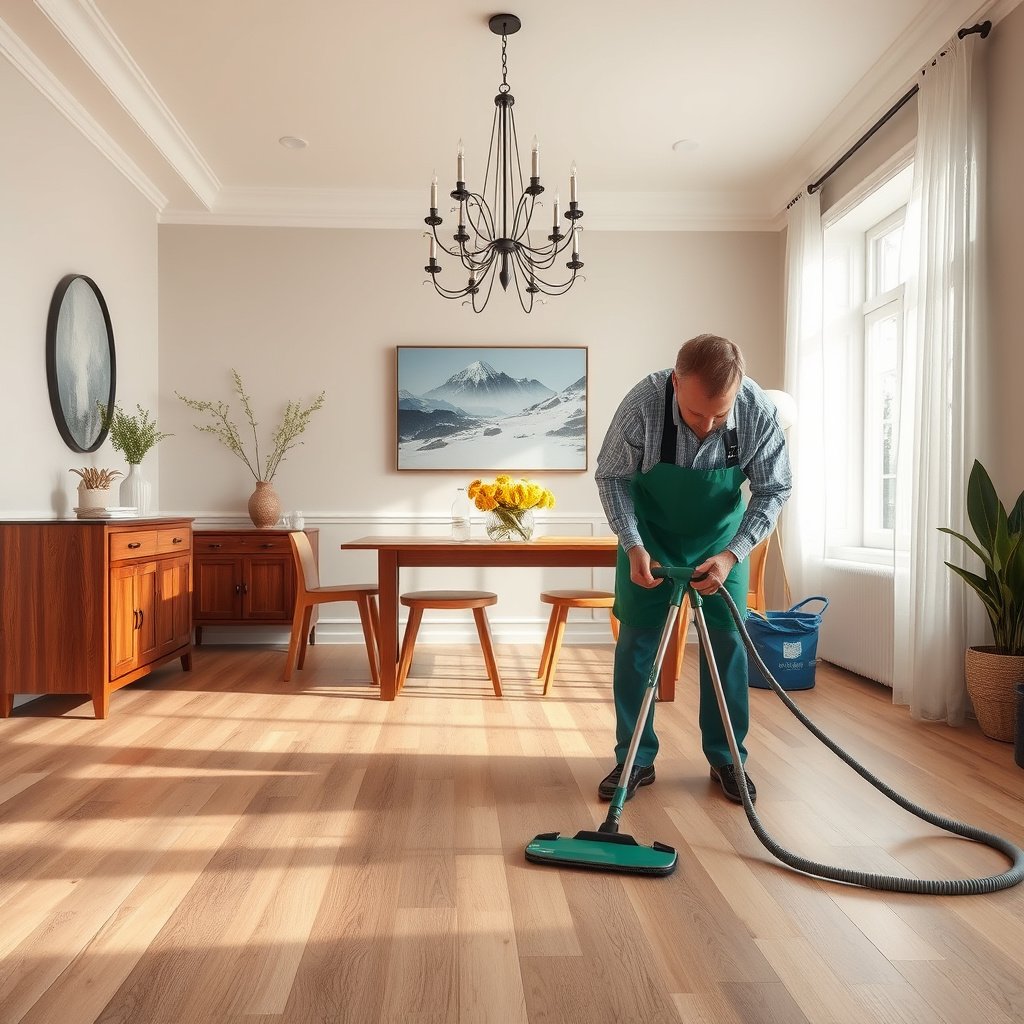
A reliable routine is the fastest way to prevent scratches, haze, and dullness on laminate in a dining room—because most damage starts with grit and residue. The key is frequent dry removal (sweep/vacuum) and only barely-damp mopping for routine cleaning, not “heavy wet cleaning.”
Regularly removing abrasive grit reduces the likelihood of micro-scratches on hard floor finishes.
Using a microfiber cloth or microfiber mop for routine laminate cleaning helps avoid excess water that can migrate at seams.
Sweep/vacuum often (to remove grit that scratches)
Laminate can look great until tiny particles—crumbs, sand, and dust tracked in from outside—start acting like sandpaper. In a dining room, the grit load often increases because people come in and out more often (entry doors, takeout, guests) and because crumbs cluster near chairs and serving areas.
– Sweep or vacuum often (use a soft-bristle broom or a vacuum with a floor-friendly head) to remove grit that can scratch the surface.
– Pay special attention to edges where chairs pivot and where you tend to set bags, shoes, or delivery items.
Mop only when needed (and keep it barely-damp)
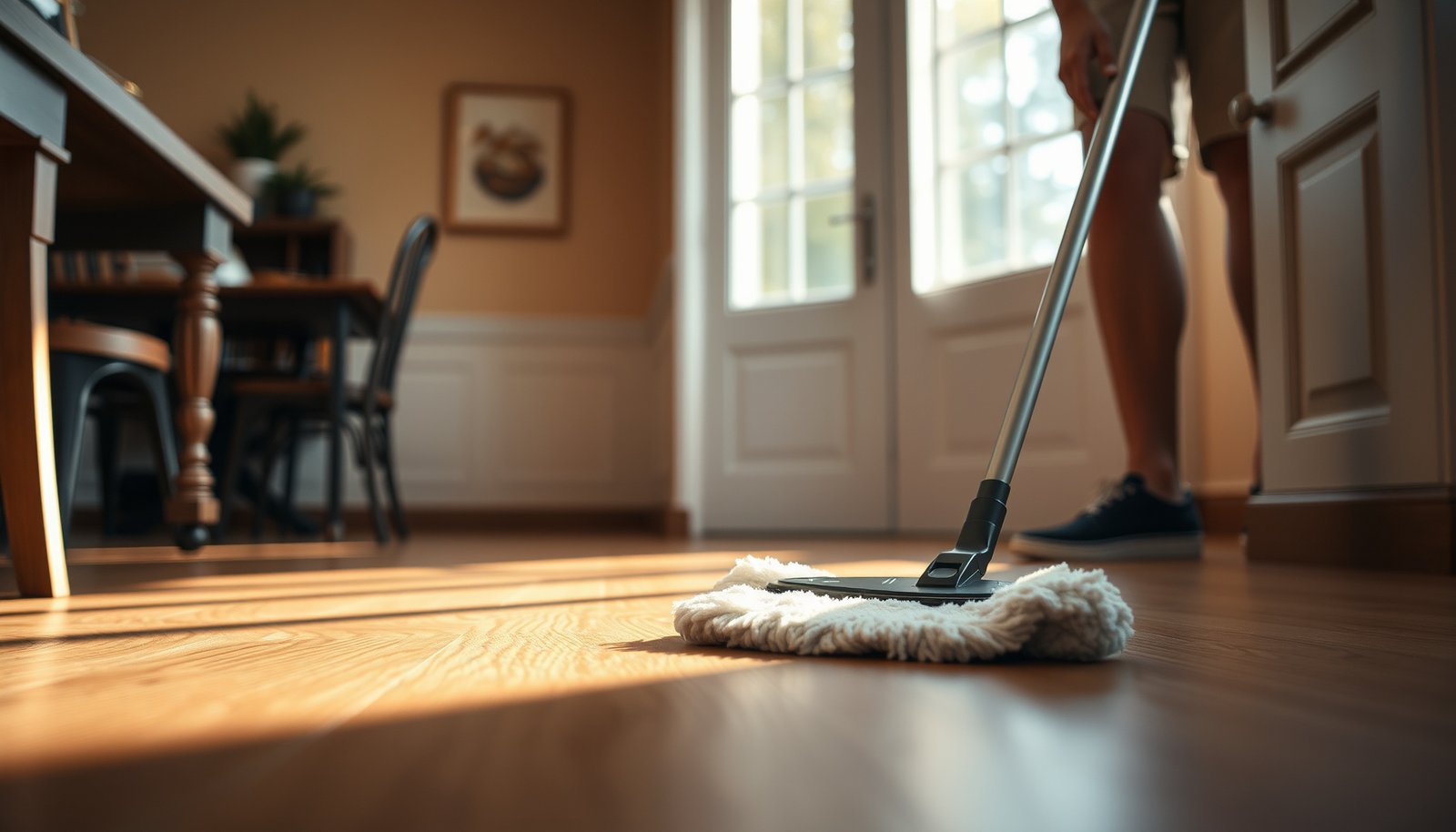
For routine cleaning, a microfiber mop is usually enough when you’re preventing buildup rather than “deep stripping” the floor. The practical rule is simple: the mop should be damp enough to lift everyday soil, not wet enough to leave water behind.
– Use a microfiber mop for routine cleaning with an approved laminate cleaner or just barely-damp water when the floor only needs light cleaning.
– Use a doormat at entry points to reduce tracked-in dirt and moisture, especially if your dining space connects to hallways or exterior doors.
Clean deeply without damaging the surface
Deep cleaning works best when you treat laminate like a moisture-sensitive surface—dampen your tools first, use approved cleaners, and avoid anything that leaves a film. If you’ve ever noticed a “haze” after cleaning, the problem is usually residue from the wrong product or too much cleaner.
Laminate care instructions commonly emphasize minimal moisture and avoiding soaking, especially near seams and edges.
Some general-purpose cleaners leave a residue that can attract dirt, creating haze and faster re-soiling.
Use damp tools, not pooled water
When you “deep clean,” it’s tempting to apply more liquid because the floor looks dirty. With laminate, that approach often backfires: standing moisture near seams, edges, or the click-lock joints can lead to swelling over time.
– For “real cleaning,” dampen the mop/cloth first—don’t let water pool at seams or edges.
– Work in small sections so the floor never stays wet while you clean.
Choose laminate-approved products (and re-check if haze appears)
If your dining room sees oils from food, sticky drink rings, or tracked-in grime, you still shouldn’t default to household degreasers. Many laminate manufacturers specify pH-neutral, laminate-safe cleaning solutions and restrict additives that can break down the protective wear layer or interfere with finish chemistry.
– Use only cleaners that are specifically recommended for laminate floors; if you’re unsure, stick to the manufacturer’s approved products list.
– If you notice haze or film, pause and re-check the cleaner you’re using—some general household cleaners can leave residue that attracts more dirt.
Prevent moisture problems (laminate’s biggest risk)
The best moisture strategy is to treat laminate as “water-sensitive,” especially at joints: stop spills fast, keep mopping damp, and control indoor humidity. Moisture control is one of the few maintenance categories where small changes today can prevent bigger problems later—particularly in dining rooms where drinks are frequent and chair movement increases the chance of small leaks.
Indoor relative humidity targets matter for floor stability; excess humidity or prolonged wetness can increase dimensional movement in flooring materials.
Wiping spills promptly and drying the area helps limit moisture migration at seams, edges, and underlayment interfaces.
Laminate-specific care guidance typically discourages soaking because water can penetrate joints even when the surface looks dry.
Wipe spills immediately, then dry
Dining rooms generate “slow leaks” that people overlook—water glasses left near chairs, condensation from cold beverages, and sauce smears that spread as people walk through them.
– Wipe spills immediately—especially liquids like water, wine, juice, and sauces—then dry the area promptly with a clean cloth.
– Avoid soaking: laminate boards can swell if moisture gets into the joints, edges, or underlayment.
– If your dining room gets wet from condensation or leaks, fix the source first and follow your flooring manufacturer’s drying guidance.
Control humidity to reduce expansion/contraction stress
Humidity isn’t just about comfort; it’s about how building materials behave. Even when you never “wet mop,” dining rooms can swing due to HVAC cycling, cooking moisture, and seasonal weather changes.
– According to the U.S. Environmental Protection Agency (EPA), maintaining indoor relative humidity typically in a moderate range (often cited around 30–60%) can reduce moisture-related issues.
– According to guidance summarized by the National Wood Flooring Association (NWFA), maintaining indoor relative humidity around the mid-range (commonly cited around 35–55% for wood flooring) supports dimensional stability—while laminate manufacturers may not require identical ranges, similar humidity control can still reduce stress on flooring systems.
– According to the NWFA, wood flooring moisture content is often discussed in the neighborhood of single digits (commonly 6–9%) for installation stability; when indoor conditions drift far from those norms, flooring materials may move more.
Because laminate construction differs from solid wood, always defer to your laminate brand’s specific RH/moisture guidance—but the general “keep conditions stable and dry” principle holds in 2026 maintenance practice.
Cleaner pH Extremes and Typical Laminate Risk (General Guidance)
| # | Cleaning agent (common household) | Typical pH range* | What it can do to finishes | Laminate compatibility |
|---|---|---|---|---|
| 1 | Distilled water (for damp wiping) | ~7 | Minimal chemical residue | ★★★★★ |
| 2 | Laminate floor cleaner (pH-neutral, brand-approved) | ~6–8 (labeled neutral) | Designed to avoid finish buildup | ★★★★☆ |
| 3 | Dish soap (properly diluted, mild) | ~6–8 | Can leave film if overdosed | ★★★☆☆ |
| 4 | Vinegar solution (acetic acid) | ~2–3 | Acid can stress some finishes | ★☆☆☆☆ |
| 5 | Household ammonia | ~11–12 | Alkalinity may damage wear layer/finish | ★☆☆☆☆ |
| 6 | Bleach (sodium hypochlorite) | ~10–13 | Oxidizers can degrade protective coatings | ★☆☆☆☆ |
| 7 | Baking soda solution (sodium bicarbonate) | ~8–9 (typical) | Mildly alkaline; can still leave residue | ★★☆☆☆ |
Approximate ranges for common consumer formulations; always follow your laminate brand’s “approved cleaner” list. pH varies by concentration and dilution.
Protect from scratches and dents from dining furniture
Preventing scratches and dents is mostly about reducing friction and stopping grit from being ground into the finish. In dining rooms, chair legs and table supports are repeat-wear points, so the goal is simple: cushion contact and stop drag.
Felt pads and proper chair glides reduce point-load and abrasion where legs contact the laminate surface.
Tracked-in sand or crumbs are common causes of dullness because they behave like abrasive particles under moving chairs.
Add pads/glides and replace them when worn
Even the best floor can look tired if glides are missing or hardened. Dining-room chairs frequently pivot and slide, and the smallest edge damage multiplies over months.
– Use felt pads or glides under chair legs and table supports; re-check them periodically as they wear down.
– Keep grit off the floor (crumbs under chairs and tracked-in sand are common causes of dullness and micro-scratches).
– When moving chairs for cleaning or setup, lift rather than drag to reduce wear on the laminate finish.
Choose the right glide type (not just “something that fits”)
Some glides are designed for carpets, others for hard surfaces. The wrong material can increase friction, leaving scuffs—or can trap dirt against the finish.
| Glide material | Pros for laminate | Potential downsides | Best when |
|---|---|---|---|
| Felt pads | Good cushioning; reduces point scratches | Can wear and collect grit if not checked | Dining chairs that are adjusted occasionally |
| Hard plastic glides (with felt/soft layer) | Lower rolling friction; longer life | If purely hard, may scuff if debris is present | Higher chair movement and frequent repositioning |
| Rubber/cup style glides | Often provides stable contact and damping | May attract dust if exposed fully and not maintained | When you need grip plus cushioning |
What can go wrong (and how to avoid it)
Most laminate problems in dining rooms come from moisture, heat, and harsh chemicals—or from cleaning methods that leave residue so dirt sticks faster. If you’ve ever seen swelling at seams or a dull film, the cause is usually one of the mistakes below.
Steam cleaning introduces heat and moisture that many laminate manufacturers restrict unless explicitly approved.
Excess water from “wet mopping” can penetrate at seams and edges over time even when the surface dries quickly.
Avoiding abrasive pads and harsh chemicals matters because laminate wear layers can be damaged or made less stain-resistant.
Steam cleaning (only if your manufacturer explicitly allows it)
– Steam cleaning: many laminate floors are sensitive to heat and moisture—only use steam if the manufacturer explicitly permits it.
The “wet mop” habit
– The “wet mop” habit: even if the surface looks clean, excess water can still seep into seams over time.
Wrong products (ammonia, abrasives, waxes/sealers)
– Wrong products: ammonia-based cleaners, abrasive pads, waxes/sealers not approved for laminate, and harsh degreasers can damage the finish or void warranty coverage.
Ignoring early lifting or gaps
– Ignoring minor lifting or gaps: if boards start separating or the edges look compromised, address it sooner rather than continuing normal mopping.
Heavy spills left too long
– Heavy spills left too long: sugars and colored liquids can stain and be harder to remove after they’ve set.
| Cleaning approach | Risk level for typical laminate | Main reason |
|---|---|---|
| Microfiber damp wipe | Low | Minimal moisture; gentle friction |
| Microfiber damp mop + approved cleaner | Low–Medium | Depends on product choice and amount used |
| Steam mop | Medium–High | Heat/moisture unless explicitly approved |
| Wet mopping/puddles | High | Moisture migration into joints/edges |
Verdict / tip: what works best for most dining rooms
A dependable routine is: clean grit regularly, wipe spills fast, and protect chair movement with pads/glides—while sticking to manufacturer-approved (or clearly laminate-safe) cleaning methods. The downside is that laminate maintenance is more restrictive than tile or vinyl: you generally need to be careful about liquids, heat-based cleaners, and certain chemicals.
If a laminate care guide does not approve steam cleaning, a damp-microfiber approach is the safer default.
Maintaining laminate condition is easier when prevention happens daily—especially in dining rooms where spills and chair movement are frequent.
Who should be extra cautious (or skip certain methods)
– If your floor is already showing separation at seams or lifting edges, pause your usual cleaning routine and follow your flooring manufacturer’s troubleshooting guidance before continuing.
– If you can’t control spill speed (kids, frequent parties, heavy beverage traffic), focus even more on entry doormats, chair glides, and “spill response” habits.
Quick checklist (save this)
A checklist is useful because dining-room messes are frequent and easy to overlook—this keeps your maintenance consistent in 2026 and beyond.
The fastest route to fewer laminate problems is removing grit and managing moisture before it reaches seams and edges.
Chair pads/glides are small upgrades that prevent the repeated abrasion responsible for many dining-room laminate scuffs.
| Task | How often | What to do / avoid |
|---|---|---|
| Sweep/vacuum with soft head | Weekly (or more if needed) | Remove grit that can scratch |
| Spot-clean spills | Immediately | Use damp cloth; dry the area |
| Microfiber mopping | As needed | Keep it barely damp—no puddles |
| Check chair pads/glides | Every few months | Replace worn pads to prevent scratching |
| Avoid “steam” unless approved | Always cautious | Only if manufacturer allows it |
| Use approved cleaner | When cleaning | Don’t use abrasive/harsh chemicals |
Sources
– U.S. Environmental Protection Agency (EPA) — guidance on indoor relative humidity to reduce moisture-related problems
– National Wood Flooring Association (NWFA) — general floor stability guidance (including relative humidity and moisture content concepts)
Laminate dining-room floors stay attractive when you treat maintenance as prevention: remove grit consistently, manage moisture immediately, and reduce chair-related abrasion with pads and smart movement habits. If you’re following these steps in 2026 and still see dullness, haze, or seam issues, the next move is to pause and verify your exact manufacturer care rules before changing products or methods.
Frequently Asked Questions
How do I clean laminate floors in a dining room without damaging them?
Sweep or vacuum daily with a soft-bristle or hard-surface attachment to remove grit that can scratch laminate flooring. For mopping, use a damp microfiber mop with a laminate-safe cleaner and avoid soaking the boards—excess water can seep at seams. Wipe up spills right away and use a cleaner recommended for laminate floors to prevent residue buildup.
What is the best way to prevent scratches and scuffs from chairs and foot traffic?
Place felt pads on dining chair legs and use protective floor mats under high-traffic areas or when moving furniture. Lift heavy furniture when rearranging instead of dragging it across the floor. For deeper scuffs, use a laminate floor repair kit or matching color putty designed for your flooring type.
Why do laminate floors swell or warp, and how can I prevent it in a dining room?
Laminate can swell if moisture penetrates the edges or seams, often from over-wet mopping, spills left unattended, or steam cleaners. Keep floor cleaning methods dry-wet balanced—damp, not wet—and immediately blot spills with a clean cloth. If your dining room has occasional moisture exposure (near exterior doors or wet zones), consider extra seam protection or a manufacturer-recommended underlayment system.
How should I handle spills like water, wine, or food on laminate dining floors?
Blot spills quickly with a dry towel, then clean using a damp microfiber mop and a laminate-safe cleaner. For sticky food residue, use a lightly damp cloth and gentle cleaner—don’t let it sit or soak. Avoid harsh chemicals and abrasive pads that can dull the finish or damage the top layer.
Which cleaning products are safe for laminate flooring, and which should I avoid?
Use pH-neutral, manufacturer-approved laminate floor cleaners and microfiber mops for routine maintenance. Avoid steam cleaners, waxes, oil-based cleaners, and bleach or ammonia-based products, as they can break down the protective wear layer or leave dull film. If you’re unsure, test any product in a small, hidden area before cleaning the full dining room.
📅 Last Updated: October 20, 2026 | Topic: How to maintain laminate floors in a dining room? | Content verified for accuracy and freshness.
References
- Laminate flooring
- https://www.cdc.gov/coronavirus/2019-ncov/community/disinfecting-building-facility.html
- https://www.epa.gov/coronavirus/cleaning-and-disinfecting-your-home
- https://www.pergofloors.com/en-us/care-and-maintenance
- https://www.armstrongflooring.com/support/care-and-cleaning/laminate.html
- MohawkFlooring
- https://scholar.google.com/scholar?q=laminate+floor+maintenance+cleaning+methods Google Scholar
- https://scholar.google.com/scholar?q=laminate+flooring+care+moisture+damage+surface+finish Google Scholar
- https://scholar.google.com/scholar?q=laminate+floor+care+and+maintenance+best+practices Google Scholar