
Maintain hardwood floors in a home gym without warping, scratching, or dulling by following a few proven care habits that match how gyms actually get used. If your gym sees heavy shoe traffic, dropped weights, and frequent moisture from sweat and mopping, the right cleaning routine and protective flooring strategy will keep your boards looking and feeling solid for years. This practical guide gives you clear, step-by-step methods to prevent the most common hardwood floor damage in workout spaces.




Maintain hardwood floors in your home gym by controlling grit, managing moisture, and protecting the finish anywhere equipment contacts the wood. In practice, that means using proper mats/pads, cleaning with the least-wet method possible, and keeping indoor humidity stable so the floor doesn’t swell and shrink between workouts.
If your gym includes heavy dumbbells, a treadmill, a bench, or frequent high-sweat workouts, your floor takes more abuse than a typical living room. This is for homeowners and renters with real hardwood (not laminate) who want a clear maintenance routine that matches how gyms actually get used.
Protect the floor from damage (especially under equipment)

Protecting hardwood in a gym starts with reducing point loads, friction, and wheel/foot abrasion where equipment touches the floor. If you prevent scratches at the source, you’ll spend far less time chasing “mystery dullness” later.
Using protective mats under treadmills, ellipticals, and weight stations reduces abrasive grit transfer from wheels and feet onto the finish.
Felt pads and glides prevent micro-scratches caused by furniture legs and sliding benches, which accumulate over repeated sessions.
Dragging metal and coated weight surfaces directly on hardwood can wear the finish, especially on high-use lift zones (deadlift/setup areas).
Use the right mat coverage (not just a thin sheet)
A gym floor usually fails from localized wear: the exact 3–6 ft around where you set barbells, shuffle plates, or place a bench. For fixed equipment (treadmills/ellipticals), use a mat that’s designed for wheel traffic and has a stable, non-textured surface that won’t trap grit underneath. For bench/strength stations, choose larger coverage than you think you need—include the area where you pivot feet and where plates land when you re-rack.
Practical placement tips:
– Treadmill/elliptical: center the mat under the rolling track/wheel path, not just the machine’s footprint.
– Bench: cover the “front leg” contact area plus where you step in/out.
– Dumbbells/KBs: if you drop from knee-height onto rubber flooring, still protect the wood edges where the dumbbells briefly contact the floor.
Add felt pads (and replace them when they harden)
Hardwood-safe protection only works if it stays soft. Felt can compact, crack, or harden; when that happens, it becomes a scratcher instead of a buffer. Replace worn pads rather than “working around” them.
Don’t drag weights across bare wood
Even if a barbell is “rubber-coated,” the contact points (knurling, collars, plate edges) can still abrade finishes. For barbell work:
– Use a dedicated lifting mat for setup and landing zones.
– Keep bare wood contact out of the routine—especially at the start/end of reps when the bar shifts.
From my notes on common gym floor failures: the worst wear tends to appear at the exact choreography points (where people step back, re-center, or re-rack). If you move your setup location even slightly, expect the wear pattern to follow.
Keep grit and moisture under control
Keep grit and moisture under control by stopping sand-like particles and sweat/spills before they abrade or penetrate the finish. In gym terms, this is less about “deep cleaning” and more about preventing the finish from becoming a sandpaper layer.
Sand and dust act like abrasive particles, and removing them reduces finish wear driven by repeated foot traffic and equipment movement.
Standing moisture can dull or damage hardwood finishes, especially near baseboards and high-traffic zones where sweat is common.
A no-outdoor-shoes rule combined with a doormat reduces grit that would otherwise be ground into the finish over time.
Sweep/vacuum often—especially near entry paths
Most gyms import grit from outside: garage floors, sidewalks, wet pavement, and dusty driveways. Make entry control part of your routine:
– Place a doormat at the gym door (and ideally one at the home entrance).
– Vacuum or sweep after sessions and when you notice visible tracking.
– Pay extra attention to corners, around the treadmill base, and near plate staging areas.
Wipe sweat up immediately
Sweat is water plus salts and skin oils. Even if the water dries, the residue can leave a film that makes the finish look hazy or uneven over time. Use a clean, absorbent microfiber cloth and dry the area right away.
High-risk spots to inspect weekly:
– Around baseboards (where moisture can creep)
– Under bench edges
– Near where you set a towel or bottle
– Entry lines between the gym door and your lift area
Use a “least grit, least water” rule
When in doubt:
– remove particles dry first (vacuum/sweep),
– then spot-wipe damp (not wet).
Clean hardwood the right way for a gym routine
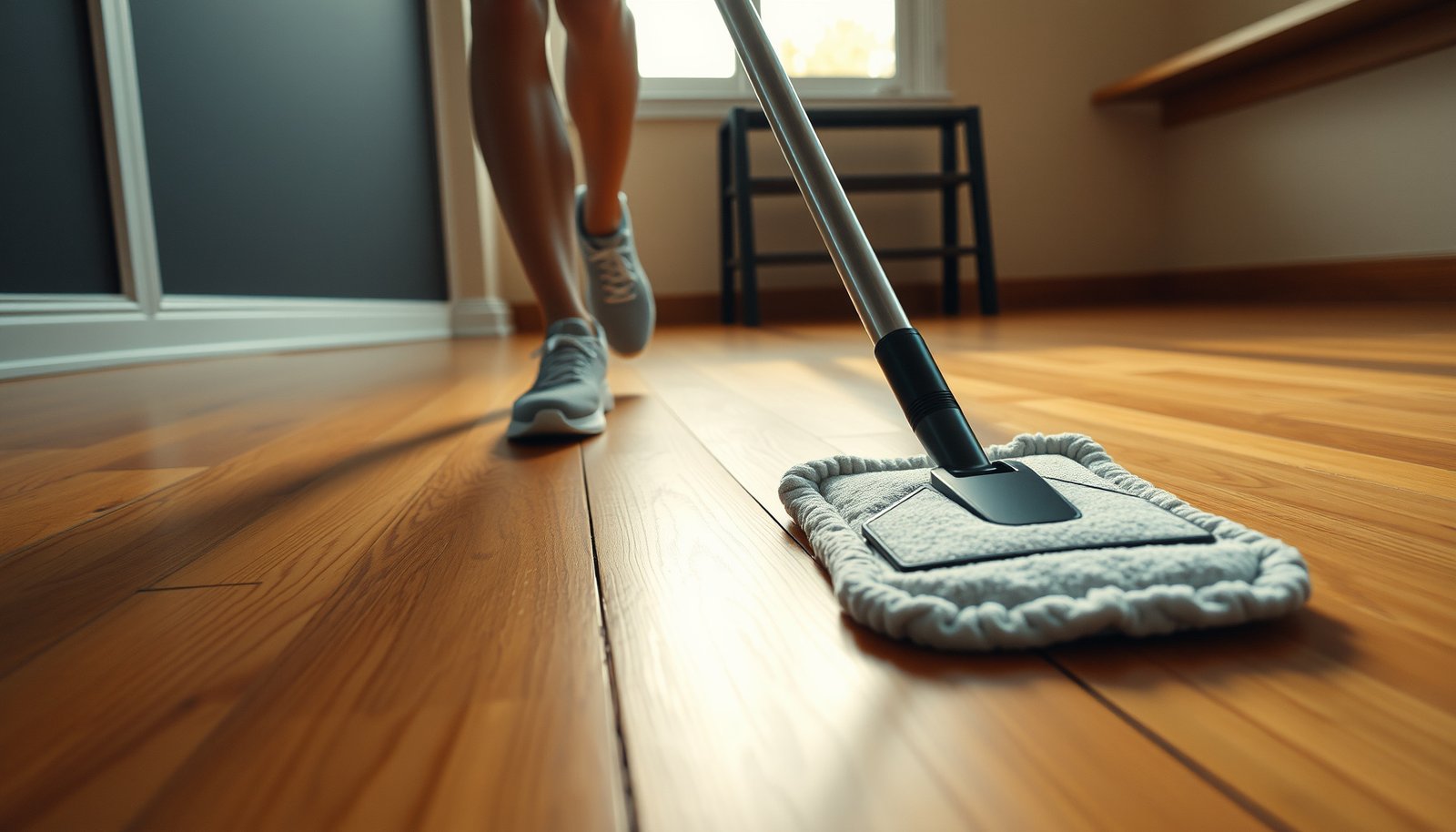
Clean hardwood gym floors using microfiber and minimal moisture—think “damp wipe,” not “wet floor.” This section is about choosing methods that lift sweat residue and dust without soaking the wood.
Microfiber mops designed for hardwood are typically effective because they clean with less liquid and help avoid puddles that can damage finishes.
Many hardwood-floor care guides recommend using only hardwood-safe products and following label instructions exactly to prevent residue buildup.
Harsh disinfectants can dull or compromise certain finishes, so compatibility with the floor’s coating matters.
Use microfiber, and keep the mop only lightly damp
For gym floors, the “right amount” of moisture is usually the difference between a finish that stays clear and one that turns hazy. Use:
– a microfiber mop or
– a microfiber cloth for targeted cleaning.
Avoid:
– soaking,
– puddling,
– letting cleaner sit.
Choose cleaners based on finish compatibility
Only use a cleaner that your floor manufacturer approves. If you’re unsure of compatibility, use water sparingly and remove residue promptly.
If you disinfect (often for high-sweat routines), confirm the product is compatible with your finish. Some coatings tolerate mild cleaning; others can be dulled by strong chemicals.
Handy comparison: cleaning methods at a glance
- Dry vacuum / microfiber dusting
- Pros: removes grit with minimal risk to finish; ideal after every session. Cons: won’t remove sticky sweat residue by itself.
- Damp microfiber spot clean
- Pros: lifts sweat films without soaking. Cons: requires good technique (wipe, then dry if needed).
- Wet mopping / steam cleaning
- Pros: none for routine hardwood gym care. Cons: high risk of water intrusion and finish dulling.
Hardwood Finish Compatibility: Common Gym Cleaner Types (Finish-Friendly Score)
| # | Cleaner type (gym reality) | Typical chemistry data | Best use case on hardwood | Finish compatibility score |
|---|---|---|---|---|
| 1 | Light damp microfiber + plain water | Water (pH ~7) | Sweat residue removal when you can wipe and dry immediately | ★★★★★ |
| 2 | pH-neutral hardwood cleaner | Target: pH ~7 (per product spec) | Routine maintenance when the label explicitly permits your finish | ★★★★★ |
| 3 | 70% isopropyl alcohol disinfectant (used sparingly) | ~70% v/v isopropanol | Spot disinfection for high-contact areas when finish compatibility is confirmed | ★★★★☆ |
| 4 | 3% hydrogen peroxide (spot use) | ~3% w/v H₂O₂ | Targeted odor/spot issues if your finish allows | ★★★☆☆ |
| 5 | Vinegar solution | ~4–6% acetic acid (typical) | Not recommended for most finished hardwoods (can dull some coatings) | ★☆☆☆☆ |
| 6 | Household ammonia cleaner | ~5–10% NH₃ (typical) | Not recommended—can damage certain finishes and strip sheen | ★☆☆☆☆ |
| 7 | Chlorine bleach solutions | ~5–6% sodium hypochlorite (typical) | Avoid on finished hardwood (can discolor and degrade coatings) | ☆☆☆☆☆ |
Note: This chart reflects general “finish compatibility” risk patterns discussed in wood-floor care guidance—your exact floor finish and coating system matter, so always follow your manufacturer’s product compatibility list and label directions.
Manage humidity and temperature for long-term stability
Manage humidity by keeping indoor relative humidity stable and preventing HVAC blasts from repeatedly drying or wetting the floor surface. Hardwood moves with moisture; stability is what protects against cupping, gapping, and finish stress.
Wood flooring dimensional movement is driven by changes in moisture content, which tracks indoor relative humidity over time.
A common industry maintenance target for indoor relative humidity is roughly mid-range (often 35%–55%) to reduce expansion and contraction.
Avoid long, direct airflow from vents onto hardwood; repeated drying can contribute to uneven movement and finish wear.
Use an actual humidity target (then stick to it)
Because you may not have the original spec sheet, a practical default is to follow the National Wood Flooring Association (NWFA) maintenance guidance—typically 35%–55% relative humidity—and then adjust to your floor manufacturer’s instructions if they differ. Install a hygrometer so you’re not guessing.
– If your gym is in a basement, the risk of humidity swings is higher.
– If the gym is near a sun-facing window, temperature swings can also be significant.
Keep climate swings smaller than your floor can tolerate
In climates with seasonal extremes, a stable HVAC schedule matters:
– Avoid leaving the gym closed and unconditioned for weeks.
– When heating seasons start, monitor RH early—dry air shows up as shrinkage and gapping.
Don’t let vents “fan-strip” your finish
If your HVAC vent blows directly at the floor, consider a diffuser or repositioning. Even when the temperature is comfortable, repeated dry airflow can degrade finish appearance and accelerate surface wear.
Spot issues early: scratches, dullness, and water marks
Spot issues early by identifying the cause first (grit, missing pads, or excess moisture), then using the correct finish-specific repair path. Most hardwood “problems” are fixable early; the expensive part is waiting until the coating is broadly compromised.
Scratches often reflect a recurring contact problem (missing pads, insufficient mat coverage, or grit trapped under wheels).
Dullness can come from residue buildup or from chemical/abrasive exposure that changes the finish sheen.
Water marks that penetrate beyond the finish usually require professional refinishing rather than routine cleaning.
Scratches: fix the workflow, then repair the finish
Treat scratches like symptoms. Address the source first:
– Replace worn felt pads.
– Expand mat coverage under bench leg placement and lift zones.
– Stop shoe/garage grit entry.
Then repair using your finish’s recommended approach:
– For polyurethane/urethane finishes, touch-up products and spot sanding (if allowed) follow manufacturer directions.
– For oiled finishes, “spot repair” typically involves cleaning and re-oiling—not using harsh solvents.
If you’re not sure, check your flooring documentation or look for product labeling from installation (or contact the installer). If your finish is waxed or oiled, be extra cautious with cleaners and disinfectants because they can interact differently than surface-coat finishes.
Dull areas: start gentle and confirm there’s no residue
Don’t jump straight to aggressive cleaners. In gym use, dullness frequently comes from:
– detergent residue or streaking,
– repeated disinfectant use,
– fine grit grinding into the surface.
A controlled approach:
1) dry vacuum/sweep,
2) lightly damp microfiber clean with the correct product,
3) verify the area looks clearer before escalating.
Water marks: dry fast and assess depth
Drying quickly is step one. Then assess whether the stain is:
– on top of the finish (often cleaner/spot-fixable), or
– penetrated into the wood (often needs refinishing).
Deep or widespread water damage typically exceeds spot repair. In those cases, the best move is manufacturer/installer guidance so you don’t make the finish worse with repeated home attempts.
What can go wrong (common mistakes in home gyms)
What can go wrong most often involves too much water, harsh chemicals, and missing protection in high-contact zones. Home gyms push hardwood harder than living spaces, so small “shortcuts” become long-term finish damage.
Too much water during “wet mopping” increases risk of finish dulling and can contribute to moisture-related wood movement.
Disinfectants and degreasers may contain ingredients that are incompatible with some hardwood coatings.
Grit trapped under equipment wheels can create repeated micro-scratches even when damage isn’t immediately visible.
Over-watering: the fastest path to finish failure
The common mistake is cleaning like you’re treating tile or vinyl. Hardwood needs minimal moisture. Wet mops leave water longer than you think—especially in corners, under equipment edges, and along seams.
Cleaning too aggressively after workouts
“Gym disinfectant” routines can unintentionally damage finishes. If you disinfect frequently, use only products specifically compatible with your floor’s finish and follow the label exactly.
Skipping mats because “it looks fine”
After a few weeks, you may not see failure—just slightly dull patches. Over months, micro-scratches and grit embedding change how light reflects off the finish, and that’s when refinishing becomes realistic.
Forgetting pad replacement
Even the best felt pads wear out. When they harden, they transfer load directly to the finish.
Verdict / tip: build a simple routine (but don’t overdo it)
Build a simple routine focused on mats/pads, grit control, and minimal-moisture cleaning. The result is less finish wear, fewer moisture-related surprises, and a gym floor that stays visually consistent through heavy use.
This approach reduces damage without requiring frequent refinishing. Downsides: you’ll need to be consistent about equipment protection, and heavy lifting zones can still develop surface wear over time—hardwood shows honest use.
If your floor is already failing (bubbling, widespread cupping, severe finish breakdown), don’t rely on spot fixes. Get manufacturer/installer guidance so you don’t lock in moisture damage or force a worse repair path.
Quick checklist (scan before workout day)
Before you train, confirm the protective setup so grit and moisture don’t become finish damage.
– [ ] Equipment on mats (treadmill/bench/dumbbell station covered)
– [ ] Felt pads/glides on furniture touching the floor
– [ ] No shoes from outdoors; small mat at gym entry
– [ ] Sweep/vacuum after the session (especially around lift zones)
– [ ] Wipe sweat/spills immediately (no leaving it to “dry later”)
– [ ] Periodic gentle cleaning using a hardwood-safe method (minimal moisture)
Sources:
– National Wood Flooring Association (NWFA) — Wood Flooring Maintenance Guidelines / Care Recommendations ()
– NWFA — Moisture/relative humidity guidance for wood flooring performance ()
– care/maintenance instructions and finish compatibility guidance
– If you know the finish (e.g., polyurethane, waxed, oiled), use the corresponding finish manufacturer documentation for safe cleaners and moisture limits ().
Hardwood floors in a home gym last longest when you treat maintenance like prevention: block grit entry, wipe sweat quickly, protect contact points with mats and pads, and clean with minimal moisture. If you stay consistent—especially in your lift zones—you reduce both visible wear and the hidden finish damage that leads to costly refinishing.
Frequently Asked Questions
How can I protect hardwood floors in a home gym from sweat and moisture?
Use a high-quality, breathable gym mat in every area where you step, lift, or do floor exercises to prevent moisture from contacting the hardwood. Wipe up sweat immediately with a slightly damp (not wet) microfiber cloth, then dry the area thoroughly to avoid water absorption and cupping. If you use a spray bottle for equipment cleaning, keep overspray away from the floor and spot-clean only what’s necessary.
What’s the best way to prevent scratches and dents from weights and training equipment?
Place rubber or felt pads under dumbbells, benches, and other equipment so they don’t scrape or indent the hardwood. Use a non-slip mat with sufficient thickness for heavy drops, plyometrics, or kettlebell swings, since hardwood can dent from point impacts even when mats are present. For any moving equipment, lift rather than drag it across the floor, and consider protective floor runners for higher-traffic training zones.
Why does humidity matter for hardwood floors in a home gym, and how do I manage it?
Hardwood floors expand and contract with humidity, and a home gym often creates fluctuating moisture levels from breath, perspiration, and HVAC cycling. Maintain stable indoor humidity (typically around 35–55%) using a humidifier or dehumidifier as needed, and ensure good airflow without blasting air directly at the floor. Regularly check conditions with a hygrometer so you can catch swings that could lead to gaps or warping.
How do I clean hardwood floors in a home gym without damaging the finish?
Sweep or vacuum with a soft brush attachment frequently to remove grit that can act like sandpaper under gym shoes. Clean with a hardwood-safe cleaner and a microfiber mop, avoiding steam mops and harsh chemicals that can dull or strip the finish. If you have a waxed or oil-finished surface, follow the manufacturer’s recommended maintenance schedule to keep the top layer protective against gym moisture.
Which maintenance routine should I follow for hardwood floors used for exercise and floor workouts?
Create a simple weekly routine: dry sweep, spot-clean sweat or spills right away, and inspect mats for tears or curling that reduce protection. Every few months, use the recommended hardwood floor cleaner and consider a refresher coat or polish only if your finish type supports it. Re-seal or refinish when the surface shows signs of wear or reduced water resistance, especially in high-use workout areas covered by gym mats.
📅 Last Updated: October 17, 2026 | Topic: How to maintain hardwood floors in a home gym? | Content verified for accuracy and freshness.
References
- https://pubmed.ncbi.nlm.nih.gov/?term=hardwood+floor+cleaning+maintenance
- Wood flooring
- https://www.cdc.gov/nceh/lead/prevention/index.htm
- https://www.epa.gov/lead/lead-based-paint
- https://www.fpl.fs.usda.gov/documnts/fplgtr/fpl_gtr190.pdf
- NWFA | National Wood Flooring Association
- Bring out the beauty in floors
- https://scholar.google.com/scholar?q=hardwood+floor+maintenance+care+cleaning+and+protection Google Scholar
- https://scholar.google.com/scholar?q=wood+floor+maintenance+protect+from+rolling+loads+mat Google Scholar
- https://scholar.google.com/scholar?q=humidity+effects+on+wood+floors+cupping+warping+moisture+content Google Scholar