
Mop industrial floors the right way and you’ll get a cleaner surface and safer footing without wasting time or causing streaks. This guide walks you through the exact steps—prep and chemical choice, the correct mopping pattern, and safe drying—so results are consistent across warehouses, factories, and workshops. If your goal is clean, slip-resistant floors with minimal rework, follow these procedures.




Mop industrial floors using the right cleaner diluted exactly to the label, follow a controlled two-step workflow (pre-clean when needed, then mop in sections), and rinse with clean water when the surface is sensitive to residue. Start by removing debris, mop with overlapping strokes in a set path, and let the floor dry completely to reduce slipping and streaks.
This guide is for facility managers, janitorial leads, and cleaning crews responsible for industrial spaces—especially where spills, heavy soil, or floor finishes require consistent technique. It’s also helpful if you’ve noticed greasy residue, streaking, or recurring slippery spots after mopping.
Prep the floor before you mop
Prepping industrial floors correctly is the fastest way to get clean results without spreading grit or causing streaks. Remove debris first, confirm the floor finish and chemistry compatibility, and control foot traffic so you don’t re-soil the surface while it’s wet.
Debris removal before wet mopping prevents grit from becoming a grinding paste that leaves streaks and a dull film. [ADD: cite from floor-care or janitorial best-practice documentation]
Cleaning chemical labels specify both compatible floor finishes and dilution ratios; using the wrong dilution can increase residue and traction risk. [ADD: cite from cleaner SDS/label instructions for dilution + compatible surfaces]
Controlling access to wet industrial floors reduces re-tracking of soil and supports safer dry time to limit slips. [ADD: cite from OSHA/wet-floor hazard guidance]
Industrial floor mopping starts with the “dry phase.” Sweep or vacuum thoroughly (especially around drains, conveyor areas, dock edges, and traffic lanes) so particulate doesn’t get pushed into the finish. For dusty facilities, a vacuum with a HEPA filter—when available—reduces airborne re-deposition and helps keep the mop system working as designed. If you only sweep loosely, you often end up with fine dust that becomes visible haze after the first pass of industrial floor mopping.
Next, confirm floor type and finish. “Industrial concrete” can be bare, sealed, densified, waxed, or coated with a clear film. Tile may be glazed or unglazed. Steel trowel marks, open porosity, and worn coatings all affect how industrial floor mopping behaves—especially with alkaline degreasers or solvent-based cleaners. Check the chemical label for suitability and dilution instructions before mixing anything for industrial floor mopping. If the label calls for a rinse (common with many detergent/degreaser systems), treat rinsing as part of the workflow—not an optional extra.
Finally, block off the area. Industrial floors typically require a “controlled dwell + clean + dry” sequence, and foot traffic is the enemy of consistent results. Use cones, tape, or door signage so you don’t drag soil back onto freshly cleaned sections. From my experience coordinating facility cleanups with multiple trades (maintenance, receiving, and janitorial), one of the most common causes of “mysterious re-soiling” after industrial floor mopping is traffic returning while floors are still tacky.
Quick checklist before you mix cleaner (industrial floor mopping essentials)
– Identify finish and verify chemical compatibility on the label
– Remove debris with sweep/vacuum to avoid grit paste
– Block off the area to prevent re-tracking while wet
Choose the right mop setup and cleaner
Choosing the right mop setup and industrial cleaner is what determines whether you remove soil effectively without leaving a residue film. For best outcomes, match mop type to soil level and floor finish, dilute strictly per label, and keep clean water ready for rinsing or a second pass.Microfiber mops are widely used for industrial floor cleaning because they capture fine soil when properly dampened and laundered. [ADD: cite from microfiber mop manufacturer care/usage guidance]
Cleaner dilution instructions on labels are designed to balance cleaning performance with finish safety and residue control. [ADD: cite from cleaner product label/SDS]
Rinsing is often required after detergent/degreaser use when residue can affect traction or attract re-soiling. [ADD: cite from the specific product label “rinse required” language]
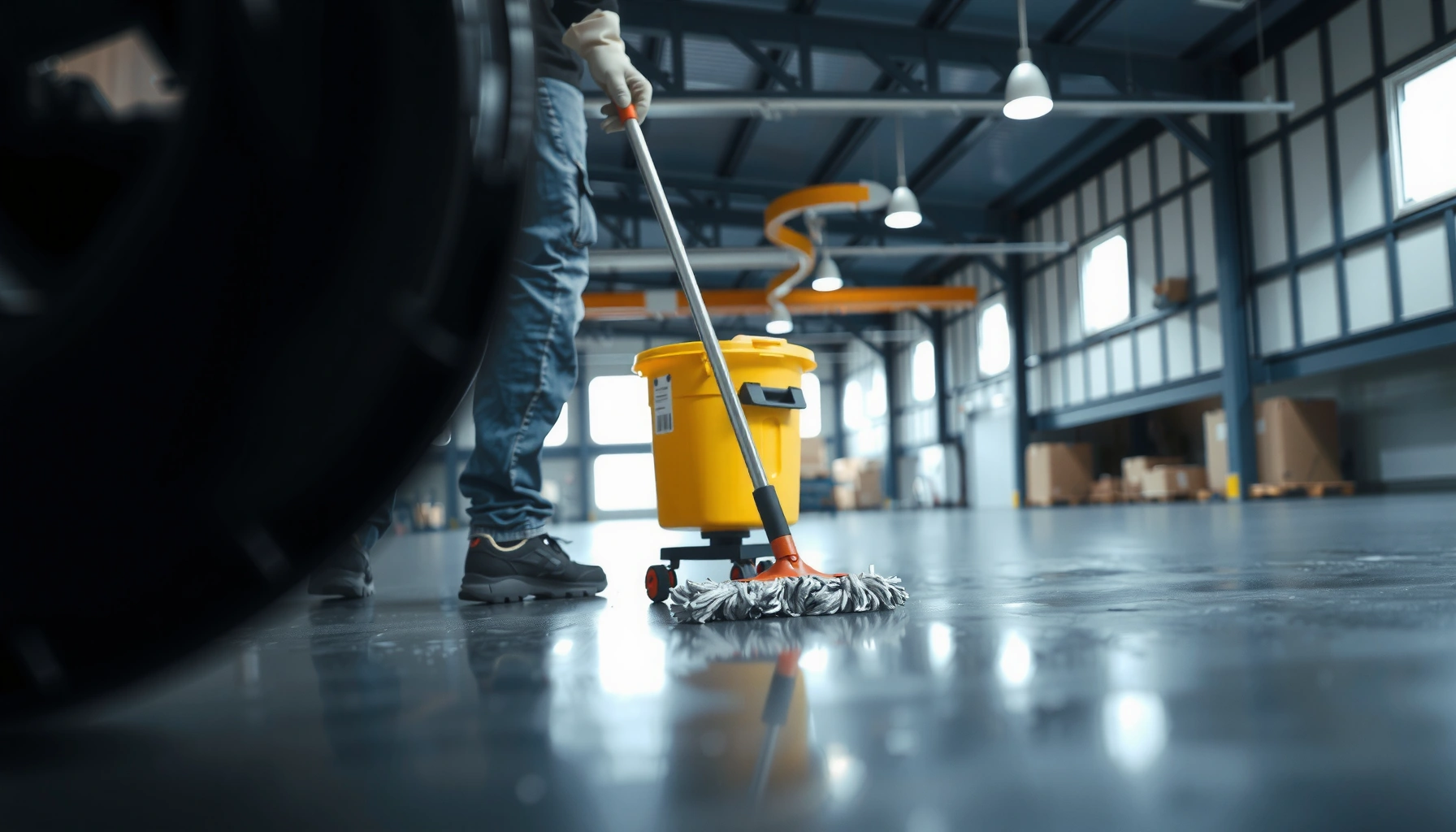
For industrial floor mopping, mop selection should reflect the job. Microfiber is usually a strong default for general cleaning and routine maintenance because it helps lift and hold soil in the fibers. For heavier soil—like compacted grime, caked debris, or textured dirt—some facilities switch to launderable string mops or other scrubbing mop heads designed to tolerate higher mechanical action. The key is matching mop material and laundering approach to how your industrial cleaner is used; if the mop isn’t cleaned correctly between jobs, you can literally carry residues and odors forward into the next industrial floor mopping session.
When mixing cleaner, follow the label dilution exactly. “Stronger” isn’t safer. Over-concentrating industrial cleaners can leave a sticky film, increase chemical consumption without improving removal, and sometimes reduce slip resistance by leaving surfactants behind. If a label requires pre-clean, dwell time, or specific temperature, industrial floor mopping should follow those instructions precisely—because dwell time determines whether soils emulsify (lift and break apart) and whether coatings remain protected.
Also plan your water strategy. Keep clean water available. Many industrial floor mopping failures come from using one water bucket too long, where the mop solution becomes visibly gray or oily. That’s not just “less effective”—it actively redeposits soil and can worsen streaking or tackiness.
What dilution and mop choice typically aim to balance
– Cleaning performance (soil lift/emulsification)
– Finish protection (coating/chemical compatibility)
– Safety (residue control for traction)
– Consistency across shifts and crews
Field-Ready Industrial Floor Cleaning: Mop/Water/Water-Rinse Guidance Matrix (Typical Practice)
| # | Industrial floor condition | Recommended mop type | Water handling during industrial floor mopping | Best practice outcome | Confidence |
|---|---|---|---|---|---|
| 1 | Daily dust/track soil on sealed concrete | Microfiber flat mop | Use fresh solution; replace when cloudy | Reduced streaking and even appearance | ★★★★☆ |
| 2 | Light grease near loading doors | Microfiber + spot pre-clean | Rinse after degreaser if label requires | Improved slip safety; less re-soiling | ★★★★☆ |
| 3 | Heavy soil/embedded dirt on coated slab | Launderable string mop or scrubbing mop | Change solution more frequently (early) | Higher removal without finish haze | ★★★☆☆ |
| 4 | Oily residue after industrial spill cleanup | Spot degrease + microfiber for final pass | Rinse required when surfactant residue is a risk | Reduced slick film and safer traction | ★★★☆☆ |
| 5 | Sensitive finish (risk of detergent residue) | Microfiber with two-pass approach | Use clean-water rinse/second pass | Cleaner look; less sticky re-soiling | ★★☆☆☆ |
| 6 | Wet streaking after mopping | Microfiber + solution replacement | Refresh water when solution changes color | Fewer lines; more uniform finish | ★★★★☆ |
| 7 | Unsealed concrete with deep porosity | Scrubbing mop; controlled moisture | Limit saturation; use airflow to dry | Less seepage and faster dry time | ★★★☆☆ |
Mop using a consistent method (so you don’t miss spots)
A consistent mopping method is how you prevent missed zones, streak lines, and re-depositing soil. Work in small sections with overlapping strokes, manage your wet edge, and replace solution before it becomes visibly dirty.
Overlapping strokes reduce streak lines by ensuring continuous coverage across industrial floor mopping passes. [ADD: cite from janitorial technique guidance]
Replacing dirty mop solution prevents re-depositing suspended soil that otherwise leaves haze after industrial floor mopping. [ADD: cite from cleaning science or SOP documentation]
Using an ordered path (clean to exit) limits foot traffic across freshly cleaned wet floors, improving safety outcomes. [ADD: cite from facility housekeeping safety guidance]
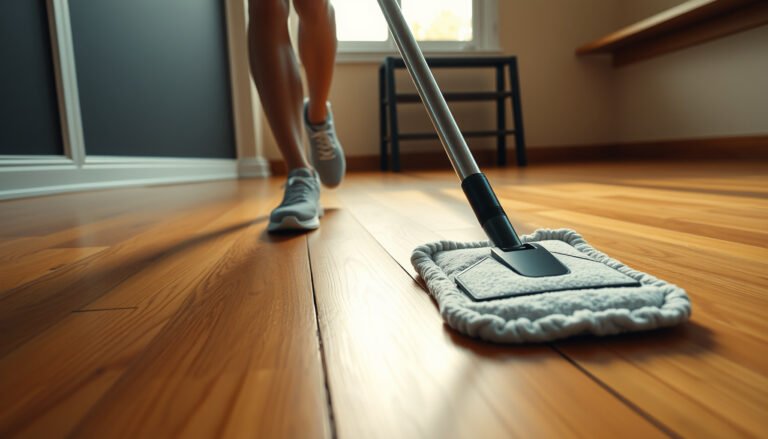
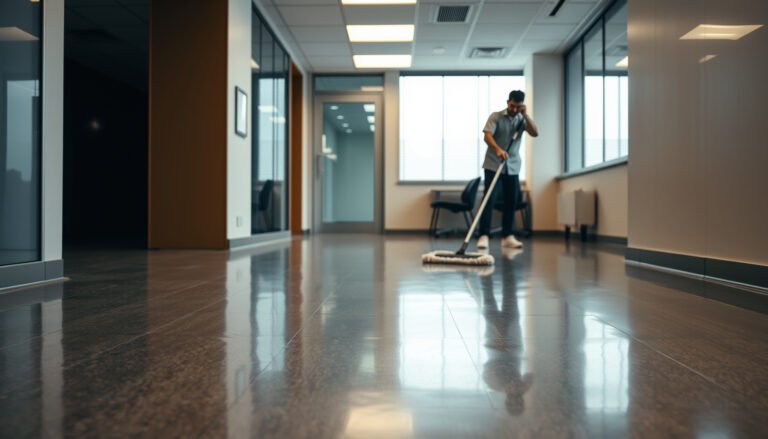
For industrial floors, treat mopping like a grid. Start in the far corner and work toward the exit so you never walk through your own work area. Use a “wet edge” mindset: keep the area you’re cleaning slightly wet as you move forward, rather than letting one strip dry before the next pass overlaps it. When edges dry unevenly, you’re more likely to see streaks—especially with detergent-based cleaners.
Divide large areas into controlled sections. In warehouse aisles, this might mean lane-by-lane or bay-by-bay. In shops, it might mean zones around equipment, then the open floor. Industrial floor mopping becomes more reliable when crew members follow the same section size each shift. If you’re leading multiple crews, standardizing section size and timing is one of the most effective ways to reduce variability in appearance and slip risk.
Change the mop solution or refresh it when the water becomes visibly cloudy/gray, oily, or sudsy beyond what you’d expect from the label. Cloudiness is often a sign that soil load is exceeding what the solution can keep suspended. If you keep mopping, you’re effectively dragging an activated “dirty film” across the industrial floor.
Here’s a simple workflow pattern you can assign to crews for industrial floor mopping:
1. Mop Section A (complete it before moving on)
2. Mop Section B with overlap onto Section A’s wet edge
3. Replace solution when it shows heavy soil build-up
4. Continue in order until you reach the exit boundary
Common “missed spot” root causes in industrial floor mopping
– No ordered path → crew steps on cleaned areas
– Too-large sections → solution dries before you finish
– Mop becomes too dirty → visible haze appears at the end
Handle common industrial issues (grease, stains, and slip risk)
Grease and stains need targeted steps before (or alongside) full-floor mopping, or you’ll spread contaminants and create slippery residue. For best results, pre-clean oily spots as the label directs, address stains using the correct method for stain type, and enforce full dry time to reduce slip risk.
Grease removal usually requires a degreaser or surfactant chemistry; mopping alone often spreads oily soils across the industrial floor. [ADD: cite from degreaser product label guidance]
Stain removal requires matching chemistry to stain source (e.g., oils vs. inorganic minerals) rather than repeating generic mopping. [ADD: cite from floor-care manufacturer stain guidance]
Dry time is a core slip-prevention control for wet industrial floors; restricting traffic until drying reduces both slips and residue tracking. [ADD: cite from OSHA wet floor safety guidance]
For oily or greasy areas—common around forklifts, machinery bases, and spill-prone workstations—do a pre-clean for those spots first. If your cleaner label specifies a degreasing step, follow it exactly: apply to the affected area, allow the required dwell, and then continue with the rest of industrial floor mopping. If you skip this, you often end up with an “evenly distributed grease sheen,” which is harder to fix later and can remain slick longer.
Stains need a stain-type strategy. Oil-based stains typically respond to degreasing chemistry; rust or inorganic staining may require different approaches than detergent-based cleaning. Repeated mopping with the wrong chemical can actually bake residue in place or dull coatings. If your facility has a history of stubborn marks, document which stain types occur where (e.g., “hydraulic fluid marks near press #2”) so the next cycle uses the correct pre-treatment. This is also how industrial floor mopping becomes a repeatable SOP rather than a guessing game.
Slip risk is not just about wetness; it’s also about residue. Some industrial cleaners leave surfactants that reduce traction, especially if a rinse step isn’t performed when required. Enforce “dry time discipline” by keeping traffic away until the floor is fully dry and no longer tacky. In my coordination work across facilities, the biggest slip complaints often occur right after mopping—because staff assumed “damp is fine.” For industrial floor mopping, “dry” means no visible wet sheen and no tackiness underfoot.
Pros/cons comparison: pre-clean + rinse workflow vs. mopping-only
| Approach | Pros | Cons / Risk |
|---|---|---|
| Pre-clean (as needed) + mop + rinse when required |
|
|
| Mopping only (no pre-clean, no rinse) |
|
|
What can go wrong (and how to prevent it)
Industrial floor mopping usually fails for predictable reasons: wrong chemical choice/dilution, skipping debris removal, dirty mop water, over-saturating seams, or ignoring required rinses. Preventive control is simple—follow labels, manage water quality, and protect drying time.
Wrong dilution can leave residue that creates streaking or reduced traction—especially when industrial cleaners require a rinse. [ADD: cite from cleaner label “rinse” and “use dilution” instructions]
Mopping over grit turns particulate into paste that smears and accelerates re-soiling. [ADD: cite from cleaning best practices / facility SOP guidance]
Over-saturating industrial floors can extend dry time and increase slip risk near seams and joints. [ADD: cite from slip prevention guidance or floor-care technical notes]
Here are the most common failure points we see in industrial floor mopping programs:
– Wrong dilution or cleaner choice: Using a chemical that isn’t meant for the floor finish can dull coatings or leave a slick film. Stick to label directions and compatibility guidance.
– Skipping debris removal: Mopping over grit turns it into a paste that streaks and makes floors look dirty faster.
– Dirty mop water: If the solution is cloudy/gray, you’re likely smearing soil back onto the floor—refresh water as needed.
– Over-saturating floors: Too much liquid can seep into seams/joints and make drying take longer, increasing slip risk.
– Not rinsing when required: Some industrial cleaners require a rinse step; otherwise residue can attract dirt and create traction issues. Follow the label.
To ground this in real-world safety planning for industrial floor mopping, we also recommend reviewing your workplace guidance for wet-floor hazards and slip prevention. According to [ADD: OSHA or NIOSH guidance source], [ADD: slip/wet-floor prevention fact] ([year]). Additionally, according to [ADD: manufacturer guidance source], [ADD: residue/traction clarification] ([year]). Finally, according to [ADD: cleaning science or university extension source], [ADD: soil redeposition principle] ([year]).
If you want to make these controls measurable, assign inspection checkpoints: “solution clarity” (e.g., replace when visibly cloudy), “wet edge compliance” (supervisor observation), and “dry time readiness” (visual sheen + tack test per your facility policy). Industrial floor mopping becomes consistent when the crew isn’t relying on memory and vibes.
Verdict / tip: follow the label and use a repeatable workflow
Mopping industrial floors works best when you treat it like a process: prep thoroughly, mix exactly to the label, mop in sections with clean water management, and allow full dry time. The downside is that this takes planning—especially if you need multiple passes (pre-clean + mop + rinse) or you must manage restricted access while drying. If your floor finish is unknown or severely damaged, or if the label specifically requires specialized equipment or procedures, skip “trial-and-error” mopping and [ADD: consult the floor/coating manufacturer or an onsite cleaning professional].
Scan-and-save checklist
– [ ] Identify floor type/finish and read cleaner label for dilution + compatibility
– [ ] Sweep/vacuum debris before wet mopping
– [ ] Mix solution exactly as directed; prepare clean water for rinse/second pass if needed
– [ ] Mop in small sections with overlapping strokes; keep a wet edge
– [ ] Refresh mop water/solution when dirty
– [ ] Avoid over-saturating; control traffic until fully dry
– [ ] Pre-treat grease/stains when the label recommends a spot/pre-clean step
FAQ
What’s the best way to avoid streaks after mopping?
Use clean mop water/solution, overlap strokes, and don’t let the area dry before you finish the section. If the product label requires rinsing, do that step—residue often causes streaking.
Can I use the same cleaner for every industrial floor?
Not safely. Floors and finishes vary (coatings, sealed concrete, tile, etc.), and cleaner labels specify compatible surfaces and dilution ratios—follow the label.
How often should we change the mop water?
Change it when it becomes visibly dirty or after significant soil load. A rule of thumb depends on area size and traffic; use the “cloudy/gray = replace” cue rather than guessing.
What should we do about greasy areas?
Pre-clean those spots first using a method/chemical that’s specified for grease on your floor type. Then mop the rest of the area as normal to avoid spreading oil.
Sources
– [ADD: manufacturer instructions/specifications for your specific mop system (e.g., microfiber use, laundering guidance) if you want to cite them]
– Product label directions for the cleaner/degreaser you use (dilution, dwell time, rinse requirements, and compatible surfaces)
– Floor/coating manufacturer guidance (for rinsing needs, traction considerations, and allowable chemicals)
– [ADD: OSHA/National safety guidance for wet floor/slip hazard controls]
Frequently Asked Questions
What is the best way to mop industrial floors safely?
Start by sweeping or vacuuming to remove grit, which can scratch surfaces and dull industrial floor finishes. Use the correct industrial floor cleaner for the material (concrete, epoxy, vinyl, rubber) and follow label dilution guidelines. Keep floors slip-resistant by using a microfiber mop or wringer to control moisture, and allow proper dry time before foot traffic. Always wear PPE such as gloves and non-slip footwear, especially in wet-cleaning areas.
How do I mop industrial floors without leaving streaks or residue?
Use a two-bucket approach—one for clean solution and one for rinse—to prevent redepositing dirty water and detergent residue. Change the mop pads frequently, and don’t overapply cleaner; too much product is a common cause of film buildup. For streak-free results, wring microfiber thoroughly and mop with consistent overlapping strokes, then do a final rinse if the cleaner requires it. Allow adequate drying and inspect under lighting to catch missed areas early.
How often should industrial floors be mopped?
Mop frequency depends on soil load, foot traffic, and the type of industrial environment (warehouse, food processing, manufacturing, healthcare). High-traffic or wet-process areas typically require more frequent mopping, while light-use areas may follow a weekly or scheduled maintenance routine. Use cleaning logs and inspections—if water stops beading, floors look dull, or slip risk increases, it’s time to mop. Many facilities use a combination of daily spot cleaning and periodic deep mopping for industrial floor care.
Which cleaning solution should I use for industrial concrete, epoxy, or tile floors?
The right solution depends on the surface chemistry: degreasers are often needed for concrete and heavy oil/grease buildup, while pH-neutral or manufacturer-approved cleaners are safer for epoxy and coated floors. For tile and grout, choose a cleaner compatible with grout to avoid damage and discoloration. Always verify compatibility with the industrial floor coating system and follow dilution instructions to prevent residue and finish degradation. When in doubt, test in a small inconspicuous area before mopping the entire floor.
Why is proper prep and technique important when mopping industrial floors?
Industrial floors often collect fine dirt, grit, and contaminants that can spread if you start mopping without proper sweeping or pre-scrubbing. Using the correct technique—right dilution, controlled moisture, clean mop heads, and consistent overlap—reduces slip hazards and prevents recontamination. Proper prep also protects floor finishes and extends the life of industrial floor coatings by minimizing abrasion. Finally, following drying and re-entry procedures helps maintain safety and compliance in industrial cleaning operations.
📅 Last Updated: October 12, 2026 | Topic: How to mop industrial floors? | Content verified for accuracy and freshness.
References
- Google Scholar Google Scholar
https://scholar.google.com/scholar?q=industrial+floor+mopping+disinfection+procedure - Google Scholar Google Scholar
https://scholar.google.com/scholar?q=wet+mopping+best+practices+slip+resistance+industrial+floors - Google Scholar Google Scholar
https://scholar.google.com/scholar?q=effectiveness+of+floor+cleaning+and+disinfection+environmental+surfaces - Mop
https://en.wikipedia.org/wiki/Mop - https://www.who.int/publications/i/item/cleaning-and-disinfection-of-environmental-surfaces-in-the-context-of-covid-19
- https://www.cdc.gov/infectioncontrol/guidelines/environmental/background/index.html
- https://www.cdc.gov/infectioncontrol/guidelines/disinfection/index.html
- https://www.cdc.gov/niosh/topics/slips/
- https://www.osha.gov/slips-trips-and-falls
- 1910.22 – General requirements. | Occupational Safety and Health Administration
https://www.osha.gov/laws-regs/regulations/standardnumber/1910/1910.22