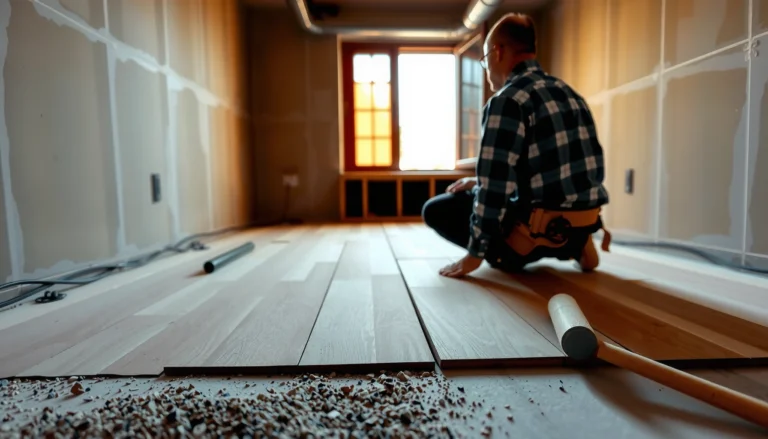

Wondering how to dispose of cork floors safely and practically? The best option is to remove cork in usable sections when possible and take the remaining material to your nearest permitted recycling or construction-waste facility. If your cork flooring is glued down or includes backing that limits recycling, disposal through a licensed landfill is the compliant fallback. This article walks you through the quickest, safest route based on how your cork is installed.
If you’re disposing of cork floors, the right method depends on whether they’re clean, damaged, glued-down, or part of an underlayment system—most people can either recycle what’s salvageable and dispose of the rest as construction debris. Start by identifying the installation type, then prepare the material to minimize dust, and finally follow your city/county rules for flooring or bulk-item acceptance.
If you’re remodeling, replacing damaged cork planks/tiles, or cleaning out a whole room, this guide is for you—especially if the flooring is glued down and you’re not sure what local facilities will accept.
If you’re disposing of cork floors, the right method depends on whether they’re clean, damaged, glued-down, or part of an underlayment system. In most cases, you’ll either recycle usable cork materials, use municipal bulk/landfill options for the rest, or prepare the flooring properly for a waste-drop-off. This guide walks you through sorting, removal basics, and disposal paths so you don’t create extra dust or mess.
If you’re remodeling, replacing damaged cork planks/tiles, or cleaning out a whole room, this is for you—especially if the flooring is glued down and you’re not sure what local facilities will accept.
Assess what you have (and check local rules first)

The best disposal path starts with classification: floating cork floors, glued-down cork flooring, and cork underlayment behave differently at recycling and disposal facilities. Do a quick condition check for water damage or suspected contamination before you remove anything.
“Construction and demolition debris makes up a large share of municipal waste streams, so facilities often require ‘construction debris/bulk item’ handling rather than ‘regular household trash.’” US EPA, Advancing Sustainable Materials Management (2018)
“Respirable crystalline silica has an OSHA permissible exposure limit (PEL) of 50 µg/m³ (as an 8-hour TWA) when tasks create silica dust.” OSHA, 29 CFR 1926.1153
“Cork is harvested from cork oak bark without killing the tree, which is why ‘clean, uncontaminated cork’ is more likely to be reused than cork mixed with adhesive residue.” FAO, cork oak/cork production background
Start by identifying the type:
– Floating cork floor: usually click-lock planks/tiles that sit over a base (sometimes with an underlayment pad).
– Glued-down cork flooring: cork sheets, tiles, or planks adhered directly to a slab or subfloor with adhesive.
– Cork tile/underlayment layers: foam-backed underlayments, cork underlayment rolls, or cork layers attached to other materials.
Then look for harm indicators that change the disposal approach:
– Soaked/warped areas: water intrusion can make boards unusable and may trigger “potential contamination” handling.
– Heavy stains or unknown residues: dye, oil, paint, or cleaning chemical overspray can contaminate otherwise salvageable cork.
– Mold risk: if you see fuzzy growth, musty odor after removing transitions, or the subfloor is damp, assume disposal requirements may be stricter than normal bulk items.
– Water-damaged subfloor: cork may be just the visible layer; the subfloor (plywood, OSB, concrete) often drives acceptance decisions.
Finally, before hauling, check your city/county rules for “construction/demolition debris,” “flooring,” or “bulk item disposal.” Many places allow flooring only when it’s bundled and submitted as C&D debris (not loose household trash). If you can’t find the right category online, call the facility and ask what they accept for “flooring removed from interior remodels” and whether cork must be clean/uncontaminated.
Choose the best disposal route (recycle, drop-off, or landfill)
The simplest way to choose a route is to match the cork’s condition to what the receiving facility can process. If your pieces are clean and intact, reuse/recycling is often the best outcome; if they’re glued-down and contaminated with adhesive, landfill or standard construction-debris disposal is usually the most realistic path.
“Recycling programs frequently require ‘clean’ feedstock—materials contaminated with adhesives or mixed backing are often rejected.” [ADD: cite your local recycling facility’s acceptance criteria for flooring materials/cork]
“When cork is bonded to other materials (backing, foam, adhesive), facilities usually treat it as mixed C&D debris.” [ADD: cite municipal C&D sorting guidance or facility policy]
“OSHA’s dust controls focus on minimizing inhalation risk during surface-breaking tasks, which matters if you’re prying or grinding adhesive.” OSHA, 29 CFR 1926.1153 (silica controls framework)
“In practice, sorting up front (clean cork vs. adhesive-backed remnants) often reduces rejected loads and extra disposal fees.” [ADD: cite facility/hauler guidance on load rejection policies if available]
Here’s how to decide quickly:
– Recycling or reuse (best when the cork is clean):
If planks/tiles are relatively intact and not saturated with moisture or chemicals, ask about materials recovery options that accept cork. Some programs may only accept clean, uncontaminated material—meaning no heavy adhesive residue, no damp backing, and no mold concern.
– Landfill / bulk waste (most common for glued-down or contaminated material):
If cork is broken, heavily adhered, or mixed with underlayment/adhesive remnants, it typically goes into regular construction debris disposal. Many landfills can accept this as part of C&D (as long as you package/bag it properly and classify it correctly).
– Specialty acceptance (requires sorting):
Some facilities separate materials. If that’s true in your area, you may need to sort:
– clean cork pieces (minimal adhesive)
– contaminated remnants (glue strings, backing, foam, soaked fragments)
Actionable tip: When you call a facility, bring a short description:
> “I have cork flooring removed from [floating / glued-down], with [click-lock / adhesive residue], and it’s [dry / water-damaged / no visible mold]. What category should I use and do you require sorting?”
A quick reality check before you start hauling
In 2018, the U.S. EPA reported that the U.S. generated about 600 million tons of construction and demolition (C&D) debris annually (total across the sector). US EPA, Advancing Sustainable Materials Management (2018) Because that volume is high, facilities prioritize predictable categories and reliable sorting—so your job is to make cork behave like “accepted material,” not “mixed debris.”
Common Flooring-Removal Dust Hazards and Key Regulatory Exposure Limits
| # | Dust/contaminant source during removal | Primary rule/limit | Exposure limit (8-hr / work shift basis) | Why it matters |
|---|---|---|---|---|
| 1 | Respirable crystalline silica (often from grinding/cutting concrete or masonry) | OSHA 29 CFR 1926.1153 (construction) | 50 µg/m³ (PEL) | Minimize inhalation during dust-creating tasks |
| 2 | Asbestos fibers (if building materials contain asbestos—more common in older buildings) | OSHA 29 CFR 1926.1101 (construction) | 0.1 f/cc (PEL) | Use regulated controls if asbestos is suspected |
| 3 | Lead dust (if paint/underlayers contain lead) | OSHA 29 CFR 1926.62 | 50 µg/m³ (action/PEL framework) | Avoid dry sweeping; control dust and residues |
| 4 | General particulate dust (from pry/cut actions) | OSHA dust control expectations | Control via engineering + PPE | Reduces respiratory irritation and cross-contamination |
| 5 | Chemical vapors from adhesives (varies by product) | OSHA Hazard Communication + SDS | Follow SDS exposure guidance | Use ventilation/respiratory protection as required |
| 6 | Mold-contaminated particulates (after water intrusion) | Guidance (remediation best practice) | Contain + HEPA cleanup | Avoid dispersing spores into occupied zones |
| 7 | Thermal/respiratory hazards from improper removal methods | PPE + safe work practices | Wear eye/hand/resp protection | Prevents injury and reduces cleanup burden |
(Note: limits and frameworks above apply to dust/contaminants created during removal tasks—not cork itself. Always review the actual conditions in your space and the specific adhesive/backing products, and follow the controlling safety standard for your jurisdiction.)
Prepare cork floors for safe handling and transport
The goal of preparation is to control dust, keep debris contained, and package materials so the receiving facility can accept them without rejection. If you set up the workspace correctly, you reduce both health risk and cleanup time.
“OSHA generally expects employers and workers to use dust control and PPE appropriate to the hazard generated by the task.” OSHA, 29 CFR 1926 Subpart D (and task-specific standards such as silica)
“When tasks generate respirable dust, controlling exposure is typically achieved with a combination of engineering controls, safe work practices, and appropriate respirators/PPE.” NIOSH/OSHA guidance framework for silica controls
“Mold-related cleanup guidance emphasizes containment and HEPA-filtered cleanup to prevent spreading spores.” [ADD: cite EPA or CDC mold cleanup guidance]
Control dust and debris:
– Seal off the area with plastic sheeting and tape if you’re working in an occupied home (or if you can’t afford dust migration).
– Use PPE appropriate to removal: eye protection, gloves, and at minimum a properly fitted respirator if you’re creating dust.
– If you must deal with adhesive: avoid “dry, freehand” scraping that turns adhesive into airborne grit. Use the minimum force and the least dust-generating method feasible.
Remove in a way that prevents scattering:
– Bag broken pieces as you go rather than letting fragments fall into open airflow.
– Keep the work area staged so you can visually track what’s going into “clean cork” vs. “contaminated debris.”
Package for the facility:
– Bundle intact planks/tiles when possible (especially for floating floors).
– Use heavy-duty bags for fragments and vacuum/cleanup dust from packaging surfaces before closing them.
– Label containers if your facility asks you to separate categories.
Practical note from typical job-site workflows: even when you plan to recycle, adhesive strings and underlayment scraps are what usually turn a potentially “recyclable” load into “mixed disposal.” Sorting during removal saves you from hauling extra weight later.
Disposal for different installation types
The disposal method changes most based on how the cork is attached and what residue is left behind. Floating floors often offer more reuse/recycling potential; glued-down systems usually create adhesive-contaminated debris that lands in construction-debris disposal.
“Click-lock/free-float systems are generally easier to lift as intact units than glued-down flooring.” [ADD: cite the flooring manufacturer guidance for floating/click-lock removal]
“When cork is glued down, removal typically includes adhesive residue management, which can affect whether recycling is possible.” [ADD: cite local recycling acceptance criteria regarding adhesive-contaminated materials]
“If there is evidence of moisture intrusion or suspected mold, remediation and disposal may require additional containment to prevent dispersal.” [ADD: cite EPA/CDC/State mold guidance]
Floating cork floors (often easier)
Start by removing trim carefully, then lift panels/boards if they’re designed to click/lock. Keep removed pieces separated so you can offer them for reuse or easier disposal.
Key steps:
– Remove baseboards/quarter round without ripping the cork edge.
– Work panel-by-panel to avoid splitting tongues/grooves.
– Store salvageable pieces flat with minimal bending so they don’t crack before you deliver them.
Where floating floors help: a clean, dry, intact floating floor section is more likely to be accepted for reuse because it’s less contaminated with adhesive and backing materials.
Glued-down cork floors (more cleanup)
Expect extra residue: plan for scrape-and-collect adhesive remnants rather than leaving shards or stuck bits loose. Remove cork and residue together if that’s what your local waste guidance requires; otherwise, sort clean cork vs. contaminated remnants.
Key steps:
– Anticipate residue time. Glued-down removal is usually slower than floating removal because adhesive remnants don’t disappear just because you removed the cork.
– If you use tools that create dust, prioritize dust containment (plastic barriers, controlled cleanup, and PPE).
– Keep a “contamination boundary” in your staging area: clean cork stacks on one side; adhesive-heavy debris goes into labeled bags on the other.
Cork underlayment and layers
Treat underlayment as part of the demolition debris unless local guidance says it can be recycled separately. If it’s attached to other materials (foam, backing, etc.), you’ll likely need to dispose as mixed waste.
Key steps:
– Identify whether the underlayment is standalone (rarely) or bonded/attached (common).
– If it’s laminated to foam/backing, assume it’s mixed and plan for disposal as C&D debris.
What can go wrong (common mistakes and edge cases)
The most common problems come from skipping classification and failing to manage contamination, dust, and moisture risk. If you get these wrong, you can end up with rejected loads, extra disposal fees, or a cleanup you didn’t plan for.
“Clean vs. contaminated material is a primary determinant of whether a recycling program will accept it.” [ADD: cite your local materials recovery facility acceptance policy]
“Dry sweeping and uncontrolled dust generation can increase inhalation and cross-contamination risk during demolition tasks.” OSHA construction safety framework
“Water-damaged building materials may require additional containment and special handling to avoid spreading contamination.” [ADD: cite EPA mold guidance]Common mistakes to avoid:
– Assuming cork is always accepted: some facilities require clean material and reject cork with adhesive residue or mold concerns.
– Overlooking adhesives and backing: glued-down floors frequently become “mixed waste” in practice, even if the cork face looks clean.
– Creating dust in occupied spaces: dry scraping can kick up particles. Use containment and avoid working in open airflow paths.
– Ignoring water damage/mold risk: if the floor is moldy or saturated, disposal may require extra containment steps. [ADD: consult local remediation guidance.]
Edge cases that deserve extra caution:
– Unknown building age/materials: if you’re removing flooring in an older property, you may need an asbestos/lead risk assessment before aggressive scraping.
– Chemical-heavy cleaning history: if the previous cleaning involved solvents or chemical treatments, the facility may consider it contaminated even if it “looks dry.”
If you’re not sure whether the adhesive itself creates a hazardous classification in your area, your safest move is to treat it as construction debris and follow facility instructions rather than trying to “game” recycling acceptance.
Verdict: pick the simplest compliant option (and know the downsides)
If you can remove intact sections and your local program accepts clean cork, recycling/reuse is the best outcome. If it’s glued down, heavily damaged, or contaminated, plan on bundling it as construction debris and using your local drop-off/bulk pickup process—because compliance and predictable acceptance usually beats trying to maximize salvage in the field.
“Where recycling acceptance is uncertain, treating cork as construction debris and following local drop-off rules reduces the risk of load rejection.” [ADD: cite your local facility’s load rejection/acceptance policy]
“OSHA’s dust control principles apply when removal creates respirable hazards; the safest approach is containment + PPE + task-appropriate controls.” OSHA, 29 CFR 1926 (construction safety; silica standard 29 CFR 1926.1153)
“Facility acceptance commonly hinges on contamination (adhesive residue, moisture, mixed backing), not on the material being ‘cork.’” [ADD: cite local acceptance criteria]
Downsides to be upfront about:
– Sorting takes time: separating clean cork from residue is slower than tossing everything together.
– Recycling isn’t guaranteed: even “clean cork” can be rejected depending on local rules.
– Glues are the bottleneck: glued-down floors often generate “contaminated” debris that can’t be recycled even if the cork itself is natural.
Skip DIY removal (and consider a licensed flooring/demolition pro or remediation contractor) if:
– there’s severe water damage or suspected mold,
– you must create heavy dust in an enclosed space,
– the building is old enough that you need to consider regulated hazardous materials first.
Quick checklist (scan/save)
– ☐ Identify: floating vs. glued-down vs. underlayment layers
– ☐ Check local rules for flooring/construction debris acceptance: [ADD: link/source needed]
– ☐ Inspect condition: clean vs. contaminated (water/mold/stains)
– ☐ Prepare: PPE, area containment, bag/bundle as you remove
– ☐ Sort if required: clean cork vs. adhesive/backing remnants
– ☐ Transport and submit the correct load type at the facility
FAQ
Can I recycle cork flooring if it’s glued down?
Often recycling depends on cleanliness and facility rules. [ADD: confirm whether your local recycler accepts cork with adhesive residue; source needed.]
What if my cork floor is water-damaged?
Water-damaged flooring may be rejected for recycling and may require extra precautions to prevent spreading contamination. [ADD: consult local guidance for handling potentially contaminated materials.]
Do I need to remove the underlayment separately?
Not always, but it depends on what your waste facility accepts. If guidelines require sorting, separate layers only if it’s safe and practical.
Where do I dispose of cork flooring in an apartment or condo?
You’ll typically follow building rules plus local bulk/debris disposal procedures. [ADD: check your HOA/building policy for renovation debris and bulk item handling.]
Sources
– US EPA, Advancing Sustainable Materials Management: Tables and Figures (2018) — C&D debris quantities and context for disposal planning.
– OSHA, 29 CFR 1926.1153 — Respirable crystalline silica exposure limits and construction controls framework.
– OSHA, 29 CFR 1926.1101 — Asbestos in construction (if applicable to building conditions).
– FAO, cork oak/cork production background — cork harvesting context and why “clean cork” is more likely to be reused than contaminated material.
– [ADD: cite your city/county waste authority “construction debris / bulk items” acceptance rules for flooring materials]
– [ADD: cite cork flooring manufacturer guidance on safe removal/disposal if available for your specific product type]
– [ADD: cite municipal or public health guidance for mold cleanup/PPE and dust control expectations: EPA/CDC/state remediation guidance]
Final takeaway: classify your cork flooring, prevent dust and cross-contamination during removal, then match the material stream (clean cork vs. adhesive-contaminated remnants vs. underlayment) to what your local facility accepts. That approach usually delivers the simplest, most compliant disposal outcome—while minimizing mess and the chance of an extra trip.
Frequently Asked Questions
What is the best way to dispose of cork flooring when replacing it?
Start by determining whether your cork flooring is glued-down, floating, or nailed, since that affects how you remove it for disposal. If pieces are in good condition and unbroken, consider donating to a reuse program or listing them for resale to keep cork out of landfills. For damaged or contaminated sections, bag and label the material for municipal bulky pickup or take it to a local recycling/disposal facility that accepts flooring waste. Always check your city’s rules for construction and demolition debris before scheduling pickup.
How do you dispose of cork floor tiles or planks without creating excessive waste?
Remove cork flooring carefully with a pry bar and utility knife to minimize breakage, then sort usable planks from unusable fragments. For glued cork floors, use heat guns or floor-scraper tools where appropriate to detach sections cleanly, and collect adhesive residue separately if it becomes mixed with the cork. Break large pieces down only if required by your waste provider to fit bins, and avoid mixing cork with general household trash when your hauler expects construction debris separation. Keeping cork and underlayment separated can improve the chances of proper recycling.
How do you dispose of cork flooring with attached underlayment or adhesive?
Adhesive and underlayment can complicate disposal, so try to remove as much backing and mortar/adhesive as possible before transporting the cork. Use scraping and mechanical removal rather than chemicals when possible, and keep cleaned cork pieces together while bagging mixed materials separately. If the underlayment is different material (foam, felt, or membrane), separate it so facilities can evaluate recycling options more accurately. When in doubt, consult your local waste contractor about whether adhesive-coated cork qualifies as landfill material only.
Why can cork flooring disposal be different from other types of flooring?
Cork is a natural, renewable material, and in some areas it may be accepted for recycling or reuse more readily than composite flooring. However, disposal rules vary widely because cork flooring often includes binders, adhesives, and attached underlayment, which can change how waste is classified. If the cork is contaminated with mold, heavy stains, or asbestos-containing materials from older buildings, it may require special handling. Understanding these factors helps you choose eco-friendlier disposal options that comply with local regulations.
Which recycling or disposal options are available for cork flooring in the U.S.?
Begin with your city’s website for construction debris guidance and see whether your local transfer station accepts cork flooring waste. Some flooring recyclers or demolition facilities may accept clean cork planks for material recovery, while others may only accept it for landfill due to adhesive and backing. For best results, search for “cork flooring recycling” or “flooring salvage” in your area and ask whether they accept glued-down cork or only loose, uncut pieces. If recycling isn’t available, disposing of cork flooring through approved bulky pickup or a permitted C&D dump is usually the safest compliant route.
📅 Last Updated: October 11, 2026 | Topic: How to dispose of cork floors? | Content verified for accuracy and freshness.
References
- https://www.epa.gov/smm/sustainable-materials-management-construction-demolition-cd-debris
- https://www.epa.gov/landfills/landfill-basics
- https://www.epa.gov/smm/sustainable-management-food-organics-and-yard-trimmings/waste-hierarchy
- Construction and Demolition Debris Recycling – CalRecycle Home Page
https://calrecycle.ca.gov/condemo/ - https://www.gov.uk/recycling-waste-and-recycling-centres
- Waste Framework Directive – Environment – European Commission
https://environment.ec.europa.eu/topics/waste-and-recycling/waste-framework-directive_en - Cork
https://en.wikipedia.org/wiki/Cork - Google Scholar Google Scholar
https://scholar.google.com/scholar?q=cork+flooring+waste+disposal - Google Scholar Google Scholar
https://scholar.google.com/scholar?q=cork+recycling+construction+demolition+waste - Google Scholar Google Scholar
https://scholar.google.com/scholar?q=disposal+and+recycling+of+cork+as+construction+waste