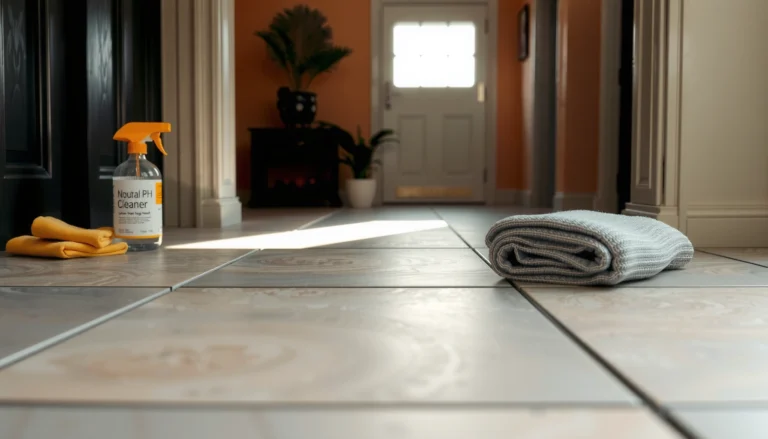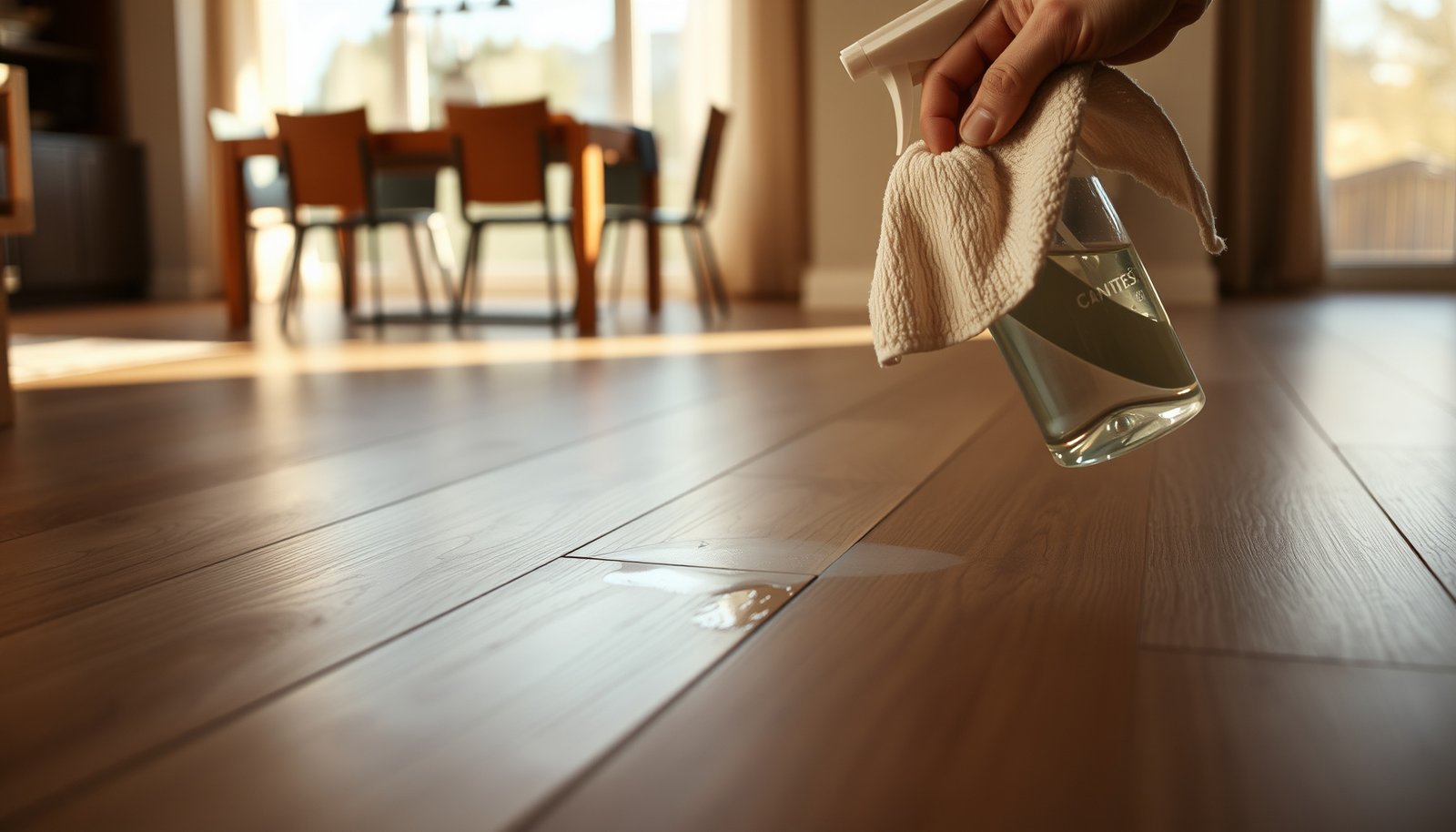

Removing stains from LVP floors in a dining room is a straightforward process when you use the right cleaner for the specific spot. This guide tells you exactly what to do to lift common spills—food, wine, grease, and scuffs—without dulling the finish or damaging the planks. You’ll get the fastest method first, plus the do-not-mix warnings that prevent permanent discoloration.



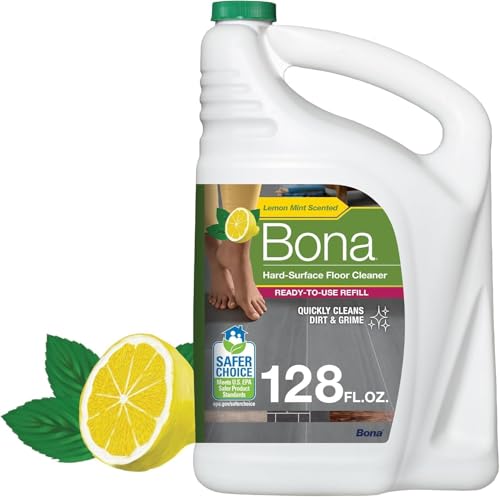
Blot the stain right away with a clean, dry cloth, then clean with a pH-neutral cleaner (or mild dish soap diluted with water) using a barely damp mop/cloth—never soak the floor. For tougher marks, spot-treat gently based on the stain type, and always test in a hidden area first to avoid dulling or haze.
If you’re dealing with the typical dining-room offenders—food spills, drink rings, grease from cooking mishaps, and the occasional pet accident—this guide focuses on what works on luxury vinyl plank (LVP) while protecting its top wear layer and seams. Also, if your specific LVP warranty/care guide differs, follow that documentation first.
Identify the stain and your LVP finish
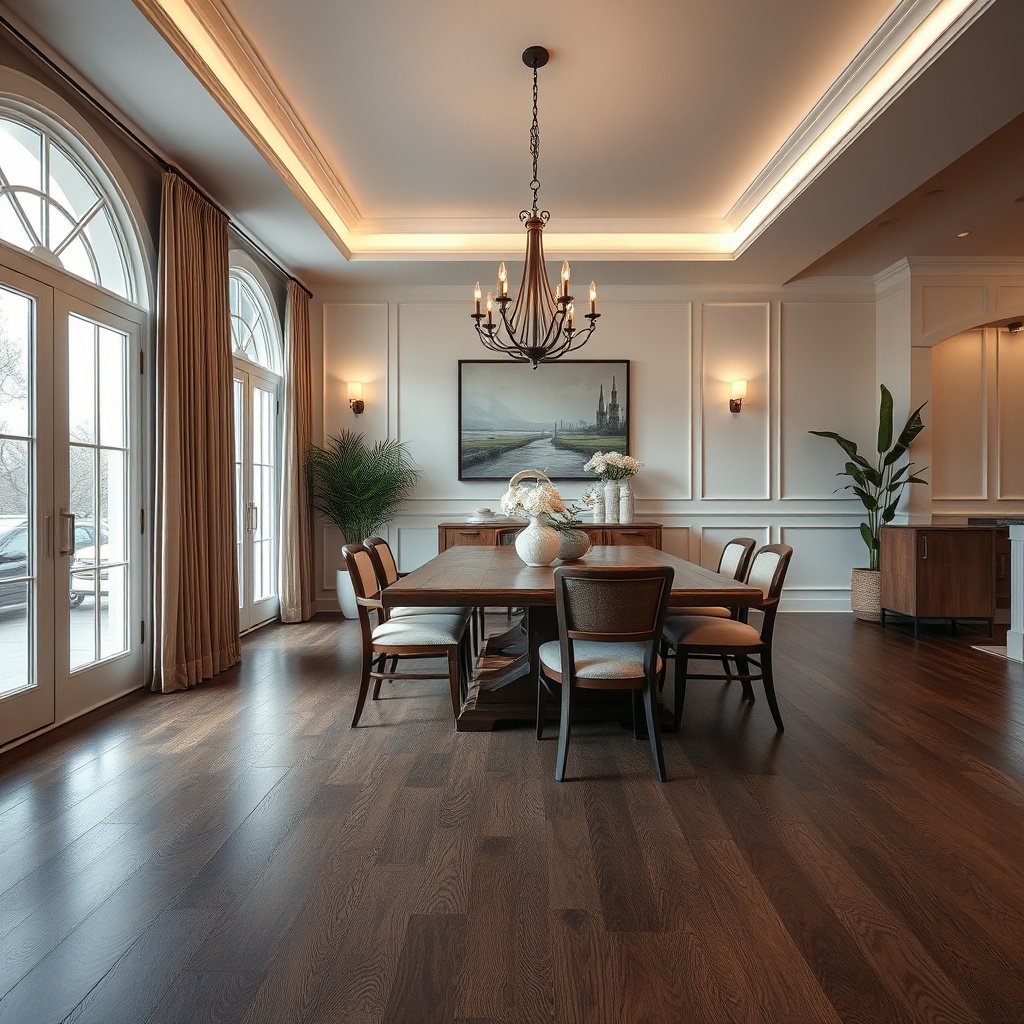
The fastest, safest way to remove a dining-room stain from LVP is to identify whether it’s fresh, dried-on, or ground in—and then match your cleaning approach to your LVP’s finish. LVP can tolerate gentle, pH-neutral cleaning, but prolonged wetting and “mystery chemistry” are where haze and dulling start.
“pH-neutral” refers to solutions close to pH 7, which are generally less likely to attack or dull many resilient floor finishes than strongly acidic or alkaline products.
Even “water-resistant” LVP is still vulnerable to damage from standing liquid at seams, so spill cleanup should focus on controlled moisture and fast drying.
Fresh vs. dried vs. ground-in discoloration
– Blot first to figure out whether it’s a fresh spill, dried residue, or a ground-in discoloration. Fresh stains usually lift with a blot + barely damp wipe. Dried residue often requires gentle repeated wipes (and careful debris removal) before it will release. Ground-in discoloration is where finish dulling can become more noticeable—especially with scuffing from shoes around dining chairs.
– Look for clues:
– Shiny wet spot after a drink = likely fresh.
– Tacky or oily halo = grease/syrup contamination.
– Rough gritty specks = tracked-in mud or dried food bits.
Confirm the LVP finish/wear layer you have
– Check the LVP’s finish/wear layer (many are “water-resistant,” but standing liquid is still a risk). “Water-resistant” describes surface behavior; it doesn’t mean the core, edges, or seams want prolonged moisture.
– Some LVP finishes hide micro-scratches better than others. If your dining room gets a lot of chair movement, consider that “stain” might be combined with light scuffing.
Use the manufacturer’s care and maintenance guidance
– If you know the flooring brand, locate the “care and maintenance” page—stain-removal guidance can vary by finish. This matters because certain brands allow only specific cleaners, and some caution against solvents for particular wear layers or printed-cork/vinyl hybrid constructions.
Gather safe supplies (and avoid the risky stuff)
The safest cleaning setup for LVP stains is simple: microfiber, clean water, and a pH-neutral cleaner (or properly diluted mild dish soap). Your goal is to remove residue without saturating seams or stripping the finish.
Microfiber pads and cloths are effective for lifting dining-room residue because they trap particles without the gouging risk of abrasives.
A “barely damp” approach matters because LVP care guidance commonly emphasizes minimizing free-standing liquid to protect edges and seams.
What to use for LVP (dining-room safe)
– Use: soft microfiber cloths/mop pads, clean water, and a pH-neutral cleaner labeled for hard-surface/vinyl flooring (or mild dish soap diluted with water).
– Keep extra dry towels ready so blotting is immediate and you’re not chasing the stain once it spreads.
– Plan on two-step wiping for many stains: (1) cleaner wipe, then (2) clean-water wipe to remove remaining cleaner film.
What to avoid on LVP (common “looks like it works” mistakes)
– Avoid: steam mops, steel wool, abrasive powders, and harsh solvents unless your LVP manufacturer explicitly allows them.
– Steam and harsh chemicals can change surface gloss, cause haze, or accelerate wear layer breakdown. In a dining room, that shows up as dull patches near high-traffic areas—often around chair legs.
Quick pros/cons comparison: safe vs. risky tools
Typical pH of Common Dining-Drink Stains (Lower pH = More Acidic)
| # | Dining spill item | Typical pH (approx.) | What it leaves behind | Finish-friendly score* |
|---|---|---|---|---|
| 1 | Hot/iced tea | 5.0–5.7 | Tannins (brown ring) | ★★★★★ |
| 2 | Coffee | 4.5–5.2 | Brown pigment residue | ★★★★☆ |
| 3 | Beer | 4.0–4.6 | Protein/sugar film | ★★★☆☆ |
| 4 | Tomato-based sauce | 3.8–4.6 | Tomato pigment + acidity | ★★☆☆☆ |
| 5 | Orange juice | 2.9–4.0 | Acid + sugars | ★☆☆☆☆ |
| 6 | Red wine | 3.0–3.7 | Tannins + pigments | ★☆☆☆☆ |
| 7 | Cola / carbonated soft drinks | 2.3–3.0 | Acid + sticky residue | ★☆☆☆☆ |
Finish-friendly score is a relative indicator that assumes prompt blotting and follow-up rinsing with clean water; it is not a warranty measure. Typical pH ranges vary by brand, dilution, and serving temperature.
Remove common dining-room stains (step-by-step)
The best LVP stain removal method depends on what’s on the floor—food pigments, oily residue, or tracked grime all respond differently to cleaning. In practice, the safest sequence for most dining-room spots is blot → pH-neutral wipe → clean-water wipe → dry, then only repeat or spot-treat if the mark persists.
Water-based stains generally respond to multiple gentle wipes, but leaving cleaner residue behind can create haze that looks like the stain “won’t come out.”
Oily residues typically require a degreasing step compatible with resilient/vinyl surfaces before you do any final rinse-and-dry.
Food & drink spills (coffee, wine, juice)
– Blot, then wipe with a slightly damp cloth using diluted, pH-neutral cleaner. Start from the outside edge moving inward to prevent spread.
– Re-wipe with clean water on a fresh cloth to lift remaining residue, then dry thoroughly with a towel.
– If the spot looks “lighter but not gone,” treat it as residue transfer rather than true “stain.” For LVP, residue removal matters as much as color removal.
Grease & oily fingerprints
– Start with a vinyl-safe degreasing approach from the cleaner you use (don’t “scrub harder”—wipe more often).
– If residue remains, repeat gentle cleaning rather than switching to stronger chemicals right away.
– Dining rooms often see grease from cooking, bottled sauces, and fingerprints near serving stations. Those oily films can attract dust, making the mark appear darker over time.
Mud & tracked-on grime
– Let dry first if it’s muddy, then remove loose debris gently before you clean. Grinding grit with a damp cloth can scratch LVP’s surface appearance.
– Use a damp cloth with the same pH-neutral cleaning method and dry after.
– After chair legs track mud, the resulting “stain” is often a mix of soil + dye pigments. Removing both requires gentle mechanical lifting (wiping) and residue rinsing.
A quick note on “hidden test spots”
Before you commit to any stain-specific method, test it where you won’t see it—under a dining chair edge or inside the closet line—because LVP finish can dull differently across brands.
What can go wrong (common mistakes and edge cases)
LVP stains don’t always disappear cleanly if the cleaning process damages the wear layer or leaves residue behind. The most common failures come from over-wetting, using the wrong chemistry, or scrubbing in a way that changes gloss.
Excess moisture can migrate into LVP seams and underlayment pathways, even when the surface looks water-resistant.
Aggressive scrubbing with abrasive tools can change surface texture, so the “stain” is sometimes actually a sheen difference.
Mistake-by-mistake: what goes wrong
– Over-wetting the seams: Even “water-resistant” LVP can be damaged by standing liquid, so wring the mop/cloth well and dry quickly.
– Using the wrong cleaner: Some all-purpose cleaners, degreasers, or “strong stain removers” can leave dull spots, haze, or color changes—especially with acidic drinks.
– Aggressive scrubbing: Scrubbing pads or circular buffing can change the surface appearance—try wiping motions and repeat gentle steps.
– Ink/marker surprises: Some marks may require a manufacturer-approved method; testing is critical because ink reagents can haze vinyl.
Edge cases that deserve extra caution
– Seam discoloration vs. surface stain: If the mark “grows” after cleaning, it may be moisture-related migration or a core/underlayment issue rather than surface pigment.
– Layered stains: A dining stain often becomes layered—grease over pigment, then dust over that. In those cases, you may need two cycles: one for oil film, one for pigment residue.
Quick comparison: symptom → most likely cause → safer correction
Verdict / tip: safest approach that actually works (with limits)
Stick to a controlled routine: blot → gentle pH-neutral cleaning → rinse wipe → dry, and only move to stain-specific spot treatment after you’ve tried that baseline. This approach is usually less likely to cause surface dulling or warranty issues than “strong” removers.
If a mark remains after pH-neutral cleaning, repeating gentle wipes is often safer than escalating to harsher chemicals on LVP.
Following a rinse-and-dry step reduces the chance of cleaner film haze, which can be mistaken for a “stubborn stain.”
Downsides / who should skip
– Skip DIY escalation if the stain is from something the label warns against (unknown chemicals, paint, certain cleaners) or you can’t identify what it is—pause and follow your LVP manufacturer’s guidance or get professional help.
– Don’t improvise if your LVP care guide explicitly forbids a product category (common with steam cleaning and certain solvents). Even if online advice says it “works,” a warranty-safe path is to use only approved methods.
A practical “do this first” tip for dining-room speed
In a dining room, the real enemy is time. The quicker you blot and the more carefully you avoid soaking seams, the more likely your LVP stays uniform in gloss and color—especially under frequent chair movement. (As of 2026, this remains consistent with how resilient flooring care is typically framed in maintenance guidance.)
Quick scan checklist (save this)
| Stain type | First move | Next safest step | Stop/avoid if… |
|---|---|---|---|
| Fresh food/drink | Blot with dry cloth | Wipe with pH-neutral cleaner (barely damp) | It spreads or looks “hazy” after wiping |
| Dried residue | Dry-remove debris (don’t grind) | Gentle repeated wipes | You feel rough texture after cleaning |
| Grease/oil | Wipe off excess | Vinyl-safe degreasing wipe (per label) | The shine dulls or you see streaking |
| Ink/marker | Test in hidden spot | Use only manufacturer-approved method | You can’t remove it without rubbing hard |
| Any stain | Dry thoroughly after cleaning | Re-check in good light | Liquid seeps at seams/edges |
Frequently Asked Questions
What is the safest way to remove common stains from LVP floors in a dining room?
Start by blotting spills immediately with a clean, dry microfiber cloth so the stain doesn’t soak into seams or edges of the luxury vinyl plank (LVP). For most stains, wipe the area with a damp microfiber mop using warm water and a small amount of pH-neutral cleaner made for LVP. Avoid harsh scrub pads, steam cleaners, and strong solvents because they can dull the finish or damage the wear layer.
How do I remove food, drink, and grease stains from LVP flooring without damaging the finish?
For food and drink stains, wipe up residue, then clean with warm water and a few drops of gentle dish soap or an LVP-safe floor cleaner, rinsing lightly with a damp cloth afterward. For grease spots from dining room meals, apply a cleaner degreaser labeled safe for vinyl (or a very diluted dish soap solution) and gently blot with a soft cloth. Let the area dry completely, and repeat as needed instead of using abrasive methods that can scratch LVP.
How can I get rid of black scuff marks or shoe transfer on LVP in a dining area?
Try rubbing the mark with a damp microfiber cloth first; many scuffs lift with light pressure. If it persists, use an LVP-safe vinyl floor cleaner or a small amount of isopropyl alcohol on a cloth (test in an inconspicuous spot first) and wipe gently. Avoid melamine “magic erasers” unless your LVP manufacturer says they’re safe, since they can wear down the protective layer over time.
Why do stains on LVP sometimes look “shadowy” or remain after cleaning, and how do I fix it?
Shadowy marks can happen when staining transfers into the surface texture, discoloration occurs in the wear layer, or residue is left behind from prior cleaners. Reclean the area with a pH-neutral cleaner, then thoroughly rinse with clean water on a damp cloth to remove any film. If discoloration remains, use the manufacturer-recommended stain remover for LVP or consult the floor’s care guide before trying stronger chemicals.
Which cleaning products are best for removing stains from LVP floors, and which should I avoid?
Best options are pH-neutral cleaners designed for luxury vinyl plank, along with microfiber cloths or a soft mop to prevent scratching. Avoid bleach, ammonia, wax-based products, abrasive scrubbers, and acetone or other strong solvents, as these can strip the protective coating or cause discoloration. For stubborn dining room stains, follow the LVP care instructions and use repeat gentle cleaning rather than aggressive treatment.
📅 Last Updated: October 27, 2026 | Topic: How to remove stains from LVP floors in a dining room? | Content verified for accuracy and freshness.
References
- https://www.armstrongflooring.com/care-and-maintenance
- Home – Tarkett Commercial
- Vinyl flooring
- https://scholar.google.com/scholar?q=how+to+remove+stains+from+luxury+vinyl+plank+flooring Google Scholar
- https://scholar.google.com/scholar?q=vinyl+floor+stain+removal+care+and+maintenance Google Scholar
- https://scholar.google.com/scholar?q=lvp+lvt+flooring+cleaning+grease+wine+urine+stain+removal Google Scholar