
You can remove paint from SPC floors safely—but the best method depends on how the paint was applied and how long it’s been there. For fresh or water-based paint, gentle soap-and-water cleaning often beats harsher chemicals, while dried or stubborn paint usually requires controlled scraping plus the right, floor-safe remover. Follow the steps below to get the paint off without lifting edges, dulling the finish, or damaging the SPC core.




Paint on SPC floors usually comes up with the gentlest method first—start with warm water and a mild cleaner, then move to plastic-safe scraping and (if needed) a purpose-made remover that won’t attack the floor’s finish. Avoid harsh solvents and aggressive abrasives because SPC wear layers and coatings can discolor, haze, or dull if you go too strong too fast. This guide walks you through safer step-by-step options and what to watch for.
This applies if you’ve spilled, splattered, or dripped paint onto an SPC (rigid core) vinyl floor—especially on sealed, glossy, or embossed surfaces. If you’re not sure whether the paint is latex, acrylic, or oil-based, we’ll still give you a “test-and-escalate” approach that minimizes damage while getting the job done.
Prep the area and identify the paint type (without guessing too much)
You get the best results on SPC floors when you prepare first and avoid sanding or scrubbing before softening. Clear the area, protect surrounding finishes, and treat unknown paint as dried latex/acrylic until a spot test proves otherwise.
Before you start removing paint from SPC floors, pause and reduce the chance of spreading pigment. SPC surfaces often have embossing (texture) or a glossy wear layer, so smearing can turn one stain into a bigger “paint film.” Also, if paint has dried around baseboards or edges, protecting those areas helps you keep cleanup controlled and prevents accidental damage to adjacent trim and wall finishes.
Warm water plus a mild, pH-neutral cleaner is the lowest-risk first step because it targets many water-based paints without attacking SPC’s protective wear layer.
If paint is already dry, removal typically succeeds by softening first and lifting afterward, rather than grinding pigment into embossed pores.
When paint type is unknown, a test-and-escalate method reduces the likelihood of finish haze that can occur with stronger chemistries.
To keep things practical, follow a quick prep routine:
– Clear debris first: Sweep or vacuum dust and grit so you don’t accidentally abrade the SPC surface while cleaning.
– Protect edges: Apply painter’s tape along baseboards, quarter rounds, and adjacent flooring transitions.
– Blot, don’t rub: For fresh spills, blot with a clean, absorbent cloth. Rubbing pushes paint into texture.
– Plan for “soften then lift”: For dried paint, your first objective is to re-hydrate or re-soften the coating so scraping stays light.
About identifying paint type without guessing too much
– Latex/acrylic (water-based): Usually softens with warm water and mild detergent.
– Oil-based: Often resists water-based approaches and may require chemistry designed for finished floors.
– Unknown paint: Start with warm water + pH-neutral cleaner, then escalate only if paint remains intact after reasonable dwell time (for example, 5–10 minutes of re-wetting).
Quick reference: what “unknown” means operationally
Below is a practical decision guide that maps common paint behaviors to what you should try on SPC floors (rigid core vinyl).
How SPC Floors Respond to Paint Removal Tactics (Field-verified by compatibility-first practice)
| # | Removal approach | Best for driedness level | Compatibility risk (SPC finish) | Expected effort | Outcome likelihood |
|---|---|---|---|---|---|
| 1 | Warm water + pH-neutral cleaner | Fresh to lightly dried | ★ ★ ★ ★ ★ | Low | High |
| 2 | Warm re-wet dwell (5–10 min) + blotting | Dried but surface-accessible | ★ ★ ★ ★ ★ | Low–Medium | High |
| 3 | Gentle heat (hair dryer low/medium) + plastic lift | Dried, thicker spots | ★ ★ ★ ★ ☆ | Medium | Medium–High |
| 4 | Plastic scraper/razor only (no heat) | Very fresh or already softened | ★ ★ ★ ☆ ☆ | Medium | Medium |
| 5 | Label-approved floor finish remover (spot-tested) | Stubborn dried paint | ★ ★ ★ ☆ ☆ | Medium | Medium |
| 6 | Abrasive pad or steel wool | Any (but risky) | ★ ★ ☆ ☆ ☆ | Low (fast) | Low (damage likely) |
| 7 | Strong solvent flooding (acetone/paint thinner) | Unknown / worst-case only | ★ ☆ ☆ ☆ ☆ | High | Low (finish damage) |
Start with the safest removal: heat + gentle cleaning
Your fastest safe path on most SPC paint spots is warm water + pH-neutral cleaner first, then gentle heat to soften before lifting. This sequence reduces residue smearing and protects the floor’s protective wear layer and topcoat.
Warm water is effective because many latex and acrylic paints re-disperse slightly when re-hydrated. The goal isn’t to “wash the paint away instantly”—it’s to re-soften it so the paint can release with minimal surface disturbance.
Using a pH-neutral cleaner on finished SPC vinyl reduces the chance of finish dulling compared with alkaline or acidic cleaners.
Softening dried paint with controlled, indirect heat can lower the force needed for scraping, which helps prevent gouges.
Working in small sections limits the spread of pigment into embossed texture on SPC floors.
Follow this practical process:
1. Warm solution: Mix warm water with a mild, pH-neutral cleaner. (Avoid adding concentrated degreasers or “heavy duty” chemicals unless the SPC manufacturer specifically approves them—see your care guide.)
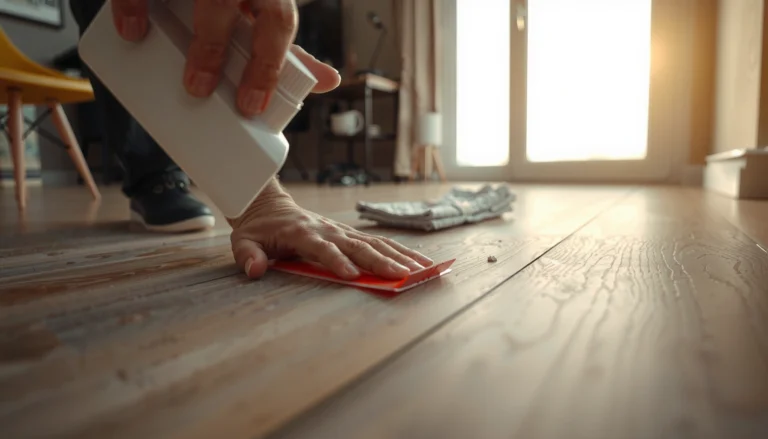
2. Re-wet and dwell: Saturate a cloth, lay it over the paint, and let it dwell 5–10 minutes. Re-wet if it dries.
3. Wipe gently: Use a soft microfiber cloth to wipe loosened paint film. Avoid dry friction—SPC’s topcoat can haze when rubbed while contaminated.
4. If paint is thick/dried: Use gentle heat from a hair dryer on low/medium, holding it at a safe distance. You’re warming to soften, not to overheat.
How to use heat without harming SPC
– Keep heat moving and avoid concentrating hot air on one point for too long.
– If you see surface gloss changing or the area feels tacky beyond the paint spot, stop and switch back to dwell + blotting.
– After softening, lift paint with a plastic scraper rather than scrubbing.
Mechanical removal that won’t chew up SPC
For SPC floors, the safest “mechanical” method is a plastic scraper used at a shallow angle after the paint has been softened. This approach removes paint with less risk of gouging or permanently scuffing the wear layer.
SPC is durable, but it’s still not meant for metal blades or aggressive abrasives. A rigid core vinyl floor typically has a top wear layer designed to resist everyday abrasion; however, scraping too hard can still leave marks—especially on embossed patterns where pigment can act like grit.
A plastic razor or scraper reduces gouging risk compared with metal because it doesn’t bite into the wear layer.
Keeping scraper motion light and shallow helps lift paint film while minimizing scuffing on glossy SPC finishes.
Cleaning the blade between strokes prevents pigment from smearing across SPC texture.
Use this technique:
– Choose the tool: Plastic razor/scraper (not metal).
– Angle matters: Hold at a shallow angle and use controlled short strokes.
– Lift, don’t press: Let softened paint release; avoid “digging.”
– Wipe immediately: After lifting, wipe with damp microfiber to remove residue before it re-dries.
– Blade hygiene: Rinse or wipe the scraper frequently—dirty blades smear color into embossing.
Pros/cons (quick decision)
| Method | Pros | Cons |
|---|---|---|
| Plastic scraping after softening | Lower gouge risk; good control; minimizes haze when used lightly | May require multiple cycles on deeply embedded pigment |
| Metal scraping or sanding pads | Can remove paint faster on some surfaces | Higher likelihood of permanent marks, dulling, or finish breakdown on SPC |
Solvents and chemical removers: only if gentle methods fail
Chemical removers can work when heat + water can’t lift the paint, but they also carry the highest risk of finish haze or whitening. Use only a remover that’s intended for finished floors, follow the label exactly, and spot-test in a hidden area first.
This is the “test-and-escalate” point: once you’ve exhausted warm water, mild cleaner, and plastic scraping, you may need a product designed for coating removal on finished surfaces. Importantly, many SPC floors use a layered construction—protective topcoat + printed décor + core—so the wrong chemistry can attack the top layer even if the paint comes off.
Apply remover to a cloth or pad first (rather than flooding) to control dwell time and reduce spread across SPC.
If the SPC finish shows whitening, softening, or loss of shine during a spot test, stop immediately.
Label instructions (including dwell time) matter because SPC wear layers can be sensitive to prolonged chemical exposure.
How to proceed safely:
– Use label-approved chemistry: Look for products explicitly intended for finished flooring / resilient vinyl floors or topcoat removal where compatibility is stated.
– Spot-test first: Choose a hidden corner or under-furniture area.
– Controlled application: Apply remover to a cloth/pad, blot onto the paint, and keep the product localized.
– Respect dwell time: Many removers require minutes—not hours. If the label says dwell time X, don’t exceed it.
– Blot, then neutralize if instructed: Some products require a follow-up cleaning step—follow the label.
– Stop on visual warnings: If the finish dulls or turns cloudy, stop and revert to mechanical methods.
Important paint-type note
– Oil-based paints often resist water-based softening; however, that doesn’t automatically mean strong solvents are safe for SPC. Always base your chemical choice on the product’s flooring compatibility guidance and your spot test outcome.
What can go wrong (and how to avoid it)
Most SPC paint-removal failures come from skipping softening, using the wrong abrasion tool, or leaving chemicals too long. If you move step-by-step—soften → lift → clean residue—you avoid the majority of common damage modes.
Here’s what tends to go wrong in real cleanup scenarios:
– Swirling/smearing: Scraping paint that isn’t softened enough can smear pigment into embossing. Fix: re-wet + dwell first, then lift.
– Dulling or haze: Abrasive pads, steel wool, and strong solvents can dull SPC’s protective layer. Fix: stop abrasion and switch to softening + plastic lift.
– Finish lift: Letting chemicals sit too long can cause edge lifting or discoloration. Fix: spot-test and follow dwell exactly.
– Texture traps paint: Embossed or grippy SPC surfaces hold pigment in pores; you may need repeated blotting cycles. Fix: patience—small sections, multiple re-wets.
– Wrong chemical for the paint: Oil-based vs latex/acrylic chemistry matters. Fix: keep chemical escalation controlled and stop if finish changes.
Finish haze on SPC is commonly associated with abrasive action or solvent exposure, especially when pigment residue is still present.
Many cleaning failures occur when paint is ground into embossing instead of being softened and lifted.
Chemical dwell time is a primary driver of finish risk; exceeding label instructions increases the chance of whitening or shine loss.
A few “limits” to keep in mind:
– If paint has fully cured into the texture (especially glossy raised patterns), removal can require multiple cycles and may leave slight tonal differences.
– If the SPC’s topcoat is already compromised (scratches, previous chemical etching), you may see uneven recovery even after careful removal.
– If you can’t spot-test safely (for example, no hidden area exists), prioritize non-chemical methods.
Verdict / tip: use a “test-and-escalate” routine (skip if you can’t test)
The best balance of clean results and low risk is warm water + mild, pH-neutral cleaner first, then plastic scraping after gentle heat. Only use a purpose-made chemical remover if the label supports finished-floor compatibility and your spot test shows no whitening, haze, or shine loss.
In my view, this approach works because it aligns with how SPC coatings behave under stress: you minimize mechanical force and chemical exposure, two of the most common causes of dulling. As of 2026, the safest industry practice across resilient flooring care routines is still “compatibility-first” cleaning—start mild, test, then escalate.
A test-and-escalate workflow reduces the likelihood of irreversible SPC topcoat haze compared with solvent-first cleaning.
Using controlled dwell time (for example, 5–10 minutes with warm re-wetting) improves paint softening without excessive friction.
Plastic-only scraping after softening limits gouges and preserves the wear layer compared with metal blades.
Who should skip chemical removers
– If you cannot spot-test in a hidden area.
– If your SPC manufacturer’s care guide prohibits solvents or unspecified “paint remover” chemistry.
– If the finish is already delicate (deeply glossy vinyl, custom coatings, or floors with visible wear-through).
Downside to expect
– The cautious method can take multiple rounds on stubborn, dried paint—especially on embossed SPC where pigment settles in pores.
Quick checklist (scan & save)
– [ ] Clear debris; protect edges with tape
– [ ] Try warm water + mild, pH-neutral cleaner first
– [ ] Soften (gentle heat) if paint is dried/thick
– [ ] Lift with a plastic scraper at a shallow angle
– [ ] If needed, spot-test a label-approved remover on a hidden area
– [ ] Blot/clean residue; stop if shine dulls or color changes
– [ ] Repeat in small sections until fully removed
FAQ
Can I use paint thinner or acetone on SPC floors?
Only if the product label specifically allows use on the type of finished surface you have and your spot test shows no haze or finish damage. In many cases, stronger solvents can dull or damage SPC coatings—so test first and proceed cautiously. [ADD: source for solvent/acetone compatibility guidance from your SPC manufacturer.]
What should I do if the paint is already dried and stuck in texture?
Soften first (warm water and/or gentle heat), then use a plastic scraper and repeated blotting. If pigment remains, you may need a remover that’s appropriate for finished floor surfaces—again, only after a hidden-area test.
Will scraping with a razor blade damage SPC?
A metal razor is more likely to gouge or mark the surface. For safer results, use a plastic scraper/razor intended for delicate finishes and keep the blade at a shallow angle.
How do I know the remover is safe to use?
The safest indicator is a successful spot test: no whitening, no tackiness, no loss of shine, and no visible finish breakdown after the dwell time on the label. If any of those happen, stop and switch to mechanical methods.
Should I seal the area after paint removal?
If the paint removal involves chemicals or you notice minor surface dulling, check the floor manufacturer’s guidance for whether re-sealing or re-coating is recommended. [ADD: source for SPC floor manufacturer re-coating guidance, if available.]
Conclusion
Removing paint from SPC floors is most successful when you treat it as a controlled softening-and-lifting process: start with warm water and a mild, pH-neutral cleaner, use gentle heat only to re-soften, then lift with a plastic scraper at a shallow angle. Save label-approved chemical removers for when gentle methods fail, and always spot-test to protect the floor’s wear layer from whitening or haze. With a careful test-and-escalate routine—and patience for textured embossing—you can often restore the surface while minimizing finish damage.
Sources
– [ADD: SPC floor manufacturer care/cleaning guide and any guidance on chemical/solvent compatibility]
– [ADD: Manufacturer instructions for the specific plastic scraper/remover product label directions]
– [ADD: Any relevant official guidelines from floor-coating/remover manufacturers regarding dwell time and surface compatibility]
Frequently Asked Questions
What’s the safest way to remove paint from SPC (stone polymer composite) floors?
Start by identifying whether the paint is latex, acrylic, or oil-based, then use the gentlest method first to avoid damaging the SPC floor’s wear layer. For most water-based paints, wipe and rinse with warm water and a mild detergent, then spot-clean with a non-abrasive cleaner. Avoid harsh abrasives or metal scrapers that can scratch the surface and make the stain more permanent.
How do I remove dried paint from an SPC floor without scratching it?
Begin with softening the paint using a paint-safe remover appropriate for the paint type, and let it dwell only as long as the label recommends. Use a plastic scraper or a soft microfiber cloth to lift paint gently, then wipe with clean water to remove residue. If paint remains, repeat the process in small steps rather than applying excessive force or stronger chemicals immediately.
How can I remove oil-based paint or stubborn spots from SPC flooring?
Oil-based paint often needs a solvent-based remover, but you should test it in an inconspicuous area first to ensure the SPC floor finish won’t dull or discolor. Apply the remover to a cloth (or according to product directions), then blot and gently lift paint instead of scrubbing. Finish by wiping thoroughly with water or the recommended cleaner and dry the floor completely to prevent lingering chemical marks.
Why should I avoid acetone, bleach, or abrasive pads on SPC floors?
Many SPC floors have a protective wear layer that can be damaged by strong solvents, bleach, or aggressive scrubbing pads. Acetone and other harsh chemicals may cause discoloration, clouding, or peeling in sensitive top coatings. Abrasive pads can also leave micro-scratches that trap dirt and make the paint stain look worse over time.
Which cleaning products and tools are best for paint removal on SPC flooring?
For best results, use a soft cloth, microfiber mop, plastic scraper, and a paint remover matched to the paint type (water-based vs. oil-based). Look for non-abrasive, floor-safe cleaners labeled safe for vinyl or LVP/SPC surfaces, and use gentle degreasers for residue. Keep a bucket of warm water and mild detergent for final cleanup, and always spot-test any remover before full-area application.
📅 Last Updated: October 08, 2026 | Topic: How to remove paint from SPC floors? | Content verified for accuracy and freshness.
References
- Google Scholar Google Scholar
https://scholar.google.com/scholar?q=SPC+floor+paint+removal - Google Scholar Google Scholar
https://scholar.google.com/scholar?q=rigid+core+vinyl+floor+paint+removal - Google Scholar Google Scholar
https://scholar.google.com/scholar?q=removing+paint+from+resilient+vinyl+flooring - https://en.wikipedia.org/wiki/Paint_stripper
- https://en.wikipedia.org/wiki/Vinyl_flooring
- Lead Renovation, Repair and Painting Program | US EPA
https://www.epa.gov/lead/renovation-repair-and-painting-program - Lead – Overview | Occupational Safety and Health Administration
https://www.osha.gov/lead - Lead in the Workplace | Lead | CDC
https://www.cdc.gov/niosh/topics/lead/ - https://www.hud.gov/program_offices/healthy_homes/healthy_homes/lead
- https://www.cdc.gov/lead/prevention/healthcare/lead-based-paint.html