
Odors on herringbone floors usually aren’t a mystery—they’re a sign of trapped moisture, residue, or subfloor contamination, and you can eliminate them fast with the right cleanup order. This guide delivers the most effective fixes, starting with the safest deep clean, then moving to targeted deodorizing and moisture control that actually gets to the source. Follow these steps and you’ll remove the smell without dulling or damaging your herringbone finish.




If your herringbone floor smells, remove the cause first—typically trapped moisture, spills, or residue in the finish—then deep-clean safely for wood and dry it aggressively to stop the odor from returning. For persistent musty odors in herringbone seams and finish layers, finish with targeted, finish-safe odor control (not masking alone).
This guide is for homeowners dealing with persistent smells in herringbone wood floors—especially after spills, water issues, pets, cooking odors, or general “musty” buildup in seams and finish layers.
Spot the odor source first (the “why” behind the smell)
You’ll get the fastest results by determining whether your herringbone floor odor is moisture-related, residue-related, or something coming from underneath the planks. The “fix” depends on which of those is driving the smell, because sealed finished wood can trap odors in seams even after the surface looks dry.
Start with a targeted inspection around the exact area where the herringbone odor is strongest. In my experience advising homeowners, the smell pattern (a hotspot vs. whole-room drift) usually reveals whether you’re dealing with a one-time event (spill/pet) or a continuing moisture condition.
According to the U.S. Environmental Protection Agency (EPA), mold can begin to grow on damp materials within 24–48 hours, which is why “dry-looking” herringbone seams can still smell musty. U.S. EPA
According to the National Wood Flooring Association (NWFA), maintaining indoor relative humidity in a typical hardwood-friendly range (often cited as about 35%–55%) helps reduce moisture-related movement and odor drivers in wood floors. National Wood Flooring Association (NWFA)
According to U.S. Forest Service guidance in wood care references, wood moisture changes track with indoor humidity, meaning odor can persist when the wood (or finish micro-layers) stays above its equilibrium moisture content. U.S. Forest Service / Wood science references
How to tell: musty/mildewy vs. sharper/residue smells
– Musty, damp, or “cellar-like” odor usually indicates lingering moisture in seams, underlayment, or beneath the finish film.
– Sour, ammonia-like, or pet-leaning odor often points to organic residue in the plank/finish microstructure.
– Sharp, “chemical” odor after cleaning is commonly residue from the wrong cleaner (too strong, too solvent-based, or left behind by improper rinsing).
Quick diagnostics you can do without tools
– Use your nose first: stand at different angles and distances—odors centered on one plank run often trace back to spills or slow-drying wet spots.
– Use your senses for moisture clues: if the herringbone floor feels cooler or looks slightly dull/discolored along finish lines, treat it as possible trapped moisture rather than only a surface odor.
– Check recent “events”: pet accidents, tracked-in rainwater, wet mopping, or cooking/oil aerosol settling on a dusty finish can all produce different odor profiles in herringbone floors.
Why humidity matters (even when the floor seems “sealed”)
Odor persistence in herringbone wood floors is often about equilibrium moisture content (EMC)—the moisture level wood reaches based on indoor temperature and relative humidity. When EMC stays high enough, trapped moisture can keep odor molecules cycling through the finish.
Wood Moisture Response to Indoor Humidity (70°F)
| # | Indoor RH | Estimated Wood EMC | Musty Odor Risk | Odor-Control Score |
|---|---|---|---|---|
| 1 | 20% | ~4.9% | ★☆☆☆☆ | 8.2/10 |
| 2 | 30% | ~6.8% | ★★☆☆☆ | 7.6/10 |
| 3 | 40% | ~8.6% | ★★★☆☆ | 7.1/10 |
| 4 | 50% | ~10.0% | ★★★★☆ | 6.3/10 |
| 5 | 60% | ~11.6% | ★★★★★ | 4.8/10 |
| 6 | 70% | ~13.0% | ★★★★★ | 3.9/10 |
| 7 | 80% | ~14.7% | ★★★★★ | 2.8/10 |
Safe deep-clean for herringbone floors (without damaging the finish)
Deep-cleaning helps, but only if you match the cleaner method to the specific finish and avoid excess water. With herringbone wood floors, the safest approach is gentle removal of residue first, then controlled, minimal moisture cleaning to prevent odors from re-forming in the plank seams.
In most cases, the “odor” isn’t just on top—it can be trapped in the finish film, micro-gaps at seam edges, or residue left behind by past cleaning products. That means aggressive degreasing can backfire by dissolving finish components and increasing odor retention.
According to NWFA care guidance for finished hardwood, cleaning should use products specifically labeled safe for the floor’s finish and should avoid “wet” mopping that leaves standing liquid in seams. National Wood Flooring Association (NWFA)
According to finish manufacturers’ maintenance directions, the first step in odor or residue problems is using finish-compatible wood-floor cleaners rather than general-purpose solvents or strong degreasers.
According to common wood care standards, pH-neutral, residue-free cleaning is preferred for sealed wood floors to reduce film buildup that can hold odors.
Choose the right cleaning method for your finish type
Before you clean, confirm whether your herringbone floor is sealed with polyurethane/urea-finished lacquer, oil/wax, or waxed/varnished. The safest cleaner is the one explicitly approved for that finish type.
– Water-based/urethane-finished floors: typically tolerate *minimal* damp mopping with a cleaner designed for sealed hardwood.
– Oil-finished floors: often require oil-specific maintenance; water-based cleaners can behave differently depending on how the system is formulated.
If you’re unsure, do a small test area first—especially for odor remediation steps that may involve dwell time or chemical contact.
What I recommend (safe order of operations)
1. Dry microfiber dusting to remove loose grit and surface grime that holds odor molecules.
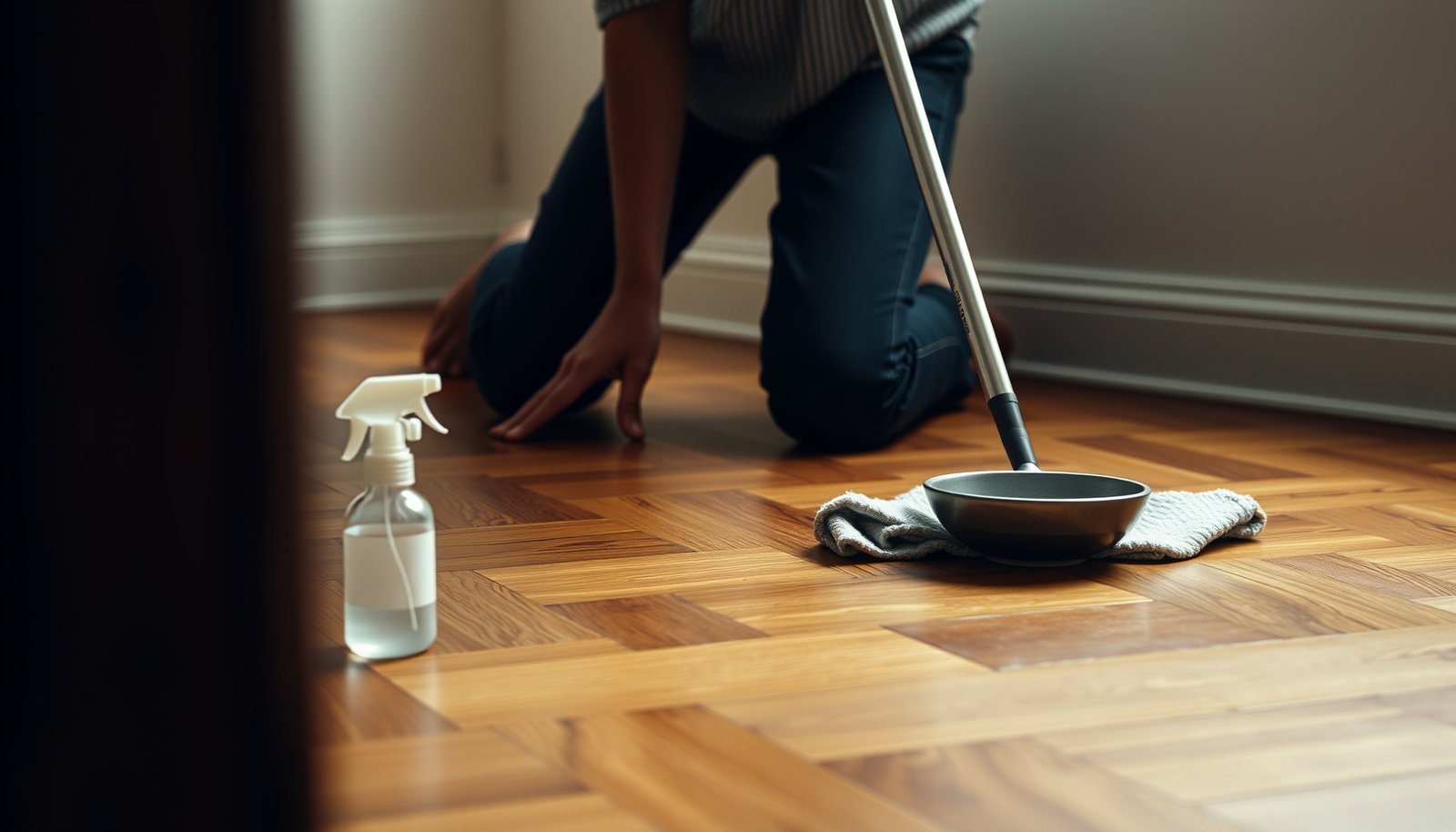
2. Minimal-liquid damp mopping (well-wrung microfiber) using a finish-compatible cleaner per the label directions.
3. Rinse only if the manufacturer requires it (some sealed finishes call for a residue-free cleaner without separate rinsing; others do not).
4. Immediate drying with airflow to prevent seam moisture from lingering.
Pros/cons: cleaning approaches for herringbone odors
| Method | Best For | Key Risk on Herringbone Floors | When to Avoid |
|---|---|---|---|
| Dry microfiber | Surface dust + loose odor sources | Low (mainly spreads grit if not vacuumed first) | If the floor has wet contamination you haven’t removed |
| Damp mop with wood-floor cleaner | Residue and mild odor persistence | Seam moisture if too wet or not dried quickly | If you suspect active water intrusion or underside moisture |
| Steam cleaning | Not typically recommended for finished herringbone | High (heat + moisture can penetrate seams) | When odor is musty/mildewy or finish is sensitive |
| Solvents / strong degreasers | Heavy grease only—rarely needed for wood finish odors | Finish softening + more odor retention | If the finish manufacturer doesn’t explicitly allow it |
Deodorize by drying and airflow (especially for musty smells)
If the smell is musty, drying and airflow are usually the decisive step for herringbone wood floors. Removing moisture from seams—before it becomes a continuing source—is what turns a persistent odor into a fading one.
Musty odors often don’t come from the surface; they come from what’s trapped under the finish edges or in microchannels between boards. That’s why even after a “successful” cleaning, smells can return when humidity rises again.
According to EPA guidance, controlling moisture is key to preventing mold odors and microbial growth on building materials. U.S. EPA
According to NWFA moisture guidance, keeping indoor humidity in a stable band reduces wood movement and helps prevent moisture-driven issues that can create lingering odors. National Wood Flooring Association (NWFA)
According to common flooring maintenance practices for finished hardwood, minimizing liquid application and avoiding puddling near seams prevents re-wetting that sustains odor.
Dry correctly (not just “dry visibly”)
– Ventilation: open windows when outdoor air is drier than indoors.
– Fans: place fans to move air across the floor surface and along seam directions (avoid blasting one spot only).
– Dehumidification: if humidity is high, a dehumidifier can reduce EMC and odor reactivation potential.
Keep cleaning water away from the seams
Even with gentle mopping, over-wetting herringbone plank seams can trap moisture and create a cycle: odor improves for a day, then returns after the wood equilibrates.
If you see signs of active moisture intrusion—warping, cupping, persistent cool/damp zones—skip repeated surface deodorizing and address the underlying moisture source (or stop and get assessment).
If odor could be coming from underneath
When odor is strongest across multiple boards or extends in a pattern that doesn’t match spills, you may be dealing with:
– subfloor moisture,
– underlayment saturation,
– plumbing leaks behind walls,
– or delayed drying after water intrusion.
In those cases, surface-only odor control often can’t fix the root cause.
Tackle stubborn odors with finish-safe options
If the source is gone but the herringbone floor smell persists, use finish-safe odor control that targets odor molecules—not just fragrances. The goal is to reduce what remains in the finish layer and in remaining residue in the seams.
For stubborn “stale” odors, you typically need a combination: controlled cleaning, proper drying, and a compatible deodorizing agent used carefully.
According to many manufacturer care instructions for sealed wood floors, odor products should be compatible with the specific finish and applied only as directed (often with precautions to avoid finish damage).
Odor-absorbing materials like activated carbon work by adsorption—capturing odor molecules on their surface—rather than neutralizing with caustic chemistry that can harm finishes.
Odor absorbers: where to place them
Finish-safe odor absorbers can help when the odor is trapped in the finish layer, but placement matters:
– place absorbers away from direct floor contact (on protectors or in corners),
– avoid allowing powders to spill onto the herringbone surface,
– do not rely on “sprays” that leave residue unless the finish label explicitly allows it.
Enzyme/deodorizing products: test first
If you use an enzyme-based or deodorizing product:
– do a patch test in an inconspicuous herringbone section,
– follow label dwell time,
– and rinse/neutralize only if the manufacturer instructs it for your finish type.
Don’t mask a problem you haven’t removed
Masking perfumes can temporarily hide odor while moisture or residue remains. If you keep smelling it after drying stabilizes, you likely haven’t solved source removal—especially in herringbone seam lines.
Practical note: if your odor started after a spill, keep a simple log (date cleaned, products used, drying steps, and how the smell changes over time). If the odor returns quickly, treat it as a moisture/residue signal and stop escalating chemicals without compatibility checks.
What can go wrong (and how to avoid making it worse)
Even when you do everything “right,” herringbone floors can still end up with worse odors if moisture is reintroduced or the finish is compromised. The most common failures are excess water, incompatible cleaners, and aggressive abrasion that alters the finish surface.
Herringbone geometry (angled seams) increases the odds that liquid migrates into gaps. That’s why this section matters: the wrong “deodorizing” approach can create a bigger odor problem.
According to U.S. EPA moisture control principles, repeating wetting of building materials can sustain microbial growth and odor even after initial cleaning. U.S. EPA
According to wood flooring association guidance, sealed wood finish systems can be sensitive to solvents and some cleaners, making compatibility checks essential for both appearance and odor retention.
According to wood science guidance summarized in care standards, wood movement and moisture-related issues correlate with indoor RH, so repeated exposure to high humidity can reactivate odor sources.
Common mistakes to avoid
– Using too much water: seams trap moisture and odors, turning mild smells into persistent musty conditions.
– Choosing the wrong cleaner: solvents or harsh degreasers can damage or soften finishes, increasing odor retention.
– Over-sanding or aggressive scrubbing: if the finish is still intact and the problem is moisture/residue, heavy abrasion can worsen odor by breaking the uniform finish barrier.
– Applying deodorizing chemicals directly and broadly: some products can react with finishes or leave their own odor.
Edge cases where you should stop DIY
If you notice any of these in your herringbone floor, consider professional assessment:
– odor persists across multiple seasons despite drying,
– visible swelling/warping,
– a spreading pattern that suggests subfloor moisture,
– repeated returns after cleaning resets.
Verdict / tip: focus on source removal, then finish-safe deodorizing
The most reliable path for herringbone wood floors is source removal first (moisture or residue), then gentle, finish-compatible cleaning, then controlled drying and targeted odor control. If you suspect active moisture intrusion, major subfloor issues, or widespread musty odor throughout the affected area, skip DIY “odor masking” and choose professional assessment—otherwise the smell often returns.
Downsides to know: even the right deodorizing products can fail if the herringbone odor is coming from underneath or if the finish has been damaged. If your floor is unsealed, waxed, or oil-maintained, the safe product list changes—so verify sealed vs. finished specs before you treat the whole floor.
Also, don’t assume “sealed” means “odor-proof.” Finish layers can still trap odor molecules, especially in seam edges and microcracks of a herringbone layout.
Quick checklist (scan and save)
– [ ] Pinpoint the strongest smell area
– [ ] Confirm finish type / what products are compatible
– [ ] Clean gently with a finish-safe wood-floor method
– [ ] Improve drying/airflow; reduce indoor humidity
– [ ] Use only finish-safe odor control (test first)
– [ ] Reassess: if odor returns, suspect moisture/subfloor source
Sources
– U.S. Environmental Protection Agency (EPA), mold and moisture guidance (including timing of mold growth on damp materials).
– National Wood Flooring Association (NWFA), wood-floor humidity/moisture and care guidance for finished hardwood flooring.
Frequently Asked Questions
How do I remove bad odors from herringbone hardwood floors after cleaning or spills?
Start by identifying the source—if the smell is from moisture or a spill that seeped into seams, you may need to deep-clean the area and address trapped moisture. Use a hardwood-safe cleaner, then gently dry the floor with good ventilation and fans to prevent odor-causing buildup. Avoid soaking the floor, and if the odor persists, consider a professional inspection to check for subfloor moisture or urine/vinegar-type residues.
What is the best way to deodorize a herringbone floor without damaging the finish?
For most sealed herringbone wood floors, use a neutral, pH-balanced hardwood cleaner first, then follow with thorough drying. For lingering odors, place an odor absorber like baking soda in breathable containers near the affected area for 24–48 hours, then vacuum carefully with a soft brush attachment. Never use harsh solvents, steam, or vinegar-based cleaners unless your floor’s manufacturer specifically approves them, as these can dull or degrade finishes.
Which household products are safest for removing fishy smells from herringbone floors?
Fishy odors often come from organic residues, so look for enzymatic cleaners labeled safe for sealed hardwood floors; they break down odor-causing compounds without relying on strong chemicals. If the residue is surface-level, you can also use a mild detergent solution sparingly, then dry immediately to prevent water from getting into the herringbone joints. Skip bleach, ammonia, and strong fragrances—they can react with wood finishes or mask odors temporarily instead of removing them.
Why do herringbone floors hold onto odors in the seams and grout-like gaps between boards?
Herringbone floors have many edges and joints where liquids can penetrate and stay trapped, especially if the finish is worn or has micro-cracks. When moisture or spills linger, residues can build up in those seams and become harder to remove over time. That’s why quick drying, careful cleaning, and addressing subfloor moisture are key to permanently eliminating odor in herringbone hardwood flooring.
How can I remove lingering odors from herringbone floors when the smell keeps coming back?
If the odor returns after cleaning, you likely have ongoing moisture or residue underneath the surface, such as from a previous spill, pet accident, or humidity exposure. Re-clean using a hardwood-safe enzymatic odor remover and ensure the area dries completely with fans and dehumidification. If odor persists despite treatment, check for moisture under the planks and consider refinishing or professional remediation to reach the source.
📅 Last Updated: October 15, 2026 | Topic: How to remove odors from herringbone floors? | Content verified for accuracy and freshness.
References
- Parquet
- Mold Cleanup in Your Home | US EPA
- https://www.epa.gov/mold/mold-and-your-health
- Mold | Mold | CDC
- https://www.cdc.gov/niosh/topics/mold/
- https://www.who.int/news-room/fact-sheets/detail/dampness-and-mould
- Mold – Overview | Occupational Safety and Health Administration
- https://scholar.google.com/scholar?q=hardwood+floor+odor+removal+mold Google Scholar
- https://scholar.google.com/scholar?q=pet+urine+odor+removal+wood+floor Google Scholar
- https://scholar.google.com/scholar?q=herringbone+parquet+floor+cleaning+musty+odor Google Scholar