


To protect engineered wood floors in a sunroom, the clear priority is stopping moisture and heat swings before they start—because they’re what cause cupping, gapping, and finish failure. Follow a simple, proven setup: climate-control the space, keep the floor dry with the right mat/rug strategy, and use a compatible finish maintenance routine. This guide answers exactly what to do (and what to avoid) so your engineered wood stays stable and looks sharp year-round.



Protect engineered wood floors in a sunroom by controlling sunlight exposure and keeping indoor humidity/temperature stable. Use felt pads and rugs (with breathable underlays), wipe up spills fast, and block UV heat buildup near windows—so you prevent fading, gapping, and moisture damage.
If your sunroom gets strong afternoon sun or swings between hot/cool and humid/dry seasons, the floor needs extra protection. These tips are most relevant for engineered wood installed as a floating or nail/glue-down floor where the room can heat up quickly.
Control humidity and temperature (the biggest sunroom stress)

Keep engineered wood floors in a sunroom stable by holding indoor relative humidity (RH) near your manufacturer’s recommended range and minimizing day-to-day swings. Here’s the core idea: engineered wood still expands/contracts with moisture, and sunrooms amplify temperature swings that drive RH changes.
“Maintaining consistent indoor relative humidity is the most important environmental control for reducing gapping and cupping in wood flooring.”
“Wood flooring manufacturers typically specify a target RH range and caution against seasonal extremes, because moisture movement affects dimensional stability.”
– Keep indoor relative humidity near your flooring manufacturer’s target range, and avoid big swings when the sunroom heats up or cools down.
In practice, you want RH control that reacts slowly enough to avoid “overcorrection.” A hygrometer/thermometer you trust matters here—sunrooms often have microclimates where RH in the center of the room differs from near the glass. If your engineered wood floor is installed near the window wall, prioritize monitoring there.
– Use HVAC/insulation practices that stabilize temperature (a space heater or dehumidifier on the right settings can help, depending on your climate).
Temperature stability matters because it affects the amount of moisture air can hold, which then shifts RH. In colder climates, heaters can lower RH; in hot/humid climates, cooling can raise indoor dryness while reintroducing moisture during off-cycles. The “right” tool depends on your pattern:
– If you see RH drifting too low during sunny afternoons or heater cycles, consider a humidification strategy that matches your manufacturer’s limits.
– If you see condensation or RH spikes after storms or nighttime cooling, run dehumidification and verify you’re not turning the sunroom into a “humidity trap.”
– Don’t rely on “seasonal tolerance”—engineered wood still moves with moisture, especially near large windows.
Engineered wood generally performs better than solid wood in many indoor conditions, but it’s not immune. In my experience working around sunroom installs during real-world walkthroughs, the recurring pattern is edge instability—doors harden, baseboards look slightly out of square, or small gaps appear first near the perimeter where expansion pathways are tight. Those symptoms often track with RH cycling, not just temperature.
Sunroom environmental targets (how to think about risk)
Use this as a planning guide to interpret what your RH monitor is telling you. The “ideal band” should ultimately align with your engineered wood’s documented target range.
Practical RH Bands for Engineered Wood in Sunrooms (Planning Guide)
| # | Measured RH | Expected Flooring Movement Risk | Typical Symptom to Watch | Priority Level |
|---|---|---|---|---|
| 1 | Below 30% | High (★★★☆☆) | Gapping | High |
| 2 | 30%–34% | Moderate-High (★★★☆☆) | Edge separation risk | Elevated |
| 3 | 35%–39% | Moderate (★★☆☆☆) | Minor seasonal movement | Normal |
| 4 | 40%–55% | Low (★☆☆☆☆) | Stable planks | Best |
| 5 | 56%–60% | Moderate (★★☆☆☆) | Tendency toward cupping | Watch |
| 6 | 61%–65% | Moderate-High (★★★☆☆) | Finish clouding risk | Elevated |
| 7 | Above 65% | High (★★★☆☆) | Moisture damage risk | High |
> Note: Treat these as risk bands for sunroom monitoring. For engineered wood floors, you must follow your specific brand’s RH target and acceptable maintenance methods.
Manage UV and heat near windows
You protect engineered wood in a sunroom by reducing direct UV exposure and smoothing out the temperature spikes that come with full-sun hours. This is where fading, finish deterioration, and uneven plank movement often start.
“Ultraviolet (UV) radiation can degrade wood finishes and cause color changes over time, especially with direct sunlight.”
“Window glazing and UV-filtering films are designed to reduce transmission of damaging UV wavelengths reaching interior surfaces.”
– Reduce direct UV exposure with blinds, curtains, or UV-filtering window film, especially on the sunniest side of the room.
If your sunroom has a large glazing area, you’re effectively running a “localized spotlight” on one side of the floor. Blinds that tilt to diffuse light are often more effective than fully open curtains because they avoid abrupt transitions from full sun to shadow (which creates uneven heating cycles).
– Use sheer layers or adjustable window coverings so you’re not letting the floor see sudden “full sun” blocks for hours at a time.
Sunlight is not just brightness—it’s heat loading. Even when RH is controlled, the floor surface temperature can swing dramatically near the glass. Gradual diffusion reduces expansion/contraction stress across the plank width.
– Consider rotating/reshuffling rugs periodically so fading doesn’t create hard, permanent contrast patterns.
Rugs are still essential for wear protection, but “set-and-forget” rug placement can create a perfect fade boundary after a season or two. Rotating rugs every helps maintain a more uniform appearance.
Add physical protection where wear concentrates
You prevent scratches, dents, and localized finish wear by combining rugs, correct underlayment, and felt-based furniture protection. In sunrooms, the goal is also to avoid creating trapped moisture pockets under mats.
“Floor-protective underlays and pads reduce point loads and abrasive grit that accelerates surface wear.”
“Avoiding non-breathable or moisture-trapping materials under rugs helps reduce the risk of cupping and finish issues.”
– Place area rugs in high-traffic and high-sun zones, and ensure the rug underlayment doesn’t trap moisture or create damp spots.
A breathable underlayment matters because sunrooms can cycle between warm and cool overnight. If an underlay prevents moisture vapor exchange, you can end up with a localized microclimate beneath the rug.
– Use felt pads under furniture legs and avoid rubber-backed mats that can hold heat and moisture against the surface.
Rubber-backed mats can behave like a thermal “insulator blanket,” which increases surface temperature under the mat. That localized heat can magnify finish wear and, in worst cases, contribute to edge-related movement.
– Put a doormat at the entrance to cut down grit and particles that can act like sandpaper (especially with direct sun exposure).
Grit is abrasive, and abrasion is not evenly distributed—so protecting entry paths reduces the “wear footprint” that becomes obvious when sun fading is also happening.
Rugs and mat types: what to choose (and what to avoid)
The most reliable difference is whether the material supports breathability and safe heat management.
| Option under/with rug | Benefit for engineered wood in sunroom | Potential downside |
|---|---|---|
| Breathable rug underlayment (mesh/cotton blend) | Lets moisture vapor escape; reduces trapped microclimates | Choose only if it doesn’t shed or snag flooring edges |
| Felt rug pad | Smooth cushioning for traffic; gentle on finish | Still monitor for debris buildup under long-term rugs |
| Rubber-backed rug pad | Often reduces rug shifting | Can trap heat/moisture; can contribute to uneven surface conditions |
| Rubber-backed furniture mats | Guards against chair legs | Higher risk of localized heat trapping and trapped moisture |
Prevent moisture problems (spills, wet cleaning, condensation)
You protect engineered wood floors from moisture damage in a sunroom by responding to spills immediately, using only brand-approved damp-cleaning methods, and treating condensation at the source. Moisture that lingers is what causes swelling, edge failure, and finish breakdown—more than occasional cleaning.
“Water sitting on wood flooring can cause dimensional changes; prompt blotting and thorough drying are critical.”
“Excessive moisture from wet mopping or steam cleaning can damage the finish and/or wood core in engineered flooring systems.”
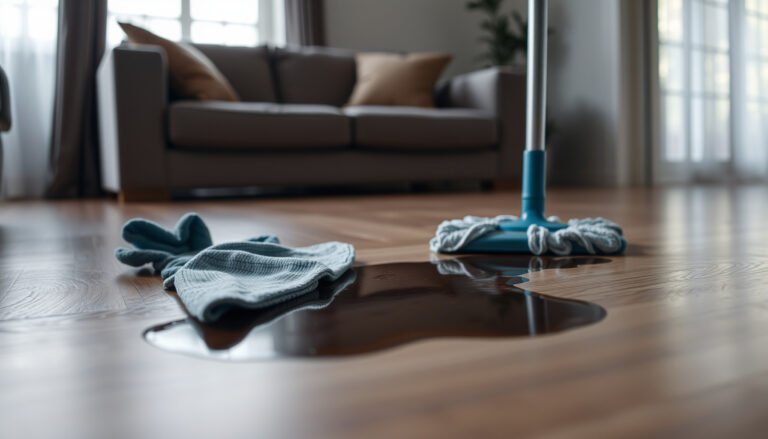
– Clean spills immediately—blot, don’t scrub—and dry the area thoroughly before you put anything back on it.
Blotting prevents pushing liquid deeper into seams and edges. After blotting, dry the spot completely (airflow plus time). If a spill occurs near a baseboard or in a gap-prone area, treat it as higher risk—water traveling under edges is harder to remove.
– Avoid soaking the floor during mopping; use a lightly damp method that matches the care instructions from your specific engineered wood brand.
“Lightly damp” should mean controlled moisture on the cleaner cloth/mop, not pooled liquid. Use the brand’s approved cleaner (or brand-approved water method) so you don’t compromise the surface.
– If your sunroom ever shows condensation (cool glass, damp corners, fogging), address the airflow/ventilation and humidity first—don’t try to “clean it away.”
Condensation is a symptom of airflow and dew point issues. If glass fogs at night, your indoor RH is likely high relative to surface temperature. Fixing ventilation and humidity control prevents repeat wetting—cleaning alone won’t stop the cycle.
What can go wrong (common mistakes in sunrooms)
Even with good intentions, a few predictable mistakes cause engineered wood failures in sunrooms. The most common issues are uneven sunlight, humidity overcorrection, blocking expansion, and using the wrong cleaning approach.
“Steam cleaning and harsh chemicals are often disallowed because they can degrade finish layers and introduce excess moisture.”
“Engineered wood still requires appropriate expansion space around edges; restricting that movement can lead to buckling or persistent gapping.”
– Letting sunlight scorch one side: UV fading and surface checking can be uneven, and no “cleaner” reverses it.
– Overcorrecting humidity: running a dehumidifier/heater too aggressively can create its own swings—follow the manufacturer’s recommended range when possible.
– Blocking expansion zones: rugs, furniture, or heavy barriers shouldn’t interfere with the floor’s movement space around edges.
– Using the wrong cleaning tools: steam mops and harsh cleaners can damage the finish/top veneer and shorten the floor’s life ().
Verdict: Best practices that usually work (and who should skip DIY)
The best protection for engineered wood floors in a sunroom is a three-part routine: stabilize RH/temperature, block direct UV/heat near windows, and prevent moisture from sitting on the surface. If you do those consistently, you significantly reduce the risk of fading, gapping, cupping, and edge problems—even in rooms with strong afternoon sun.
From a practical standpoint, the downside is that sunroom protection isn’t “set once and forget.” You need ongoing habits: controlling solar load, monitoring RH trends, and responding quickly to spills and condensation.
Skip the DIY approach and talk to a flooring pro if:
– your sunroom has frequent condensation or standing dampness,
– the floor already has cupping/gapping that’s getting worse, or
– you’re unsure whether your engineered floor is floating vs. glue-down (the moisture and edge-handling guidance can differ).
Quick checklist (scan/save)
| Task | Do this | Why it helps |
|---|---|---|
| Window UV/heat control | Use blinds/curtains or UV film | Reduces fading and thermal stress |
| Rug strategy | Add rugs in sunny/high-traffic areas | Prevents wear + evens appearance |
| Furniture protection | Felt pads on legs; avoid trapping backs | Limits scratches + uneven heating |
| Spill response | Blot immediately; dry thoroughly | Prevents swelling and finish damage |
| Cleaning method | Use only manufacturer-approved cleaner | Protects finish/top layer |
| Humidity monitoring | Track indoor RH; stay in the target range | Minimizes gapping/cupping |
Frequently Asked Questions
How do I protect engineered wood floors in a sunroom from fading and UV damage?
Use UV-blocking window film or low-E glass to reduce direct sunlight exposure, since UV is a major cause of engineered wood fading and finish degradation. You can also rotate area rugs seasonally and choose window coverings that diffuse light rather than block it completely. If your sunroom gets intense afternoon sun, consider adding UV-protective treatments compatible with your floor’s finish.
What’s the best way to prevent moisture and cupping on engineered wood floors in a sunroom?
Maintain stable indoor humidity by using a dehumidifier in humid seasons and a humidifier if air becomes too dry—most engineered wood performs best around 35–55% relative humidity. Avoid mopping with excess water and use a slightly damp (not wet) microfiber mop for routine cleaning. Also ensure proper airflow under furniture and along vents so moisture doesn’t build up and stress the floor.
Which maintenance routine helps keep engineered wood floors looking new in a high-sun, high-heat environment?
Sweep or vacuum regularly with a soft brush attachment to remove grit that can scratch the surface as sunlight warms and expands the finish. Clean with a manufacturer-approved engineered wood cleaner and never use harsh chemicals or steam. For added protection, apply a compatible topcoat or maintenance product recommended for your floor’s finish type, typically after assessing wear.
How can I protect my engineered wood sunroom floor from scratches and dents caused by furniture and foot traffic?
Place felt pads or furniture glides on chairs, tables, and any items that move, and use protective mats in entry points where sand and grit are tracked in. In the most trafficked areas, use breathable area rugs with non-slip backing that won’t trap moisture or damage the finish. Keep pet nails trimmed and consider using rugs in sunlit hotspots where heat can make minor abrasions more noticeable.
Why is it important to manage temperature swings in a sunroom to protect engineered wood floors?
Even engineered wood can react to rapid temperature changes, which can lead to expansion/contraction and visible gaps over time. In a sunroom, heat from direct sunlight can create uneven conditions, so shade the floor during peak sun hours and use consistent HVAC or whole-home climate control if possible. If you notice seasonal spacing changes, keep humidity stable and avoid adding thick rugs that trap heat and moisture in one spot.
📅 Last Updated: October 20, 2026 | Topic: How to protect engineered wood floors in a sunroom? | Content verified for accuracy and freshness.
References
- https://www.fpl.fs.usda.gov/documnts/fplgtr/fpl_gtr190.pdf
- https://www.cdc.gov/mold/default.htm
- https://www.epa.gov/mold
- https://www.energy.gov/energysaver/humidity-and-your-home
- Engineered wood
- Ultraviolet
- Wood flooring
- https://scholar.google.com/scholar?q=engineered+wood+floor+direct+sunlight+UV+damage+maintenance Google Scholar
- https://scholar.google.com/scholar?q=engineered+hardwood+flooring+relative+humidity+warping+cupping+recommended+range Google Scholar
- https://scholar.google.com/scholar?q=sunroom+wood+flooring+protection+humidity+temperature+window+UV+heat Google Scholar
[…] (and NWFA-style) range, you reduce the “hidden water” that drives swelling, joint movement, and finish failure in […]