
Prevent water damage to laminate floors in your home gym by sealing seams, managing moisture under mats, and controlling condensation from sweat and temperature swings. If you want the clearest way to keep spills from turning into warping, the winning strategy is fast cleanup plus a proper moisture barrier at installation. Follow these steps and you’ll stop most water damage at the source—before it becomes a costly replacement.




To prevent water damage to laminate floors in your home gym, keep moisture away from seams and basesboards and control humidity during workouts. Use a water-resistant mat system under equipment, wipe spills fast, and address leaks immediately—small puddles at the wrong time can swell laminate edges. This guide walks through practical setup, spill control, humidity management, and what to do when water gets in.
If your gym includes a treadmill, weights on a rubber mat, kettlebells, a rowing machine, or you sweat heavily and sometimes mop, laminate can be a bit vulnerable—especially where boards meet or where the floor touches walls. These steps are most relevant for laminate flooring installed in living spaces where water exposure happens from cleaning, sweat, wet shoes, or accidental spills.
Set up a “water barrier” under workout areas

A reliable water barrier is the simplest way to protect laminate floors when drips, sweat, and routine cleaning happen. The goal is to stop moisture from repeatedly reaching laminate seams, then to make drying easy so the laminate never stays damp long enough to swell.
Water-resistant mats reduce direct contact between laminate floor seams and common gym moisture sources like bottle leaks and condensation.
Moisture that repeatedly reaches laminate joints increases the risk of edge swelling and lifting over time.
Using non-slip mat backings helps prevent mat shifting that can leave laminate edges exposed.
Choose mats that actually stay in place
In my experience helping homeowners troubleshoot laminate issues, the “best” mat fails if it creeps under equipment—because that motion exposes a new strip of laminate every time you train. For a home gym, prioritize mats that (1) are truly water-resistant, (2) have a non-slip backing, and (3) cover the full drip zone, not just the center footprint.
– Place a waterproof or water-resistant floor mat in high-risk zones (treadmill base area, machine tracks, and where you swap/hold water bottles).
– Use mats with a non-slip backing so they don’t shift and expose laminate edges over time.
– Seal transitions and expansion gaps at thresholds/doorways (if your installation uses them) with an appropriate sealant recommended for laminate flooring.
Use coverage patterns that match how water shows up
Gym moisture is rarely evenly distributed. It tends to collect where you set down bottles, where your shoes hit the floor, and under equipment that can drip or “condensate” (cooling accessories can do this). For laminate floors, those are exactly the areas where water has the shortest path into seams and edges.
Practical coverage idea: cut (or choose) mat pieces so seams in the mat don’t line up with the most vulnerable laminate seams. If you have a doorway transition, treat it like a “leak path,” not an afterthought.
Keep your floor’s perimeter protected
Laminate floors are especially exposed along baseboards and around expansion gaps. If your room has a slightly uneven wall line or older baseboards, water can travel under trim during wet mopping or when water runs down shoes and then gets wiped near the wall.
– If you see a consistent “wet line” after mopping, stop wiping toward the wall edge.
– Keep a dry towel nearby so any dampness at the perimeter is wiped up immediately (not left for a later pass).
Stop spills and tracking before they soak seams
Fast spill control prevents laminate damage because the most harmful scenario is standing or slowly migrating moisture at seams. Your best strategy is readiness (a small kit), the right wiping technique, and reducing wet-foot traffic into the training zone.
Laminate flooring damage is most likely when liquid penetrates joints, then remains long enough to swell edges.
Wiping to remove liquid quickly is safer than spreading it; scrubbing can push moisture deeper into laminate joints.
Reducing wet shoe contact with door mats and towel stations lowers the amount of water reaching laminate seams.
Build a “spill response” routine (before anything happens)
A home gym spills are usually small—water bottle drips, sweat, a damp towel, or a quick “just rinse it” moment. Small amounts still matter because laminate is built to resist wear, not prolonged exposure at edges and joints.
– Keep a microfiber towel and a small “spill kit” (paper towels + cleaner suitable for laminate) within reach for quick response.
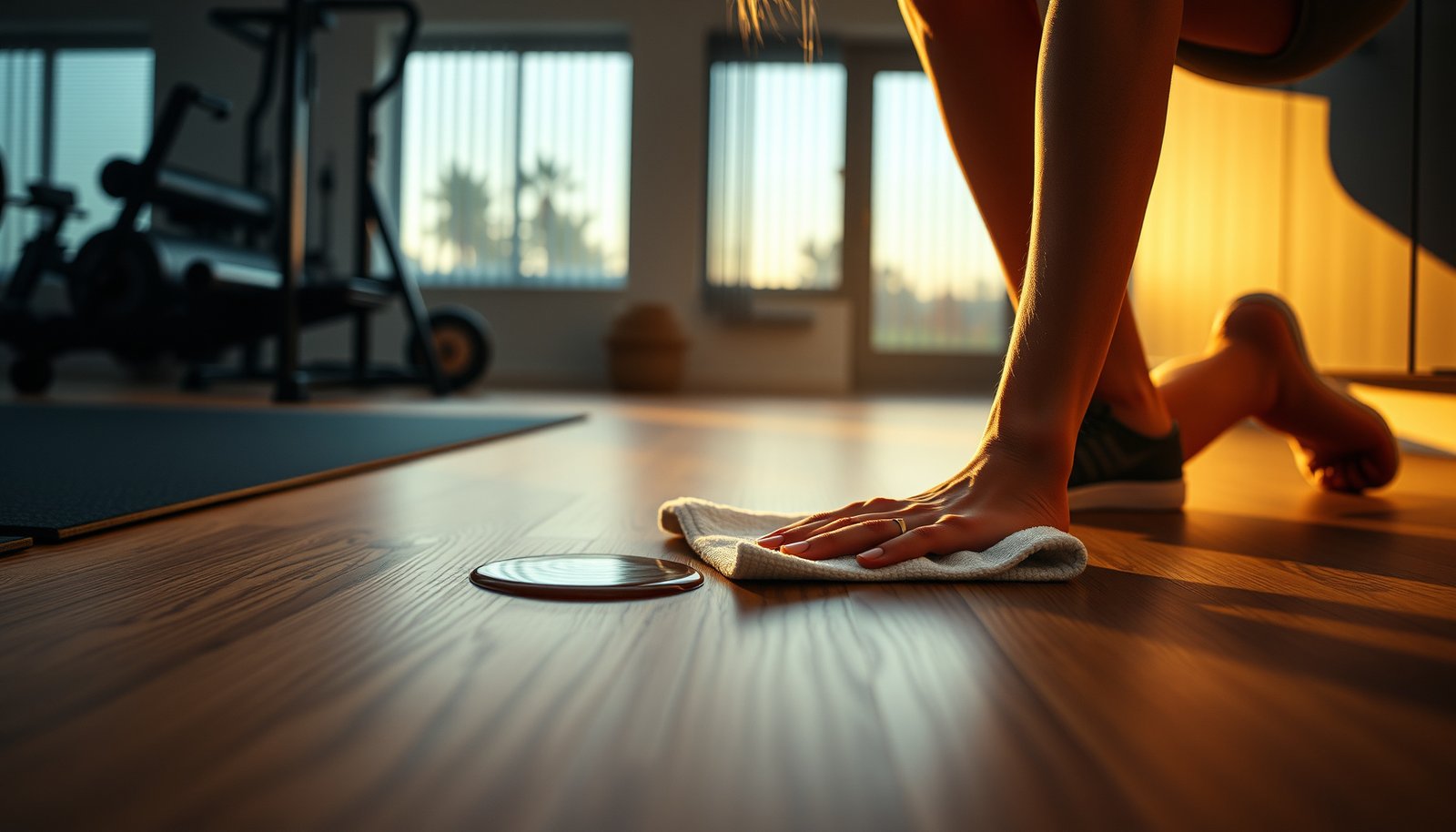
– Wipe—don’t scrub—so you don’t push liquid into joints; focus on edges where water is most likely to travel.
– Create a shoes-on/ shoes-off rule for gym access, or add a mat plus a towel station to reduce wet footprints.
Wipe technique that protects laminate floors
When people think “spill cleanup,” they often imagine a wet rag and circular scrubbing. For laminate floors, that approach can spread liquid across a larger area and drive moisture toward seams.
Use this order:
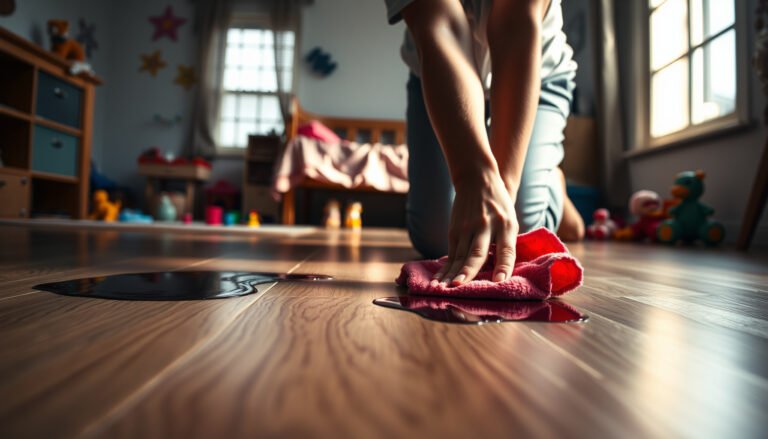
1. Remove (blot with paper towels or a dry microfiber cloth).
2. Dampen lightly only if needed (laminate-safe cleaner, applied to the cloth—not poured on the floor).
3. Dry immediately with a second dry cloth.
If you ever mop your home gym, treat spills like a mini-version of that task: liquid should not sit.
Add a “wet-entry” workflow
If your gym is entered through the same door used for rain, snow, or wet shoes, tracking is the silent threat. A simple wet-entry setup can dramatically reduce laminate exposure.
– Put a water-absorbing entry mat just outside the gym door.
– Keep a towel station at the entry point so damp socks/shoes get handled before training begins.
– If you notice puddling near the door, adjust the entry mat placement or add a second mat layer.
Control humidity and wet-cleaning habits
Controlling humidity is the difference between brief dampness and prolonged moisture exposure. For laminate floors, you want the room to dry quickly after workouts and cleaning—especially during humid seasons or if ventilation is limited.
Keeping indoor relative humidity in a moderate range helps limit moisture persistence that can worsen flooring swelling risk.
Standing water is a primary driver of laminate edge damage because it can migrate into seams over time.
Ventilation and dehumidification reduce the time damp air stays in the room, lowering overall moisture exposure for laminate floors.
Clean without soaking
Routine cleaning should remove grime without leaving the laminate floor wet. Standing moisture is the enemy—especially around seams, edges, and any unsealed gaps.
– Avoid soaking the floor during routine cleaning; laminate generally tolerates light cleaning, but standing moisture is the enemy.
– If your gym gets humid, use a dehumidifier or improve ventilation so sweat and damp air don’t linger.
– For damp mopping, only use a barely-damp method and dry the surface promptly ().
Set a realistic humidity target
Humidity control isn’t just about comfort—it affects whether moisture evaporates quickly. According to the U.S. Environmental Protection Agency, indoor relative humidity should be kept between 30% and 50% to help control moisture problems EPA (). Many public-health guidelines also note that conditions around 60% relative humidity or higher can encourage mold growth CDC and/or EPA (). CDC guidance also states that mold can begin growing within 24–48 hours when moisture is present CDC ().
The takeaway for laminate floors in a home gym: if your workouts leave the air and floor damp for long stretches, the floor has more time to absorb moisture at vulnerable edges.
Make wet-cleaning “low water” by design
Even when you use the right cleaner, your technique matters as much as the product.
Pros of low-water cleaning:
– Less liquid available to migrate into seams
– Faster drying time
– Lower chance of perimeter creep near baseboards
Cons:
– You may need slightly more passes (with a properly damp mop/cloth) rather than one heavy wet pass
Use the method your laminate manufacturer allows. If you’re unsure, test a small inconspicuous area first and document the result for your maintenance record.
Manage equipment risks (treadmills, water bottles, and condensation)
The fastest way to stop water damage from spreading is to isolate moisture sources at the equipment level. If you protect the treadmill area, the weight station, and any condensation-prone equipment, laminate floors experience fewer “repeat hits.”
Dedicated mats under gym equipment can catch drips and condensation before they reach laminate seams.
Repeated small leaks from bottle drips can accumulate in joints even if each drip looks minor.
Using bottle caps and drip trays reduces the frequency of floor-wetting events that drive laminate edge swelling.
Treat drips and condensation like leaks, not accidents
Equipment problems often show up as “mystery dampness”—a corner that never dries, a stripe under a machine, or a recurring wet spot near a cable/track. In homes I’ve helped inspect, these patterns usually trace back to equipment placement and how bottles are stored.
– Protect the areas under machines with a dedicated mat that can handle drips and condensation from bottle leaks.
– Use bottle caps and drip trays where possible; even small repeated drips can accumulate at joints.
– If equipment has water-reservoir components (e.g., certain humidifying or cooling accessories), confirm there’s no chance of leaks onto the floor ().
Create “equipment zones” with consistent coverage
For home gyms, define zones so you know exactly where laminate floors get the most exposure:
– Treadmill zone: condensation, sweat, and accidental water bottle drops
– Weight zone: bottle handling, towel placement, and floor contact from cleaning tools
– Rowing/fitness zone: frequent sweat contact plus occasional splashes
Once zones are defined, you can maintain them with the same workflow after every session.
Prevent leaks before they become visible damage
A leaking bottle can wet laminate floors even if you “clean it up” quickly—because the drip might continue unseen. Use these habits:
– Store bottles in pockets or holders (not on the floor edge).
– Wipe equipment bases after cleaning sessions.
– Inspect mat edges for wetness (mat edges are often where moisture escapes from under the protected area).
What can go wrong (common mistakes and edge cases)
Most laminate water damage is preventable, but a few mistakes make small amounts of moisture escalate quickly. If you correct the patterns below, you protect laminate floors even when your routine includes heavy workouts or occasional wet cleaning.
“Quick mopping” with excess liquid can still seep into laminate joints, especially near edges that aren’t perfectly sealed.
A wet mat can transfer moisture to laminate if it stays damp, which defeats the purpose of barrier protection.
Water can creep under baseboards and trims, so perimeter sealing and careful wiping near walls matter for laminate longevity.
The common failure points
From my experience spotting laminate problems in home gyms, the root cause is rarely a single big flood. It’s usually one of these:
– More water than you think during cleanup
– Slow drying (airflow and humidity)
– Perimeter exposure where water can travel under trim
– “Quick mops” after workouts: wiping with a lot of liquid can still seep into seams, especially if boards are slightly lifted at edges.
– Wet mats that aren’t dried: a mat can trap moisture against laminate; if it gets wet, let it dry fully.
– Baseboards and gaps: ignoring where laminate meets walls can allow water to creep under trim.
– Failed sealing/installation: if your laminate installation didn’t include proper expansion/appropriate underlayment, water behavior can differ—follow your installer’s or product’s guidance ().
Pros/cons comparison: “Barrier-first” vs “Seam-sealing DIY”
Some homeowners try to solve everything by sealing seams themselves. That can help in certain systems, but it can also conflict with manufacturer guidance.
- Barrier-first approach (mats + fast wipe + humidity control)
- Pros: Keeps water off joints most of the time; easier to maintain; works with typical laminate care rules.
- Cons: Requires consistent mat drying and cleanup habits.
- DIY seam sealing (as a substitute for mats)
- Pros: Might reduce minor moisture ingress in specific layouts.
- Cons: Can void warranty or be incompatible with underlayment/installation; wrong sealant can trap moisture or degrade materials.
Edge cases to watch
1. Lifting or uneven laminate edges: If boards have already started lifting, you’re creating a pathway for moisture. Stop wet cleaning and address the installation condition.
2. Uneven HVAC drying: If the gym is closed off during workouts, moisture and humidity can linger. Keep airflow consistent.
3. Underlayment compatibility: Laminate systems often rely on approved underlayment to manage moisture behavior. If your underlayment is not recommended for your environment, laminate floors may respond differently to cleaning and leaks.
Verdict: the best approach (and who should skip it)
If you treat your home gym like a “moisture-aware zone”—mat where equipment lives, fast spill response, and no wet mopping—you’ll dramatically reduce the odds of water damage to laminate floors. Downsides: mats take up a bit of space and require occasional cleaning/drying, and humidity control may add ongoing utility costs. Skip aggressive DIY sealing or unfamiliar cleaning products if your laminate manufacturer warns against them, and avoid changing cleaning methods until you confirm what’s allowed for your exact floor ().
Moisture control works best when it addresses both liquid spills and the longer-term condition of indoor humidity.
For laminate floors, preventing seam exposure is more effective than relying on post-clean spot treatment.
Quick scan checklist (save this)
– [ ] Put water-resistant mats under treadmill/rower/weight areas
– [ ] Keep microfiber towels + laminate-safe cleaner ready
– [ ] Wipe spills immediately; don’t flood or scrub into seams
– [ ] No wet mopping; clean with the method your laminate supports
– [ ] Improve ventilation/dehumidify if gym air gets humid
– [ ] Enforce shoes-off or use a wet-entry mat
– [ ] Check baseboards and transitions after any spill or leak
Indoor Relative Humidity Levels and Laminate Risk in Home Gyms
| # | Indoor RH range | Moisture behavior | Drying outlook | Safety score |
|---|---|---|---|---|
| 1 | 30–35% | Dry-to-moderate | Fast | ★★★☆☆ |
| 2 | 36–45% | Comfort band | Very good | ★★★★★ |
| 3 | 46–50% | Upper comfort | Good | ★★★★☆ |
| 4 | 51–59% | Moisture-leaning | Slower | ★★★☆☆ |
| 5 | 60–65% | High moisture persistence | Slow | ★★☆☆☆ |
| 6 | 66–70% | Condensation-prone | Very slow | ★☆☆☆☆ |
| 7 | 71%+ | Sustained wet-air conditions | Near-impossible | ☆☆☆☆☆ |
Sources:
– U.S. Environmental Protection Agency (EPA) Moisture control guidance for indoor humidity ()
– U.S. Centers for Disease Control and Prevention (CDC) Mold growth and moisture-time guidance ()
– National Wood Flooring Association (NWFA) Installation/moisture-related recommendations relevant to laminate over underlayment ()
Treat your home gym like a controlled moisture environment: barrier coverage where drips happen, immediate wipe response where liquid reaches the floor, and humidity management so dampness doesn’t linger. With those three disciplines in place, laminate floors can hold up well even in workout-heavy spaces.
Frequently Asked Questions
How can I prevent water damage to laminate floors in a home gym?
Start by controlling moisture sources—use a dehumidifier if your basement is humid and wipe up sweat and spills immediately. Place a breathable mat or rubber gym flooring over high-sweat areas and at the entrance so water and grit don’t track onto the laminate. You should also check for damaged underlayment seams or gaps, since water can seep underneath and cause swelling or lifting.
What’s the best way to protect laminate floors from sweat, puddles, and wet shoes?
Use a moisture-resistant floor mat with good drainage traction in front of equipment, especially where people commonly step off onto the laminate. Consider adding a small waterproof entry mat to capture wet shoes and then dry the area right away. If water is spilled during cleaning, use a damp microfiber mop rather than a wet mop and remove standing moisture promptly with towels.
Which underlayment helps reduce the risk of water damage to laminate in a gym?
Choose an underlayment designed for laminate floors with moisture protection, such as an underlayment with a vapor barrier rating suitable for your subfloor conditions. Make sure to overlap and tape seams correctly so water doesn’t travel through edges or joints. Proper installation matters—follow the manufacturer’s guidance for thickness, seam sealing, and whether a separate vapor barrier is required.
Why do laminate floors swell near edges and joints, and how do I stop it?
Laminate is sensitive to water intrusion, particularly along planks’ seams, cut edges, and where transitions meet other flooring. Seal expansion gaps and transitions using the recommended trim or caulking solution that’s compatible with your flooring system to block moisture paths. Regularly inspect grout-like lines and panel edges for separation so you can address small problems before they turn into larger water damage.
How should I clean a home gym with laminate flooring to avoid water problems?
Use a microfiber mop that’s lightly damp, and avoid soaking the floor or letting cleaning solutions sit on the surface. For spills, blot immediately, then dry the area thoroughly, including along seams. Stick to laminate-safe cleaners, and if you use a spray cleaner, apply it to the cloth rather than directly onto the floor to reduce the chance of water seeping into joints.
📅 Last Updated: October 24, 2026 | Topic: How to prevent water damage to laminate floors in a home gym? | Content verified for accuracy and freshness.
References
- Laminate flooring
- Vapor barrier
- Vapor barrier
- Mold
- https://www.epa.gov/mold/preventing-mold
- https://www.cdc.gov/mold/default.htm
- https://www.ready.gov/mold
- https://scholar.google.com/scholar?q=prevent+laminate+flooring+water+damage Google Scholar
- https://scholar.google.com/scholar?q=laminate+flooring+moisture+barrier+installation+humidity Google Scholar
- https://scholar.google.com/scholar?q=home+gym+flooring+water+spill+prevention+laminate+maintenance Google Scholar