
Preventing water damage to concrete floors comes down to one winning approach: control moisture at the source and seal the slab before it can absorb water. This guide answers exactly how to stop leaks, reduce humidity, and apply the right concrete sealers so spills and wash water don’t penetrate or cause staining, efflorescence, or cracking. Follow these practical steps and you’ll protect your floors with results that hold up year after year.




Concrete floors don’t have to suffer from water damage—use surface protection plus a plan to stop moisture at the source. The core approach is: reduce water exposure (drips, leaks, standing water) and then seal or coat the concrete so water can’t soak in. If you’re already seeing damp spots or efflorescence, you’ll also need to identify why moisture is getting through before sealing, because the “right” coating depends on the moisture pathway.
Who this is for / when it applies: This is for homeowners, facility managers, and contractors dealing with concrete slabs in garages, basements, workshops, warehouses, patios, or any area where spills, humidity, or plumbing leaks are a regular risk. It applies whether you’re preventing future problems or trying to stop an ongoing moisture issue.
Stop the water at the source first
If you prevent leaks and standing water from contacting the slab, you reduce the job of any sealer or coating to “stain control,” not “waterproofing under pressure.” Start by eliminating active water entry paths—then maintain drainage and housekeeping so water doesn’t linger long enough to migrate into pores, cracks, or joints.
According to the U.S. Environmental Protection Agency (EPA), mold can grow when indoor relative humidity is maintained above about 60% for extended periods (EPA, “Mold” guidance).
According to the IICRC S500 water-damage standard, materials may support mold growth within roughly 24–48 hours after water intrusion if conditions aren’t controlled (IICRC S500, “Water Damage—Restoration”).
– Fix plumbing leaks, sweating pipes, roof/ceiling drips, and HVAC condensate before you seal the slab—otherwise the moisture will keep finding a path. Concrete coatings can look “fine” until the moisture source keeps feeding the slab through joints, cracks, or perimeter gaps.
– Control exterior water: check grading, gutters/downspouts, and make sure water flows away from the slab rather than toward it. Even a small change in slope can alter whether water pools during rain events.
– Prevent standing water from staying in place: use mats/drip trays under equipment and clean spills promptly. Standing water increases the time water has to penetrate and increases the chance of efflorescence—white crystalline deposits that often indicate dissolved salts migrating to the surface.
What “source control” looks like in practice (fast triage)
In the field, the most time-saving step is documenting where wetness appears first—under a drain line, at the perimeter, near an equipment base, or after storms. [ADD: Briefly describe your site’s common observation pattern—e.g., “In our inspections, dampness most often starts at floor drains and expansion joints.”] This keeps you from sealing the wrong problem.
– Confirm whether moisture is episodic (storms/spills) or continuous (plumbing, condensation, groundwater).
– Look for recurring wet zones after predictable triggers (morning humidity peaks, weekly equipment operation, seasonal rain).
Use the right sealant/coating for your moisture situation
Sealers and coatings work best when they match the moisture mechanism: surface liquid vs. moisture vapor or hydrostatic pressure from below. If you choose an impermeable product for a slab that still releases moisture vapor, you can trap moisture and create bubbling, whitening, or premature failure.
According to ASTM C1582 and related concrete coating guidance, coatings are highly sensitive to surface preparation and allowable moisture conditions; applying outside those limits increases failure risk (ASTM International, concrete surface/coating-related standards).
According to ACI 302 (Mass Concrete) and commonly cited ACI construction principles, controlling curing and moisture conditions is central to durable concrete performance (American Concrete Institute (ACI), ACI 302/curing guidance).
– Choose protection based on where moisture comes from (surface spills vs. moisture rising from below). A coating meant for surface water won’t solve hydrostatic pressure/moisture vapor issues.
– Prep determines performance: concrete must be clean, sound, and dry enough for the product system you choose—otherwise the seal can fail. Manufacturer surface prep instructions typically specify cleaning method, allowable residual contaminants, and required dryness before application.
– Consider a breathable/compatible system when moisture vapor is present (or when you’re not sure yet), because some impermeable products can trap moisture inside.
Quick decision logic: which moisture problem do you have?
Here’s a practical way to decide what to buy—without guessing blindly:
- Liquid water on top (spills, leaks, condensation drips)
- Pros: A surface-penetrating sealer or stain-blocking coating often reduces absorption and improves cleanability.
- Cons: If leaks continue, even the best coating will be overwhelmed at the entry points.
- Moisture vapor from below (basement slabs, crawlspace conditions)
- Pros: Breathable or vapor-compatible systems can reduce blistering and help coatings last.
- Cons: Not all “waterproof” coatings are suitable; trapped vapor can undermine adhesion.
- Hydrostatic pressure (water table or lateral groundwater)
- Pros: A coordinated waterproofing approach (often below-slab or at drainage planes) performs best.
- Cons: Coatings alone may not stop pressure-driven flow; symptoms can return.
[ADD: If you want, name the exact product category you’re considering (penetrating sealer, epoxy, polyurethane, cementitious coating) so you can align selection with the moisture mechanism.]
Improve drainage and housekeeping around the slab
Good drainage turns water from a “contact event” into a “brief exposure,” which dramatically lowers risk of staining, joint transport, and efflorescence. Housekeeping also prevents chemicals and abrasion from damaging a compatible coating system.
EPA moisture guidance emphasizes that controlling moisture sources and preventing water buildup reduces conditions that support microbial growth (EPA, “Mold” and moisture control guidance).
The IICRC S500 restoration framework stresses timely water removal and drying to reduce secondary damage and microbial amplification (IICRC S500).
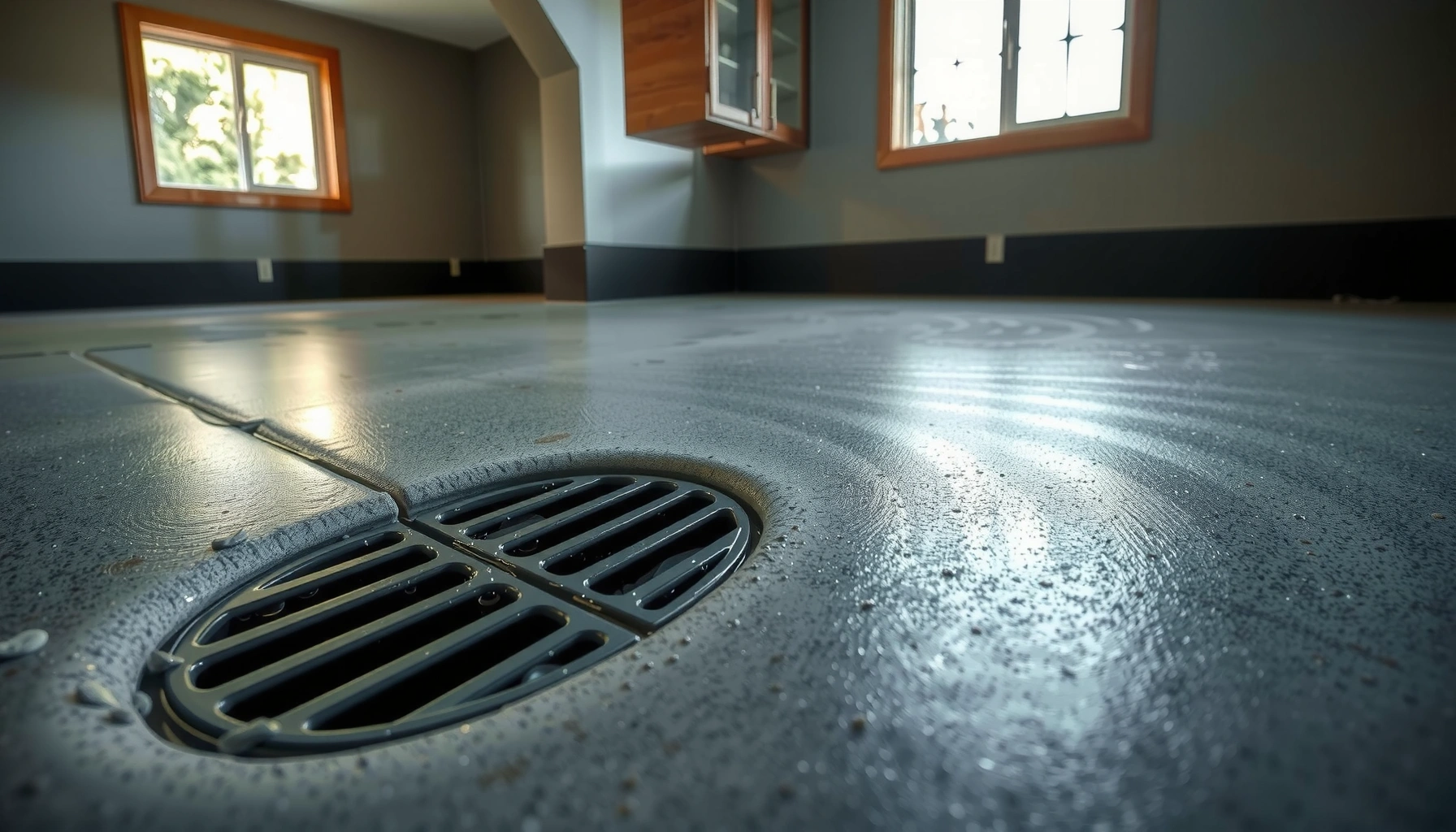
– Keep floor drains, scuppers, and expansion joints clear; blockages turn “occasional water” into constant contact. A drain that’s partially blocked can still “wet the slab edge” in a recurring pattern.
– Manage humidity where applicable: dehumidification in basements or crawl spaces can reduce condensation-related dampness. In spaces where concrete is cooler than the air, condensation can form even without a leak.
– Use spill routines: absorb quickly, avoid harsh high-pressure washing that drives water into pores/joints, and follow the manufacturer’s cleaning guidance for any coated floors. Many coating warranties assume specific cleaning methods and pH/chemical limits.
Cleaning choices that protect coatings and joints
If your slab is already sealed/coated, your cleaning method matters as much as your original application:
– Prefer neutral cleaners recommended by the coating manufacturer.
– Avoid direct blasting at joints, control lines, and edges.
– Use absorbents for fuel/oil/solvent spills—then follow the applicable removal procedure before scrubbing.
Handle joints, cracks, and edges like “water entry points”
Treat every joint, crack, and perimeter edge as a potential pathway. Even when the slab surface looks dry, water can travel through these channels and reappear as damp spots, whitening, or localized blistering.
ASTM standards and concrete-repair practice consistently require routing/prep and compatible repair materials for cracks and joints; incomplete prep reduces bond and increases re-entry paths (ASTM International, concrete repair and joint/crack detailing references).
Efflorescence is commonly associated with soluble salts transported by migrating water—so addressing crack/joint pathways is often necessary to stop recurrence (ASTM/industry references on efflorescence and moisture migration).
– Inspect control joints, expansion joints, cracks, and perimeter edges—these are common channels for water movement even when the main slab looks fine. Pay extra attention after freeze-thaw seasons or heavy vehicle use.
– Use appropriate joint/crack repair materials for concrete (and follow installation instructions), then protect those repairs with a compatible system. Many failures come from applying a generic patch that doesn’t handle movement or doesn’t bond to the surrounding concrete profile.
– Don’t rely on surface coatings to “bridge” heavily moving cracks without the right materials—movement can reopen pathways. If a crack is active, you need a system designed for it (often including flexible or movement-capable detailing where appropriate).
Where to look first (highest probability zones)
When moisture symptoms show up, prioritize:
– Perimeter edges (water can wick along the foundation-to-slab interface)
– Around drains and penetrations (plumbing penetrations create localized stress and gaps)
– Control joints (designed as movement locations, but they still move water if not detailed)
What can go wrong (common mistakes and edge cases)
Most water-damage “prevention” efforts fail due to compatibility issues—either sealing too early, selecting an impermeable product for a vapor problem, or ignoring the moisture source.
Applying coatings over unsound or insufficiently cured concrete increases the likelihood of poor adhesion and early failure due to moisture and surface condition mismatch (manufacturer technical bulletins; ASTM coating-related guidance).
In moisture-vapor situations, using non-breathable coatings can trap water vapor behind the film, raising blistering/peeling risk (manufacturer guidance on moisture vapor transmission and coating selection).
– Sealing too early: applying a sealer/coating over damp concrete or without correct surface prep can lead to peeling, bubbling, or faster re-soaking.
– Choosing the wrong product type: impermeable coatings can worsen trapped moisture problems if the slab is subject to moisture vapor or hydrostatic pressure.
– Ignoring the source: sealing over an active leak (even a slow one) can delay symptoms while the moisture problem grows underneath.
– Over-washing: frequent high-pressure cleaning or improper detergents can force water deeper into pores/joints, or damage the coating chemistry.
Edge cases worth pausing for
If any of the following are present, plan for investigation before coating:
– Recurring dampness that returns within days after drying
– Efflorescence that reappears repeatedly at the same locations
– Blistering after coating (suggests trapped vapor or ongoing moisture entry)
– Water that appears after rain events only (suggests external water path or grading/drainage issue)
Verdict / tip: what to do next (and when to pause)
If your goal is prevention, start with source control and housekeeping, then use a concrete sealer or coating that matches your specific moisture condition—and only after proper surface prep and compatibility checks. If you’re dealing with recurring dampness, efflorescence, bubbling, or signs of moisture from below, pause and figure out the moisture source first; otherwise you may spend money on coatings that won’t hold.
The practical best path is to identify the moisture mechanism (surface liquid vs. vapor vs. pressure) before selecting a sealer/coating system, because “waterproof” labels do not guarantee compatibility (manufacturer technical literature on moisture conditions and system selection).
[ADD: If you want, tell us your floor type (garage/basement/patio), indoor vs. outdoor, and what you’re seeing (spills only vs. damp spots/efflorescence/leaks), and we can suggest the right decision path.]
Moisture Risks for Concrete Floors by Common Cause (Typical Impact)
| # | Moisture source on/near slab | Most common symptoms | Risk level (1–5) | Coating likelihood to fail |
|---|---|---|---|---|
| 1 | Occasional spills (water-only) | Darkening/staining, easier cleanup | 2/5 | ★ ★ |
| 2 | Condensation drips (HVAC cold surfaces) | Recurring damp patches, mild whitening | 3/5 | ★ ★ ★ |
| 3 | Blocked drain or scupper | Standing water around openings | 4/5 | ★ ★ ★ ★ |
| 4 | Roof/ceiling leak to slab edge | Edge dampness, salt staining | 5/5 | ★ ★ ★ ★ ★ |
| 5 | Moisture vapor migration from below | Efflorescence, bubbling on films | 4/5 | ★ ★ ★ ★ |
| 6 | Hydrostatic pressure (water table / lateral groundwater) | Persistent wetness, coating failure | 5/5 | ★ ★ ★ ★ ★ |
| 7 | Repeated de-icing meltwater exposure (outdoor) | Surface scaling, salt migration | 4/5 | ★ ★ ★ ★ |
Quick checklist: prevent water damage to concrete floors
– [ ] Fix leaks and condensate sources (plumbing, roof, HVAC)
– [ ] Improve drainage/grading; keep water moving away from the slab
– [ ] Clean spills quickly; avoid leaving standing water
– [ ] Check and maintain joints/edges (seal or repair as needed)
– [ ] Select a sealer/coating compatible with your moisture condition
– [ ] Follow required concrete prep and application conditions
– [ ] Recheck after storms/season changes for early failure signs
FAQ
Will sealing concrete stop water damage from spills?
Sealers can help prevent liquid water from soaking into the surface, which reduces staining and surface-related damage from spills. However, they won’t stop moisture that enters through cracks/joints or from below—those need source control and compatible repair.
Why does my sealed concrete still get damp or show efflorescence?
That usually means moisture is still entering the slab (often from below, through joints/cracks, or from an ongoing leak). In some cases, an incompatible “non-breathable” coating can also trap moisture, making symptoms persist.
Do I need to repair cracks before sealing?
Yes—especially if cracks or joints allow water to travel. Repairing with compatible concrete repair/joint products first helps prevent water from bypassing the protection system.
What’s the biggest cause of sealer/coating failure?
Most failures come down to inadequate surface prep or sealing under unsuitable moisture/temperature conditions. Compatibility between the concrete condition and the product system is also crucial.
Can I use the same coating indoors and outdoors?
Not always. Outdoor conditions (UV exposure, freeze-thaw, and frequent wet/dry cycles) often require different coating/sealer formulations and application systems than interior-only use.
Sources
– [ADD: Manufacturer application guidelines for the specific concrete sealer/coating you plan to use—surface preparation, moisture limits, cure times, and compatibility notes]
– [ADD: ASTM standards relevant to concrete surface prep/coatings (e.g., surface profiling/cleanliness requirements) if you reference specific testing/acceptance criteria]
– [ADD: Manufacturer technical bulletin for concrete crack/joint repair materials and recommended repair approach]
– [ADD: Guidance from waterproofing/sealant manufacturers on joint/expansion joint detailing for concrete floors]
Concrete slabs stay durable when you treat moisture as a system problem, not a surface problem: control leaks and standing water first, then select a coating/sealer that matches the real moisture pathway, and finally detail joints, cracks, and edges so water has no convenient entry points. If dampness or efflorescence is already recurring, pause on “cosmetic sealing” and confirm the source of moisture before applying a full protection system.
Frequently Asked Questions
How can I prevent water damage to concrete floors in basements?
Start by controlling moisture sources like leaks, hydrostatic pressure, and condensation, since water damage prevention begins with stopping water entry. Install a proper vapor barrier under the floor if you’re renovating, and consider a waterproofing sealer or epoxy coating designed for concrete floors that resist standing water. Also improve drainage around the home and ensure downspouts direct water away from the foundation.
What is the best way to seal concrete floors against spills and standing water?
Use a concrete sealer or coating specifically rated for water resistance and concrete floors, such as a penetrating sealer for moisture resistance or an epoxy/urethane system for high-traffic areas. Before applying, clean thoroughly and repair cracks, pitting, or spalling so the coating bonds correctly and doesn’t let water seep underneath. Reapply or topcoat according to the manufacturer’s maintenance schedule to keep protection levels consistent.
Which concrete crack repair methods help prevent water seepage?
For water damage prevention, address cracks early because even hairline fissures can allow water intrusion. Use crack injection epoxy or polyurethane injection for active or leaking cracks, and patch with a concrete repair mortar for non-moving cracks. After repairs cure, apply a compatible sealer over the entire surface to reduce water penetration across the concrete floor.
Why does concrete flooring still get water damage even after sealing?
Sealing alone may fail if moisture is coming from below or through the slab from groundwater, causing hydrostatic pressure that pushes water to the surface. It can also fail if the concrete wasn’t properly cleaned, the wrong product was chosen for your moisture conditions, or the coating was applied to damp concrete without the correct primer. For effective protection, test for moisture and select a sealer or coating system that matches the source of water.
How do I prevent moisture and condensation from causing water stains on concrete floors?
Manage indoor humidity with ventilation, dehumidifiers, and HVAC control—especially in basements, garages, and laundry areas. Clean up spills quickly and use absorbent mats to reduce the time water sits on the concrete floor. If you see persistent staining or dampness, investigate the source (plumbing leaks, groundwater, or poor drainage) and consider a moisture-mitigation coating designed for concrete flooring.
📅 Last Updated: October 10, 2026 | Topic: How to prevent water damage to concrete floors? | Content verified for accuracy and freshness.
References
- Google Scholar Google Scholar
https://scholar.google.com/scholar?q=prevent+water+damage+concrete+slab+moisture+control - Google Scholar Google Scholar
https://scholar.google.com/scholar?q=concrete+slab+waterproofing+capillary+break+moisture+barrier - Google Scholar Google Scholar
https://scholar.google.com/scholar?q=best+practices+concrete+floor+sealing+water+intrusion - Waterproofing
https://en.wikipedia.org/wiki/Waterproofing - https://www.cdc.gov/mold/moisture/default.htm
- https://www.epa.gov/mold/moisture-control-preventing-mold
- https://www.who.int/publications/i/item/9789289001988
- https://www.fema.gov/floodplain-management/flood-resistance-basements
- https://www.construction.nyc.gov/owners-and-builders/basement-waterproofing
- https://www.cdc.gov/mold/cleanup/index.html