
If you’re asking how to mop chevron floors, the fastest way to get a streak-free, damage-free finish is to mop with a microfiber system and a pH-neutral cleaner—never soaking the seams. Follow a simple step-by-step routine: dry-sweep first, use the correct dilution, work in small sections, and rinse lightly when needed. Done right, this method lifts grime from chevron patterns while protecting the finish and keeping lines crisp.




Use a barely-damp microfiber mop with a pH-neutral cleaner, and avoid soaking the floor—then mop along the chevron lines, rinse your pad often, and dry promptly to prevent streaks and trapped grit. If your chevron floor is wood/engineered wood, vinyl, or tile, the “right” cleaner and water amount matter—so this method gives you a safe, low-moisture approach across most chevron layouts, plus what to watch for with seams and finish.
Who this is for (and when it applies)
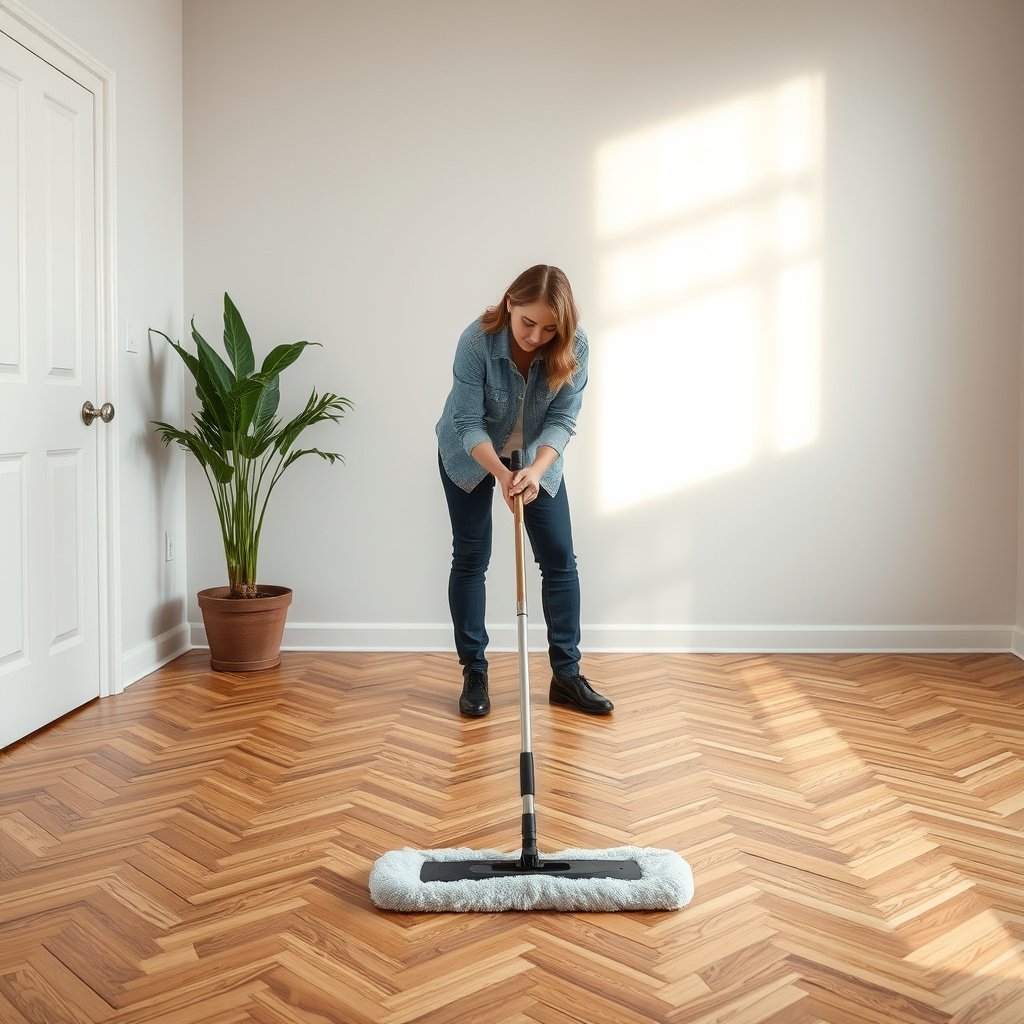
This step-by-step guide is for anyone with chevron-pattern floors who wants a reliable daily/weekly cleaning routine without damaging seams, edges, or finishes. It’s especially useful when your chevron design creates lots of corners and valleys where grit and moisture can collect—common causes of dullness and streaks.
Prep chevron floors before mopping
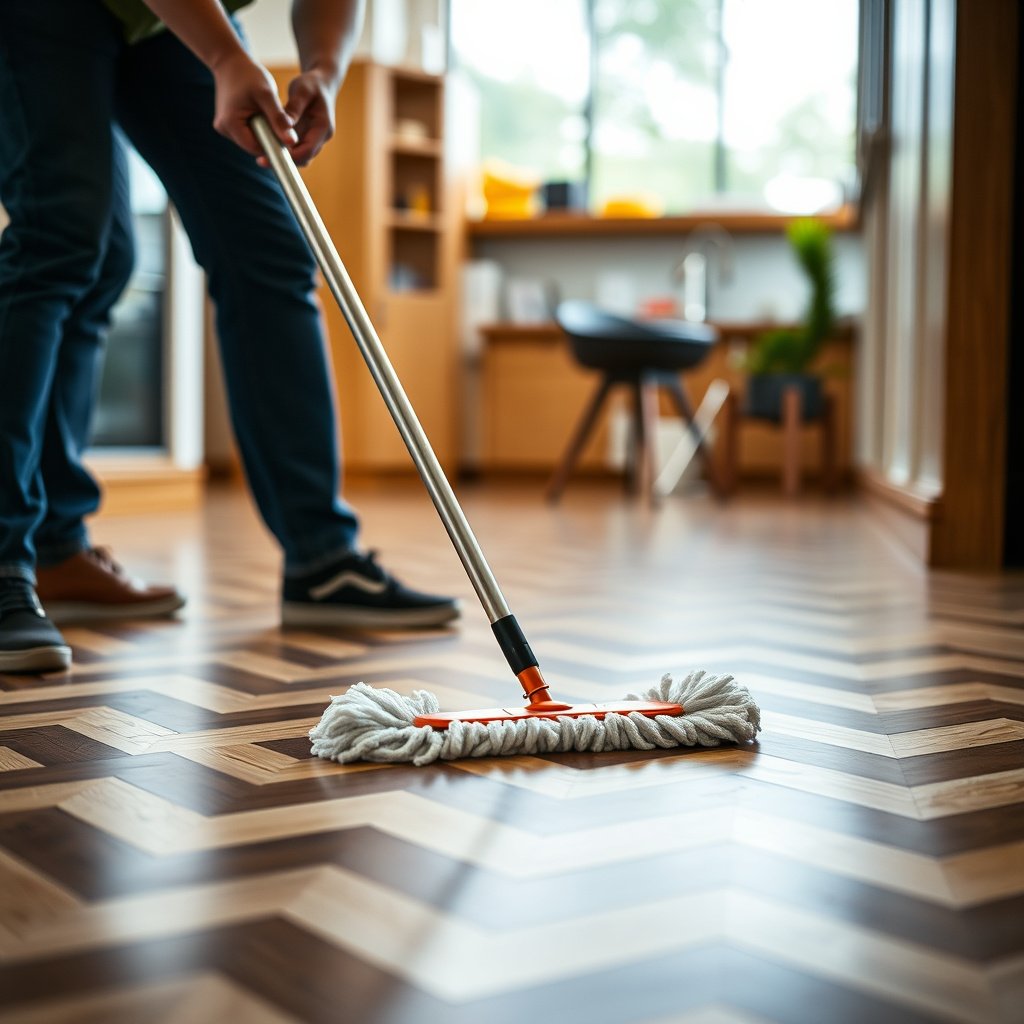
Mopping works best when you remove grit first, because chevron valleys act like miniature tracks for abrasive particles. Quick dry prep reduces the chance of finish dulling and helps your microfiber pad glide instead of grinding debris.
– Sweep or vacuum first (use a soft brush/no-beater setting if you have one) to remove grit that can dull the finish.
– Place doormats and wipe off tracked-in sand—chevron patterns can collect debris in the valleys.
Why this matters for chevron specifically: the angled “V” grooves trap dirt along the direction your shoes push it. Even if you use a pH-neutral cleaner, loose sand can behave like sandpaper when it gets redistributed into the next “V” section.
Practical prep tips that prevent recontamination:
– Target corners and the “V” intersections where debris gathers most.
– If your mop frame holds onto dust, rinse or wipe the mop head before the first pass of the session.
– Keep pet hair under control—stringy material can stick to microfiber and leave streaks later.
Chevron grooves collect grit along the angled valleys, so dry removal (sweep/vacuum) before mopping reduces abrasive transfer into the finish.
Using a soft brush/no-beater vacuum setting helps prevent micro-scratches that can show up more clearly on chevron’s high-contrast pattern.
Choose the right mop and cleaner
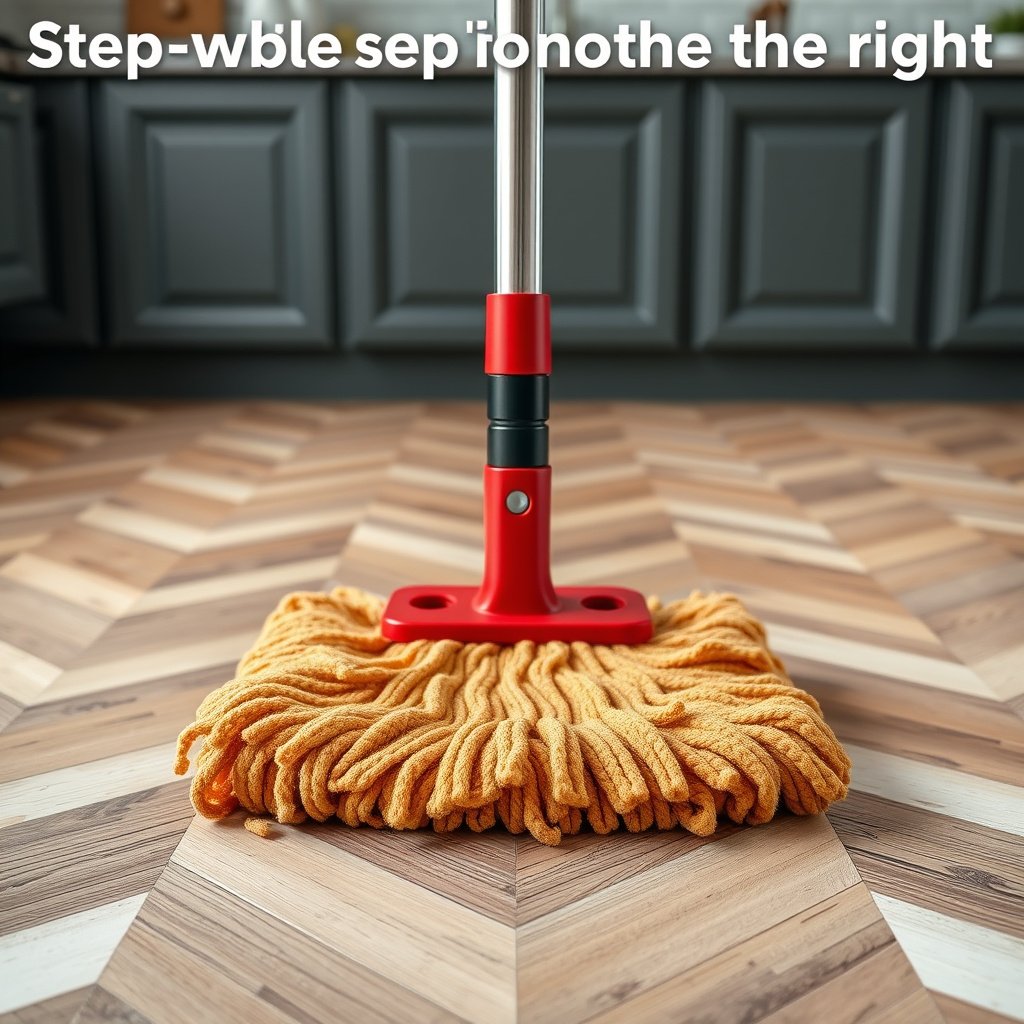
The safest default is a microfiber mop (that you can rinse) plus a pH-neutral cleaner designed for your specific floor type. Avoid strong detergents, waxes, and “scrub” formulas unless your flooring manufacturer explicitly allows them.
– Use a microfiber string or flat mop head that you can rinse—stringy dust and fuzz cause streaking.
– Pick a pH-neutral floor cleaner appropriate for your flooring type, and skip harsh detergents, waxes, and “scrub” formulas unless the manufacturer says they’re safe.
Cleaner compatibility: pH-neutral isn’t a free pass
“pH-neutral” generally means a cleaner near neutral (often roughly within about pH 6–8), which reduces the risk of damaging finishes compared with acidic or highly alkaline chemicals. Still, finish systems vary—some engineered floors, vinyl/LVP layers, and stone/tile sealers have specific restrictions on disinfectants and degreasers.
To ground the decision in something measurable, here are typical pH ranges for common cleaner categories you might be tempted to use:
Typical pH Ranges of Common Cleaners (for Hard Floors)
| # | Cleaner category | Typical pH range | Best fit for chevron mopping* |
|---|---|---|---|
| 1 | pH-neutral floor cleaner | 6.0–8.0 | ★ ★ ★ ★ ★ |
| 2 | Isopropyl alcohol (70% solution) | ~6.0–7.5 | ★ ★ ★ (use only if manufacturer allows) |
| 3 | Hydrogen peroxide (3% solution) | ~3.0–5.5 | ★ ★ (spot-clean only) |
| 4 | White vinegar (5% acetic acid) | ~2.4–3.2 | ★ (only if manufacturer explicitly approves) |
| 5 | Diluted bleach (sodium hypochlorite) | ~11.0–13.0 | ★ (typically not for routine mopping) |
| 6 | Ammonia-based cleaner | ~10.5–12.5 | ★ ★ (finish-dependent) |
| 7 | Baking soda (sodium bicarbonate) solution | ~8.2–9.0 | ★ ★ (can leave residue) |
“Best fit” assumes routine mopping; always defer to your flooring manufacturer’s moisture and chemical compatibility instructions.
“pH-neutral” is commonly used to describe cleaners formulated near neutral pH, which reduces finish risk compared with acidic or alkaline products.
Many flooring warranties limit routine wet-cleaning methods and chemical categories, so the safest cleaner is the one explicitly approved for your specific surface.
Mop in the right direction for chevron pattern
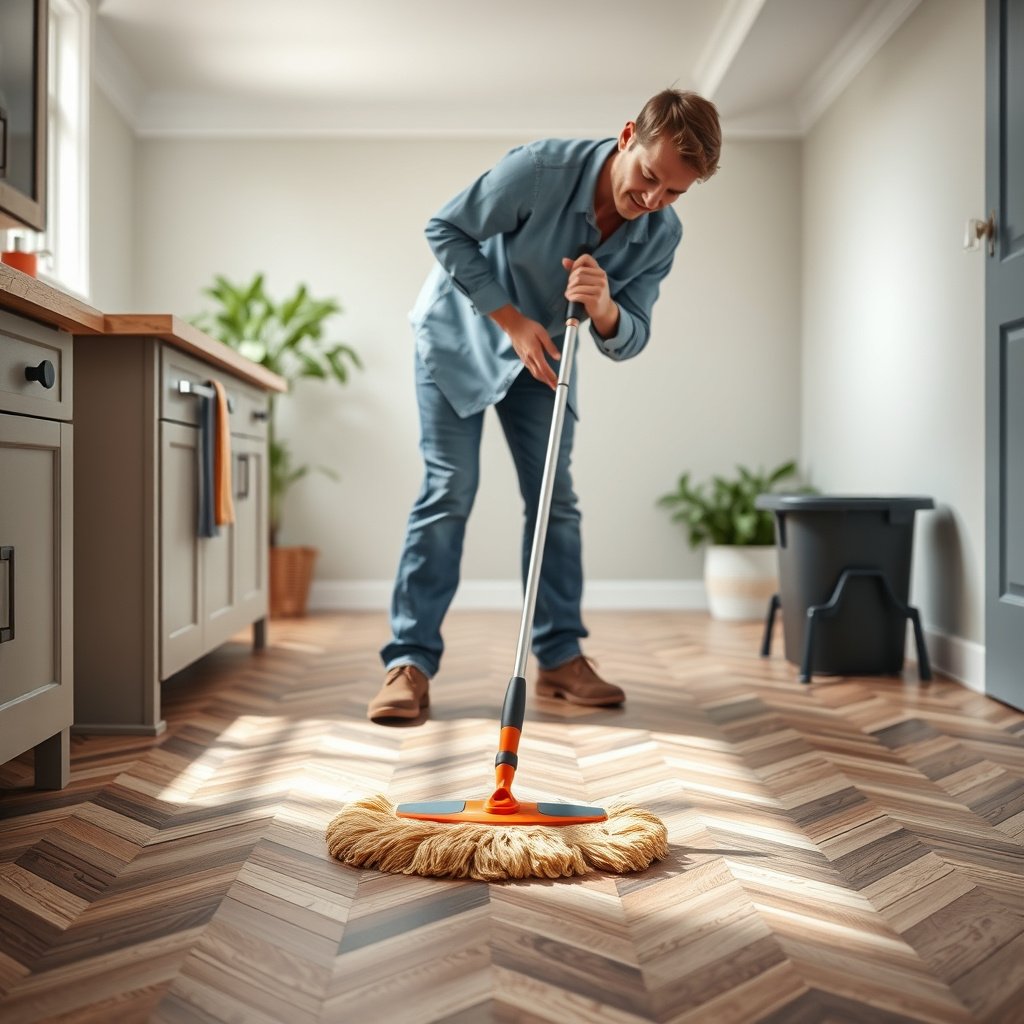
Work with the chevron lines so you’re lifting and carrying grime rather than pushing it deeper into angled grooves. Keep water light—damp, not wet—and rinse your mop pad frequently.
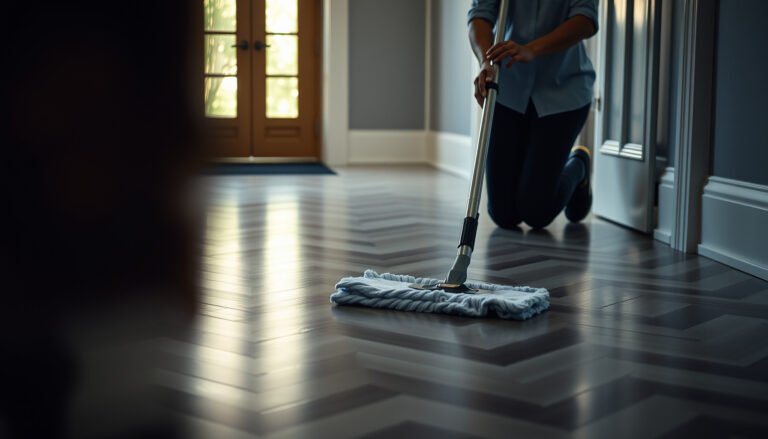
– Work with the chevron lines: mop one “V” section at a time so you don’t push grime into the next groove.
– Keep water light—damp, not wet—and rinse the mop pad frequently so you’re not re-spreading dirty water across angled seams.
Step-by-step mopping sequence (works across most chevron floors)
1. Divide the room into sections that follow the pattern (for example, one “V” band at a time).
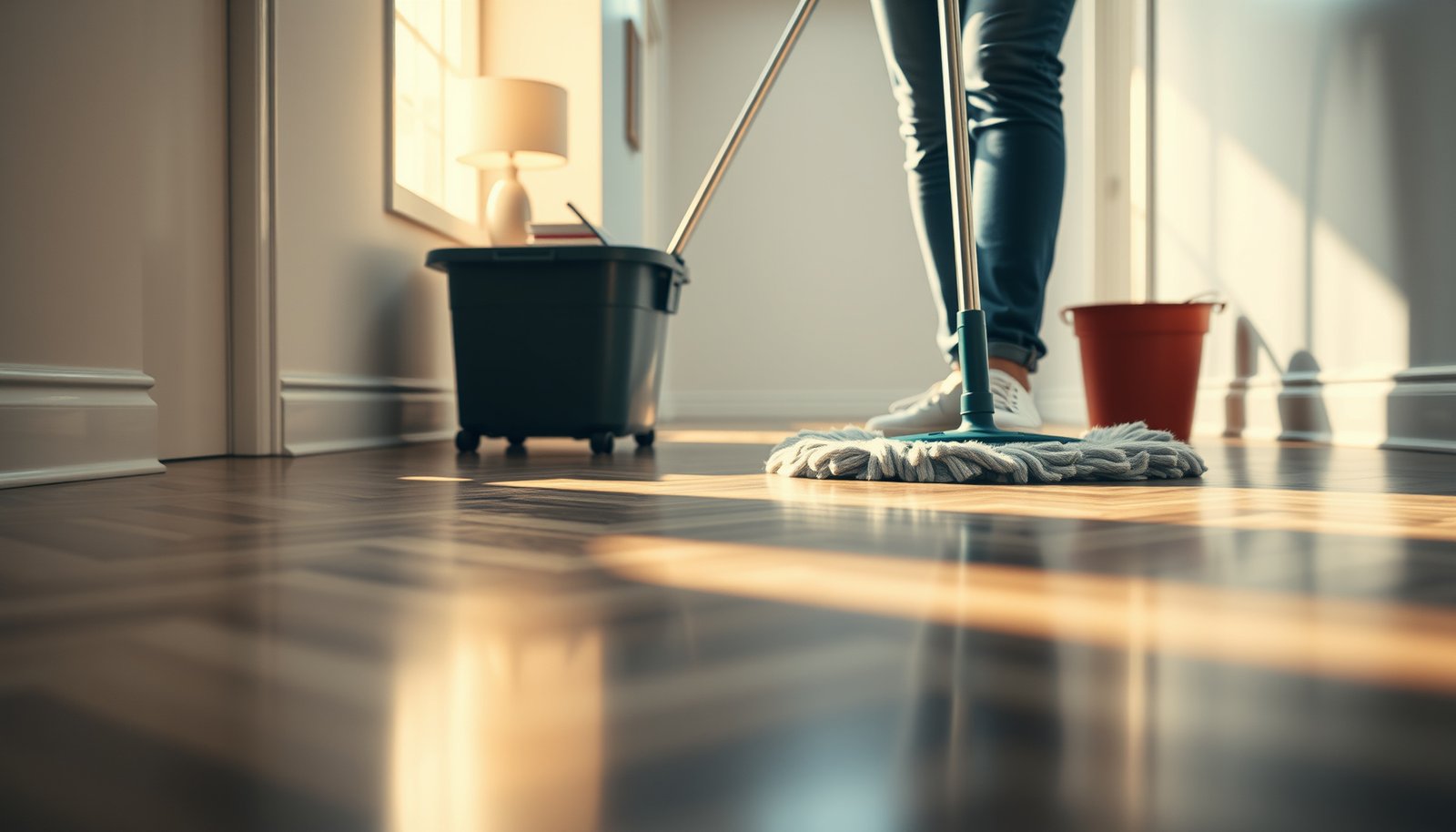
2. Load the mop correctly: damp microfiber means you should not see liquid streaming. If you can squeeze more water from the pad by hand, it’s too wet.
3. Mop along the “V” direction: make steady passes that follow the chevron geometry.
4. Overlap slightly: each pass should overlap the previous one by a small margin so you don’t leave cleaning streaks in the direction of the pattern.
5. Rinse the pad often: if the pad looks darker, gritty, or you notice suds/residue building, stop and rinse.
6. Change water as needed: dirty rinse water is one of the fastest ways to redeposit haze, especially on glossy or satin finishes.
Why “pad rinsing frequency” is the hidden variable
Chevron floors amplify redeposition because debris naturally migrates along the angle of the pattern. When a mop pad stays saturated with rinse water, it becomes a distribution tool rather than a pickup tool.
Quick comparison: damp microfiber vs. wet-mop behavior
| Method | Pros | Cons (common chevron problems) |
|---|---|---|
| Barely-damp microfiber + pH-neutral cleaner | Good pickup, less residue, easier to dry promptly | Requires prompt drying and occasional spot work |
| Wet mopping (too much water) | Feels “deep clean” initially | Moisture in seams, swelling risk (wood/engineered), trapped grit and streaking |
| Steam cleaning | Fast dwell-time sanitizing for some surfaces | Heat/moisture can damage finishes; permission depends on manufacturer |
Chevron floors show streaks faster when pads are dirty because redeposited cleaner travels along angled grooves during each mop pass.
Light moisture (damp microfiber) reduces seam exposure compared with wet mopping, which is particularly important for wood and engineered wood.
Drying and spot touch-ups
Dry high-traffic areas quickly after mopping to reduce streaks and to keep moisture from sitting in chevron grooves and seams. For sticky spots, use a slightly damp cloth with a small amount of the approved cleaner, then wipe dry.
– After mopping, dry high-traffic areas with a clean microfiber cloth to reduce streaks and prevent moisture from sitting at the seams.
– For sticky spots, use a slightly damp cloth and a small amount of the approved cleaner, then wipe dry—don’t let cleaner pools sit on the surface.
How to dry efficiently without smearing
– Use a dry microfiber cloth and blot/wipe in the same chevron direction you mopped.
– Focus on edges, seams, and transitions (door thresholds, vents, under cabinets) where water lingers.
– If the floor has a satin sheen, drying immediately helps prevent “haze” that becomes more visible under overhead light.
Spot-cleaning protocol (low-moisture)
1. Apply cleaner to the cloth—not directly to the floor.
2. Wipe the spot gently along the pattern lines.
3. Remove residue with a clean damp cloth (if your manufacturer recommends a rinse step).
4. Dry with a microfiber towel immediately.
Drying promptly after damp mopping reduces the chance that moisture stays trapped in chevron grooves and at plank edges.
Applying cleaner to the cloth rather than flooding the surface helps prevent pooling and minimizes residue build-up in angled seams.
What can go wrong (and how to avoid it)
Most chevron mopping failures come from over-wetting, dirty pads, or using the wrong chemistry for the floor finish. If you correct these three variables first, streaks and haze usually improve quickly.
– Streaks or dull haze: usually from too much water, dirty mop pads, or cleaners with residues—use fresh pads and wring thoroughly.
– Swelling/finish damage (wood/engineered): often caused by soaking or repeated wet mopping—follow your floor’s moisture guidance and stop if the floor looks “too wet.”
– Buildup in chevron grooves: can happen if you mop without rinsing—change your water and mop pad more often.
– Wrong product for the surface: some chevron floors (especially with specific finishes) won’t tolerate certain degreasers or disinfectants—.
Three moisture-related numbers to keep in mind (wood/engineered focus)
If your chevron floor is wood or engineered wood, moisture control is non-negotiable:
– According to the National Wood Flooring Association (NWFA), maintaining indoor relative humidity around 35%–55% helps protect wood from excessive dimensional movement ().
– Many industry guidelines describe wood floors as performing best when they reach an equilibrium moisture content in the typical single-digit range (often cited around 6%–9%, depending on climate and product specs) ().
– Even “small” amounts of water can matter if they migrate into seams repeatedly—so the damp-mop approach is designed to minimize cumulative exposure rather than rely on one deep clean ().
Common “fix it later” mistake
If you notice residue or streaks after the fact, don’t immediately switch to stronger chemicals. Stripping or degreasing can compound the problem if the finish is already compromised or if the cleaner leaves film.
Streaking on hard floors is frequently linked to excess water, dirty mop pads, or residue-forming cleaners rather than the chevron pattern itself.
For wood and engineered wood floors, repeated wet mopping increases the risk of swelling and finish damage when moisture moves into joints.
Verdict / tip (when to skip this method)
This approach is the safest default for most chevron floors: light moisture, pH-neutral cleaner, microfiber pad, and prompt drying. Skip DIY mopping and follow manufacturer directions instead if your floor is unfinished, severely damaged, has active swelling/cupping, or the manufacturer explicitly restricts wet cleaning.
– Downside: you may need extra drying/spot work compared with a “wet mop,” especially in deeper chevron valleys.
If you’re unsure which cleaner is approved for your exact product line, the decision rule is simple: use the cleaner category the manufacturer permits, not the one that “feels stronger.” When in doubt, start with a pH-neutral cleaner and spot-test in a less visible area.
The safest default for chevron floors is damp microfiber mopping with pH-neutral, manufacturer-approved cleaner—because it limits residue and reduces seam moisture exposure.
Some flooring finishes restrict wet cleaning entirely, so skipping DIY mopping is appropriate when the manufacturer limits or forbids moisture-based cleaning.
Quick scan checklist for mopping chevron floors
| Step | What to do | Watch out for |
|---|---|---|
| 1 | Sweep/vacuum first | Sand and grit grinding into the finish |
| 2 | Use microfiber (damp, not wet) | Over-wetting angled seams |
| 3 | Use pH-neutral, manufacturer-approved cleaner | Residue from harsh or non-approved products |
| 4 | Mop along chevron lines | Re-spreading dirt if pads stay dirty |
| 5 | Dry promptly | Moisture sitting in grooves/seams |
| 6 | Spot-clean sticky areas | Letting cleaner pool or soak |
Frequently Asked Questions
What is the best way to mop chevron floors without damaging the pattern?
Use a microfiber mop with a flat head so you clean evenly across the chevron lines without snagging or dragging dirt into the grooves. Lightly dampen the mop (don’t soak the floor), and avoid harsh scrubbing that can dull finishes. If your chevron floor is wood or engineered, always follow the manufacturer’s recommended cleaner and water limits to prevent warping or swelling.
How do I mop chevron tile floors so grout lines stay clean?
Start by sweeping or vacuuming thoroughly to remove grit that can scratch tile and grind down grout. Mop with a pH-neutral cleaner and use gentle back-and-forth motions, then slightly adjust to follow the diagonal chevron direction so cleaner reaches grout. For stubborn grout haze, spot-clean with a grout-safe brush or applicator before mopping again to avoid re-depositing residue.
How often should I mop chevron floors, and what should I do between moppings?
For most homes, mopping chevron floors once a week (or as needed based on foot traffic) helps prevent buildup that dulls the surface. Between moppings, use a dry microfiber dust mop daily or a few times per week and wipe spills immediately to prevent stains from settling into seams and grout. This routine reduces the need for deep cleaning and helps preserve the crisp chevron pattern.
Which cleaning solution is safe for mopping chevron floors—vinegar, steam, or something else?
For chevron tile, a pH-neutral or grout-safe tile cleaner is usually the safest choice; avoid acidic cleaners like vinegar that can break down grout over time. For wood or laminate chevron floors, skip steam mops and overly wet methods, and use only a cleaner specifically approved for your floor type. If you’re unsure, spot-test any product in a hidden area and check the manufacturer’s care guide before mopping chevron floors.
Why do chevron floors streak or look dull after mopping, and how can I prevent it?
Streaking is often caused by using too much water, an overly strong cleaner, or not rinsing properly after mopping. Use a well-wrung microfiber mop, change rinse water frequently, and dry with a clean microfiber cloth or mop head if your floor shows moisture marks. Regular maintenance with the right cleaner and technique helps keep chevron floors looking sharp and evenly finished.
📅 Last Updated: October 15, 2026 | Topic: How to mop chevron floors? | Content verified for accuracy and freshness.
References
- Environmental Infection Control Guidelines | Infection Control | CDC
- https://www.who.int/publications/i/item/cleaning-and-disinfection-of-environmental-surfaces-in-the-context-of-covid-19
- Mop
- https://extension.psu.edu/hardwood-floor-care-and-maintenance
- https://extension.umn.edu/household-cleaning/cleaning-hardwood-floors
- 404 Error
- https://scholar.google.com/scholar?q=how+to+mop+chevron+floor Google Scholar
- https://scholar.google.com/scholar?q=parquet+floor+cleaning+microfiber+mopping Google Scholar
- https://scholar.google.com/scholar?q=hardwood+floor+cleaning+best+practices+avoid+excess+water Google Scholar