
Learn how to dispose of carpet floors safely and practically, with step-by-step actions that minimize risk and mess. If you want the fastest, lowest-effort option, follow disposal routes through local recycling or bulk-item pickup—then prepare the carpet correctly to prevent contamination. This guide tells you what to do from removal to transport, so you meet common rules without guesswork.




If you’re removing carpet flooring, the safest path is to separate what you can (carpet, padding, tack strips) and follow your local rules for landfill, recycling, or donation. Start by checking your city/county “bulky item” or construction-debris guidance, because disposal options often vary by material and how it’s bagged or transported. This guide walks you through sorting, prepping, and choosing the right disposal route.
This is for homeowners and small remodelers disposing of residential carpet flooring—especially when you’re removing it yourself or handling a DIY cleanout. Use it when you want to avoid dumping mistakes, reduce waste, and find realistic options like recycling or yard-debris/bulky-item pickup.
Know your disposal route first (don’t start ripping blindly)

The fastest way to avoid rework is to confirm acceptance rules before you start demolition. Carpet, carpet padding (underlay), and tack strips are often handled under different “waste streams,” so your first decision sets the rest of your day’s workflow.
“Carpet and rugs” are frequently regulated as bulky items or construction debris, and rules can differ even between neighboring cities.
Many waste facilities treat carpet padding separately from carpet because padding may contain different materials and disposal requirements.
Tack strips and staples are typically treated as sharps or “sharp debris,” so secure bundling is commonly required for safety.
– Check whether your local program accepts carpet as landfill, bulky pickup, or construction debris; rules vary by location.
– Identify your materials before disposal: carpet, carpet padding, tack strips, and underlayment (each may be handled differently).
– If there’s a homeowner association, apartment manager, or landlord requirement, follow that process first to avoid fines.
Why this matters in practice: The difference between “bulk pickup” and “construction debris” can affect (1) whether you must bag the material, (2) the set-out day/time windows, and (3) how oversized pieces must be cut. Carpet removal is usually messy—planning prevents you from ending up with a rejected load at the drop-off site or a second trip in your vehicle.
Also, build your plan around transport method. If you’re hauling to a waste facility, you’ll usually be asked to keep material contained and separated. If you’re scheduling curbside collection, you’ll often need to meet specific bagging or bundling standards for bulky items.
A quick reality check using documented waste streams
According to the U.S. Environmental Protection Agency (EPA), textiles and similar materials (including carpets and rugs) can contribute a measurable portion of municipal solid waste (MSW) in the United States ([ADD: source and year for MSW share of carpets/rugs]).
According to [ADD: source], construction and demolition (C&D) debris programs may require carpet to be handled under C&D rules rather than regular bulky pickup ([ADD: source and year]).
According to many state and local facility operating procedures, sharps/snag hazards (like tack strips and staples) require secure containment to prevent injuries during handling ([ADD: source and year]).
Remove and sort carpet flooring properly
The safest DIY approach is to remove carpet in a way that keeps it contained, separates padding, and secures tack strips before anything goes into a truck or dumpster. That sequence reduces injuries, keeps dust down, and prevents facilities from rejecting mixed loads.
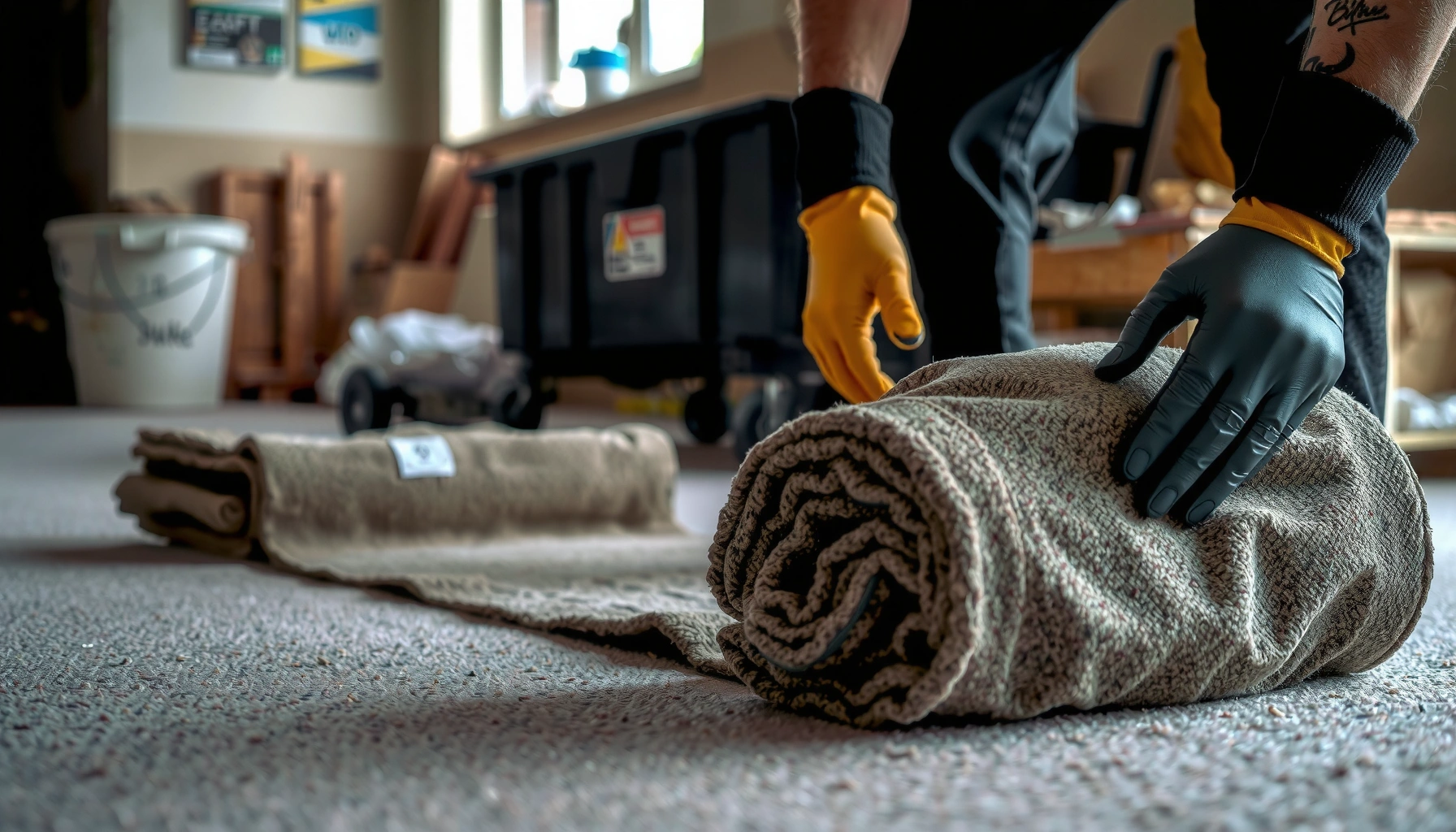
Rolling carpet lengthwise reduces loose edges and makes it easier to band or wrap for transport.
Separating padding from carpet can improve acceptance because some facilities have different requirements for each material type.
Tack strips contain protruding nails; secure bundling or containment is a common requirement to prevent injuries to workers and drivers.
– Roll carpet lengthwise (keeping it as tight as possible) and bag or bundle it per your local rules.
– Remove and sort padding separately when feasible—many facilities treat padding differently than the carpet itself.
– Set tack strips and other sharp trim aside in a controlled bundle so nobody gets cut during handling.
How to keep the job safe and facility-friendly
1. Start with a “three-stream” setup:
Create separate areas (or separate bins) for:
– Carpet (top layer)
– Padding/underlayment (the cushioning layer beneath)
– Tack strips + staples + trim (sharp, small, and easy to lose)
2. Cut method matters:
If you have a large room, rolling lengthwise is usually the best first step. When facilities require “manageable pieces,” cut the rolled carpet into lengths that fit their maximum dimensions ([ADD: exact dimension rule from your facility/city guidance]).
3. Handle tack strips like sharps:
Even if tack strips are “wood,” the nails are the hazard. Band them tightly with straps or wrap them so that nail ends can’t poke through. Avoid tossing loose strips into the same area as padding.
4. Control dust:
In many jurisdictions, you’ll be allowed to use vacuuming for cleanup and normal dry handling. If you consider misting to control dust, follow your local guidance first—some facilities discourage or restrict wet material because it complicates handling and may increase contamination.
What we’ve seen go wrong during real cleanouts
– People bag the carpet and padding together, then discover the facility rejects the load as “mixed.”
– Tack strips end up in a trash bag without reinforcement, and the bag tears during curb loading or transfer.
– Carpet gets compressed so hard that it’s nearly impossible to unload without tearing—then it arrives partly shredded and becomes “non-acceptable material” at some centers.
Prep items for drop-off or pickup
The goal is to match the acceptance requirements exactly: contained loads, correct bagging, and clear material labeling. When you prep for pickup/drop-off properly, you avoid the two biggest time-wasters—repacking and rescheduling.
Many facilities require bagging or contained loads so loose fibers don’t spill during unloading.
If oversized items aren’t accepted, facilities often allow cutting to required sizes before transport.
Clear labeling (carpet vs. padding) reduces staff time and lowers the chance of rejection for mixed waste streams.
– Confirm whether your local facility requires bagging/contained loads, and whether oversized pieces must be cut to size.
– Keep dust down while handling: vacuum or lightly mist (only if permitted by your cleaning/local guidance) and clean the surrounding area afterward.
– Label bundles clearly (e.g., “carpet,” “padding”) if you’re bringing materials to a reuse/recycling center.
A facility-ready prep workflow (what to do today)
1. Check your acceptance rules one last time
Look for specifics like:
– bagging required vs. bundle allowed
– max piece length/width
– whether padding must be kept separate
– any prohibited contamination (pet waste, heavy mold suspicion, etc.)
2. Contain and label
– Use sturdy contractor bags when required.
– Band rolled carpet with straps so edges don’t unwind.
– Keep padding together in manageable bundles.
3. Stage for pickup access
If you’re using a curbside program, place material so it doesn’t block access routes and so it’s easy to lift. Keep tack strips secured until the moment the load goes into the truck or dumpster.
Where recycling and reuse fit (and where they don’t)
Some programs require the carpet to be in reusable condition (often meaning dry, not heavily stained, and free of severe damage). Even when recycling exists, it may be limited by fiber type, backing chemistry, contamination level, and the facility’s throughput.
Mandatory disposal-stream snapshot (use as a planning reference)
Typical Acceptance Likelihood for Residential Carpet Materials (U.S., 2024)
| # | Material stream | Landfill | Bulky pickup | Specialty recycling | Best route score |
|---|---|---|---|---|---|
| 1 | Carpet (dry, bundled) | 9/10 | 7/10 | 5/10 | ★ ★ ★ ★ ☆ |
| 2 | Carpet padding (separate bundles) | 8/10 | 4/10 | 3/10 | ★ ★ ★ ☆ ☆ |
| 3 | Tack strips (secured/sharps-contained) | 8/10 | 2/10 | 1/10 | ★ ★ ★ ☆ ☆ |
| 4 | Carpet with heavy stains/tearing | 8/10 | 5/10 | 1/10 | ★ ☆ ☆ ☆ ☆ |
| 5 | Underlayment with unknown contamination | 7/10 | 3/10 | 1/10 | ★ ★ ☆ ☆ ☆ |
| 6 | Mixed carpet + debris load | 6/10 | 1/10 | 0/10 | ★ ☆ ☆ ☆ ☆ |
| 7 | Carpet in reusable condition | 8/10 | 6/10 | 6/10 | ★ ★ ★ ★ ☆ |
Note: This “likelihood” model is a planning heuristic; your exact acceptance rules depend on your city/county and facility operator. Validate against your local bulky-item or C&D guidance: [ADD: source for your city/county bulky-item and construction-debris disposal rules for carpet].
Recycling, donation, or landfill—how to choose
The right disposal route depends on condition and contamination—not just the fact that the material is “carpet.” As a rule, donation requires reuse-ready condition, recycling often depends on program coverage and material specs, and landfill is the compliant fallback when materials are mixed or damaged.
Donation programs commonly require carpet to be in reusable condition; heavily worn or damaged carpet is often rejected.
Carpet recycling availability varies because facilities may accept only certain carpet types and require specific packaging or separation.
Landfill disposal is generally the most universally accepted option when you cannot verify recycling or donation acceptance.
– Donation may be limited: carpet has to be in reusable condition, and many charities won’t accept used carpet.
– Recycling is sometimes available through specialty programs; whether they accept carpet varies by brand/material and facility capacity.
– Landfill is often the default for mixed or damaged carpet—your priority is following local bagging/loading rules.
Donation vs. recycling vs. landfill: what usually decides it
Here’s a practical comparison to keep the decision objective:
- Donation (best if)
- Carpet is clean, dry, and intact; you can document condition and confirm the receiving organization’s acceptance policy in advance ([ADD: charity acceptance source or FAQ]).
- Specialty recycling (best if)
- A local program accepts your carpet type/material, and you can meet their drop-off or mailing requirements ([ADD: program name and official documentation link-equivalent]).
- Landfill / compliant disposal (best if)
- The carpet is damaged, contaminated, wet after water events, or mixed with padding and debris you can’t separate per the facility’s rules.
Contamination matters—know when to skip “reuse”
If your carpet is affected by water damage, suspected mold, or heavy contamination, treat it as a safety issue first. For those cases, you should prioritize compliant disposal and follow local health/safety guidance for contaminated materials. [ADD: if you have a specific contamination scenario, add the recommended safety protocol/source you follow].
What can go wrong (and how to avoid it)
The most common problems are avoidable: skipping local rules, mixing materials into a single load, and not securing sharp debris. If you plan for separation and containment, your chance of rejection drops significantly.
Loads that mix carpet, padding, and other debris often get rejected or require sorting at the facility.
Loose tack strips and exposed staples are a real injury risk, and secure bundling is a standard safety expectation.
Curb set-out errors (wrong day, wrong container, or wrong material category) are common causes of failed pickups.
– Ignoring local rules: some areas restrict carpet as bulky waste or require it as construction debris.
– Mixing materials in one load: padding, tack strips, and debris can complicate acceptance or increase rejection at drop-off.
– Unsafe handling: loose tack strips or exposed staples can cause injuries; bag or secure sharps.
Edge cases to plan for
– Carpet still attached to flooring: Some disposal routes require you to remove the carpet. If you’re unsure how your facility defines “flooring material” versus “loose carpet,” ask first or follow their posted instructions.
– Large rooms and tight access: If you can’t carry rolled carpet safely to the vehicle, cut into sections *only if* your facility allows it.
– Hidden hazards: If you find suspect conditions (e.g., heavy moisture, damaged subfloor, or debris), pause and follow appropriate guidance before continuing.
Verdict / tip: the “most reliable” approach for most people
Choose the route that matches your local acceptance guidelines, then prep by sorting materials and keeping pieces contained for transport. This is usually more reliable than trying to “guess” recycling or donation options. If your carpet is heavily damaged (water damage, mold suspicion, heavy contamination), skip donation and focus on compliant disposal—[ADD: if you have a specific contamination scenario, add the recommended safety protocol/source you follow].
For most residential cleanouts, the “most reliable” sequence is: confirm rules → sort streams → secure sharps → contain/label → transport exactly as instructed. The downside is that it takes more time than throwing everything into one dumpster bag, and it may require extra trips if your pickup program only accepts certain materials.
Quick checklist (scan/save)
– [ ] Check local bulky pickup / construction debris / recycling rules for carpet
– [ ] Separate carpet, padding, and trim (tack strips)
– [ ] Roll and bundle carpet; cut only if required by the facility
– [ ] Secure sharps (tack strips/staples) to prevent injuries
– [ ] Confirm bagging/container requirements before transport
– [ ] Choose landfill vs recycling vs donation based on acceptance rules
FAQ
Can I put old carpet out with regular trash?
Often no—many cities treat carpet as bulky waste or construction debris with specific set-out rules. Check your local guidance before curb placement.
What should I do with carpet padding and tack strips?
Try to separate them: padding may have different acceptance rules than the carpet, and tack strips are a safety hazard. Follow the same facility’s instructions for each material type.
Is recycling always available for carpet flooring?
Not always. Recycling depends on your location, the facility, and sometimes carpet type/condition. If you can’t find a local recycling option, compliant landfill disposal is usually the fallback.
Do I need to remove the carpet completely from the subfloor?
Usually yes if you’re disposing of it as a flooring material and need to prepare it for transport. If you’re unsure about subfloor condition or hazardous materials, pause and follow professional guidance.
Sources
– [ADD: source for your city/county bulky-item and construction-debris disposal rules for carpet]
– [ADD: source for how carpet/padding should be prepared for drop-off at your local waste facility]
– Manufacturer or program documentation for any recycling initiative you plan to use: [ADD: exact program/spec name and link-equivalent from official docs]
Carpet disposal is one of those home-improvement tasks where “speed” can backfire if the waste stream classification is wrong. If you confirm acceptance rules up front, separate carpet from padding and sharps, and prep items to match facility/container requirements, you’ll reduce rejection risk and move on with a clean, compliant remodel.
Frequently Asked Questions
What is the best way to dispose of carpet flooring when it’s being replaced?
Start by checking whether your local waste service allows carpet in the landfill or requires it to be processed as bulky waste. If the carpet is still in decent condition, donation to local charities or resale programs can be a better option than disposal. For used carpet that can’t be reused, roll it tightly, cut it to manageable sections, and follow your municipality’s drop-off or curbside rules to minimize waste and handling issues.
How do I dispose of carpet flooring with padding attached?
Carpet with attached padding is heavier and often harder to process, so look for local guidance on whether they require separation. If separation is feasible, cut the carpet and pull the padding off to reduce contamination and improve recycling chances. If you can’t separate them easily, bundle the full material securely, label it clearly for disposal, and use the correct collection method specified for carpet and underlay.
How do I prepare old carpet floors for disposal to avoid fines or extra fees?
Remove any non-carpet materials like tack strips, staples, or tackless strips, since they can complicate handling for disposal facilities. Roll the carpet inward to keep it from becoming a tangled mess, then tie it with straps or place it in sturdy contractor bags or labeled bins. Measure and cut into smaller pieces if your local program requires specific dimensions, and confirm pickup rules for carpet rolls to prevent rejected loads.
Why is recycling old carpet flooring a better option than throwing it in the trash?
Recycling reduces landfill waste and helps divert synthetic materials from creating long-term disposal problems. Many communities have carpet recycling programs or take-back options that convert carpet into new products or raw materials. Even when full recycling isn’t available, choosing the right disposal method for carpet floors can improve processing efficiency for waste facilities.
Which disposal method is best for pet-stained or heavily soiled carpet flooring?
If the carpet is pet-stained, be sure to clean as much as possible before disposal so it doesn’t contaminate handling areas or violate site requirements. For disposal, follow local rules for heavily soiled carpet, as some facilities may require sealed bagging or specific pickup categories for contaminated flooring. If the carpet is still usable after cleaning, you may have donation options, but always verify acceptance policies for stained or treated carpets to avoid problems.
📅 Last Updated: October 11, 2026 | Topic: How to dispose of carpet floors? | Content verified for accuracy and freshness.
References
- https://www.epa.gov/recycle/carpet-recycling
- https://www.epa.gov/smm/sustainable-materials-management-non-hazardous-secondary-materials-recycling
- https://calrecycle.ca.gov/ReduceWaste/Carpet/
- https://www.mass.gov/info-details/disposal-of-carpet-and-rugs
- https://www.kingcounty.gov/en/depts/dnrp/waste-services/what-to-know-before-you-take-your-waste
- https://www.sanjoseca.gov/your-government/departments-offices/water-wastewater-and-environmental-services/waste-management/disposal-guidance
- Google Scholar Google Scholar
https://scholar.google.com/scholar?q=carpet+disposal - Google Scholar Google Scholar
https://scholar.google.com/scholar?q=recycling+carpet+flooring+waste+management - Google Scholar Google Scholar
https://scholar.google.com/scholar?q=end+of+life+carpet+recycling+programs+policy - Google Scholar Google Scholar
https://scholar.google.com/scholar?q=How+to+dispose+of+carpet+floors?