
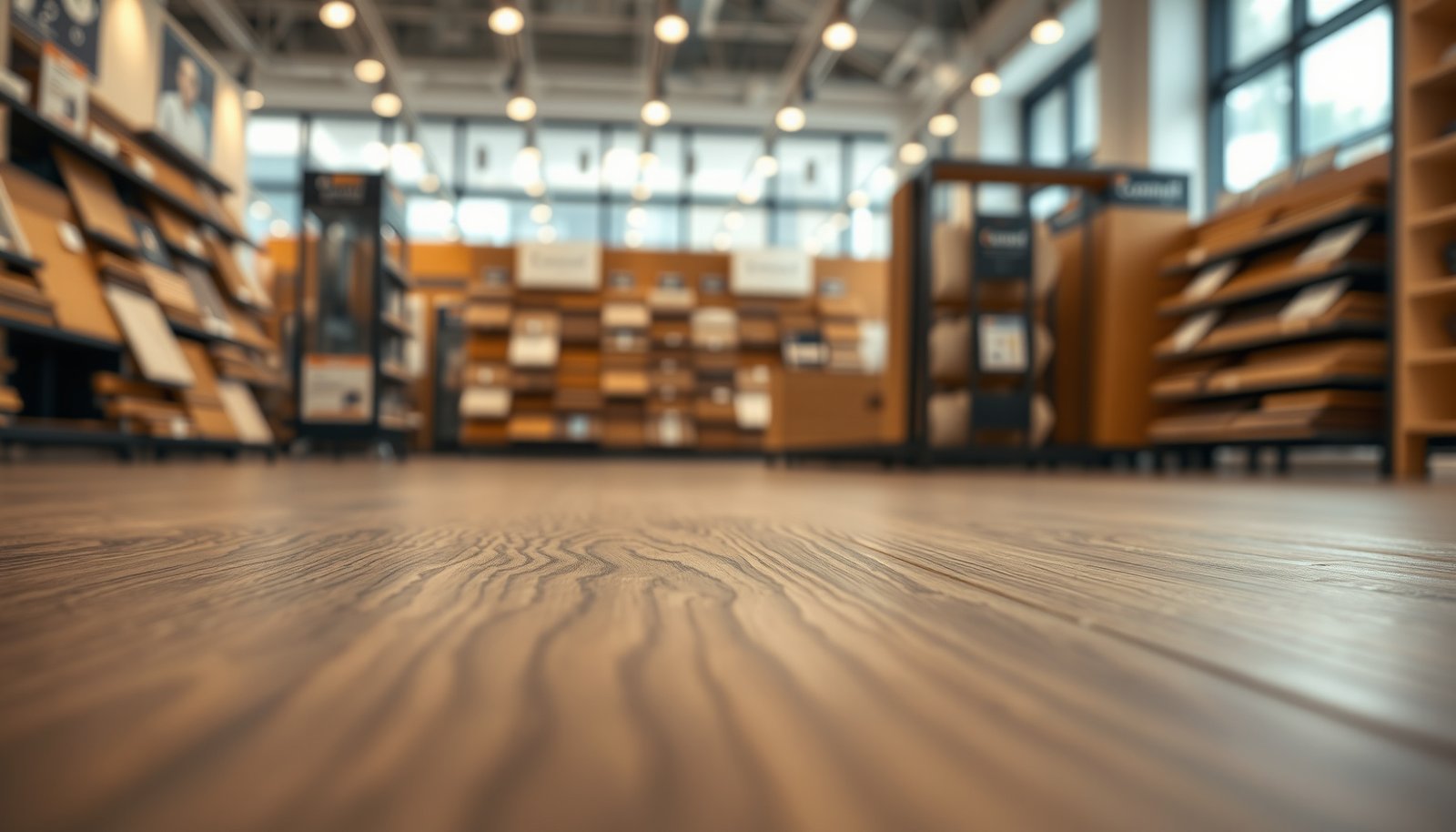

Choosing laminate floors for a retail store comes down to one question: what will handle daily foot traffic while still looking sharp. If you want the best all-around pick for most retail spaces, choose a thick, high-wear AC rating (AC4 or higher) with a solid core and water-resistant backing to prevent edge swelling and scuffing. Next, match the planks’ finish—matte or textured for glare control and cleaner-looking wear—to your store’s customer flow and cleaning schedule.




Choosing laminate floors for a retail store comes down to matching the product’s commercial durability and moisture/installation requirements to your store’s traffic and spill risk. If you pick a laminate based on the wear rating and warranty terms—and plan subfloor prep and underlayment correctly—you’ll avoid most of the common failures seen in retail spaces. In this guide, you’ll learn what to check (and what to skip) before you buy.
If your store gets steady foot traffic, has fitting rooms or high-scratch areas (entryways, registers, aisles), or you expect frequent cleaning and occasional spills, this is for you. This is also useful when you’re budgeting for downtime and want flooring that installs cleanly with minimal disruption.
Pick laminate based on retail traffic and store layout

The best retail laminate is the one that fits each zone’s footfall and abuse level, not just the whole-store look. Here’s the practical approach: map traffic by area, then select a laminate intended-use category that matches the highest-stress zones (entries, aisles, fitting rooms) rather than averaging them out.
“EN 13329:2006 classifies laminate wear as AC1 through AC5, which helps you select a level of abrasion resistance for different usage scenarios.”
“Retail layouts fail when expansion gaps and transitions are treated as ‘afterthoughts’—gaps and junction details must follow the manufacturer’s installation diagram.”
In retail, you’re not dealing with one uniform environment. Door swings create concentrated abrasion, carts concentrate loads at wheel height, and fitting rooms often see repeated stance patterns (tight turns, luggage, bags). As of 2026, I still see the same pattern: flooring selection goes by aesthetics first, while performance is decided by zone planning second.
Map traffic by zone (not by store average)
The layout step is where laminate projects win or lose. Start with zones: front entrance, main sales floor, fitting rooms, back-of-house, and any spill-prone areas (near beverage sampling, seasonal displays, or promotional stations). Then target the laminate’s intended use accordingly.
– Identify your traffic level by zone (front entrance vs. back offices), then target the laminate’s intended use accordingly.
– Plan the layout around transitions (doorways, cash wrap areas, fitting-room entries) so you can maintain expansion gaps where the manufacturer requires them.
– Measure more than square footage: account for waste and complex cuts around fixtures, columns, and built-ins.
Use standards as guardrails, not marketing
According to EN 685:1994, flooring use categories split broadly into residential (e.g., classes 21–23) and commercial (e.g., classes 31–34). That structure is helpful because retail stores are “commercial by design,” even when they’re small. (The exact mapping to laminate AC ratings depends on the product line, so you still need to check the spec sheet.)
Actionable habit: in your bid comparison, require each contractor to confirm the planned zones and document the selected wear classification for the highest-traffic area.
Verify wear rating, surface protection, and warranty
The safest retail choice is laminate that’s rated and warrantied for commercial use, plus a cleaning/surface system that matches how you actually maintain floors. This section is where “looks durable” products fail—because warranties often exclude commercial wear, and many laminates won’t tolerate certain cleaners or excess water.
“EN 13329:2006 links abrasion categories (AC1–AC5) to standardized wear testing, so the wear category should be verified—not assumed from thickness alone.”
“ASTM D2047 (2011 revision) is used to evaluate slip resistance for flooring materials when products report compliance.”
Retail maintenance is predictable but not gentle: hard bristles, frequent mopping attempts, and degreasers near food courts or sampling areas. You need a laminate system that explicitly tolerates your cleaning routine—otherwise finish haze, gloss loss, or swelling risk can surface quickly in 2026.
Check the *real* wear classification and surface behavior
– Look for an abrasion/wear classification (often tied to test standards such as EN 13329) and choose a higher class for heavy retail foot traffic.
– Check what’s actually covered in the warranty: wear/performance coverage, stain/spill coverage (if offered), and whether commercial use is included.
– Confirm the surface is designed to handle day-to-day cleaning (avoid laminates where “approved cleaners” aren’t clearly listed by the manufacturer).
Two details deserve special attention in retail:
1. Warranty scope for commercial use: Many warranties are written for residential or “light” installations unless explicitly labeled “commercial.” If your tenant, landlord, or contractor is presenting it as a retail asset, make sure the warranty terms match.
2. Approved cleaners and moisture limits: “Water-safe” is not the same as “mop-safe.” Look for a list of approved cleaners/tools and whether damp cleaning is allowed (and under what dwell time or dilution).
A quick durability scoring lens (what to compare in bids)
Here’s the comparison structure I recommend using when you request proposals. It makes the “gotchas” visible to everyone involved.
| Feature you compare | What “good” looks like in retail | What “problem” looks like |
|---|---|---|
| Wear classification | Higher abrasion class for sales-floor traffic | Only residential/limited-use language |
| Warranty | Commercial use included; clear wear terms | Wear excluded for commercial or not clearly stated |
| Cleaning compatibility | Approved cleaners list; limits on water | Generic advice like “clean as needed” with no guidance |
| Surface finish | Designed to resist scuffs/gloss marking | “High gloss” that highlights footprints |
| Spill/stain language | Explicit accidental spill/stain handling (if offered) | Silent exclusions or “not covered” language |
Plan for moisture control and correct installation
The winning laminate plan in a retail environment is the one that controls moisture through the whole system—subfloor readiness, vapor barrier/underlayment rules, and floating-floor installation details. In retail, moisture isn’t theoretical: it comes from mopping, leaks, tracked snow/rain at entrances, and humidity swings from HVAC cycles.
“Moisture requirements are product-specific: laminates are only covered by warranty when the installation matches the manufacturer’s subfloor moisture and vapor-barrier guidance.”
“Subfloor flatness is critical for laminate locking systems—unevenness can translate into seam stress, gapping, and clicking noises.”
Retail owners often want “a fast install,” but moisture control is where speed can become cost. If you skip the steps that the manufacturer calls out, the floor may look fine at handover and then fail under real cycles of cleaning and seasonal humidity.
Moisture isn’t optional—follow the manufacturer’s limits
– Don’t treat moisture as optional in retail—verify the manufacturer’s subfloor moisture requirements and whether a vapor barrier is required with that specific product.
– Use the right underlayment (or none, if the manufacturer says so) and ensure it’s compatible with the plank locking system and installation method.
– Prep matters: laminates are sensitive to subfloor flatness—follow the manufacturer’s prep guidance for leveling/flatness tolerances.
Key detail: underlayment can be “allowed” but still incompatible with the locking system or vapor behavior. For each shortlisted product, request:
– the underlayment brand/type (or “no underlayment” instruction),
– whether a vapor barrier is required,
– and the subfloor moisture test method and acceptable results.
Why retail failures happen (so you can prevent them)
Swelling at seams, edge lifting, and permanent banding are commonly linked to mismatch between the product system and site conditions. In 2026, the most effective prevention is documentation: moisture test results, underlayment/vapor barrier specification, and confirmation of flatness prep before installation begins.
Match look, slip resistance, and sound for customers
The most customer-friendly retail laminate checks three things: visual wear resistance, slip risk near high-contact zones, and acoustics that don’t create fatigue for shoppers. Even if durability is right on paper, a laminate that’s too glossy, too loud, or not documented for traction can create operational problems.
“Retail environments benefit from a finish that hides scuffs and normal foot marking; high gloss can reveal traffic patterns faster than textured/matte finishes.”
“EN 13893 and ASTM D2047 provide standardized ways to evaluate slip resistance when a product declares compliance.”
Choose textures that hold up under real cleaning
– Choose textures/colors that hide normal retail scuffs without looking “too glossy” (gloss can show traffic patterns more quickly).
– Near entrances and spills-prone zones, check whether the product provides documented slip resistance results (e.g., test standards such as ASTM D2047 or EN 13893, if listed).
– For comfort and noise, select an underlayment strategy aimed at reducing impact sound—especially if your store has echo-y hard walls.
In practice, sound is not just comfort—it affects perceived cleanliness and customer experience. A hard sales floor can amplify wheel noise from carts and make footsteps feel “brittle,” especially with high-gloss or minimal underlayment.
Retail slip risk: verify documentation where it matters
You don’t need slip certification for every square foot equally. But you do need to check the product’s reported slip behavior for zones where wet entry is possible (weather fronts, mopping overspray, beverages). If the product doesn’t provide documentation, treat it as a risk factor and plan safer matting/cleaning protocols.
Laminate Use Classes for Retail Traffic (EN 685, 7 usage categories)
| # | Use Class (EN 685) | Typical Setting Scope | Best Fit for Retail Zones | Retail Suitability |
|---|---|---|---|---|
| 1 | 21 | Light residential | None (avoid) | ★☆☆☆☆ |
| 2 | 22 | General residential | Low-traffic back areas only | ★★☆☆☆ |
| 3 | 23 | Heavy residential | Very light retail, limited hours | ★★★☆☆ |
| 4 | 31 | Light commercial | Small offices, slow days | ★★★☆☆ |
| 5 | 32 | Medium commercial | Main sales floors (moderate) | ★★★★☆ |
| 6 | 33 | Heavy commercial | Entries, aisles, fitting rooms | ★★★★☆ |
| 7 | 34 | Very heavy commercial | High-volume retail and public use | ★★★★★ |
Note: The star score above is an editorial interpretation of intended-use scope in EN 685, not a replacement for a specific product’s published warranty terms.
What can go wrong when choosing laminate for retail
Most laminate failures in retail aren’t “mysterious”—they come from predictable mismatches between the product system and site conditions. If you avoid the top mistakes below, you reduce seam failure, finish damage, and slip/cleaning complaints.
“Warranty coverage is tied to correct installation; choosing a product outside its commercial scope can void wear-related protections.”
“Moisture-related laminate failures often present as seam swelling or edge lifting—both are preventable by following vapor-barrier and subfloor moisture limits.”
Here’s what I’ve noticed in retail planning conversations (and what you should check with your installer and spec sheets). If you want a quick internal audit, treat each bullet as a “red flag” in procurement.
– Buying based only on appearance: a laminate with a lower wear classification may fail early in high-traffic retail, and the warranty may not apply for commercial use.
– Skipping moisture/vapor-barrier steps: swelling at seams or edge lifting can happen when the installation doesn’t match the manufacturer’s moisture guidance.
– Ignoring subfloor prep: uneven subfloors can cause plank movement, resulting in visible gaps, clicking noise, or premature wear.
Pros vs. cons: laminate for retail (decision-ready)
- Pros
- Fast installation, predictable floating-floor detailing, good aesthetic variety, and—when specified correctly—solid commercial wear performance.
- Often easier to phase into remodels versus full tear-outs in existing retail footprints.
- Cons
- Performance depends on correct moisture control, underlayment, and flatness—skipping prep usually shows up later (in retail).
- Not every laminate is meant for frequent wet mopping or high-splash environments, even if it looks “water resistant.”
Verdict: when laminate works—and when to skip it
Laminate works best for retail stores when you select a commercial-appropriate wear classification, install exactly per moisture/vapor/underlayment guidance, and budget for subfloor prep. Skip laminate (or get specialist input) when you expect frequent standing-water risk or you can’t meet strict flatness/moisture requirements.
“EN 13329:2006 provides wear classification (AC1–AC5), but the warranty outcome still depends on installation compliance with manufacturer moisture and underlayment instructions.”
From a practical procurement standpoint in 2026, I recommend treating laminate like a system rather than a product. The same way you wouldn’t choose roofing without addressing underlayment and flashing, don’t choose laminate without addressing vapor control and flatness.
When to choose laminate for your retail store
Laminate can be a smart retail choice when you can (1) confirm a commercial-appropriate wear classification, (2) follow the manufacturer’s moisture and underlayment instructions exactly, and (3) invest in subfloor prep. The downside is that laminate performance still depends heavily on installation details and proper cleaning methods—cut corners and it can show up quickly in retail.
When to skip laminate
Skip laminate (or get a specialist to advise) if you have frequent standing-water risk, you can’t meet strict subfloor flatness/moisture requirements, or your store needs flooring compatible with a much higher “wet” environment than the laminate’s warranty supports.
Save this checklist before you buy
| Decision point | What to check | Why it matters |
|---|---|---|
| Use / traffic rating | Wear classification and intended use (commercial if applicable) | Prevents premature wear in high-footfall areas |
| Warranty wording | Commercial coverage, exclusions, and what “accidental spills” means | Avoids voiding coverage after installation |
| Moisture + vapor barrier | Manufacturer moisture/subfloor limits; whether vapor barrier is required | Reduces swelling and edge failure |
| Underlayment compatibility | Required/allowed underlayment and installation method | Prevents locking-system issues and performance loss |
| Subfloor prep | Flatness/leveling instructions from the manufacturer | Prevents gaps, noise, and seam wear |
| Slip resistance (if needed) | Any listed slip resistance test data/standard | Helps reduce slip risk at entries and near spills |
| Maintenance rules | Approved cleaners/tools and what to avoid | Protects the finish over daily cleaning |
Frequently Asked Questions
What laminate floor thickness is best for a retail store?
For retail spaces, choose laminate planks around 8mm to 12mm thick because thicker wear layers and denser cores help resist dents from rolling carts and heavy foot traffic. If the store is high-traffic or has heavy fixtures (like shelving or promotional displays), a thicker option with a higher AC rating is usually the safer choice. Also verify the product’s attached underlayment or plan for an appropriate underlayment to improve comfort and reduce noise.
How do I choose the right laminate AC rating for high-traffic retail?
Look for an AC rating that matches your traffic levels—typically AC4 is a common minimum for commercial light to moderate use, while AC5 is better for heavy retail foot traffic and frequent movement. The wear layer thickness matters more than just the design, so prioritize models explicitly marketed for commercial or retail environments. If your store will see lots of chair movement, rolling equipment, or daily setup changes, leaning toward a higher AC rating can reduce premature wear.
Which laminate floor finish and texture works best for retail durability and safety?
For retail, choose finishes designed to resist scuffs and fading, and consider a realistic embossed-in-texture surface to help hide minor imperfections from shoe marks. A matte or low-sheen finish often looks better over time than high-gloss options, which can show scratches and glare. If slip resistance is a concern, look for laminate flooring with a traction rating and avoid overly slick finishes, especially in entrances where moisture or spills may occur.
What design factors should I consider when selecting laminate floors for a retail space?
Choose a laminate floor style that complements your brand and product displays—neutral tones like oak, walnut, or driftwood are popular because they pair with most colors and signage. For busy retail areas, consider plank widths and patterns that help conceal seams and small debris, and avoid very high-contrast designs that can make wear more noticeable. Ordering samples is important: view them in your store’s lighting (including near windows) to ensure the laminate floor color stays consistent throughout the day.
Why should I use commercial-grade laminate and how can I ensure easy installation in a store?
Commercial-grade laminate is engineered for more rigorous daily use, meaning better wear protection, stronger locking systems, and improved stain resistance compared with basic residential products. For installation, look for a click-lock design for faster flooring replacement and fewer disruptions, and confirm that the product supports your subfloor conditions (flatness, moisture levels, and underlayment needs). If your store must remain operational, plan phased installation, protect finished floors during setup, and select an appropriate underlayment to reduce noise and improve comfort for customers and staff.
📅 Last Updated: October 24, 2026 | Topic: How to choose laminate floors for a retail store? | Content verified for accuracy and freshness.
References
- Laminate flooring
- Redirecting…
- Volatile Organic Compounds' Impact on Indoor Air Quality | US EPA
- Formaldehyde | US EPA
- D2047 Standard Test Method for Static Coefficient of Friction of Polish-Coated Flooring Surfaces …
- E648 Standard Test Method for Critical Radiant Flux of Floor-Covering Systems Using a Radiant Hea…
- E662 Standard Test Method for Specific Optical Density of Smoke Generated by Solid Materials
- https://scholar.google.com/scholar?q=how+to+choose+laminate+flooring+for+commercial+retail Google Scholar
- https://scholar.google.com/scholar?q=laminate+flooring+AC+rating+wear+classification+EN+13329 Google Scholar
- https://scholar.google.com/scholar?q=laminate+flooring+slip+resistance+ADA+static+coefficient+friction Google Scholar



[…] routes. In other words, you level first for flatness, then plan the layout so movement control (expansion gaps and transitions) matches your traffic […]