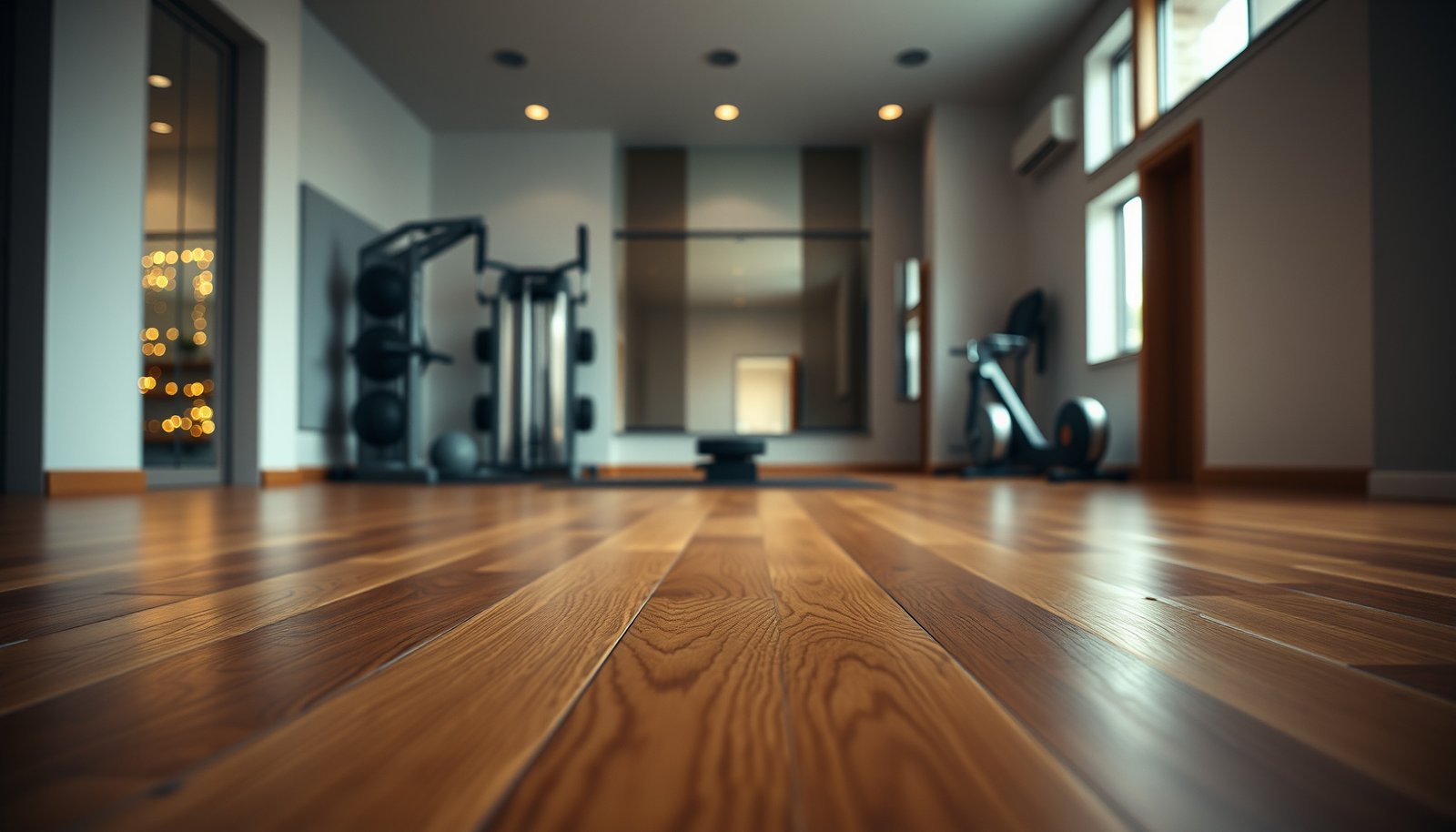

Choosing hardwood floors for a home gym comes down to one clear question: which type will stay stable under repeated impact, sweat, and occasional spills? If you prioritize durability and dimensional stability, engineered hardwood is the best pick—harder wearing, more moisture-tolerant, and less likely to cup or gap than solid planks. Next, you’ll want to match the finish and thickness to your training style, so you get grip underfoot without turning your workouts into a racket.




Hardwood can work in a home gym if you plan for impact, moisture, and vibration—not just aesthetics. The right approach is to match the wood construction (often engineered), choose a gym-ready finish, and set up the subfloor so the floor stays stable under barbell drops, rolling cardio, and sweat-heavy training—especially in basements or slab-on-grade rooms.
If your home gym includes free weights, cardio equipment on wheels, or frequent floor contact (jumping, burpees, rowing spill risk, sweat, etc.), these choices matter more than “pretty wood.” This is especially relevant if you’re installing over a slab, have a basement/garage-level room, or worry about noise and floor movement under vibration.
Gym floor requirements (before you pick wood)
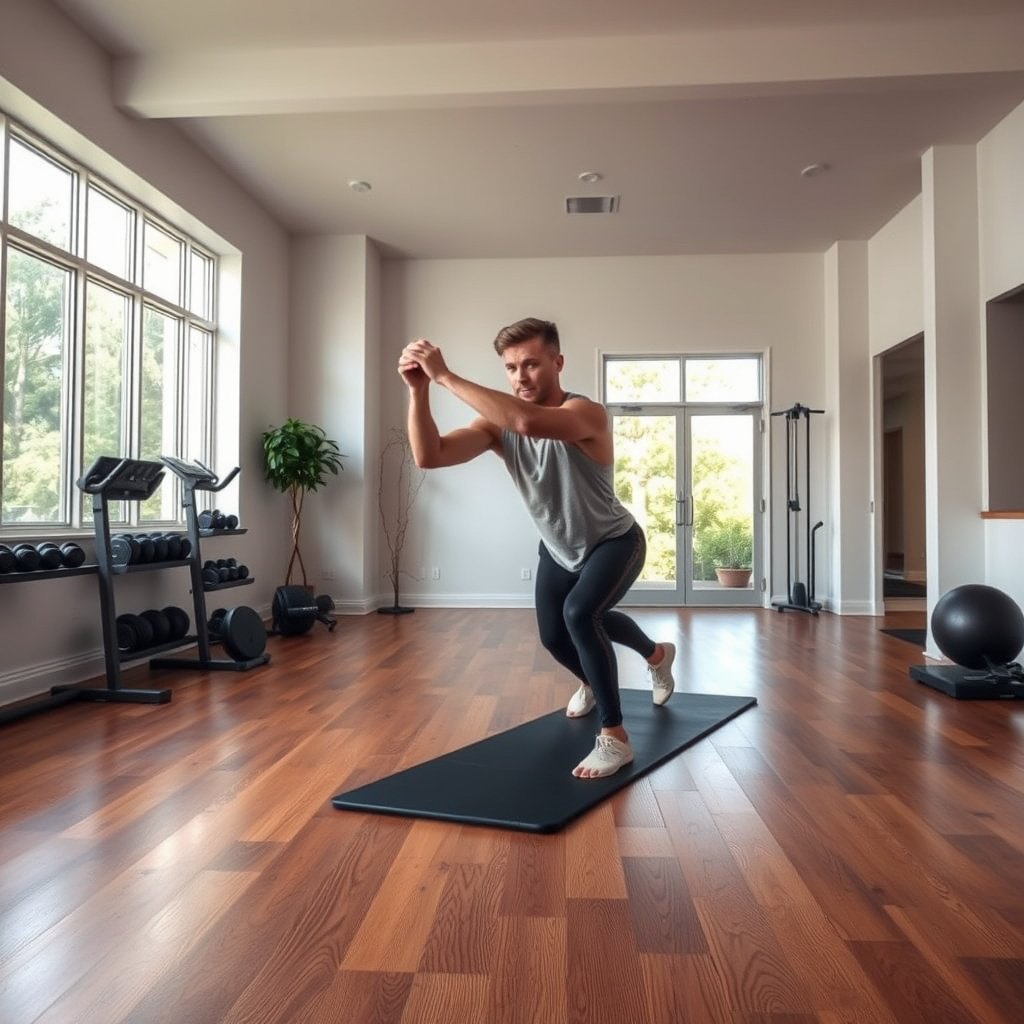
If you’re deciding whether hardwood belongs under your training plan, treat it like a performance surface first and a decorative surface second. The goal is to reduce two major risks—wear on top and movement from moisture—while controlling sound and shock where your workout concentrates force.
Gym workouts introduce both abrasion (grit from shoes/sweat) and mechanical damage (dropped weights and dragging plates), so surface durability is non-negotiable.
Wood floors are hygroscopic, meaning they gain and lose moisture with indoor humidity, which can cause expansion/contraction and visible movement if conditions swing.
Noise and “bounce” are design outcomes: underlayment, subfloor flatness, and equipment mats often matter as much as the hardwood species.
– Decide what “abuse” your workouts will deliver: dropped weights, rolling machines, sweat/water exposure, and constant foot traffic.
– Plan for the two biggest flooring risks in gyms: surface wear (scratches/dents) and dimensional movement from humidity changes.
– If you’re training with barbells or lots of high-impact moves, treat sound and shock control as a design requirement, not an afterthought.
In my experience reviewing gym floor projects with contractors and builders, the biggest “surprises” weren’t the wood look—they were how the room’s humidity behaves week-to-week and whether the lifting zone had a dedicated impact mat. As of 2026, more homeowners are also mixing home gyms with other living spaces, so HVAC setbacks and seasonal humidity swings are common—even when the room “feels dry.”
A practical way to audit your gym load
Make a quick map of where impact and rolling happen most:
– Main lifting lane: where you deadlift, squat, or do power moves (highest drop risk).
– Cardio paths: treadmill front/back zones, rower spill zones, and any path where wheels travel repeatedly.
– Sweat/wipe-down areas: where water or cleaning solution may accidentally sit or pool.
– Dropped-item hotspots: near plate storage, where a kettlebell or bumper plate might fall during setup.
Then choose materials and installation details that reduce each risk at its source.
Choose the right hardwood species and hardness level
If you want hardwood that holds up under heavy training, pick species with higher dent resistance and plan for protective zones where you drop and slide. Hardness matters, but it’s not the whole story—finish system and subfloor stability determine whether dents turn into permanent damage or quickly become manageable wear.
Janka hardness (a common benchmark for dent resistance) is measured by pressing a standardized steel ball into wood to a defined depth.
Very hard woods can still dent under repeated barbell drops, so impact mats remain important in lifting zones.
Oak and maple often balance appearance and durability, but soft-grain woods will show scuffs faster under grit and shoe drag.
– Look for naturally harder, more dent-resistant species (many people use Janka hardness ratings to compare options), but still expect some dents under very heavy drops.
– Match the species to your tolerance for patina: character woods may be more forgiving visually, while very smooth/soft species can show marks faster.
– If you’re unsure, prioritize a mid-to-high hardness wood and plan for protective zones under equipment, even if the wood itself is tough.
Real-world species guidance using hardness (Janka)
Hardness is a useful starting point because it correlates with dent initiation under concentrated loads. For example, ipe is far harder than red oak, and jatoba/hardwoods commonly used for flooring generally fall between these extremes.
Janka Hardness Benchmarks for Common Flooring Species (for home gym impact resistance)
| # | Wood species (common flooring use) | Janka hardness (lbf) | Janka hardness (N) | Gym dent resistance |
|---|---|---|---|---|
| 1 | Ipe (Brazilian walnut) | 3680 | 16340 | ★★★★★ |
| 2 | Jatoba (Brazilian cherry) | 2350 | 10440 | ★★★★☆ |
| 3 | Pecan | 1850 | 8230 | ★★★☆☆ |
| 4 | Hickory | 1820 | 8100 | ★★★☆☆ |
| 5 | Hard maple | 1450 | 6450 | ★★☆☆☆ |
| 6 | White oak | 1360 | 6060 | ★☆☆☆☆ |
| 7 | Red oak | 1290 | 5740 | ★☆☆☆☆ |
Important reality check: hardness ≠ impact-proof
Even with high Janka values, gyms still beat floors by combining:
– Repetition (many drops over time)
– Concentration (edges/collars land on small areas)
– Grit (sand and dust act like micro-sandpaper)
According to the U.S. Forest Products Laboratory’s Wood Handbook (2010), Janka hardness provides a standardized comparison of resistance to denting. Wood Handbook: Wood as an Engineering Material (U.S. Forest Products Laboratory, 2010)
And according to common flooring testing methodologies described by ASTM for wood properties, hardness measurements reflect localized indentation behavior—not unlimited drop survival. ASTM wood property standards (ASTM D143/D1037 family, as referenced in wood property testing literature)
Solid vs. engineered hardwood for gyms
If your gym includes a basement-level room, variable HVAC, or slab installations, engineered hardwood is usually the safer default. It’s more dimensionally stable because the top wear layer is bonded to layered cores that resist expansion/contraction compared to solid boards.
Engineered hardwood typically uses plywood/composite cores that reduce seasonal dimensional movement compared with solid hardwood.
Solid hardwood relies heavily on stable indoor humidity; large swings increase risk of gaps, cupping, or buckling.
Installation method (nail/glue/float) affects how vibration travels and how the floor “moves,” which directly impacts gym sound and longevity.
– Solid hardwood is more sensitive to moisture and temperature swings; engineered hardwood is often more stable across the conditions typical of basements or fluctuating homes.
– Pick thickness/board size with your room in mind: wider boards can look amazing, but installation and acclimation details become more important as the floor spans vary.
– Think about installation type (including whether the flooring will be nailed, glued, or floated), since that affects how the floor responds to vibration and how sound travels.
From a practical design perspective, many home gyms behave like “multi-impact zones.” If you’re rolling treadmills, dragging sleds, or doing kettlebell complexes, the floor sees repeated micro-loading. In those scenarios, installation choices and subfloor flatness often dominate long-term outcomes more than whether you used oak vs. maple.
Solid vs. engineered: pros and cons at a glance
| Factor | Solid hardwood | Engineered hardwood |
|---|---|---|
| Humidity sensitivity | Higher—needs tighter control of indoor RH | Lower—often tolerates typical basement HVAC swings better |
| Slab installations | More constrained by moisture conditions | Often easier to design around slab moisture controls (per manufacturer guidance) |
| Gym vibration / movement | Movement risk can increase squeaks or gapping when conditions drift | More stable under movement—still needs correct subfloor prep |
| Best use-case | Well-controlled homes with consistent humidity and careful maintenance | Basement/garage-level gyms, remodeled rooms, and mixed-use spaces |
Finish matters: durability, glare, and sweat resistance
If you want hardwood that survives gym life, choose a finish built for abrasion and follow the manufacturer’s cleaning rules exactly. In gyms, grit from shoes and sweat can behave like mild sandpaper, and moisture exposure can damage finish integrity or allow swelling if cleaning is too aggressive.
Gym traffic concentrates grit on high-contact paths, so finishes must resist abrasion and micro-scratching from everyday wear.
Lower-sheen finishes typically hide scuffs better, while high-gloss finishes can make scratches more visible.
Avoid assumptions about “wet mopping”: engineered and solid hardwood both require finish-specific cleaning methods.
– Choose a finish system that’s designed for abrasion and everyday traffic—gym floors get lots of grit from shoes and skin/sweat that can act like mild abrasion.
– Consider sheen level: glossier finishes can highlight scratches and scuffs more, while some lower-sheen options hide wear better.
– Confirm the finish’s suitability for the environment you have (humidity, cleaning routine, and whether you’ll ever have incidental moisture). Use the manufacturer’s care instructions, not guesswork.
What to look for in a gym-ready finish
When you talk to a flooring retailer or installer, ask for these specifics (and get them in writing when possible):
1. Finish type and performance claims (e.g., abrasion rating, wear layer details for engineered floors).
2. Approved cleaners and whether they support “clean-dry” maintenance (damp cleaning only if allowed).
3. Glare and sheen recommendations for basements or rooms with overhead lighting.
According to NWFA moisture and installation guidance (current editions), wood floors perform best when installation conditions and maintenance methods maintain the product’s designed moisture equilibrium. National Wood Flooring Association (NWFA), Installation Guidelines for Hardwood Floors (moisture/acclimation guidance, current edition)
A finishing detail people miss: sheen. In my walkthroughs, gym owners often choose higher gloss because it looks “clean,” then regret it when light catches every scuff. If your gym has bright overhead LEDs, a lower-sheen (matte/satin) finish often looks more consistent over time.
Installation, subfloor prep, and sound control
If your gym is going to feel solid (and stay stable), moisture testing, flatness, and underlayment strategy are as important as the wood itself. This section determines whether your hardwood behaves like a floor—or like a squeaky, drifting panel under vibration.
Moisture control starts before installation: subfloor moisture testing and correct acclimation protect wood from expansion/contraction after the floor is down.
ASTM F2170 measures in-situ relative humidity in concrete, while ASTM F1869 uses calcium chloride; both are used to manage slab moisture risk.
Mats under high-contact gym equipment reduce impact transfer and rolling noise, because the hardwood alone should not be your only shock absorber.
– Control moisture first: follow the flooring manufacturer and installation guide for subfloor moisture testing, acclimation, and acceptable conditions.
– Reduce movement and bounce: a good subfloor plan (flatness, proper fastening, and correct underlayment choice—if applicable) can limit squeaks and excessive flex.
– Address sound and impact where it matters: use appropriate mats under machines, weight trees, and high-contact zones, rather than relying on the hardwood alone for shock absorption.
Subfloor moisture: what to verify before ordering
For slab or basement-level rooms, ask your installer to document:
– Which moisture test they use (commonly ASTM F2170 or ASTM F1869 for concrete).
– Which maximum limits apply to your exact flooring product (these limits are usually manufacturer-specific).
– Whether acclimation is performed per manufacturer instructions.
In 2026, many installation failures are still traced to skipped or misapplied moisture verification rather than to the wood species. NWFA guidance emphasizes moisture testing, acclimation, and installing within specified conditions. National Wood Flooring Association (NWFA), Installation Guidelines (moisture testing/acclimation)
Sound control isn’t just “underlayment”
Hardwood sound behavior depends on:
– Subfloor stiffness
– Fastener system
– Underlayment compatibility
– Where the load lands (deadlift lane vs. treadmill path)
For practical gym design, treat the hardwood as the walking and aesthetics layer, and treat mats/pads as the shock and rolling-control layer. For example:
– Impact mat under your main lifting zone (barbell drop pattern).
– Vibration pads under weight trees and heavy equipment legs.
– Roller-wheel protection where cardio wheels travel repeatedly.
What can go wrong (and how to avoid it)
If you choose hardwood without planning for gym-specific stresses, common failures are dents, scuffs, finish breakdown, and gaps from humidity swings. The good news: each problem has a design fix—impact mats, grit control, moisture testing, and strict cleaning.
Repeated heavy drops can dent even hard woods, so protecting the lifting lane prevents small dents from accumulating into cosmetic and structural wear.
Debris and grit are abrasive; regular dry cleaning and grit control reduce scratch propagation on the finish.
Finish failure often comes from moisture or cleaning methods that exceed what the finish system is designed to handle.
– Dents from heavy drops: Even hard species and durable finishes can dent if you drop weights repeatedly. If you do lots of barbell work, plan a dedicated impact mat area sized to your lifting pattern.
– Scratches from debris and rolling equipment: Sand/grit acts like sandpaper. Sweep/vacuum regularly and avoid dragging plates or shoes with embedded grit; also consider protective pads under roller wheels.
– Gaps or buckling from moisture swings: Basements and rooms with inconsistent HVAC can cause movement. If humidity varies, engineered hardwood (per manufacturer guidance) and strict moisture/acclimation steps become more important.
– Finish failure from the wrong cleaning: Avoid wet-mopping hardwood unless the manufacturer specifically allows it. Use cleaning methods consistent with the product’s published care instructions.
According to NWFA installation guidance (current editions), following manufacturer moisture and acclimation requirements is key to minimizing post-install movement. NWFA, Installation Guidelines for Hardwood Floors
From a gym-owner standpoint, the “wrong cleaning” problem often shows up as:
– dulling or spotting in the sheen,
– softening or wearing at edges,
– or accelerated wear where sweat is frequently wiped with the wrong products.
So the best prevention is boring but effective: stick to the product’s approved cleaning method and treat spills as “wipe immediately,” not “leave to soak in.”
Verdict: what to pick—and who should skip hardwood
Hardwood is a strong home gym option when you choose stable construction (often engineered), a durable gym-appropriate finish, and installation details that control slab moisture and vibration. If your training includes heavy drops without protection or your environment is consistently wet or wildly humid, hardwood becomes a risk rather than a benefit.
In practice, the decision comes down to whether you can support the floor with:
1) Material stability (engineered vs. solid),
2) Finish durability (abrasion + cleaning compatibility),
3) Subfloor control (moisture testing + correct installation),
4) Zone protection (impact mats + equipment pads).
You should consider skipping hardwood (or limiting it to a zone) if your gym regularly includes frequent high-impact dropping (no mats), a very wet environment, or you can’t maintain indoor temperature/humidity within the flooring manufacturer’s recommended range. In those cases, a purpose-built gym surface may save you money and frustration.
Hardwood can support home-gym use, but its long-term success depends on moisture control and correct installation as much as on species and finish.
Even durable hardwood floors benefit from impact and vibration zoning, because gym forces are concentrated and repetitive.
Quick checklist (scan before you order)
| Decision point | What to look for | Quick “yes/no” |
|---|---|---|
| Wood type | More stable option for your room conditions (often engineered) | ☐ Yes ☐ No |
| Hardness/durability | Species suited to dents and scuffs for your training style | ☐ Yes ☐ No |
| Finish | Published durability + cleaning compatibility for sweat/regular traffic | ☐ Yes ☐ No |
| Subfloor prep | Flatness + moisture testing + required acclimation | ☐ Yes ☐ No |
| Installation method | System that matches your room (and your sound/vibration concerns) | ☐ Yes ☐ No |
| Protection plan | Mats/pads for weights, treadmill areas, and roller wheels | ☐ Yes ☐ No |
FAQ
– Can hardwood floors handle heavy weights in a home gym?
They can, but not equally across all workout types. Consistent weight drops and high-impact moves usually require mats/impact zones to prevent accelerated denting.
– Is engineered hardwood better for a basement gym?
It often performs better in variable moisture/temperature conditions than solid hardwood, but you must still follow the manufacturer’s installation and moisture guidance.
– Should I use a mat under every piece of equipment?
For durability and noise control, place mats or pads under machines with vibration and rolling contact, and use an impact mat for your main lifting zone.
– What’s the safest way to clean hardwood in a gym?
Follow the manufacturer’s cleaning instructions for your specific finish (often “clean-dry” methods and approved products). Avoid assumptions like wet mopping unless explicitly allowed.
Sources:
– National Wood Flooring Association (NWFA), Installation Guidelines for Hardwood Floors (moisture testing, acclimation, and installation recommendations)
– Flooring manufacturer installation instructions for specific product lines (subfloor moisture testing requirements, acclimation, and approved cleaning methods)
– ASTM wood property testing standards and wood hardness benchmarks; Janka hardness is widely documented in wood property references and related standards (Janka as a standardized indentation test)
– U.S. Forest Products Laboratory, Wood Handbook: Wood as an Engineering Material (wood properties including hardness benchmarks) (2010)
Hardwood can look and feel great under a home gym, but it wins only when you design around real gym forces—especially moisture stability, impact zoning, and finish-safe cleaning. If you treat those as requirements (not optional upgrades), you’ll end up with a floor that stays attractive and performs the way your training demands, even as your routines evolve in 2026 and beyond.
Frequently Asked Questions
What type of hardwood flooring is best for a home gym?
Look for hardwood engineered for durability and moisture stability in high-activity spaces. Engineered hardwood is often the best choice because it resists seasonal expansion and contraction better than solid hardwood, which helps prevent warping near HVAC vents or during workouts. If you prefer solid hardwood, choose a very hard species and ensure a tight, professional installation to minimize movement. Pair it with a quality gym floor mat strategy to protect against dropped weights and high-traffic wear.
How do I choose hardwood species for a home gym that won’t scratch easily?
For scratch resistance, consider harder hardwood species like hickory, maple, or Brazilian walnut (where sustainably sourced). Hardwoods with a higher Janka hardness rating generally hold up better under dumbbells, kettlebells, and moving equipment. You can also reduce visible dents by choosing boards with a tougher finish and a thicker wear layer (for engineered hardwood), which provides more material to wear down before refinishing. Using floor protectors and limiting friction from rubber equipment mats also makes a big difference.
Which hardwood finish is most resistant to sweat, scuffs, and gym traffic?
Choose a factory-finished hardwood with a durable wear layer, such as a commercial-grade polyurethane or hardwax oil designed for residential heavy-use areas. These finishes are better at resisting scuffs from shoe tread and can handle occasional sweat exposure more effectively than softer finishes. Avoid overly glossy finishes that may show scratches easily; a matte or satin sheen often hides minor marks better. For best results, wipe up moisture promptly and use felt pads under benches and racks.
Why is plank thickness and wear layer important when selecting hardwood for a home gym?
Thicker planks and a substantial wear layer help your hardwood floor tolerate the repeated impacts and abrasion typical of strength training. For engineered hardwood, a thicker wear layer gives you the option to refinish later, restoring the look even after years of gym use. In general, consider installation quality and subfloor stability as well, since movement can create gaps or squeaks under heavy equipment. If your gym has heavy rolling items, stabilize the flooring and use protective mats to prevent concentrated damage.
How should I install and protect hardwood floors in a home gym to prevent damage?
Start with proper subfloor preparation, including levelness checks and correct moisture conditions, because uneven surfaces and moisture issues can shorten hardwood life. Use underlayment only when recommended for your specific hardwood type and flooring system, and follow manufacturer guidelines for expansion gaps. For protection, place a high-density rubber or interlocking gym mat under free weights, benches, and areas with kettlebells, and use floor protectors on equipment feet. Consider establishing a cleaning routine that avoids wet mopping—use a damp microfiber mop or hardwood-safe cleaner to maintain the finish without trapping moisture.
📅 Last Updated: October 17, 2026 | Topic: How to choose hardwood floors for a home gym? | Content verified for accuracy and freshness.
References
- Wood flooring
- Engineered wood
- Solid wood
- Janka hardness test
- https://en.wikipedia.org/wiki/Wood_moisture_content
- https://www.fpl.fs.usda.gov/documnts/fplgtr/fplgtr190.pdf
- https://www.cdc.gov/homeandrecreationalsafety/falls/index.html
- https://scholar.google.com/scholar?q=hardwood+flooring+home+gym+selection+impact+sound+absorption Google Scholar
- https://scholar.google.com/scholar?q=Janka+hardness+wood+floor+wear+resistance Google Scholar
- https://scholar.google.com/scholar?q=impact+loading+flooring+shock+absorption+wood+vs+other+surfaces Google Scholar