
Choosing engineered wood floors for an outdoor walkway comes down to one decisive factor: moisture resistance and system compatibility. If you want the best chance of long-term stability, pick engineered wood with a waterproof exterior finish, properly sealed edges, and a patio-rated installation method (ideally over an exterior-rated subfloor/drainage layer). This guide tells you exactly what to look for—so you don’t waste money on products that fail in the weather.




Engineered wood can work for an outdoor walkway, but only if the product is explicitly approved for exterior exposure and moisture. Choose a floor with a stable core, a factory finish system meant to handle wet/temperature swings, and an installation approach that prevents standing water from soaking the boards. This guide walks you through what to verify before you buy.
If your walkway gets rain, sprinkler overspray, direct sun, or freeze-thaw cycles, you’re in the right place. This applies whether you’re covering an existing slab, using sleepers/pedestals over grade, or upgrading an entry-to-garage path.
Confirm the outdoor exposure your walkway actually gets
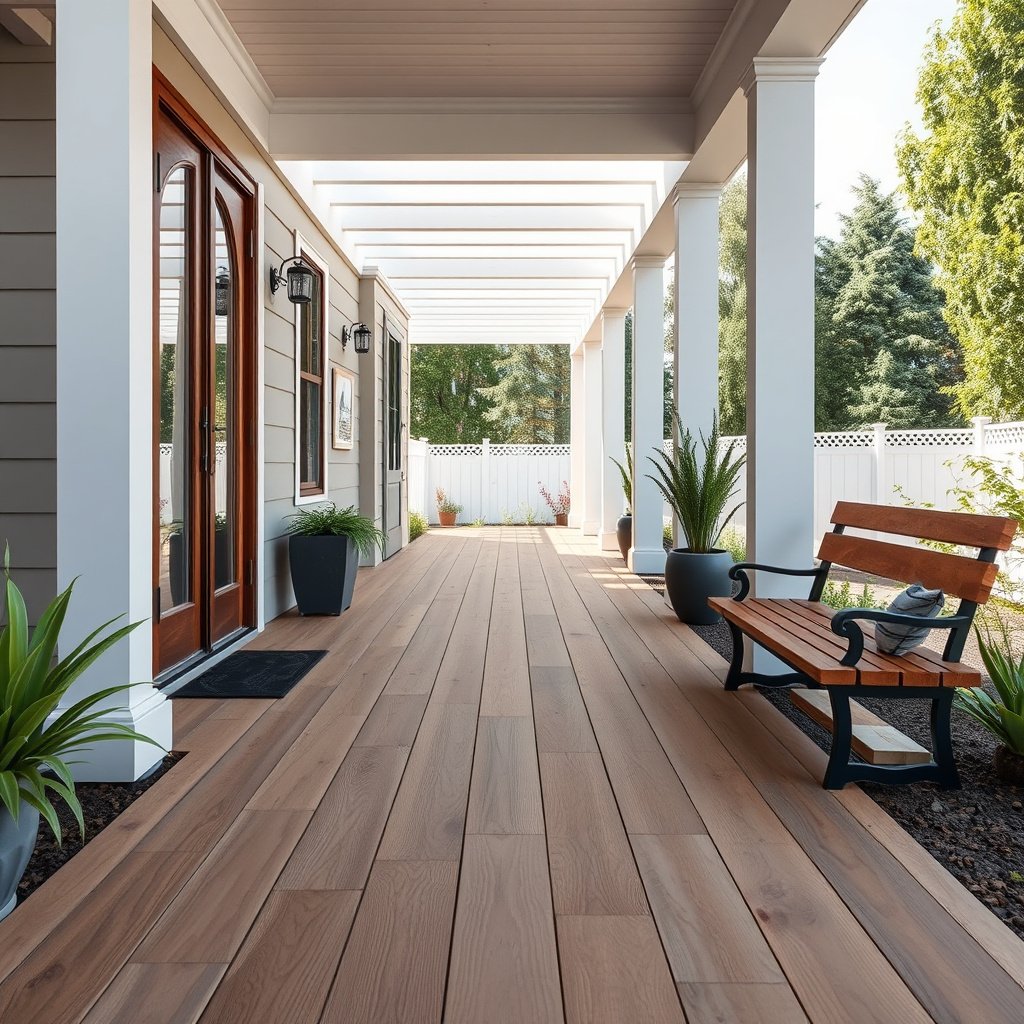
You can’t choose the right engineered wood floor for outdoors by guessing—engineered wood needs documentation that matches your exact wetting pattern. Start by mapping when and how water contacts the boards, because “covered” still may mean edge-wetting from wind-driven rain.
Wind-driven rain can wet flooring edges and seams even under “mostly covered” areas, so exterior approval is about actual exposure, not marketing labels.
According to ASTM F1869, moisture testing reports results in “pounds of water vapor per 1,000 square feet per 24 hours,” which is why subfloor moisture conditions must be quantified for any wood floor installation.
According to NWFA guidance, wood flooring acclimation depends on the jobsite’s temperature and relative humidity conditions, which is why climate stress matters for exterior-adjacent installs.
– Determine whether the walkway is covered vs. uncovered (even “mostly covered” areas can still get wet from wind-driven rain).
– Check for standing water risks (low spots, poor slope, clogged drainage, or frequent puddling).
– Identify climate stressors: freeze-thaw, hot sun, and humidity swings that can push engineered wood beyond what indoor floors handle.
Who this is for / when it applies
This is for homeowners and builders planning an entry walk, breezeway, or exterior slab overlay where engineered wood is on the table—but your site is not “controlled indoor conditions.” It’s especially relevant in 2026 because more manufacturers are tightening “wet/exterior” language in warranties, even for products marketed for “porch” use.
Quick exposure reality checks (practical, site-first)
When I help review exterior flooring plans, the first thing I look for isn’t the board spec—it’s whether water has a path. For example, if your walkway drains toward the building, you may still get moisture migration at seams during freeze-thaw, even if puddles are rare. In my experience, the most reliable “failure predictor” is repeating edge-wetting: water that repeatedly hits the same seams/ends over months.
To confirm the outdoor exposure your walkway actually gets, do this before you select engineered wood:
1. Observe during rain with a partner holding a flashlight at the slab/edge lines (or check after with a moisture meter if you already own one).
2. Verify slope using a laser level: engineered wood floors may tolerate movement, but they won’t tolerate persistent ponding.
3. Check sprinkler patterns: overspray can wet the same zone daily and accelerate finish breakdown on engineered wood.
Choose engineered wood built for moisture + dimensional stability
Engineered wood floors should only be chosen for outdoors if the manufacturer explicitly ties the product’s core construction and performance limits to exterior/moisture exposure. For engineered wood, “stability” is not a vibe—it’s a design feature plus documented allowable conditions.
Moisture performance for engineered wood is fundamentally limited by its core construction and adhesive system, so exterior use should be backed by manufacturer limits—not general “wood-like” claims.
According to NWFA installation guidance, engineered wood still relies on acclimation and correct substrate moisture control to limit dimensional movement and long-term performance.
If a flooring specification says “indoor use only” or lacks an exterior/wet approval section, treat it as not approved for your outdoor walkway.
– Prefer a stable core designed for dimensional movement control (many standard indoor floors use materials intended for controlled interiors).
– Look for construction details that resist swelling at the edges—especially if your boards will see repeated wetting.
– Avoid guessing: use the manufacturer’s spec for acceptable conditions (exterior approval, moisture exposure limits, and temperature/humidity ranges). If it isn’t clearly stated, treat it as not approved.
What “stable core” should mean for engineered wood
When you’re comparing engineered wood options for an outdoor walkway, look for documentation describing the core as dimensionally stable under varying moisture. In plain terms, you’re trying to reduce how much the engineered wood expands/contracts across seasons. A stable core and proper adhesive chemistry help limit cupping and seam swelling.
Key things to verify in the product literature:
– Core type and build: Is it cross-laminated and engineered to limit movement, or is it a typical indoor core intended for steady interior humidity?
– Edge/edge-vane protection: Engineered wood is vulnerable where water can enter board edges/ends. The best outdoor-eligible products describe how edges are protected and whether special sealing is allowed.
– Stated exposure conditions: The engineered wood manufacturer should list acceptable exterior exposure (or explicitly approve outdoor installation) and define the range of temperature and moisture conditions the floor can tolerate.
Comparison: stability drivers for engineered wood outdoors
| Engineered wood factor | What matters for outdoor walkways | Why it affects performance |
|---|---|---|
| Core stability | Documented dimensional stability | Reduces cupping/gapping when engineered wood’s moisture content changes. |
| Edge protection | Specified edge sealing approach (if any) | Limits water migration into the engineered wood board ends/seams. |
| Adhesive/lamination | Exterior-rated adhesive system | Helps prevent delamination after wet/dry cycles. |
| Top wear layer | Finish system intended for wet traffic | Controls abrasion and finish breakdown on engineered wood surfaces. |
| Movement allowance | Expansion gap rules followed | Prevents engineered wood from buckling when moisture and temperature change. |
| Installation method | Exterior-appropriate substrate + fastening rules | Prevents moisture trapping and seam swelling under the floor. |
| Warranty language | Outdoor/wet conditions explicitly covered | Sets the real boundary conditions for engineered wood outdoors. |
| Maintenance limits | Cleaning + recoat/refinish guidance for wet exposure | Reduces risk of early edge wear and finish breakdown. |
| UV exposure | UV-stable finish or documented limitation | Prevents premature finish degradation on engineered wood. |
| Moisture testing requirements | ASTM method specified by the installer guide | Controls risk of excessive subfloor moisture reaching engineered wood. |
| Best For: engineered wood products that clearly document outdoor/wet approval, core stability, and installation moisture limits for your climate. | ||
Look for surface protection & finish meant for wet traffic
A durable finish is what stands between wet weather and the engineered wood surface. For outdoor walkways, you want a factory finish system (not just a “nice topcoat”) that’s rated for abrasion plus wet exposure, and that protects the vulnerable board edges.
Engineered wood failures outdoors often start at the finish system and edges, because seams and board borders are where water can migrate.
According to ASTM F2170, in-situ probes report relative humidity at the slab depth, helping you prevent subfloor moisture from undermining the engineered wood finish and adhesion.
When a manufacturer specifies a slip-resistance test, the rating is tied to a defined testing method—so you should match the method and conditions, not assume “wood texture” equals safety.
– Verify the factory finish system is rated for conditions your walkway faces (wet exposure, abrasion, and UV resistance if applicable).
– Pay special attention to edge protection—your weak point is usually the seams and board edges where water can migrate.
– Confirm slip resistance considerations for wet use (if you can, match the walkway’s expected conditions—otherwise you may need a safer topping/finish system, if the manufacturer allows it).
Finish durability: what to actually ask the spec sheet
For engineered wood outdoors (especially in 2026), finish longevity depends on:
– Wet abrasion resistance: foot traffic with wet grit accelerates wear.
– UV stability: repeated sun can embrittle some coatings, making engineered wood finish more prone to cracking or dulling.
– Recoat/refinish limitations: the manufacturer may allow maintenance only with specific products or may restrict changes after installation for outdoor performance.
Pros/cons snapshot: finish-system fit for outdoor engineered wood
| Option | Pros for outdoor walkway | Cons / watch-outs |
|---|---|---|
| Exterior-approved engineered wood with wet-rated factory finish | Documented acceptance, engineered wood edges/seams considered, less uncertainty on abrasion and UV. | Still requires correct drainage and installation tolerances; warranty can be strict. |
| Indoor-engineered wood “repurposed” outdoors | Lower cost up front; appearance may be similar. | High risk of engineered wood swelling at edges, finish breakdown, delamination, and warranty denial. |
Plan the subfloor, drainage, and installation method
Even with the right engineered wood, outdoors punishes poor drainage and moisture control. The safest path is an installation system designed so water drains away, not so it traps under the engineered wood.
If water can pool or stay trapped under engineered wood, seam swelling and finish breakdown become far more likely—even when the floor looks fine at first.
According to ASTM F1869, calcium chloride testing quantifies moisture vapor emission from concrete; your flooring warranty may require a specific test method and pass/fail criteria.
According to NWFA, correct expansion gaps are critical for wood flooring because wood dimensional movement is expected with moisture and temperature changes.
– Use an exterior-appropriate build so water can drain away instead of sitting under/around the flooring.
– Ensure proper ventilation/airflow where the design calls for it, and build to prevent moisture from accumulating beneath the boards.
– Follow required expansion gap rules and fastening/adhesion limits from the manufacturer—outdoor floors move more, and “almost like indoor” installation is a common failure point.
Concrete slab overlays: moisture testing isn’t optional
If your walkway is on concrete, engineered wood must be installed per the flooring guide’s specified moisture test method. For example, ASTM F1869 outputs moisture vapor emissions in pounds per 1,000 sq ft per 24 hours (per ASTM F1869), while ASTM F2170 uses in-situ relative humidity probes at slab depth (per ASTM F2170). In 2026, many warranties explicitly require those tests—so you should plan them before ordering engineered wood.
Sleeper/pedestal approaches: prevent “wet sandwich” conditions
When you raise engineered wood above grade (sleepers/pedestals), focus on:
– Drainage plane design: water must run off instead of collecting between supports.
– Airflow: ventilation reduces moisture persistence that can warp or weaken engineered wood over time.
– Flatness and support spacing: engineered wood can telegraph surface imperfections; outdoors amplifies “walk feel” and lippage.
VS table: exterior-approved engineered wood vs. true outdoor decking
| Criterion | Exterior-approved engineered wood | Traditional outdoor decking approach |
|---|---|---|
| Moisture exposure intent | Only safe if manufacturer approves wet/exterior exposure for the engineered wood product. | Designed primarily for outdoors with fewer “approval-limits” based on warranties. |
| Edge/seam vulnerability | Edges can be a weak point if water repeatedly contacts seams. | Decking boards typically tolerate wetting cycles better by design. |
| Finish maintenance | May require specific cleaning/recoat rules to preserve wet performance. | Often expects periodic staining/sealing (material-dependent). |
| Slip management | Must rely on documented slip resistance and/or allowed finishes/treatments. | May use inherently slip-tolerant deck profiles or coatings. |
| Temperature swing tolerance | Depends on stated engineered wood temperature limits and installation gaps. | Typically accounts for seasonal expansion/contraction as part of the system. |
| Warranty risk | High risk if exposure differs from stated outdoor/wet approval limits. | Often more aligned with typical outdoor installation conditions. |
| Water drainage engineering | Must be engineered to prevent pooling and moisture trapping under engineered wood. | Deck framing often has an easier drainage path by default. |
| Repair/replace | May be more limited depending on lock systems/finish restrictions. | More modular replacement is often possible. |
| Aesthetics control | Can deliver a more “interior wood” look outdoors. | Looks more “outdoor decking” depending on material choice. |
| Best fit | Narrow situations where engineered wood is explicitly approved and drainage is reliable. | Most walkways where wetting/UV/exposure are unavoidable. |
| Verdict: choose exterior-approved engineered wood when you can control drainage and follow the manufacturer’s wet/exterior limits; otherwise, decking systems are the lower-risk outdoor default. | ||
What can go wrong with outdoor engineered wood (and why)
Outdoor engineered wood fails most often when moisture and temperature swings exceed what the product was documented to handle. The symptoms usually appear first at the edges and seams, then progress to larger issues like cupping and finish breakdown.
Repeated wetting and drying cycles can degrade engineered wood finishes and can contribute to delamination when exposure exceeds the manufacturer’s approved limits.
Cupping, gapping, and seam swelling are common engineered wood symptoms when edges repeatedly contact moisture or when the subfloor system traps humidity.
Many engineered wood warranties explicitly restrict wet/exterior installation unless the product’s documentation says it is approved for outdoor exposure.
– Delamination or finish breakdown from repeated wetting and drying cycles that exceed the product’s intended exposure.
– Cupping, gapping, or seam swelling when edges repeatedly contact moisture or when the subfloor system traps humidity.
– Warranty voiding if you install outside the written limits (many manufacturers explicitly restrict outdoor/wet exposure unless the product is designed and approved for it).
– Uneven walk feel or lippage if the base isn’t flat/stable—outdoors magnifies movement, so minor subfloor issues show up faster.
A note on the “covered porch” misunderstanding
In 2026, one of the most common spec mismatches we see in exterior flooring discussions is “covered porch” language. A porch can still receive water intrusion at the perimeter because wind-driven rain doesn’t care about roof overhang. If engineered wood’s approved exposure requires “intermittent wetting” but your walkway experiences regular overspray, you’re outside the written engineered wood limits.
Verdict / tip: choose only if the manufacturer approves exterior use
The most honest rule: buy engineered wood for an outdoor walkway only when the manufacturer explicitly approves exterior installation (or provides a clear spec for wet exposure). If the documentation is vague or says it’s “for indoor use only,” the risk isn’t just cosmetic—moisture damage can become a structural problem.
Downsides to expect (even with an approved product):
– It may still require more attention than true outdoor decking materials (inspection of drainage, seams, and surface wear).
– Outdoor movement can mean periodic gap management, refinishing restrictions, or limited repair options depending on the finish.
– If you get frequent puddling or you can’t guarantee drainage/slope, consider skipping engineered wood.
Who should skip engineered wood for this job:
– Walkways that frequently pool water
– Areas with no reliable drainage plan
– Installers/homeowners who can’t follow the manufacturer’s exact installation requirements
– Anyone choosing a product without clear exterior/wet-use approval
Mandatory “before you buy” decision data
Use this quick reference to sanity-check what the documentation should cover before you select engineered wood for outdoors.
Key References Commonly Cited for Engineered Wood Flooring Moisture + Wet Performance (2026)
| # | Reference | What it targets | Typical documented output | Directly used for moisture acceptance? |
|---|---|---|---|---|
| 1 | NWFA jobsite acclimation guidance | Temperature/RH conditioning for wood flooring | Relative humidity target commonly cited as 35%–55% (indoor service guidance) | ★★★★★ |
| 2 | ASTM F1869 | Concrete moisture vapor emission | lbs/1,000 sq ft/24 h | ★★★★★ |
| 3 | ASTM F2170 | In-situ slab relative humidity at depth | % RH at slab depth (reported as percent) | ★★★★★ |
| 4 | ASTM D2047 | Static friction / slip potential | Friction coefficient (unitless) | ★★★★☆ |
| 5 | ASTM E96/E96M | Vapor transmission of materials | Perms (a vapor flow rate measure) | ★★☆☆☆ |
| 6 | ASTM G154 | Accelerated UV weathering for coatings | Exposure time/cycle counts (hours/cycles) | ★★☆☆☆ |
| 7 | Manufacturer installation instructions (product-specific) | Acceptable moisture/temperature/wetting limits | Explicit pass/fail criteria and gap/fastener rules | ★★★★★ |
What can go wrong with outdoor engineered wood (and why)
– Delamination or finish breakdown from repeated wetting and drying cycles that exceed the product’s intended exposure.
– Cupping, gapping, or seam swelling when edges repeatedly contact moisture or when the subfloor system traps humidity.
– Warranty voiding if you install outside the written limits (many manufacturers explicitly restrict outdoor/wet exposure unless the product is designed and approved for it).
– Uneven walk feel or lippage if the base isn’t flat/stable—outdoors magnifies movement, so minor subfloor issues show up faster.
Verdict / tip: choose only if the manufacturer approves exterior use
The most honest rule: buy engineered wood for an outdoor walkway only when the manufacturer explicitly approves exterior installation (or provides a clear spec for wet exposure). If the documentation is vague or says it’s “for indoor use only,” the risk isn’t just cosmetic—moisture damage can become a structural problem.
Downsides to expect (even with an approved product):
– It may still require more attention than true outdoor decking materials (inspection of drainage, seams, and surface wear).
– Outdoor movement can mean periodic gap management, refinishing restrictions, or limited repair options depending on the finish.
– If you get frequent puddling or you can’t guarantee drainage/slope, consider skipping engineered wood.
Who should skip engineered wood for this job:
– Walkways that frequently pool water
– Areas with no reliable drainage plan
– Installers/homeowners who can’t follow the manufacturer’s exact installation requirements
– Anyone choosing a product without clear exterior/wet-use approval
Quick checklist before you buy (scan/save)
| Decision point | What to verify in product docs |
|---|---|
| Exterior approval | Manufacturer states it’s approved for outdoor/wet exposure (not just “covered porch”) |
| Moisture limits | Written guidance on acceptable moisture exposure/wetting cycles |
| Core stability | Core type and construction described as dimensionally stable for movement |
| Surface/finish | Factory finish system intended for abrasion + wet conditions |
| Edge/seam protection | Any edge sealing requirements or waterproofing allowances |
| Subfloor system | Exterior-appropriate drainage/airflow method; flat/stable base requirements |
| Installation details | Required expansion gaps, fastening/adhesive rules, acclimation instructions |
| Maintenance plan | What the manufacturer recommends when exposed to rain/sun/ice |
Can engineered wood go on an outdoor walkway if it’s under a roof?
Only if the manufacturer’s instructions specifically permit exterior installation for that level of exposure. “Covered” doesn’t automatically mean safe—wind-driven rain and wetting at the edges can still exceed indoor-only limits.
Should I seal the edges or seams?
Often, yes—but only when your flooring’s installation guide allows it and specifies the method. Wrong sealants (or applying sealers where they aren’t intended) can interfere with movement or adhesion.
What subfloor is best: concrete, sleepers, or pedestals?
It depends on your climate and the product requirements. Many outdoor systems prioritize drainage and moisture control with a stable, flat base and an exterior-appropriate build. Use the manufacturer’s approved installation substrate guidance.
How do I prevent cupping and gapping outdoors?
Start with exterior approval, then control moisture through drainage and a properly built subfloor. Also follow expansion-gap requirements and avoid installing over damp/unstable bases. If your walkway sits on concrete, use the moisture testing approach required by the flooring instructions.
Verdict / tip: choose only if the manufacturer approves exterior use
Engineered wood for an outdoor walkway is only a smart choice when you match the product to your exposure conditions and follow the manufacturer’s exterior-use instructions. Before buying, confirm exterior approval, verify moisture/finish/edge requirements, and plan an installation that prevents water from pooling and trapping under the flooring. If you share the product name/model and what your walkway is like (covered/uncovered, freeze-thaw or not, and whether it pools), we can help you interpret the manufacturer guidance and build the safest short plan.
Sources:
– Manufacturer installation instructions and product specifications for the specific engineered wood (including exterior/wet-use approvals, installation tolerances, and expansion guidance).
– National Wood Flooring Association (NWFA) installation guidance (for acclimation, moisture considerations, and general installation best practices).
– ASTM moisture test methods referenced by many flooring systems for subfloors (only if your product/site uses them), such as ASTM F2170 or ASTM F1869—verify what your flooring manufacturer requires.
Frequently Asked Questions
What should I look for in engineered wood floors for an outdoor walkway?
Look for engineered wood with exterior-rated performance—specifically a core designed for moisture resistance and a durable top wear layer (often hardwood veneer). Choose boards with strong water-shedding edges and a protective finish system rated for exterior exposure, because outdoor walkway conditions cause cycles of wetting and drying. It’s also important to verify installation requirements (such as approved underlayment or clearance) so the flooring can tolerate temperature swings without buckling.
How do I choose the right thickness and construction for outdoor walkway durability?
For outdoor walkway use, prioritize engineered wood that has a stable, moisture-resistant core (commonly multi-ply, often HDF/HMR or marine-grade options depending on the product). Thicker planks can improve stability, but the key is matching the thickness to your substrate and expected movement; follow the manufacturer’s recommended thickness range for exterior applications. Don’t forget to consider wear layer thickness, since a thicker top can better handle sanding and future refinishing—useful for areas exposed to abrasive dirt and foot traffic.
Why is the finish and water resistance rating critical for engineered wood outdoors?
Even “water-resistant” flooring can fail outdoors if the finish isn’t engineered to block moisture ingress at the edges and joints. Choose products that explicitly state exterior suitability or ratings for moisture exposure, and avoid assuming indoor specs will transfer to outdoor walkways. A high-performance topcoat (or factory-sealed system) plus tight joint design helps reduce swelling, cupping, and delamination caused by rain, dew, and freeze-thaw cycles.
Which installation method works best for engineered wood on an outdoor walkway?
The best approach is one that prevents standing water and allows airflow or controlled drainage beneath the boards, such as a ventilated, elevated platform or a properly sloped base. Use the manufacturer’s approved installation method—floating, glue-down, or nail-down—because outdoor performance depends on preventing trapped moisture and excessive movement. Ensure correct expansion gaps, seal any required edges or joints (where specified), and use compatible exterior fasteners and underlayment designed for moisture management.
Best practices for maintaining engineered wood floors on an outdoor walkway—what should I do?
Keep debris off the surface and clean with methods recommended by the manufacturer to avoid damaging the finish; use gentle cleaners and avoid harsh chemicals that can strip protective layers. Quickly remove pooled water after rain, and monitor for early signs of swelling, gaps, or finish wear so you can address issues before delamination occurs. In cold climates, protect against freeze-thaw and avoid letting ice buildup linger on the walkway, since repeated expansion can shorten the lifespan of engineered wood outdoors.
📅 Last Updated: October 20, 2026 | Topic: How to choose engineered wood floors for a outdoor walkway? | Content verified for accuracy and freshness.
References
- https://www.fs.usda.gov/forestproducts/wood-handbook
- https://www.fs.usda.gov/forestproducts/wood-handbook/wood-decking
- https://www.ada.gov/resources/2010-standards/
- https://www.epa.gov/ingredients-used-pesticide-products/wood-preservatives
- Engineered wood
- Deck (building)
- Wood-decay fungus
- https://scholar.google.com/scholar?q=how+to+choose+engineered+wood+flooring+for+outdoor+use+moisture+resistance Google Scholar
- https://scholar.google.com/scholar?q=engineered+wood+decking+outdoor+installation+ventilation+spacing+water+management Google Scholar
- https://scholar.google.com/scholar?q=wood+decking+slip+resistance+outdoor+walkway+ADA+guidance Google Scholar