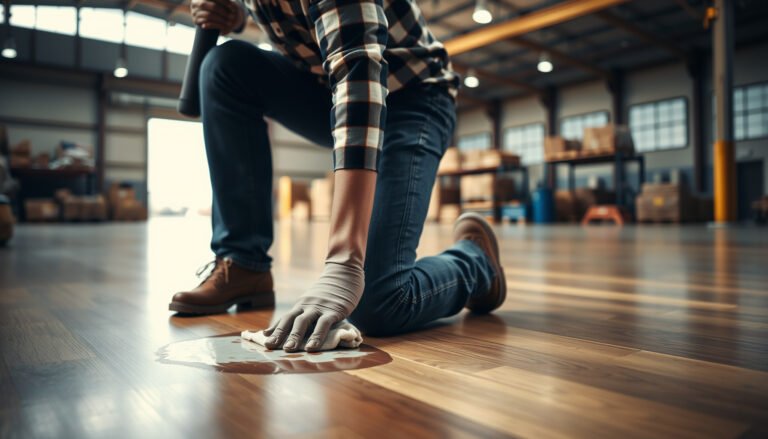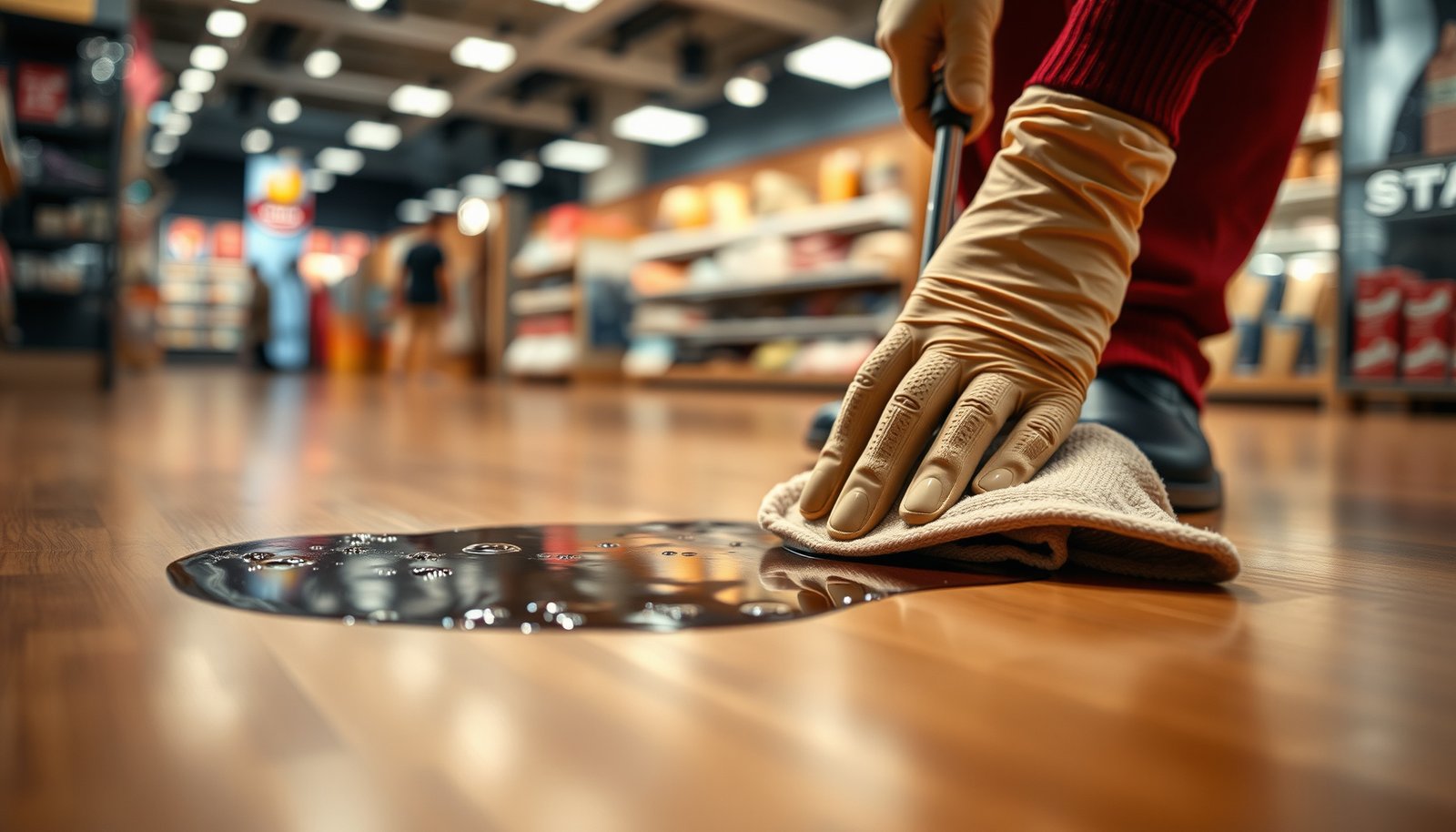

Learn how to remove stains from hardwood floors in a retail store without damaging the finish or disrupting daily operations. This guide gives you the fastest, most reliable stain-removal method for the common offenders in high-traffic spaces—water, food, grease, ink, and scuffs—plus the exact steps to follow on hardwood. You’ll also get clear do-not-mix warnings and when it’s time to call a professional refinisher.




If your hardwood floor is stained in a retail store, the fastest safe route is to (1) identify what kind of stain it is and (2) start with the mildest cleaning method before moving to targeted spot treatments. Most marks clear with careful blotting and a pH-neutral hardwood-floor cleaner, while dark water spots, rust, or grease usually need a specific remover matched to the stain type.
This guide is for store managers, cleaners, and facilities teams dealing with visible hardwood staining during normal operations—where you can’t shut down the store for days and you need a method that won’t damage the finish.
Identify the stain type (before you treat anything)
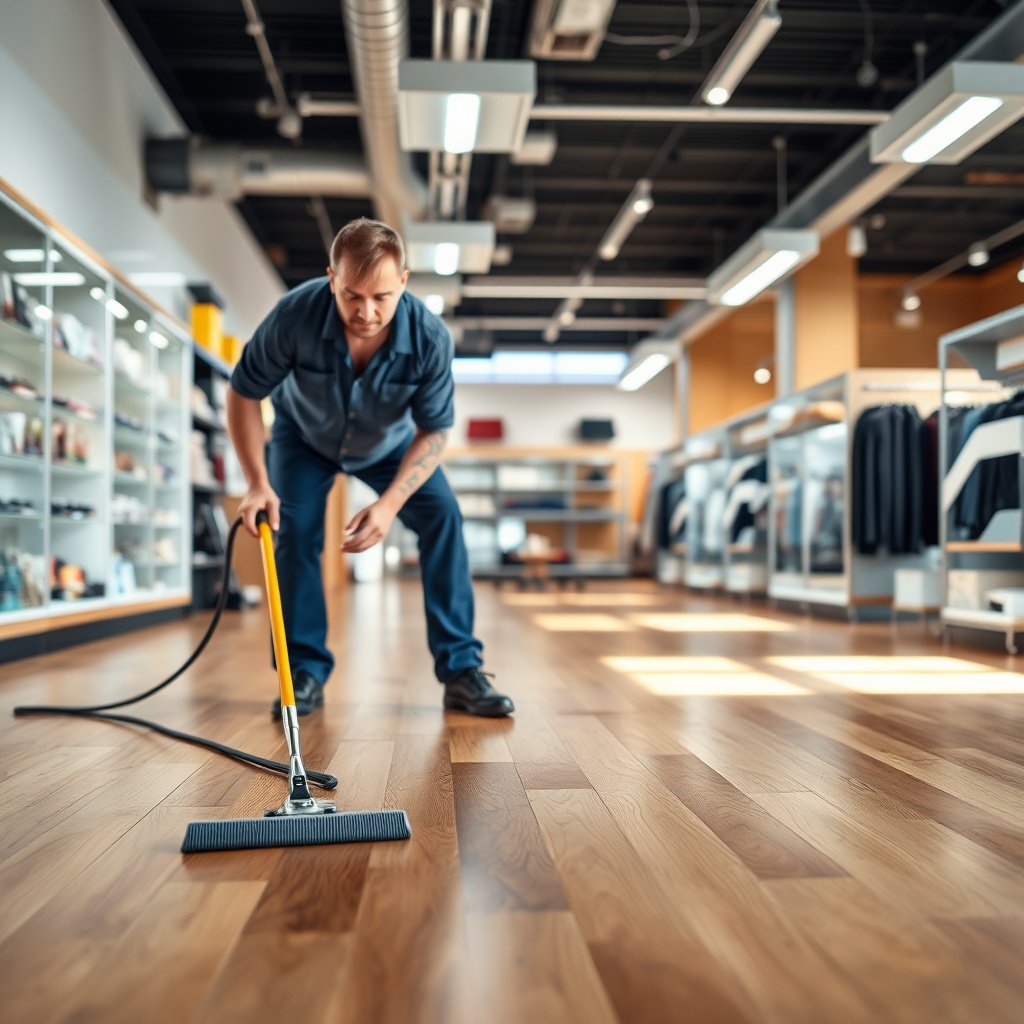
Identify the stain category first, because the “wrong chemistry” is the fastest way to spread discoloration across a finished hardwood floor in a retail store. Here is what I recommend: classify the mark visually, confirm the floor is sealed/finished, and only then choose the mildest compatible cleaner.
Water rings and gray haze typically indicate moisture or mineral transfer that sits on top of (or near) the finish film, so staged cleaning is safer than immediately using stronger solvents.
Rust (iron/iron-oxide) stains often respond best to oxalic-acid-based chemistry because it helps convert iron compounds into removable residue; stop as soon as the stain lifts to protect sheen.
– Look for clues: water rings/gray haze, dark spreading marks, orange-brown rust spots, oily/track-like discoloration, or dye/ink transfer.
– Check the finish status first: sealed/finished wood usually reacts differently than unfinished or repeatedly refinished floors.
– Spot-test every cleaner in an inconspicuous area (and wait for it to dry) before you treat the whole affected section.
– Add a quick “source check” specific to retail: spills near doors, restroom corridors, seasonal foot traffic (salt), and product-handling zones (ink pens, boxed displays, cooking grease from nearby tenants) are the most common causes of staining on hardwood floors in a retail store.
– If you can, review the last maintenance pass: some stores apply spot-wax, polishes, or coatings on schedule—previous product build-up can react to cleaners and make stains look darker right after treatment.
A practical staging rule for stained hardwood floors
For stained hardwood floors in a retail store, assume the finish is vulnerable until proven otherwise. That means start with blotting and pH-neutral cleaning, then move only to stain-type-specific removers after the spot test confirms no dulling, whitening, or color shift.
Also, As of 2026, many facilities teams are working with layered finish systems (multiple coats or maintenance products), so “one-step removal” attempts can create a visible halo. Plan to clean in stages so the treated area blends back into the surrounding sheen over a normal operating day.
Start with gentle cleaning (what fixes most “everyday” stains)
Use gentle, pH-neutral cleaning first because it removes soil and residues without aggressively altering the finish on stained hardwood floors in a retail store. In most day-to-day cases, this is enough—especially for footprints, everyday grime, and light discoloration.
Using a pH-neutral hardwood-floor cleaner reduces the risk of finish damage compared with strongly acidic or alkaline solutions, which can dull or haze certain urethane/varnish systems.
Over-wetting finished wood can temporarily increase moisture in the top fibers; wood dimensional change is driven by moisture content, which becomes significant as moisture rises toward the wood’s fiber saturation region (~30% moisture content).
– Blot liquids immediately (don’t scrub wet areas), then clean with a pH-neutral hardwood floor cleaner according to the label.
– Use a microfiber pad/mop head or a well-wrung cloth—avoid soaking the floor.
– Dry thoroughly after cleaning to prevent lingering discoloration and dull spots in high-traffic retail areas.
– For retail operations, use “time-boxed cleaning”: apply cleaner to the cloth/pad rather than the floor, work in a small section, then wipe dry immediately so the area can be reopened quickly.
– If the stain is “shadowed” rather than fully visible, you can often lift surface grime first; once the residue is gone, the stain type becomes clearer and you avoid mis-treatment on stained hardwood floors in a retail store.
When gentle cleaning works best
Gentle cleaning is most reliable for:
– Soil transfer (shopping bags, stroller wheels, dusty entrances)
– Light scuffs where the finish film remains intact
– Residue from sugary spills that have dried on the surface
Pros/cons of starting with gentle cleaning
| Approach | Pros (Retail-friendly) | Cons / Limits |
|---|---|---|
| Gentle pH-neutral cleaning first | Lower finish risk; reduces soil so the real stain becomes easier to identify on stained hardwood floors in a retail store. | May not remove deep rust, dye/ink, or true mineral staining if the finish has been compromised. |
Use targeted spot treatments by stain cause
Use targeted removers only after gentle cleaning and confirmation of the stain type, because each stain category responds to different chemistry on hardwood floors in a retail store. The goal is lift-and-stop: remove the stain without widening it or creating a sheen mismatch.
Stain-type-specific products are designed to work with a given finish system; following the label’s dilution and dwell time is critical to prevent finish whitening or dulling.
If you’re unsure which stain caused the discoloration, pausing and re-checking source clues is safer than applying a “universal” remover that can spread pigments or residues.
– Water stains / cloudy rings: Treat only after the area is fully clean; choose a product or method that’s specifically intended for hardwood finishes, and follow the manufacturer’s label directions. Avoid household bleach unless your floor/finish manufacturer explicitly allows it.
– Grease, scuffs, and tracked marks: Use a hardwood-floor-safe degreaser or spot cleaner designed for wood floors (again, follow dilution/dwell time on the label), then rinse/wipe lightly if the product requires it.
– Rust/iron marks: Use a rust remover designed for wood floors (often oxalic-acid-based products) and stop as soon as the stain lifts—over-treatment can affect finish sheen.
– Ink/dye transfer: Use a finish-safe spot remover recommended for ink/dye on wood; do not jump straight to harsh solvents.
– If you’re unsure: Pause and re-check the stain source—mis-matching a chemical to the stain is one of the quickest ways to spread the discoloration.
A quick reality check: why “spot removal” can still look different
Even when a stain lifts, stained hardwood floors in a retail store can show a subtle sheen difference due to:
– Surface finish absorption (some removers change gloss temporarily)
– Residue in the surrounding coating layer
– Uneven cleaning time across the footprint of the original mark
That’s why the best practice is still: mild first, targeted next, then finish-safe maintenance only after drying.
Hardwood species commonly used in commercial floors: abrasion resistance context
| # | Hardwood species | Janka hardness (lbf) | Scouring tolerance | Abrasion resistance index |
|---|---|---|---|---|
| 1 | Hickory (Carya spp.) | 1820 | ★★★★★ | 10/10 |
| 2 | Hard Maple (Acer saccharum) | 1450 | ★★★★☆ | 9/10 |
| 3 | White Oak (Quercus alba) | 1360 | ★★★★☆ | 8/10 |
| 4 | Red Oak (Quercus rubra) | 1290 | ★★★☆☆ | 7/10 |
| 5 | Yellow Birch (Betula alleghaniensis) | 1260 | ★★★☆☆ | 6/10 |
| 6 | Black Walnut (Juglans nigra) | 1010 | ★★☆☆☆ | 5/10 |
| 7 | American Cherry (Prunus serotina) | 950 | ★★☆☆☆ | 4/10 |
Species matters—especially for retail stain removal
This table is a context tool for stained hardwood floors in a retail store: harder species (like hickory and maple) generally tolerate gentle agitation better than softer species (like cherry). Still, finish chemistry—not wood hardness—drives whether a cleaner will dull, haze, or discolor the surface finish. For stained hardwood floors, always match the product to the finish system first.
Protect the finish after stain removal
Protect the finish immediately after the stain is gone (or visibly reduced), because reopening too soon or adding random products can create permanent halos on stained hardwood floors in a retail store. The win is consistent drying and finish-safe maintenance, not shortcuts.
Finishes and coatings rely on proper drying to restore uniform appearance; evaluating sheen only after the treated area is fully dry prevents false conclusions.
Indoor humidity control matters for finished wood floors; many maintenance guidelines target an approximate 35%–55% relative humidity range to limit expansion and contraction.
– Once the stain is gone (or noticeably improved), let the area dry completely before you reopen that section to foot traffic.
– If the treated area looks uneven, use a finish-safe maintenance product (e.g., cleaner/polish designed for your floor system) rather than adding random oils or wax.
– Reapply protection only if your floor program allows it—retail floors often have layered coatings or specific maintenance routines.
As of 2026, more retail chains are standardizing floor-care programs across locations. If your store uses a defined maintenance schedule, keep stain removal aligned with that program so you don’t accidentally “break” compatibility between cleaners, degreasers, and the site’s scheduled products.
What can go wrong (common retail-floor mistakes)
Avoid these errors because they are the usual reasons stained hardwood floors in a retail store look worse after “cleanup.” Many mistakes come from over-wetting, mismatched chemicals, or aggressive abrasives that damage the finish film.
Flooding or over-wetting finished hardwood can cause permanent halos or sheen differences because moisture redistributes into the top surface layers and affects how the finish reflects light.
Using bleach, strong acids, or strong alkalis can chemically alter surface finish components, which may create haze or discoloration even when the stain temporarily disappears.
– Over-wetting: Flooding the area, leaving it damp, or using too much cleaner can cause swelling, edge lifting, or a permanent halo.
– Abrasive pads and harsh chemistry: Scouring pads, “magic” erasers used aggressively, or bleach/strong acids/alkalis can dull or haze the finish.
– Treating the wrong stain: Rust remover on an oil mark (or a solvent on a water stain) can spread the problem.
– Skip testing: A spot-test is critical because store environments often have different sealers/coatings, wax build-up, or prior repairs.
– In retail, another common failure is timing: if you treat the stain too late in the day without allowing full drying, customers track residue back onto the surface before it stabilizes.
Verdict / tip (what we recommend—and when to stop)
For most retail hardwood stains, start with gentle cleaning using a pH-neutral hardwood cleaner, then move to stain-type-specific products only if the first step doesn’t work. The downside: targeted removers can still cause finish color shifts or sheen differences, especially on older floors with worn coatings—so you may end up needing a pro to blend or refinish a small section.
Skip DIY and call a floor professional if:
– the stain penetrates deeply (you see darkening that doesn’t fade after proper cleaning),
– the discoloration keeps “coming back” after drying,
– you don’t know the floor finish/maintenance history,
– or your store can’t spare time for thorough drying and re-opening.
Decision timing for stained hardwood floors in a retail store
As of 2026, facilities often have tight labor windows. If the stain isn’t improving in a controlled first pass (gentle cleaner + correct spot remover matched to the stain cause), it’s usually safer to stop and escalate—because second attempts with the wrong dwell time can enlarge the affected area.
Quick checklist (scan before you start)
– ✅ Identify the stain type (water, rust, grease, ink/dye)
– ✅ Blot/clean gently first using a pH-neutral hardwood cleaner
– ✅ Spot-test any treatment in an inconspicuous area
– ✅ Use finish-safe, stain-specific products and follow label directions
– ✅ Dry completely; reopen only after the area is fully dry
– ❌ Don’t soak the floor
– ❌ Don’t use bleach/strong acids or abrasives without finish approval
FAQ:
– Can I use bleach to remove hardwood floor stains? Only if the floor/finish manufacturer explicitly allows it—many finishes can be damaged or permanently discolored.
– Why does the stain look worse after cleaning? Some stains become visible as moisture and oils are redistributed; it can also be a sign the stain is penetrating deeper than the surface.
– What if the stain won’t fully come out but looks lighter? Stop and reassess—continued treatment can harm the finish. Consider professional spot blending/refinishing.
– How do I avoid sheen differences in a store? Use the same maintenance approach and products for the area, and ensure full drying before judging the result.
Sources:
If you treat stained hardwood floors in a retail store like a controlled, staged process—identify the stain, start mild, switch only to stain-matched chemistry, and protect the finish after drying—you can remove most visible marks while keeping the finish uniform. When the stain is deep, persistent, or the floor history is unknown, stopping early and involving a flooring professional is the fastest way to avoid a bigger, more expensive repair.
Frequently Asked Questions
How do I remove water stains from hardwood floors in a retail store?
Start by blotting the area with a clean, dry cloth and letting it fully dry to avoid spreading the moisture. For light water rings, try a hardwood floor cleaner and then gently buff with a microfiber cloth. If the stain remains, use a wood-safe moisture-absorbing method like a very light application of mineral oil, followed by a test spot of a small amount of hydrogen peroxide solution mixed with water (only if your finish allows it). Always spot-test and avoid soaking the floor.
How can I remove oil or grease stains from hardwood floors without damaging the finish?
Blot up excess grease first with paper towels, then place an absorbent material (like baking soda or cornstarch) on the stain for several hours to lift oils. Afterward, gently wipe away the residue with a slightly damp cloth using a cleaner labeled safe for hardwood floors. For persistent spots, use a manufacturer-recommended degreaser or a wood-safe cleaner designed for commercial floors, but only on a test area. Never use strong solvents, steam, or harsh chemicals that can strip the protective coating.
Why do hardwood floor stains keep coming back in high-traffic retail areas?
In retail stores, repeated foot traffic, frequent cleaning, and ongoing exposure to spills can force stain particles deeper into the wood finish. Improper cleaning products—especially those that leave residue—can also darken stains over time or make them reappear after they dry. Use a consistent commercial hardwood floor care routine, clean spills immediately, and apply routine maintenance (like microfiber mopping and correct pH-neutral cleaners). If staining is embedded in the wood, you may need refinishing in the affected areas.
What’s the best way to treat black marks from scuffing or rubber heels on hardwood?
Begin with dry cleaning: try a clean eraser pad or a soft nylon brush to lift surface scuffs without wetting the wood. If the mark remains, use a hardwood floor cleaner and gently buff with a microfiber cloth, working with the grain. For rubber transfer, a wood-safe cleaner or specialized remover for scuffs may be required, but test it first in an inconspicuous spot. Avoid abrasive pads and excessive scrubbing that can dull the finish and make the damage more noticeable.
Which cleaning products should I use (and avoid) when removing stains from hardwood floors in a commercial setting?
Use pH-neutral, wood-finish-safe cleaners and microfiber mops to remove stains from hardwood floors without stripping the protective seal. Avoid steam cleaners, ammonia, bleach, and harsh solvents like acetone or lacquer thinner, as they can permanently damage or discolor the finish. For spills, always follow the label directions, use minimal moisture, and dry promptly to prevent water rings and swelling. If you’re unsure, consult the floor’s finish type (polyurethane, varnish, wax, or oil-based) and choose products specifically designed for that finish.
📅 Last Updated: October 17, 2026 | Topic: How to remove stains from hardwood floors in a retail store? | Content verified for accuracy and freshness.
References
- wood bleaching hydrogen peroxide discoloration – Search Results – PubMed
- oxalic acid wood bleaching – Search Results – PubMed
- water stains wood tannin bleed – Search Results – PubMed
- wood surface cleaning stain removal – Search Results – PubMed
- iron staining wood discoloration – Search Results – PubMed
- wood discoloration chemical treatment – Search Results – PubMed
- wood flooring stain removal cleaning – Search Results – PubMed
- https://scholar.google.com/scholar?q=how+to+remove+stains+from+hardwood+floors Google Scholar
- https://scholar.google.com/scholar?q=hardwood+floor+water+stain+removal+hydrogen+peroxide+oxalic+acid Google Scholar
- https://scholar.google.com/scholar?q=wood+surface+stain+removal+procedures+maintenance+flooring Google Scholar