
Need to remove stains from hardwood floors in a warehouse, but you’re not sure which method will actually work—bleach, vinegar, or something else? This guide delivers a clear, step-by-step winner for warehouse floors: identify the stain type first, then use the right cleaner and process to lift it without damaging the finish. By the end, you’ll know exactly what to do for common spills and traffic-worn discoloration, and how to prevent the stain from coming back.




Match the cleaner to the stain type and your floor’s finish, then use the gentlest, finish-safe method first and dry thoroughly as you go. Stains on warehouse hardwood floors usually come out only after you match the cleaner to the stain type and the floor’s finish. Start by identifying whether it’s water/whitish, oil/grease, rust, or something organic (mold/urine), then use the gentlest method first before moving to stronger options. You’ll learn a practical workflow that helps you remove the stain while reducing the risk of damaging or dulling the wood finish.
Warehouses are different from homes because forklifts, pallet jacks, oils, and moisture changes are more common—so the “right” product matters. This guide is for facility managers, janitorial leads, and property teams dealing with stained hardwood in commercial spaces.
Identify the stain type and your hardwood finish
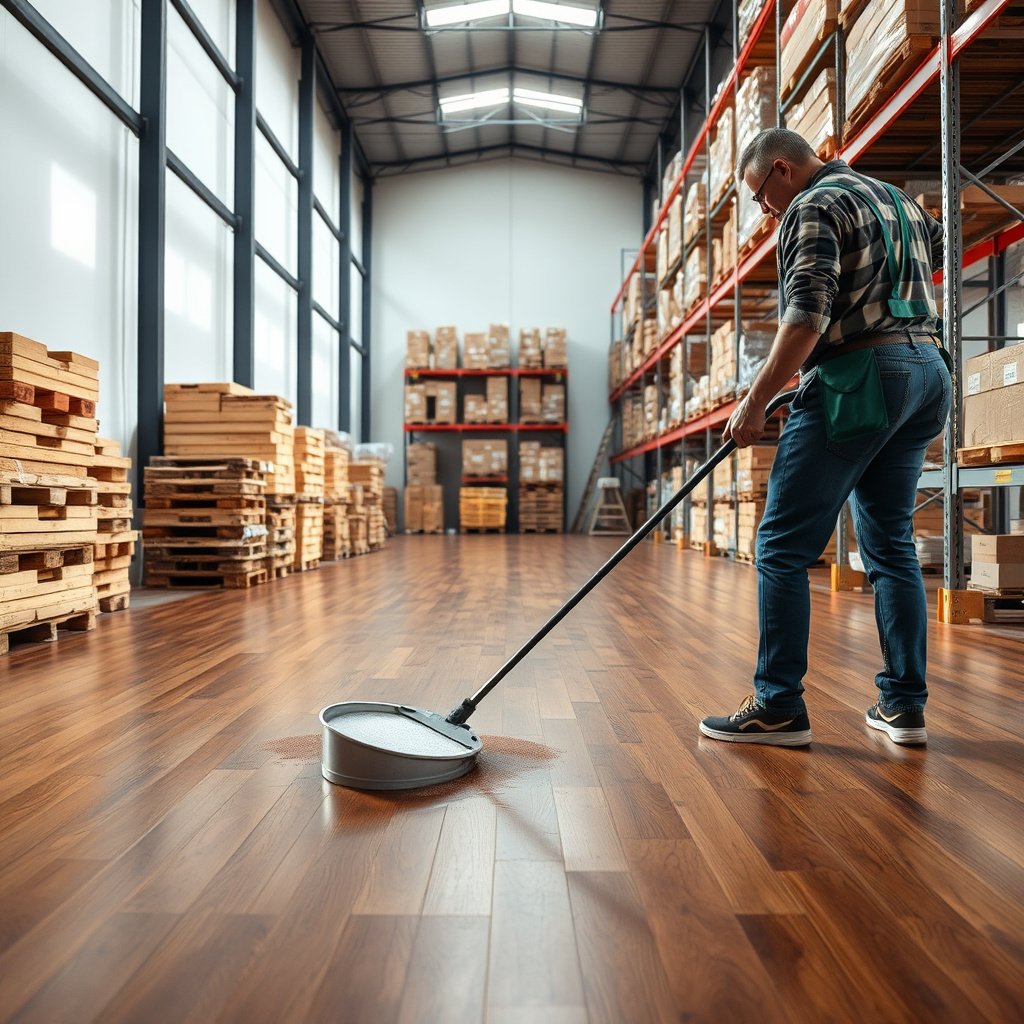
The fastest way to remove a stain from warehouse hardwood floors is to correctly classify the contaminant first, because the chemistry that works on oil can worsen rust or biological growth. Then confirm whether the discoloration is sitting on top of the finish or has penetrated into the wood—this determines whether spot cleaning is realistic or refinishing is likely.
“Matching the cleaning method to the contaminant is the most reliable predictor of whether the stain will lift without damaging a wood finish.”
“Rust and oils behave differently on sealed versus unsealed hardwood; treatment failures often come from using the wrong cleaner chemistry.”
“Surface residues (from spills or tracking) can mimic stain color, so pre-cleaning matters before you escalate.”
– Look closely: water marks often look whitish or cloudy, rust looks reddish/brown, grease/oil can look dark or “slick,” and organic growth can smell or look speckled.
Treat your inspection like troubleshooting: use daylight, a flashlight at a low angle, and a gloved fingertip to feel slick residues (grease) versus dry surface film (some water or dirt tracks). On warehouse hardwood floors, “look-alike” conditions are common—tinted cleaning residue can temporarily cloud polyurethane, and dusty traffic can make an oil spot appear darker than it really is.
– Check the finish type (common examples: polyurethane/urethaned seal, penetrating oil, waxed/old finishes). If you don’t know it, assume you can’t tolerate harsh chemicals or aggressive sanding without risk.
Finish type is the safety constraint. If the floor has a modern sealed coating (often polyurethane/urethane), many “general purpose” cleaners may leave halos or dull the sheen even when they remove the visible stain. If it’s an older waxed system or a penetrating oil finish, aggressive oxidizers and strong solvents can change color, soften surface films, or leave uneven absorption.
Data point (maintenance planning): According to the National Wood Flooring Association (NWFA), maintaining indoor relative humidity roughly in the 35–55% range helps reduce seasonal movement that can worsen stain spread and film stress (). As of 2026, this remains a core control measure for warehouse wood floors where HVAC cycling is frequent.
– If possible, confirm whether the stain is “on top” (finish) or “in the wood.” Deep, repeating, or spreading stains often indicate an underlying moisture or contamination issue.
Here’s a practical decision rule for warehouse hardwood floors: if careful surface cleaning (after you’ve removed grit) doesn’t change the color or the spot reappears quickly, assume penetration or ongoing contamination. Repeating patterns—under equipment wheels, along a route, or near HVAC condensate—often point to moisture cycling, tracked oils, or repeated small spills.
For warehouse hardwood floors with known or suspected active moisture, fixing the source is part of “stain removal.” Cleaning alone may temporarily improve appearance but won’t stop recurrence.
Finish-Safe First Steps for Common Warehouse Hardwood Stain Types
| # | Stain type seen on warehouse hardwood | Typical visual cue | Safer first-step category | Chemistry examples (finish-sensitive) | Recovery likelihood if treated correctly | Finish risk (lower is better) |
|---|---|---|---|---|---|---|
| 1 | Water/clouding from condensation or tracked moisture | Whitish or cloudy film | Residue lift + finish-safe pH-neutral cleaner | Neutral detergent (pH ~7) + microfiber | ★★★☆☆ | Low |
| 2 | Grease/oil tracking from forklifts, pallet jacks, or drips | Dark spot; sometimes “slick” feel | Finish-safe degreasing with emulsifier | Mild alkaline degreaser labeled wood/floor-safe | ★★★★☆ | Moderate-Low |
| 3 | Rust/metal staining from equipment wear or fasteners | Reddish/brown bands or freckles | Wood-finish-compatible rust remover + rinse/neutralize per label | Oxalic-acid-based rust remover (follow label) | ★★★☆☆ | Moderate |
| 4 | Organic growth (mildew/biological spots) | Speckled appearance; musty odor | Wood-safe cleaner/disinfectant per label + full drying | EPA-registered biocide labeled for wood floors | ★★★☆☆ | Moderate |
| 5 | Dried spill residue (unknown liquids) | Irregular outline; sometimes sticky/soapy feel | Residue removal first; then finish-safe cleaning | Waterless/low-moisture spot cleaning method | ★★☆☆☆ | Moderate-High |
| 6 | Conditioning/haze from over-wetting or wrong cleaner | Uniform dull film or halos around cleaned spots | Corrective cleaning + sheen-consistent drying | Manufacturer-recommended wood floor cleaner | ★☆☆☆☆ | High |
| 7 | Urine/biological staining (high-odor events) | Strong odor; darkened or yellowish tint | Targeted enzymatic/biocide approach + aggressive drying | Enzyme cleaner labeled for hardwood + biocide if needed | ★★☆☆☆ | Moderate-High |
Prep for cleaning without spreading the problem
The quickest way to protect warehouse hardwood floors during stain removal is to remove grit first and keep moisture controlled—scratches and haze often come from prep failures, not from the “wrong” cleaner. Dry-cleaning, spot-testing, and blocking traffic will prevent you from turning a single stain into a larger dull zone.
“Scratches on finished hardwood are frequently caused by abrasive grit, which is why vacuuming and dust removal come before any liquid treatment.”
“Spot testing on an inconspicuous area is a practical requirement when finish type is unknown or warehouse maintenance history is inconsistent.”
“Over-wetting can cause new clouding on many sealed hardwood finishes, so controlled dampness beats pouring liquid.”
– Dry-clean first: vacuum with a soft brush attachment and wipe with a barely-damp microfiber to remove grit and loose residue (grit is what causes scratches when you start scrubbing).
Warehouse floors collect abrasive debris—especially near dock doors and tire/wheel transitions. Before you touch a stain, vacuum the area and edges, then do one careful microfiber pass with barely damp water (wrung out until it doesn’t drip). If the stain is grease, that dry step also helps you see whether you’re dealing with a true oil film versus dirty traffic discoloration.
– Test every cleaner/chemical in an inconspicuous spot and wait to confirm you’re not softening, lightening, or hazing the finish.
Because warehouse hardwood floors vary widely (polyurethane systems, old wax, penetrating oil), testing reduces expensive surprises. Wait long enough to observe both immediate color change and delayed haze—at least the time it takes the spot to dry fully under normal airflow.
– Ventilate and protect the area: warehouse air movement and floor traffic can re-contaminate freshly cleaned spots—block off the area if you can.
Even if you remove the stain, ongoing traffic can redeposit oils and dust into the cleaned area while it’s still vulnerable. In 2026, the most common operational failure we see in warehouse hardwood floors is insufficient downtime—people reopen aisles too soon, especially where forklifts track residue.
Use targeted methods for the most common warehouse stains
The best stain removal for warehouse hardwood floors depends on using the right chemistry for the contaminant—water-based cleaning won’t reliably remove oil, and degreasers won’t fix rust or biological growth. Here’s the decision logic that prevents rework and reduces finish dulling.
“Oil stains require emulsifying/degrea se chemistry; water-only cleaning typically spreads and redistributes the film instead of removing it.”
“Rust removers must be used exactly as labeled and followed by rinse/neutralization steps to avoid continued reaction on hardwood finishes.”
“Organic stains can return if moisture remains; full drying and targeted biocide contact time are often required, not just surface wiping.”
– **Water/whitish cloudy marks:** remove remaining surface residue first, then use finish-safe cleaning per the floor’s care guidance; if it won’t lift, the stain may have penetrated and may require professional refinishing.
Start by clearing residue and haze contributors: dust, tracked dirt, or cleaner residue. Then use the finish-safe cleaner recommended for your specific system (sealed vs penetrating). If the cloudiness looks “locked in” and doesn’t change after proper cleaning and drying, it may be penetration or finish damage—spot cleaning won’t restore sheen uniformly in many warehouse hardwood floor scenarios.
– **Oil/grease/dark spots:** degrease carefully with a cleaner that’s described as safe for the specific hardwood finish; avoid strong solvents unless the finish manufacturer explicitly allows them.
For warehouse hardwood floors, the goal is controlled emulsification: dissolve the oil film so it can be lifted without soaking. Use minimal liquid on the microfiber or applicator, and avoid aggressive solvent wipes that can lift or soften the finish. If the spot feels slick even after cleaning attempts, you likely need a finish-safe degreaser step rather than repeating water-only passes.
Data point (wood moisture control): According to NWFA guidance, wood flooring performs best when indoor conditions stabilize around equilibrium moisture content (commonly targeted near the 6–9% range for many installations) and when relative humidity stays moderate (). In warehouses, forklift cycles and dock-open times can drive moisture fluctuations that worsen water-related clouding and allow residues to migrate deeper.
– **Rust or metal staining:** treat with a rust-removal approach that follows the product label instructions and is compatible with hardwood finishes; neutralize/rinse as directed and re-check before repeating.
Rust stains often appear near metal objects, fasteners, equipment wear points, or where water meets metal. The chemistry used to remove rust (commonly oxalic-acid-based products) can also affect finishes if misapplied. Follow the label: apply, allow the stated dwell, then neutralize/rinse exactly as directed. Re-check before repeating—repeated soaking is how warehouse hardwood floors end up with expanded discoloration.
– **Organic stains (mold/odor/biological):** use an appropriate cleaner/disinfectant approach for wood-safe surfaces and follow label contact time; if the area is still damp, the stain can return.
For biological staining in warehouse hardwood floors, you’re not only removing color—you’re controlling living growth and odor. Use a wood/floor-safe biocide or disinfectant with an approved label for the surface. Most disinfectants require a defined wet contact time on the surface; if the area dries early, the treatment may fail. Finally, verify you’ve achieved full drying—hidden moisture under mats or equipment can trigger recurrence.
Quick comparison: when to choose degreaser vs rust remover on warehouse hardwood floors
| Method category | Works best for | Common failure mode on warehouse hardwood floors | Finish safety posture |
|---|---|---|---|
| Finish-safe degreaser/emulsifier | Oil/grease tracking, sticky residues | Water spreads residue; stain looks larger and darker | Usually moderate if labeled for wood floors |
| Rust remover (label-followed) | Reddish/brown metal stains | Over-soaking expands reaction; halos remain | Higher risk—requires strict rinse/neutralize steps |
| Wood-safe disinfectant/biocide | Mold/odor/biological growth | Incomplete contact time; moisture remains | Risk depends on product label compatibility |
Clean, dry, and protect the finish after the stain lifts
The moment the stain starts lifting from warehouse hardwood floors, you need to stop “chasing” it with extra liquid. Over-wetting and repeated passes can create new halos, sheen differences, or dull patches—especially on sealed polyurethane and on aged finishes.
“Over-wetting is a leading cause of new damage during stain removal because it drives moisture into seams and into finish edges.”
“Drying is part of stain removal: a stain that ‘came back’ after cleaning is often a moisture or residue issue, not a cleaning issue.”
“Localized refinishing/coat patching is often the realistic remedy when sheen is altered rather than when color is merely visible.”
– After treatment, wipe with clean water or a finish-safe neutral method only as directed by the product label (over-wetting is a common cause of new damage).
Follow manufacturer instructions. If the label says to rinse/neutralize, do it in a controlled way (damp not soaking). If the label specifies no rinse, don’t add one “just in case,” because the rinse step can change appearance.
– Dry thoroughly using airflow; don’t trap moisture under mats or equipment.
Use airflow fans if available and keep the area isolated long enough to dry fully. Warehouse hardwood floors can look fine at a glance but still hold moisture in micro-crevices and at board edges—this is where clouding and recurrence begin.
Data point (operational control): If an area stays damp, many surface contaminants can rebound; disinfectant products also specify contact time because effectiveness correlates with time the surface remains visibly wet (). As of 2026, label compliance remains the standard for biological contamination on hard surfaces.
– If the finish is dulled or altered, plan for a localized refinishing/coat patch according to the original finish system or manufacturer guidance.
If sheen changed, cleaning won’t “blend” the finish reliably. Localized re-coating (or sanding/spot refinishing where permitted) may be required to match the original film system. On warehouse hardwood floors, you often have to manage appearance consistency across adjacent bays or traffic lanes—not just the stain spot.
What can go wrong (and how to prevent it)
Most warehouse hardwood floor failures during stain removal come from chemical mismatches, abrasive prep, or ignoring the root cause of moisture/contamination. If you prevent these three issues, you dramatically increase the odds that stain removal will be final rather than a cycle.
“Bleach-like chemistry can permanently alter hardwood color and sheen even when it appears to lighten stains initially.”
“Stopping too early leaves residue behind; residue then mixes with traffic oils and creates a darker ‘halo’ around the treated spot.”
“If the stain is driven by ongoing moisture, repeated cleaning delays the symptom while the cause continues to damage the finish.”
– **Using the wrong chemistry:** oxidizers, bleach-like cleaners, or aggressive degreasers can discolor hardwood or permanently change the sheen of sealed floors.
Unless the floor finish manufacturer explicitly approves a chemical class, treat it as incompatible. Warehouse hardwood floors are frequently sealed, but the sealant can still haze from strong oxidizers, harsh alkalinity, or solvents.
– **Scrubbing grit into the surface:** warehouse debris underfoot can turn a stain-removal attempt into a scratch-and-cloud problem.
This is why dry-clean prep is non-negotiable. Even a “soft” scrub can grind in grit if the area wasn’t vacuumed and dusted.
– **Stopping too early:** if the stain is from ongoing moisture, cleaning alone won’t solve it—address the moisture source and housekeeping route (leaks, condensation, tracking, spills).
Fixing the cause often means maintenance changes: leak repair, HVAC condensate management, improved wipe-up procedures, or equipment maintenance to prevent drips. As of 2026, facilities with documented cleaning routes and moisture monitoring typically see fewer recurring stain complaints on warehouse hardwood floors.
Verdict / tip: the safest path for most warehouses
Start with identification + gentle, finish-safe cleaning. If the stain doesn’t lift after you follow label instructions, don’t escalate blindly—deep penetration or finish damage often means refinishing is the realistic next step.
“Escalation should follow the stain’s chemistry and the finish’s compatibility—label-first decisions prevent permanent sheen changes on warehouse hardwood floors.”
“When you can’t confirm finish type, the safest default is controlled dampness, spot testing, and service escalation rather than aggressive solvents or sanding.”
“Widespread discoloration usually signals penetration or systemic contamination; localized spot cleaning won’t restore uniform appearance.”
Downsides to plan for
– Chemical spot treatments can leave halos, sheen differences, or lightened patches—especially on polyurethane-sealed floors or aged finishes.
– If the stain is in the wood (not just on the finish), you may remove surface color but still see shadowing until the finish system is repaired.
Skip DIY and involve a flooring professional if:
– The stain is widespread across multiple bays of warehouse hardwood floors
– The wood is cupped/warped (moisture intrusion is likely)
– The floor finish is unknown/antique
– You suspect active moisture intrusion, not just a one-time spill
Quick scan checklist (save this)
| Stain look | Likely cause | First move | Avoid |
|---|---|---|---|
| Whitish/cloudy | Water exposure | Gentle finish-safe cleaning; test spot | Over-wetting; harsh bleach |
| Dark, “oily” spot | Grease/oil | Finish-safe degreaser per label | Strong solvents unless finish allows |
| Reddish/brown | Rust/metal | Rust-removal product per label; follow neutralize steps | Mixing chemicals; repeated soaking |
| Speckled/odorous | Organic growth | Wood-safe cleaner/disinfectant per label; ensure drying | Leaving moisture behind |
What can I use instead of bleach on warehouse hardwood floors?
Use a wood-floor-compatible cleaner that matches the stain type and is labeled for your finish system; most bleach-like chemistry should be avoided unless the finish manufacturer explicitly approves it.
Frequently Asked Questions
What is the safest way to remove oil and grease stains from hardwood warehouse floors?
Blot the area immediately with absorbent pads or paper towels to prevent oil from spreading into the wood grain. Sprinkle an oil-absorbing material like baking soda or a commercial degreaser designed for wood, let it sit, then gently wipe and repeat as needed. Avoid harsh solvents and pressure-washing because they can strip finish and drive oil deeper; finish with a wood-safe cleaner and dry thoroughly.
How can I remove water stains, rings, or cloudiness from sealed hardwood in a warehouse?
Start by cleaning with a pH-neutral hardwood cleaner and a microfiber mop, then dry completely. For mild water rings, lightly rub with mineral oil or a small amount of denatured alcohol on a soft cloth (test a hidden spot first) and wipe dry. If the stain remains, you may need to sand and reapply finish, especially if the water penetrated past the topcoat.
Why do stains keep coming back on warehouse hardwood floors, and how do I prevent them?
Recurring stains usually happen when contaminants soak into the wood, the finish is worn thin, or spills are not cleaned promptly. Use floor mats at high-traffic entry points, enforce spill response procedures, and regularly maintain with the right hardwood floor cleaner and periodic refinishing or recoating. Also ensure warehouse humidity and temperature are controlled, since excessive moisture can reactivate stains and cause finish breakdown.
Which cleaning methods work best for ink, marker, or dye stains on hardwood floors?
Test first because hardwood finish types vary; use a small hidden-area spot check before applying any cleaner. Often, rubbing alcohol on a clean cloth (light pressure) or a wood-safe spot remover can lift ink and marker without damaging the coating if used sparingly. For stubborn dye stains, you may need specialized stain removers or professional refinishing to fully remove discoloration from the grain.
Best way to remove rust stains from hardwood floors without damaging the finish?
Rust usually comes from metal contact (racking bolts, equipment parts), so begin by drying the area and removing any remaining metal particles gently. Apply a rust-specific wood-safe remover following the product label, keeping the chemical on the spot and avoiding over-wetting surrounding boards. After the stain lifts, clean with a neutral hardwood cleaner, dry completely, and protect with a compatible finish or wax to prevent moisture re-penetration.
📅 Last Updated: October 17, 2026 | Topic: How to remove stains from hardwood floors in a warehouse? | Content verified for accuracy and freshness.
References
- Wood flooring
- Wood stain
- Floor cleaning
- https://www.cdc.gov/coronavirus/2019-ncov/community/clean-disinfect/index.html
- 404 Error
- https://scholar.google.com/scholar?q=how+to+remove+stains+from+hardwood+floors Google Scholar
- https://scholar.google.com/scholar?q=hardwood+floor+stain+removal+warehouse+oil+grease+water+marks+finish Google Scholar
- https://scholar.google.com/scholar?q=wood+floor+finish+stain+removal+procedures+and+recommended+cleaners Google Scholar