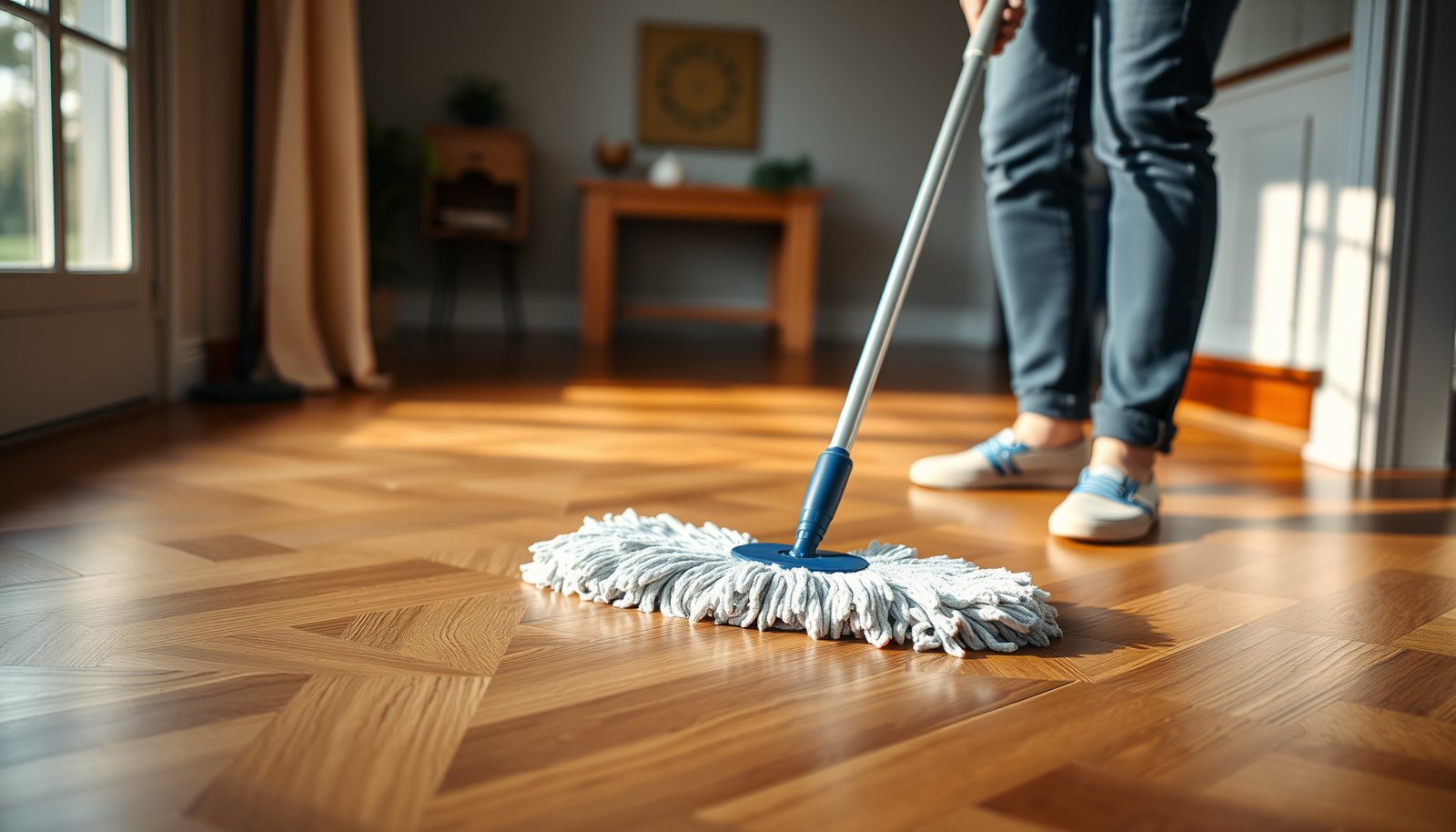

How to mop parquet floors without damaging the finish depends on one simple rule: use a nearly dry, pH-neutral cleaner and avoid soaking. If you mop with a wrung-out microfiber mop (or soft cloth) and rinse lightly when needed, you’ll remove grime while protecting the seal. Skip steam, harsh detergents, and puddles, and your parquet stays glossy instead of dull, cloudy, or warped.



Use a well-wrung, barely damp microfiber mop, then dry any remaining moisture immediately. For sealed parquet floors, use a pH-neutral wood-floor cleaner and clean in small sections so the boards don’t swell or the finish dull.
This guide is for homeowners (and renters) cleaning sealed parquet, dealing with everyday dust/grime, and wanting a safe routine that won’t leave streaks or cause long-term damage. If your parquet is unsealed—or you’re unsure what finish you have—read the “What can go wrong” section first.
Gather the right tools and products
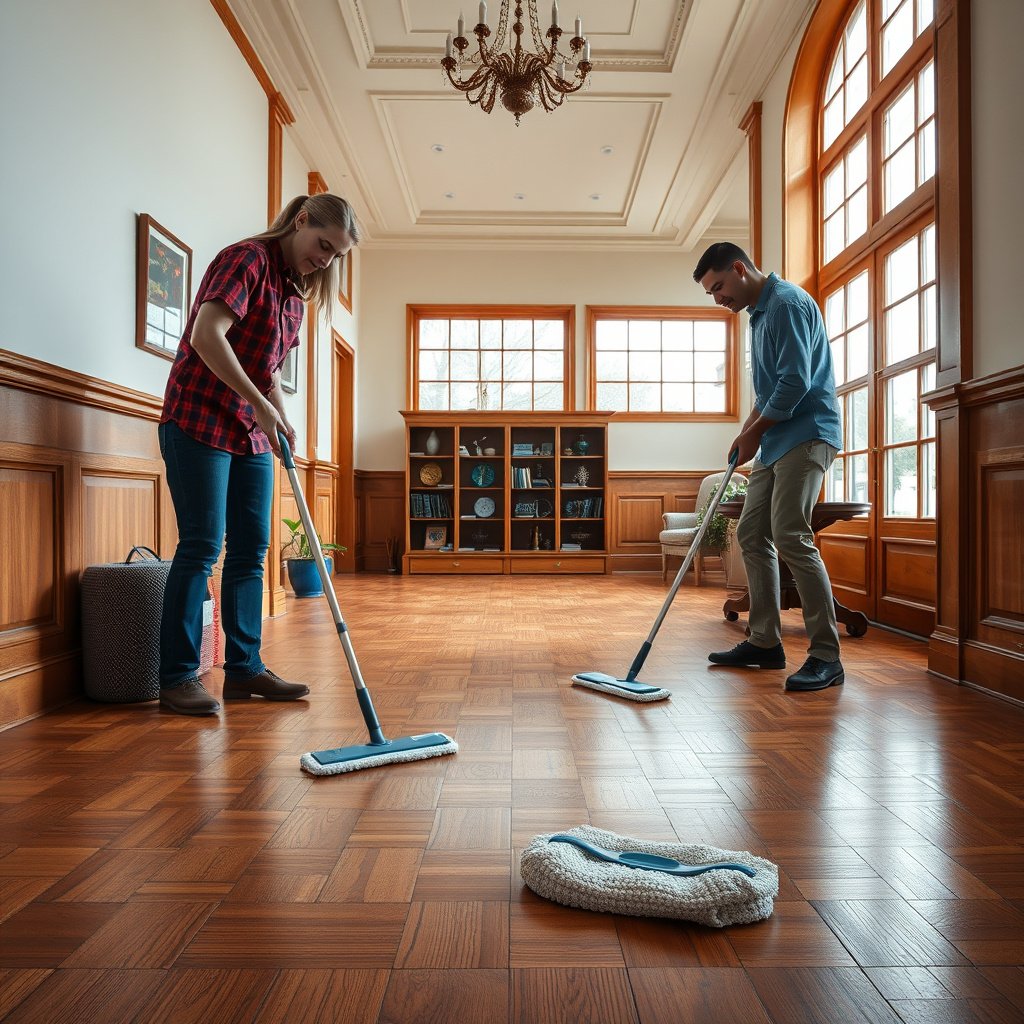
Use the least aggressive tools possible: a microfiber mop (lightly damp) plus a pH-neutral cleaner made for wood floors. That combination is designed to remove haze and grime without flooding the seams that protect sealed parquet floors.
A pH-neutral wood-floor cleaner helps avoid finish dulling caused by strongly acidic or alkaline chemistry (neutrality is pH 7 at 25°C in pure water, per IUPAC) (IUPAC 2007).
Microfiber mops are typically preferred for sealed wood surfaces because they trap fine dust and release less particulate than string mops, reducing drag that can haze parquet finishes.
For moisture-sensitive materials like wood, the risk comes from excess water getting into seams and expanding/contracting the substrate over time (fiber saturation is ~28–30% moisture content, per USDA) (USDA Forest Products Laboratory 2010).
What to buy (and what to avoid)
– Use a microfiber mop designed for wood floors (preferably one with washable pads).
– Choose a pH-neutral wood-floor cleaner; skip anything “degreasing,” abrasive, or strongly alkaline/acidic.
– Keep clean, dry microfiber towels or a second mop pad for quick drying.
From a finish-protection standpoint, the biggest “hidden variable” isn’t the brand name—it’s how much liquid you’re actually delivering to sealed parquet floors. Even with a good cleaner, a mop pad that’s too wet or a solution that’s too concentrated can leave streaks and dullness. If you’re reusing pads, ensure they’re not oily/dirty; embedded grit turns a routine mop into a micro-scratching tool.
Cleaning Products: Typical pH and Finish Safety on Sealed Parquet (Practical Risk)
| # | Product type (typical use) | Typical pH range | Primary risk to finish | Sealed parquet safety |
|---|---|---|---|---|
| 1 | pH-neutral wood-floor cleaner | ~6.0–8.5 | Minimal chemical stress when used as directed | ★★★★★ |
| 2 | Mild dish soap (used sparingly) | ~7–9 | Residue risk → streaking/dull haze over time | ★★★☆☆ |
| 3 | Water-only (for light grime) | pH ~7 | Main risk is excess moisture, not chemistry | ★★★☆☆ |
| 4 | Vinegar solution (home remedy) | ~2–3 (undiluted) | Acid can dull certain finishes; also leaves residue if not wiped | ★☆☆☆☆ |
| 5 | Ammonia-based cleaner | ~11–12 | Alkalinity can harm finish clarity and cause haze | ★☆☆☆☆ |
| 6 | Chlorine bleach solutions | ~11–13 | Strong oxidizers/alkalinity can damage coatings and discolor | ★☆☆☆☆ |
| 7 | Abrasive/scrub additives (polish/“degreasers”) | Varies; often non-neutral | Mechanical abrasion can remove finish wear layer | ☆☆☆☆☆ |
Prep the floor before you mop
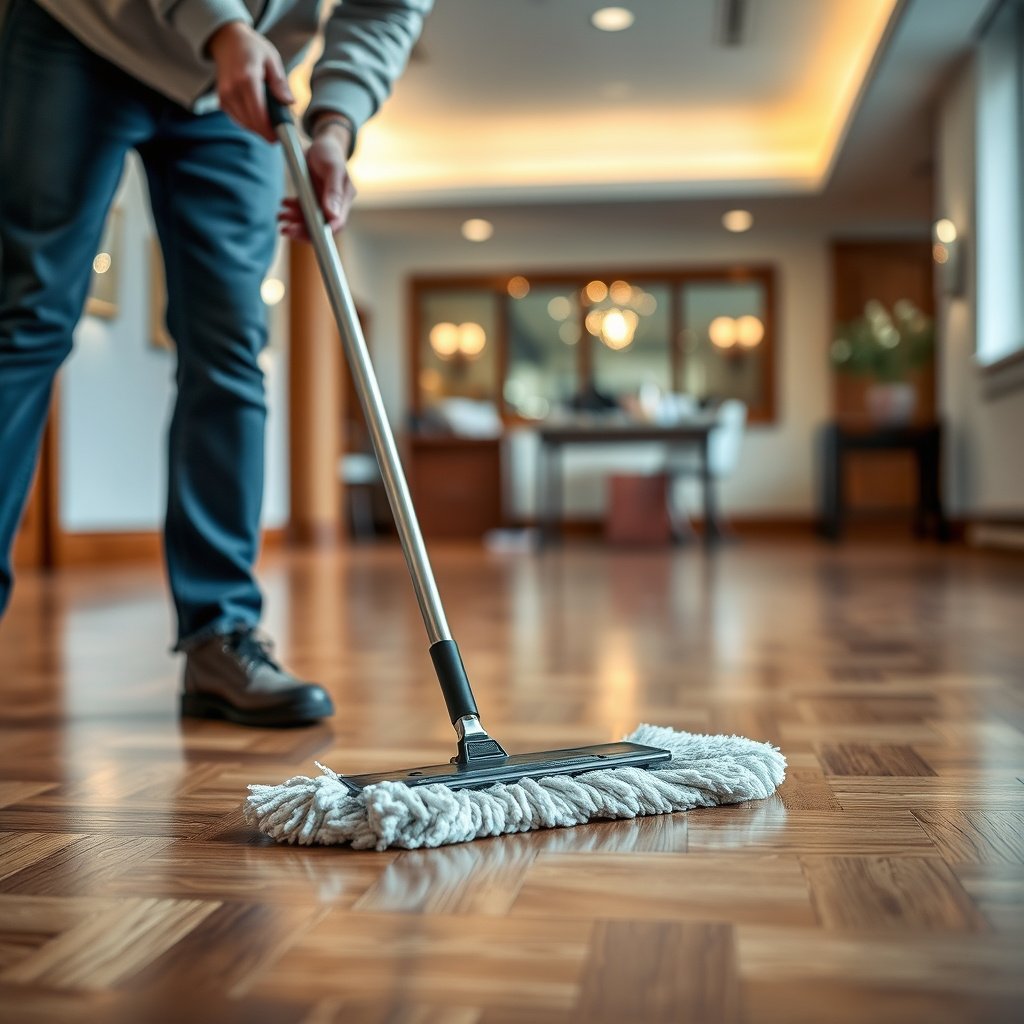
Prep sealed parquet floors first—because grit you don’t remove will scratch the finish even if your cleaner is perfect. A dry sweep or vacuum is the fastest way to protect the look you’re trying to maintain.
Mopping over sand or dried grit converts it into a grinding medium that can micro-scratch sealed parquet finishes.
If you can feel dust or grit with your hand, it can almost certainly leave dull patches when you later drag a damp pad across it.
Using a cloth for spot cleaning limits liquid spread and helps prevent excess moisture in joints between sealed parquet boards.
– Sweep or vacuum thoroughly with a brush attachment to remove grit that can scratch.
– Remove surface debris (sand, hair, dry mud) before any wet cleaning—parquet is easily marked when particles get dragged.
– If there are sticky spots, follow with a targeted spot-clean using the wood-floor cleaner on a cloth (not a soaking application).
Why this matters: sealed parquet floors are vulnerable to surface damage because the protective layer (seal, varnish, or finish system) is designed to wear slowly—not instantly under abrasive particles. When debris is trapped under a microfiber pad, the pad may look gentle, but the friction concentrates at contact points. In 2026, many households still use “quick mop” routines that skip prep—those are exactly the routines that lead to uneven sheen and streaks over time.
Also, if you’re dealing with sticky spots (candy residue, heel marks, beverage spills that dried), don’t treat them like general cleaning. Use the wood-floor cleaner on a cloth, work the area gently, then blot/dry. This reduces both chemical exposure and moisture exposure to sealed parquet floors.
How to mop parquet step by step
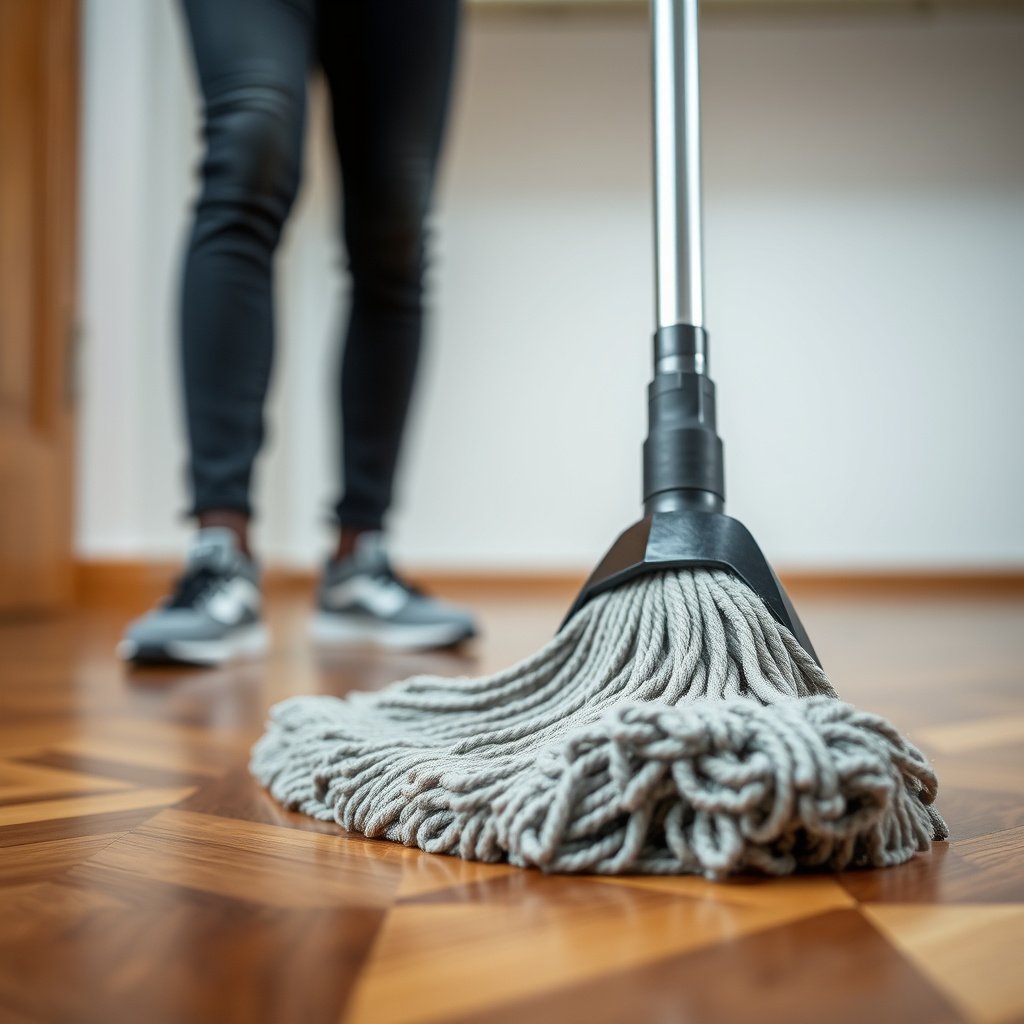
Mop sealed parquet floors using minimal liquid: mix the cleaner correctly, then wring the mop until it’s only lightly damp. This is the core routine—less water on the surface equals less risk of finish dulling and board swelling.
Wood dimensional movement is driven by moisture changes below the fiber saturation point (~28–30% moisture content), so excess mop water can create long-term movement risk for wood substrates (USDA Forest Products Laboratory 2010).
Moisture content for wood is calculated gravimetrically as ((wet mass − dry mass) / dry mass) × 100 per ASTM D4442-07 (ASTM International 2007).
Cleaner dilution matters: using more product than the label calls for increases residue risk, which often shows up as streaks or hazy finish.
– Fill a bucket with the recommended amount of cleaner in water (follow the product label).
– Dip the mop, then wring it out until it feels only lightly damp—no dripping, no puddles.
– Mop in small sections with gentle pressure, working along the grain/pattern, and stop if the floor looks wet.
Here’s a practical workflow for sealed parquet floors:
1. Mix precisely: Follow the cleaner label for dilution. If a product says “X mL per Y liters,” use it—don’t guess.
2. Wring harder than you think: The mop should leave almost no visible sheen. If water beads or drips, it’s too wet for sealed parquet floors.
3. Work by section: A “section” is the amount you can finish and dry quickly (often a few boards wide). This keeps the finish from staying wet.
4. Use gentle pressure: Pressing down may remove grime, but it also forces liquid into seams and can wear the finish faster.
5. Stop when it looks wet: If the surface reflects like a wet floor, you’ve crossed the line—pause, wring again, and dry.
From the way finishing systems fail in the field, the biggest culprit is usually staying wet too long, not the cleaner itself. Sealants and topcoats can tolerate normal damp cleaning; they struggle when moisture lingers at the edges and seams between sealed parquet boards.
Drying and finishing touches
Dry sealed parquet floors immediately after mopping—this single step prevents the “invisible problem” of moisture sitting in seams. A fast dry pass also reduces streaking caused by leftover cleaner residue.
Drying right after damp mopping limits moisture migration into joints between sealed wood elements.
A clean microfiber towel prevents re-depositing cleaner onto sealed parquet while you’re trying to remove haze and streaks.
– After mopping, run a dry microfiber towel over damp areas to prevent water from lingering between seams.
– Let the floor air-dry fully before walking with socks or moving furniture back.
– If you notice streaks, your mop pad may be too wet, the cleaner may be too concentrated, or you may need a fresh pad for the next section.
In 2026 maintenance routines, the most common “why does it look streaky?” causes on sealed parquet floors are:
– Too much liquid (mop pad not wrung enough)
– Over-concentrated cleaner (label dilution ignored)
– Dirty/greasy pad (pad carried residue from another zone)
– Not drying after damp mopping
If streaks appear, fix the process—not the finish. Use a fresh, dry pad/towel and do a light dry wipe. Then adjust: wring more, reduce cleaner concentration, and clean smaller sections. Avoid going back and scrubbing with extra pressure; that can quickly dull sealed parquet coatings.
What can go wrong
The main risks for sealed parquet floors are over-wetting, incorrect chemicals, and skipping prep—each can dull the finish or weaken the underlying wood. If your parquet is unsealed, waxed, or oiled, the “pH-neutral + damp mop” method may be inappropriate.
Over-wetting increases the chance that moisture penetrates seams and drives dimensional movement in wood substrates (USDA Forest Products Laboratory 2010).
Strongly alkaline cleaners can haze or degrade certain wood coatings, so “degreasing” products are high-risk for sealed parquet finishes.
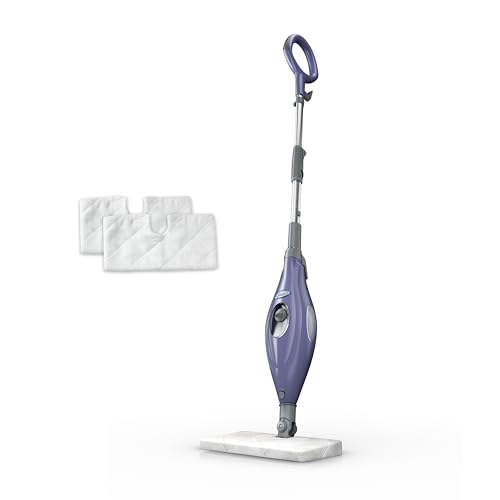
Steam adds heat and moisture simultaneously, which can lift edges and accelerate failure in many sealed floor systems unless the manufacturer explicitly allows it.
– Over-wetting: too much water can seep into joints, causing swelling, cupping, or finish failure.
– Wrong cleaner: bleach, ammonia, “steam mop” settings, or abrasive surfactants can dull or damage finishes—especially on older parquet.
– Skipping prep: mopping over dust/grit often creates dull patches and micro-scratches.
– Unsealed parquet: if the parquet is waxed, oiled, or otherwise unsealed, the “mop with pH-neutral cleaner” approach may not be appropriate—use the finish-specific care method.
Sealed vs. unsealed: what changes
- Sealed parquet (varnish/polyurethane/laminate-like topcoat)
- Goal is to remove dirt with minimal dampness, then dry quickly; cleaners should be pH-neutral and residue-minimizing.
- Unsealed or waxed/oiled parquet
- Finish can require reconditioning (oil/wax refresh) and may not tolerate the same damp-mop chemistry or moisture exposure. Always follow the specific finish guidance.
- Steam cleaning
- Even when it “feels” like it’s working, steam can drive moisture into seams and stress coatings; only use if the parquet/finish manufacturer explicitly approves it.
Verdict / tip
If your parquet is sealed, this “lightly damp microfiber + pH-neutral cleaner + quick drying” method is usually the safest, lowest-risk way to maintain the look. The downside is that it won’t tackle heavy buildup instantly—tough spots often need careful spot-cleaning rather than a full-floor soak, and frequent wet mopping can gradually dull finishes.
Who should skip this approach:
– Unsealed/waxed/oiled parquet (use the finish-specific method first).
– Floors with known seam gaps or lifting edges (fix the condition before cleaning).
– Anyone planning to use steam without explicit manufacturer approval for their sealed parquet finish.
Quick checklist (save this)
– [ ] Sweep/vacuum first (no grit left behind)
– [ ] Use microfiber mop + pH-neutral wood-floor cleaner
– [ ] Mop pad only lightly damp (no dripping)
– [ ] Clean small sections; avoid puddles
– [ ] Dry any remaining moisture with a clean microfiber towel
Sources
– USDA Forest Products Laboratory, Wood Handbook (2010) (wood moisture behavior including fiber saturation concepts)
– ASTM International, ASTM D4442-07 (moisture content measurement method and calculation)
– IUPAC (2007) (pH definition and neutrality context at 25°C)
– General guidance based on standard wood-floor care principles: avoiding excess water and using finish-appropriate cleaners (refer to your floor/finish manufacturer’s care sheet for confirmation).
A good sealed parquet cleaning routine isn’t about using more product—it’s about controlling moisture and residue. When you keep the mop barely damp, use pH-neutral cleaner, clean in small sections, and dry immediately, you protect both the surface sheen and the long-term stability of your parquet floors.
Frequently Asked Questions
What is the best way to mop parquet floors without damaging the finish?
Use a microfiber mop that’s lightly damp, not soaking wet, because parquet is vulnerable to swelling and warping. Sweep or vacuum first to remove grit that can scratch the wood surface. For cleaning, use a pH-neutral wood floor cleaner diluted according to the label and mop in the direction of the grain. Finish by drying any excess moisture with a clean, dry microfiber cloth.
How do I mop parquet floors if they’re sticky or have residue?
Start with a dry clean—vacuum and a gentle sweep—so you don’t spread residue across the parquet. Use a properly diluted pH-neutral cleaner and mop with minimal water, changing the pad frequently. If residue remains, spot-clean with a wood-floor-safe cleaner on a damp microfiber cloth, then immediately wipe dry. Avoid harsh solvents, wax removers, or all-purpose cleaners that can dull the parquet finish.
Which cleaning solution is safe for parquet floors and should I avoid any products?
Choose a pH-neutral cleaner specifically designed for sealed wood or parquet floors, as it’s formulated to lift dirt without attacking the finish. Avoid acidic or alkaline cleaners, ammonia, vinegar, and steam cleaners, since they can damage the varnish or penetrate seams. Also skip abrasive scrubbers and thick detergents that may leave a film. When in doubt, test any product in a hidden area before mopping the whole floor.
How often should you mop parquet floors, and what’s the right routine?
Mop parquet floors as needed—typically weekly or every couple of weeks—depending on foot traffic and how quickly dirt builds up. Between moppings, dry maintenance is key: sweep with a soft-bristle broom or vacuum with a floor-brush attachment. When you do mop, do it quickly with a damp microfiber mop and avoid letting liquid sit on the wood. Consistent, gentle cleaning helps preserve the parquet’s shine and prevents grime from bonding into the finish.
Why does parquet get cloudy after mopping, and how can I prevent it?
Cloudiness is often caused by over-wetting, leaving soap residue, or using the wrong cleaner that builds up on the finish. To prevent it, use the correct dilution, don’t oversaturate the mop pad, and rinse/damp-wipe if the product instructs so. Make sure you dry the floor promptly after mopping, especially around edges and seams. If haze already formed, use a manufacturer-recommended wood floor cleaner and follow up with thorough drying rather than adding more water or stronger detergents.
📅 Last Updated: October 14, 2026 | Topic: How to mop parquet floors? | Content verified for accuracy and freshness.
References
- Parquet
- Wood flooring
- Floor cleaning
- Mop
- https://www.who.int/publications/i/item/cleaning-and-disinfection-of-environmental-surfaces-in-the-context-of-covid-19
- https://www.cdc.gov/coronavirus/2019-ncov/community/disinfecting-building-facility.html
- https://www.epa.gov/coronavirus/disinfecting-your-home
- https://scholar.google.com/scholar?q=parquet+floor+cleaning+mopping Google Scholar
- https://scholar.google.com/scholar?q=wood+floor+cleaning+water+mop+parquet Google Scholar
- https://scholar.google.com/scholar?q=parquet+floor+maintenance+microfiber+mop+care Google Scholar