
Buckling in industrial floors is fixable fast, but the right repair depends on the root cause—settled subgrade, failing base, or moisture-driven movement. This guide delivers a clear, practical sequence of steps to stabilize the slab, correct the underlying soil/base issue, and restore flatness for forklift and heavy-traffic use. If you want the most reliable path to stop buckling from coming back, follow the process exactly as laid out here.




Buckling in industrial concrete floors is usually a sign the slab (or the subgrade/subbase beneath it) can’t carry load or hold stable support—so “patching over the top” rarely solves it. The practical fix is to diagnose why support is failing (often moisture/drainage or settlement), then repair the correct layer (frequently removal and re-pour or engineered stabilization/underpinning), and finally prevent water and movement from returning in 2026.
If you’re seeing raised edges, waves/ridges, or repeated cracking on a warehouse, manufacturing, or loading dock floor—especially when the problem is spreading or recurring after repairs—this guide walks through the decision points facilities managers and contractors typically need: assessment, root cause, repair method, and what to avoid.
Step 1: Diagnose buckling with a quick site assessment
Buckling repairs start with a targeted assessment, because the repair method depends on whether the issue is localized (e.g., a drain line leak under one bay) or system-wide (e.g., generalized loss of subgrade support). The fastest way to avoid expensive repeat failures in 2026 is to map the movement, not just photograph the cracks.
– Map the affected area: where the buckling starts, how far it extends, and whether it follows joints, cracks, drains, or loading patterns.
– Look for supporting red flags: standing water, visible settlement, broken/missing joint seals, and moisture staining beneath edges or near penetrations.
Buckling is commonly associated with a loss of support beneath the slab, so the “shape” of the deformation (ridges/waves) can indicate settlement or subgrade instability rather than surface-only cracking.
A floor “movement map” (starting point, extent, and alignment with joints/drains) helps separate localized causes (leak/washout) from broader subgrade or construction defects.
If buckling recurs after patching, the cause is usually still present underneath—often drainage failure or ongoing settlement—rather than a cosmetic top-surface defect.
What you should record on day one
1. Start point and directionality: Note where the ridge begins and whether it progresses along a joint line, around a drain, or across a specific traffic lane.
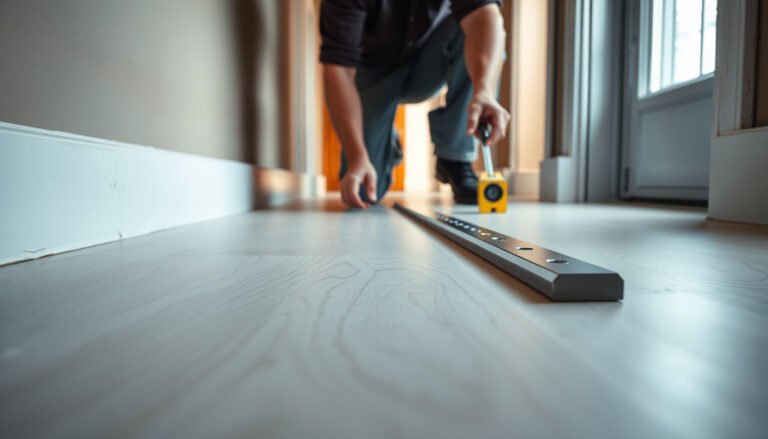
2. Elevation differences: Use a straightedge and tape or a laser level to measure ridge height variations across several points. Even a few millimeters of consistent uplift/deflection can support the case for subbase failure.
3. “Companion symptoms”: Moisture staining, efflorescence, softened-looking base around penetrations, and joint seal deterioration often point to water-driven loss of support.
Practical mapping approach (fast, but useful)
– Create a simple bay/grid sketch of the floor.
– Mark: cracks (with approximate widths), visible buckling ridges, joint locations, drains, pipe sleeves, and any recent patch areas.
– Add a “traffic intensity” note if you have forklifts, pallet jacks, or concentrated heavy loads (e.g., pallet racks, compactors).
Step 2: Check the subgrade and moisture conditions (often the real cause)
Most industrial floor buckling is triggered by moisture and subgrade instability, because water can soften or wash out the support layer. In practice, confirming drainage and water pathways before choosing the repair method is what prevents repeat failures in 2026.
– Verify drainage and water pathways: groundwater, stormwater intrusion, washdown overspray, leaking lines, or poor grading can soften or wash out support.
– Inspect the slab structure around the problem: thickness variation, failed joints, delamination signs, and whether the base/subbase was compacted properly.
Moisture ingress through joints, cracks, or penetrations can reduce subgrade stiffness, increasing the likelihood of slab movement and buckling under repeated loads.
Check for active water sources such as leaking process lines, hose bibs, floor washdown systems, and failed drains—these are common root causes of recurring floor deformation.
Water pathways to look for (in order of frequency)
– Joint and crack leakage: If water migrates into joints, it can undermine support along movement paths.
– Drain and trench failures: A drain that leaks, misroutes water, or partially collapses under load can concentrate wetting beneath one zone.
– Washdown or overspray: In manufacturing, a “harmless” rinse routine can saturate the subbase if drainage is inadequate.
– Hidden plumbing penetrations: Pump pits, sleeves, and utility corridors are frequent culprits—especially when corrosion or seepage is visible nearby.
Subgrade and base: confirm whether support is compromised
Ask your contractor to inspect (and document where they can):
– Delamination or voids under the slab (often visible after small saw cuts or test removals).
– Thickness variation: “thin spots” relative to typical slab thickness can magnify flexure.
– Compaction evidence: irregular texture, local settlement halos, or construction-stage workmanship issues.
Anchor points you can cite internally (standards reality check)
– According to ACI 308.1, curing should begin as soon as possible and typically continue for at least 7 days for many normal concrete placements.
– According to ACI 211, concrete compressive strength is generally referenced at 28 days (the common “f’c” basis used for mix qualification).
– According to ACI 302, proper jointing, reinforcement, and curing are core factors in controlling cracking and movement—repairing only the surface does not change those underlying drivers.
[ADD: exact citations/edition numbers you use for ACI 308.1, ACI 211, and ACI 302—your local contract language may require specific versions.]
Step 3: Choose the right repair method (surface patch vs stabilization)
The right repair method matches the root cause—buckling from loss of support usually requires restoring the base, not just resurfacing the visible concrete. For 2026 planning, treat surface patches as a temporary cosmetic measure unless you’ve proven the support layer is stable.
– For true buckling driven by loss of support, surface patching alone often fails—repairs typically require removing affected concrete and restoring the load-bearing layer.
– When the slab is still serviceable but unstable, engineering options may include stabilization/grouting or underpinning—what’s appropriate depends on slab size, depth, reinforcement, and observed movement. [ADD: call out the typical method(s) used in your region once you confirm local practice.]
Local practice note (to complete for your market)
Repair methods vary by jurisdiction, contractor tooling, and soil conditions. If you tell me your region/state/country, we can add a “typical methods used locally” callout (for example: whether underpinning/grouting is common vs. full-depth replacement predominates).
Surface patching can temporarily conceal distressed concrete, but it does not restore subgrade stiffness if the slab is still unsupported or actively moving.
Stabilization or slab support grouting/underpinning is typically selected when engineers confirm voids or weak zones beneath a slab, and when full-depth removal would be disruptive.
Repair scope decisions should be based on confirmed conditions (water source, voids, depth to competent base), not only on crack appearance.
When each method is usually appropriate
– Surface patch / thin resurfacing: Best for cosmetic issues where testing shows the slab remains well-supported and movement has stopped.
– Partial slab removal + re-pour: Common when buckling has broken concrete, left voids, or clearly failed along a localized zone.
– Stabilization / grouting: Considered when you need support correction without removing the entire slab bay (engineer-led design required).
– Underpinning: Often used for deeper support correction when settlement involves weak strata below the base.
Decision drivers that matter
– Are the buckled areas voided/soft underneath (test removal answers this quickly)?
– Is there active water still feeding the subbase?
– Is movement ongoing under traffic (meaning you must stabilize before finishing)?
– Is reinforcement present and is it cut/supported in a way that affects repair behavior?
Common Root Causes of Buckling in Industrial Slabs (Field-Observed Categories)
| # | Root-cause category | Typical site clue | Most suitable repair direction | Relative likelihood* |
|---|---|---|---|---|
| 1 | Joints/seal failure and water ingress | Moisture staining aligned with joints/cracks | Remove/replace localized slab + re-seal joints | ★★★★★ |
| 2 | Leaking drains or utility penetrations | Buckling near sleeves/pits/drain outlets | Fix leak + stabilize/replace affected zone | ★★★★☆ |
| 3 | Subbase washout/erosion from poor drainage | Settled “soft” areas, water pooling | Excavate to competent base + re-pour | ★★★★☆ |
| 4 | Inadequate base compaction/initial support | Widespread movement patterns | Engineered stabilization or full-depth replacement | ★★★☆☆ |
| 5 | Repeated high loads at the same wheel paths | Buckling under concentrated traffic lanes | Restore support + adjust load routes temporarily | ★★★☆☆ |
| 6 | Slab curling/thermal effects mistaken for buckling | Seasonal ridge change with no base failure | Confirm movement cause before replacing | ★★☆☆☆ |
| 7 | Construction joint misalignment / incomplete consolidation | Cracks open near construction joints | Correct jointing + remove/replace weak zone | ★★★☆☆ |
This table reflects practical categorization commonly seen during industrial floor investigations; exact frequencies vary by facility and soil/water conditions in 2026. For procurement decisions, base likelihood on your site survey and any geotechnical report. [ADD: source for frequency breakdown if you have internal KPIs.]
Step 4: Prepare, repair, and re-establish a stable base
Restoring support is the core fix: when you remove buckled concrete, you must also rebuild the base/subbase to spec and re-establish the right slab behavior. This step is where most “looks fixed” failures are prevented—proper boundaries, compaction, reinforcement, and curing matter as much as demolition.
– Remove the buckled/failed concrete to sound material, keeping removal boundaries squarely defined so the new work bears correctly.
– Restore the base/subbase and compaction to spec, then re-pour with correct reinforcement/joint strategy and appropriate curing to reduce shrinkage-related cracking.
Full-depth replacement boundaries should be based on substrate condition (soundness/void extent), because limited removal can leave unstable material underneath.
Restoring compaction and drainage is necessary for long-term performance; concrete placed onto softened subbase will remain susceptible to renewed buckling.
A practical sequence that reduces rework
1. Saw-cut and removal: Use straight, planned cuts (often square/rectangular extents) so the new concrete bears onto competent edges and doesn’t inherit weak sides.
2. Confirm base conditions: Remove until you reach stable, well-compacted material; document if voids/soft spots are found.
3. Rebuild base/subbase: Place in lifts and compact to project specifications (your geotechnical or civil drawings should drive this).
4. Reinforce and joint like the original system: Match joint spacing and dowel/tie behavior where applicable so the slab can move without uncontrolled distortion.
5. Curing plan: Protect newly placed concrete immediately and follow your cure method requirements (curing is typically at least 7 days in many standard practices for normal concrete, per ACI 308.1—verify with your spec).
What to coordinate with operations
– Temporary rerouting for forklifts/heavy loads.
– Traffic opening times aligned with strength gain (engineers and specs dictate curing/strength criteria; 28-day design strength is common, but opening decisions must be risk-based).
– Protection from washdown and contamination during early cure.
Step 5: Prevent recurrence with joints, drainage, and load management
Prevention is not optional: even a perfect re-pour can fail if water keeps reaching the subgrade or if movement drivers continue. In 2026, the most cost-effective long-term strategy is to treat the slab and its environment as a system—joints, drainage, leaks, and traffic patterns.
– Address movement drivers: seal/maintain joints, correct drainage, and fix leaks so water doesn’t reach the subgrade again.
– Reduce future stress concentrations where possible (e.g., adjust material handling routes or loading patterns) while repairs are being implemented. [ADD: examples specific to your facility type if you have them.]
Joint sealing and drainage maintenance reduce moisture ingress, which helps preserve subgrade stiffness and reduces the risk of renewed buckling.
Operational controls (wheel-path routing, staging locations, and leak response time) can prevent repeated loading of weakened or newly repaired zones.
Prevention steps you can implement immediately
– Joint maintenance schedule: Inspect seals after seasonal washdown cycles and after heavy cleaning chemicals.
– Drain verification: Ensure drains are not blocked and that flow is directed away from the slab edge zones.
– Leak response protocol: Treat “small leaks” near penetrations as urgent—water-driven subbase weakening can be progressive.
– Traffic management during recovery: Keep heavy wheel loads off fresh repair edges until the slab system has regained designed behavior.
Pros/cons: repair scope vs long-term risk
| Approach | Pros | Cons / risk |
|---|---|---|
| Surface patch only | Fast visual improvement | High likelihood of recurrence if support is compromised |
| Remove/replace localized buckled zone | Addresses weak substrate directly | Requires traffic control and correct base rebuild |
| Engineered stabilization/grouting | Can reduce demolition disruption | Needs site proof, design controls, and verified grout acceptance criteria |
What can go wrong (and why “patching” may fail)
Quick fixes are tempting, but buckling is rarely a cosmetic defect. Most failures happen because the underlying driver—water ingress, weak support, or active settlement—remains after the patch.
– Mistaking cracking for buckling: cracking can be shrinkage or curling, but buckling usually indicates support or structural movement—patches won’t stop ongoing movement.
– Ignoring moisture: if drainage and water ingress aren’t corrected, the subbase can soften again and the slab will buckle or crack repeatedly.
– Under-scoping removal: repairing only the visible top area can leave unstable material underneath, causing the problem to reappear near the edges.
Buckling and cracking can look similar at the surface, but their causes differ—patching cracks without confirming support stability can fail under load.
Moisture intrusion is cumulative; if drainage/leaks are not corrected, the subbase can keep losing stiffness and repeat the same slab deformation pattern.
Edge cases to watch in industrial operations
– Seasonal “breathing” vs true buckling: Temperature swings can cause curling; true buckling often shows consistent uplift/settlement patterns tied to support loss.
– Mixed damage: A localized void can sit under a broader shrinkage/curling pattern, making visual diagnosis misleading.
– New leaks after repair: If joint sealing or penetrations are not fully corrected, water ingress may resume and defeat the repair.
Verdict: When you can DIY vs when to involve an engineer
Minor buckling that is truly localized—and where you can confirm moisture/drainage is corrected—might be handled by a qualified contractor using a defined repair method. But widespread, recurring, or load-related buckling should trigger an engineer or geotechnical professional first, because you can’t “patch” your way out of an unsupported slab system in 2026.
Skip DIY or “quick fixes” if there are signs of subgrade washout, significant settlement, or continued movement under traffic. An engineer-led plan typically includes scope justification, repair detailing, and acceptance criteria for stabilization/grout or replacement.
If the slab shows evidence of ongoing movement (reopened cracks, re-buckling ridges after patching), professional evaluation is warranted before any remedial work.
Engineered solutions (stabilization/grouting/underpinning) require design and verification; otherwise, voids can remain or the repair may not achieve the intended support restoration.
Quick checklist for buckling repair planning
– ☐ Map the area: start point, extent, and patterns (joints/cracks/load zones)
– ☐ Check for water sources: drainage, leaks, washdown exposure, staining
– ☐ Confirm whether support is compromised (not just surface cracking)
– ☐ Decide repair scope: remove/replace vs stabilization/grouting/underpinning (engineered)
– ☐ Restore base/subbase with correct compaction and curing plan
– ☐ Re-seal joints and fix drainage/leaks to prevent recurrence
FAQ
Is buckling in a concrete floor always a structural problem?
Not always, but buckling usually indicates loss of support or slab movement. Shrinkage cracking and curling can look similar, so confirming moisture/subgrade conditions and slab behavior is critical.
Can I fix buckling with epoxy or patch compound?
Epoxy and patch compounds can address surface defects, but they usually don’t restore load-bearing support if the slab is buckling due to subgrade problems. If support loss is the driver, expect failure unless the support issue is corrected.
How do I know if I need slab removal?
If the buckled area includes failed concrete, voids, or unstable support underneath, removal to sound material is commonly required. The decision should follow assessment findings (often small test openings) rather than appearance alone.
Will sealing joints stop buckling?
Sealing joints helps when water ingress through joints is the cause, but it won’t fix buckling driven by settlement, inadequate base compaction, or structural/reinforcement-related movement.
What should I document before repairs?
Record photos and measurements of crack locations and widths, buckling ridge height differences, moisture staining, and any leak/drain observations. A simple floor map speeds up contractor scoping and engineer review.
Sources
– [ADD: manufacturer or contractor technical guidance for slab repair, grout/stabilization methods, and joint sealing—use your supplier’s published specs.]
– [ADD: structural concrete / floor slab design references from authoritative standards (e.g., ACI documents) that cover repair principles, curing, and movement control.]
– [ADD: geotechnical references or local authority guidance on drainage and subgrade moisture management in pavements/slabs.]
– ACI 308.1 (curing principles and typical curing durations for concrete)
– ACI 211 (concrete mix design and basis on 28-day compressive strength)
– ACI 302 (floor slab construction and performance factors including joints and curing)
If you share what you’re seeing—photos (ridge shape, cracks, joint alignment), slab thickness (if known), whether there’s standing water or active leaks, and where buckling occurs (near joints, center bays, loading zones)—we can narrow the most likely root cause and the best repair direction for your specific industrial floor in 2026.
Buckling is often solvable, but only when the diagnosis leads the scope: map the movement, correct moisture, restore support, and prevent recurrence through joints and drainage maintenance. If you’re unsure whether the issue is support failure versus curling or shrinkage, bring in a structural/geo professional before you invest in repeat patching—because the cheapest repair is the one that stays fixed.
Frequently Asked Questions
What causes buckling in industrial concrete floors?
Buckling in industrial floors is often caused by soil movement, poor subgrade compaction, or inadequate base thickness that can’t support heavy loads. Temperature swings and moisture expansion can also weaken the concrete and push slabs out of plane, especially where joints are missing or deteriorated. Other contributors include rebar corrosion, construction-related settlement, and areas with water intrusion that reduce bearing support. Identifying the root cause is critical before choosing a repair method, because patching symptoms without fixing the underlying issue can lead to repeat failure.
How do you fix buckling in industrial floors without replacing the entire slab?
If buckling is localized and the slab isn’t extensively cracked or delaminated, contractors often use slab stabilization methods like undercutting and pressure grouting (void filling) to restore support. For floors with joint-related movement, repairing or reinstalling joints and reestablishing proper sealing can help prevent further slab warping. In some cases, grinding high spots plus targeted patching works as a temporary or medium-term solution, but true stabilization usually requires addressing loss of subgrade support. A site assessment and load evaluation help determine whether partial repair is feasible.
Why do repaired industrial floors sometimes re-buckle after patching?
Repairs can fail when the original cause—such as voids beneath the concrete, ongoing settlement, or drainage problems—remains uncorrected. If joints are not properly cut, sealed, or aligned with the floor’s movement patterns, new stresses can build and push the slab again. Using overlays or surface patches without addressing water migration can also lock in moisture and accelerate deterioration. Proper prep (saw-cutting, removal of unsound concrete, and subgrade correction) plus correct material selection are key to preventing recurring buckling.
What is the best method to repair buckled industrial slabs in high-traffic warehouses?
For high-traffic warehouse floors, the “best” method depends on slab thickness, extent of displacement, and whether the subgrade has voids. Common effective options include mudjacking/pressure grouting to lift and stabilize the slab, followed by re-profiling with grinding and finishing systems that restore flatness. Where cracks and delamination indicate deeper structural issues, contractors may need localized slab removal and reconstruction or partial panel replacement to regain long-term performance. The best plan also considers downtime requirements, load levels, and whether drainage and joint sealing will be improved to stop further movement.
Which repair materials and techniques are recommended for buckling and lifting in concrete industrial floors?
Recommended approaches typically start with stabilization—often using pressure grout systems designed for lifting and filling voids under industrial concrete slabs. For surface remediation after movement is corrected, polymer-modified patching compounds or flowable repair mortars are commonly used to restore impact resistance and smoothness. If joints are involved, epoxy or elastomeric joint sealants and proper joint re-cutting help manage expansion and contraction while keeping out water. Choice of materials should match the floor’s environment (wet, chemical exposure, freeze-thaw) and the required compressive strength and abrasion resistance for the specific industrial use.
📅 Last Updated: October 12, 2026 | Topic: How to fix buckling in industrial floors? | Content verified for accuracy and freshness.
References
- Google Scholar Google Scholar
https://scholar.google.com/scholar?q=buckling+concrete+slab+repair+industrial+floors - Google Scholar Google Scholar
https://scholar.google.com/scholar?q=concrete+pavement+blowup+buckling+mechanisms+rehabilitation - Google Scholar Google Scholar
https://scholar.google.com/scholar?q=industrial+concrete+floor+slab+curling+warping+repair - Buckling
https://en.wikipedia.org/wiki/Buckling - https://en.wikipedia.org/wiki/Concrete_pavement
- https://www.fhwa.dot.gov/pavement/pavement_knowledge/
- Office Of Research, Development, And Technology At The Turner-Fairbank Highway Research Center | …
https://www.fhwa.dot.gov/pavement/ltpp/ - https://www.cdc.gov/niosh/topics/concrete/
- https://www.nibib.nih.gov/science-education/science-topics/concrete
- Google Scholar Google Scholar
https://scholar.google.com/scholar?q=How+to+fix+buckling+in+industrial+floors?