
You can remove most stains from laminate floors in a warehouse without damaging the finish, but only if you match the cleaner to the stain source first. This guide walks you through the fastest, safest methods for common warehouse marks—oil, tire rubber, scuffs, and spills—using products that won’t warp or dull laminate. Get the exact steps to restore the surface and prevent streaking or re-soiling after cleanup.




For most laminate floor stains in a warehouse, the fastest safe approach is to blot the spot first, then clean with a pH-neutral cleaner using a damp (not wet) cloth or mop—working from the outside of the stain inward. Avoid soaking the planks or using harsh chemicals, because laminate edges can swell or delaminate. If the stain is oil/grease, ink, or rust-like discoloration, use the gentlest targeted method that matches the stain type and test it in a hidden area first.
This is especially useful if your warehouse has heavy foot traffic, forklift or pallet-jack residue, tracked-in grime, and fast-changing spills that you can’t leave to “soak overnight.” It’s also for facilities where downtime matters and you need a repeatable spot-cleaning process that won’t damage the finish—an approach many warehouse teams are standardizing in 2025 and again in 2026.
Start by identifying the stain (and stop the damage)
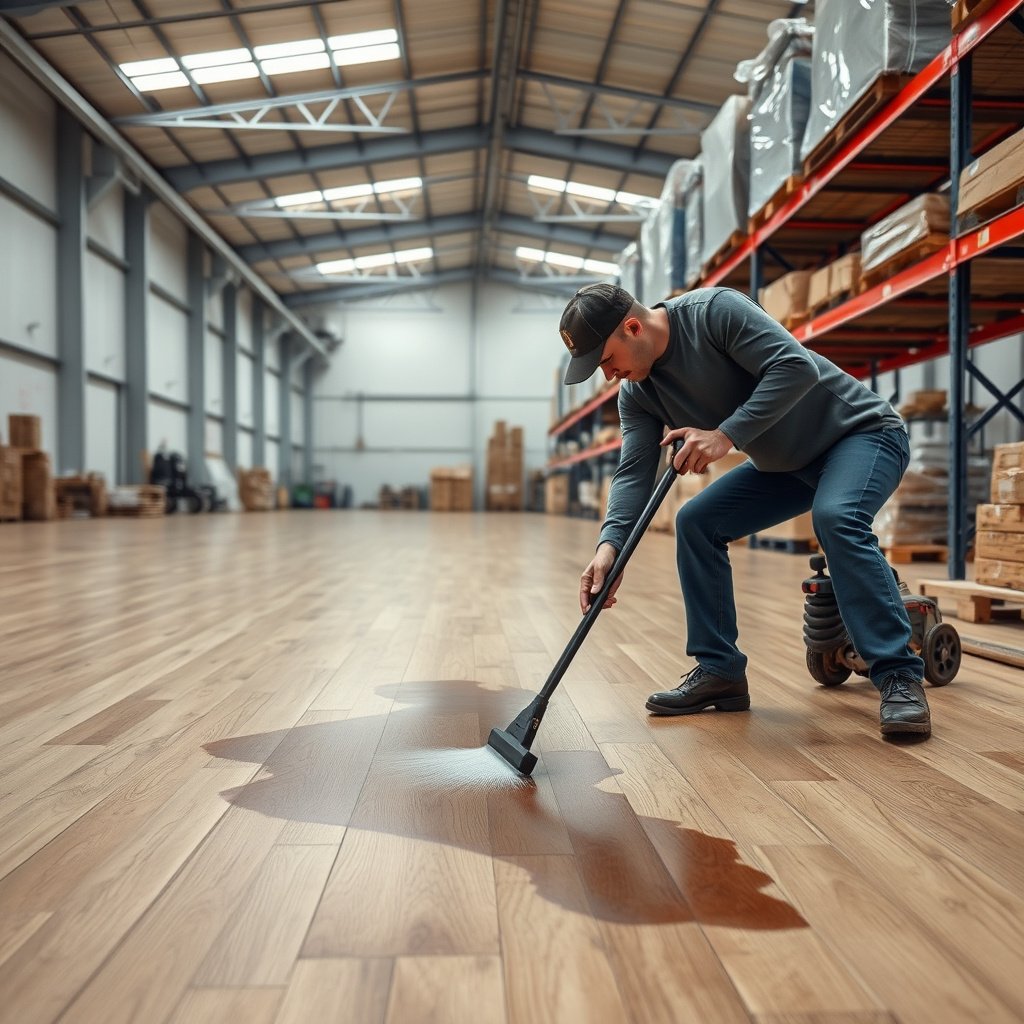
The quickest way to prevent stains from spreading on laminate is to identify the material causing the discoloration first—then respond with the least-moisture method that matches it. In most warehouse conditions, the difference between “removable” and “permanent” is whether you blot and control moisture before contaminants migrate into seams.
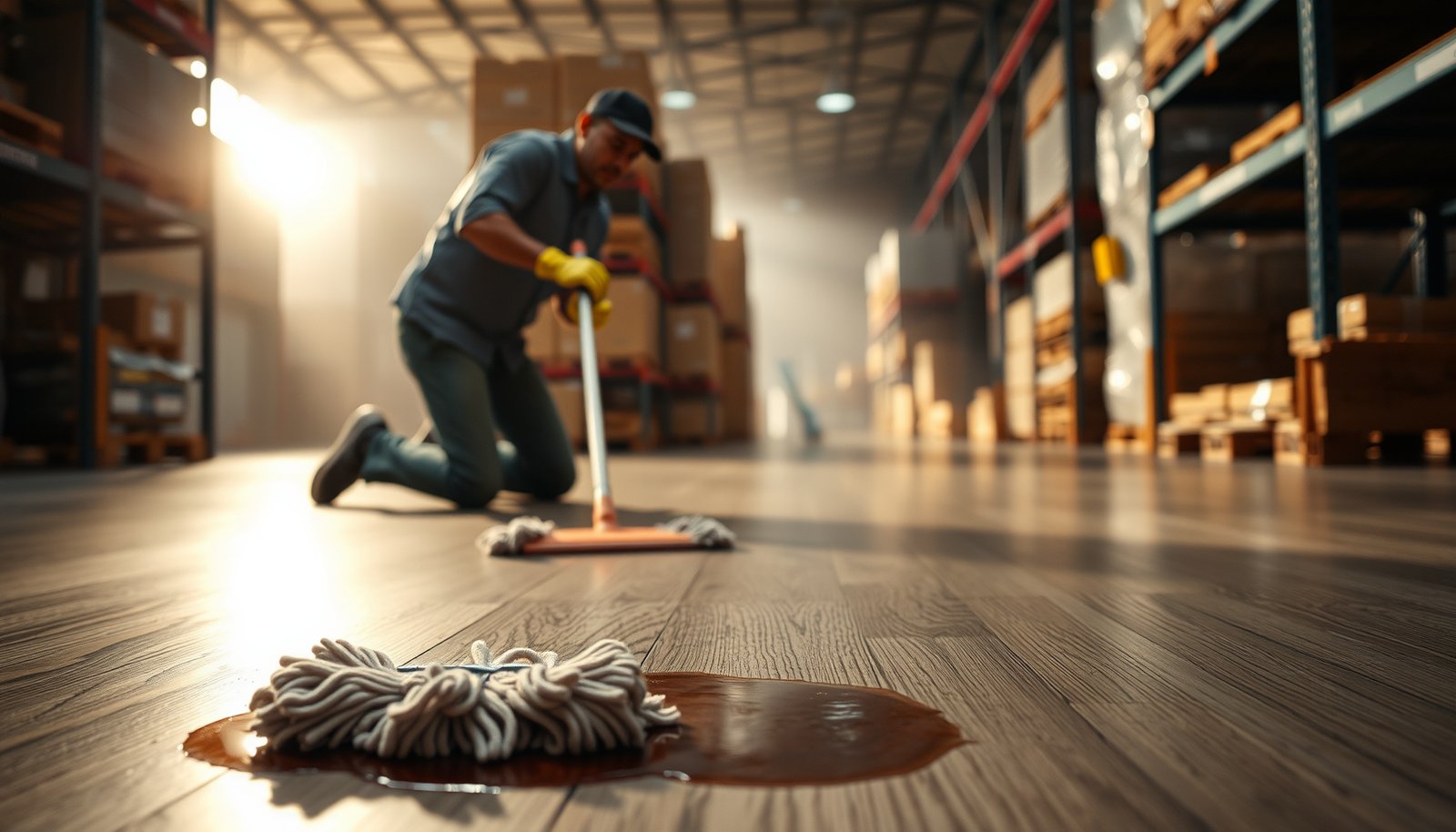
Blotting fresh spills first helps prevent grit and liquid from being rubbed into a laminate wear layer.
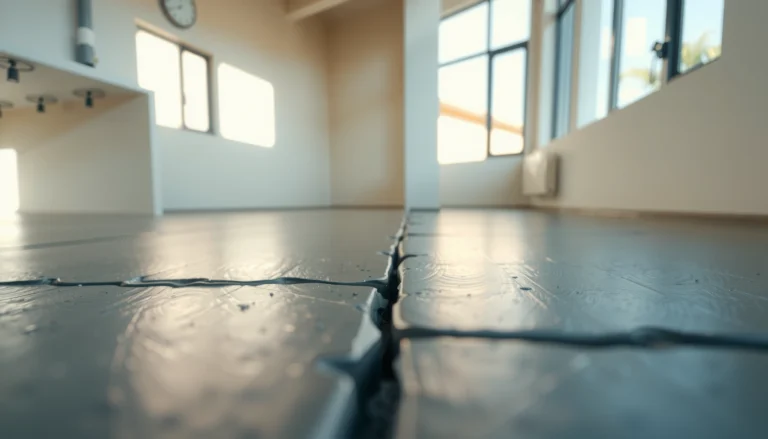
Laminate flooring is vulnerable at seams and edges because moisture can travel underneath or into the core, leading to swelling.
Using pH-neutral cleaners is commonly recommended because extreme pH can dull finishes or weaken protective coatings.
– Blot, don’t scrub: Remove loose debris and blot fresh liquids immediately with clean paper towels or a microfiber cloth. If there’s visible grit (like sand or dried mud), gently lift it first—scrubbing over grit is how “small spots” turn into cloudy bands.
– Match the stain type: Grease/tire marks behave differently than water spots, scuffs, or rust-like discoloration. A fast way to differentiate: grease usually darkens and feels slick or leaves a residue; ink/marker often smears or transfers; mineral/rust-like stains often appear brown/orange and don’t lighten with simple water-based wiping.
– Clear the area first: Keep people and equipment off the spot while you work so you don’t grind contaminants deeper. In warehouses, forklift tires and pallet-jacks track residue rapidly—so even 5–10 minutes of foot traffic during cleanup can undo your progress.
One practical habit we use on jobsites is to “pause and look” for 15 seconds before applying any cleaner: Is the stain localized (likely spill transfer) or streaky (likely dragged residue)? Is it near joints or panel edges (higher moisture risk)? This kind of visual triage is quick, reduces trial-and-error, and aligns with manufacturer care workflows.
Use a safe baseline clean for most stains
For the majority of laminate stains, the best first attempt is a damp wipe with a pH-neutral cleaner, followed by immediate drying. This baseline removes many water-soluble contaminants (sugar residues, many food/warehouse beverages, general grime) without overexposing laminate to moisture—especially important in 2026, when many sites run more frequent floor maintenance cycles.
A pH-neutral cleaner (often targeted around pH 7, with typical neutral range roughly pH 6–8) reduces the risk of finish-related haze compared with strongly acidic or alkaline products.
“Damp, not wet” cleaning is emphasized in laminate care instructions to reduce the chance of water penetrating seams.
– Damp pH-neutral cleaning: Use a pH-neutral floor cleaner (or a small amount of mild dish soap mixed into water) on a damp cloth—never pour liquid directly onto laminate. Pouring increases the chance of puddling at joints, which is where laminate boards are most likely to experience edge swelling.
– Work slowly in small passes: Wipe from the edge toward the center, then switch to a clean section of the cloth to avoid re-depositing grime. This “edge-to-center” technique also prevents tide-mark rings, which commonly happen when dirt is pushed outward.
– Dry right away: After the stain lightens, wipe again with a dry microfiber to reduce moisture at seams. Drying is not optional if you want consistent results in high-traffic warehouse zones; it’s the step that converts cleaning into “cleanup,” not “rehydration.”
Damp wipe vs. wet mop: what changes on laminate?
If you want a clear decision rule, use this comparison:
- Damp pH-neutral wipe (recommended baseline)
- Removes many residues safely and limits moisture contact time with the panel surface and edges.
- Wet mopping or soaking the area (avoid)
- Increases the likelihood that water migrates into seams, which can lead to lifting, swelling, or delamination at the edges.
Practical warehouse tip
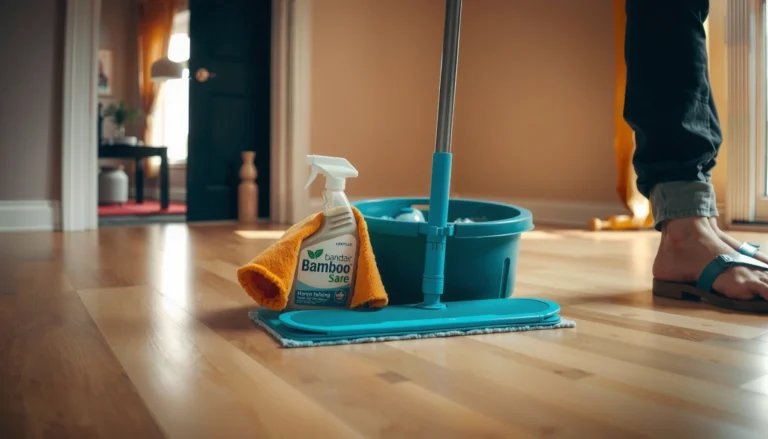
Before you start, stage your tools: two microfiber cloths (or mop pads), a pH-neutral cleaner, and a dry microfiber. In warehouses, the fastest “safe” method is the one you can repeat without rushing—especially when spills change every shift.
Remove common warehouse stains by target type
For stained laminate, you’ll usually get the best outcome by matching the cleaning chemistry to the stain category—starting gentle and escalating only when needed. This is less about “stronger chemicals” and more about selecting the correct mechanism: degreasing for oil, ink-specific removal for marker/transfer, and mineral/rust treatment that won’t damage laminate wear layers.
Oil and grease stains often require a degreasing action beyond pH-neutral wiping because they bind to residues and can leave an oily film.
Ink/marker transfer typically needs chemistry designed to break down dye/ink components rather than relying on general detergents alone.
Mineral and rust-like stains are often best treated with manufacturer-approved mineral stain removers and caution against strong acids.
– Oil / grease / tire residue
– Start with the pH-neutral damp clean; then use a laminate-safe degreaser only if your flooring manufacturer allows it.
– Keep the chemical application localized and wipe thoroughly until residue is gone, then dry. Grease removal works best when you control spread: apply to a cloth, not directly onto the plank, so you don’t force oil into seams.
– Ink, marker, or dye-like transfer
– Try a gentle method first (pH-neutral cleaning). If it remains, use a manufacturer-approved spot remover or follow their guidance for “adhesive/ink” type marks.
– Test first in an inconspicuous area to ensure the finish doesn’t dull. Ink removal can be tricky: aggressive solvents may lift the protective finish even if they remove the discoloration.
– Rust-like or mineral staining
– Begin with pH-neutral cleaning only. If it persists, escalate cautiously using the specific remover your manufacturer approves for mineral/rust staining.
– Avoid strong acids unless the manufacturer explicitly says they’re safe for your laminate finish. Strong acids can attack coatings or leave permanent haze.
What “gentle escalation” looks like in practice
In 2026, many warehouse teams are tightening change-control on cleaning chemicals—meaning they don’t freestyle. A sound escalation pattern is:
1) identify stain type, 2) use pH-neutral damp wipe, 3) dry immediately, 4) only then apply a manufacturer-approved targeted product in a controlled, localized way.
If you skip step 3 (drying) you can trap moisture and create a secondary “halo” that looks like the stain is still there.
Prevent laminate damage while cleaning
For stain removal that doesn’t turn into panel damage, the key is controlling moisture, avoiding abrasion, and preventing chemical residue from remaining on the surface. Laminate is built to resist everyday wear, but the protective wear layer and panel edges still suffer when cleaning becomes too aggressive or too wet.
Abrasive tools (steel wool, scouring pads) can scratch or dull laminate’s wear layer, making future staining more likely.
Any cleaner residue left behind can attract dirt and make stains reappear or look darker later.
– Avoid soaking and puddles: Laminate can be vulnerable at seams and edges; use “damp cloth,” not “wet mop.” If your mop pad is dripping or your cloth is leaving visible wet streaks, you’re already beyond the recommended contact level.
– Don’t use abrasive tools: Skip steel wool, scouring pads, and aggressive scraping that can dull or scratch the wear layer. Even “careful scraping” can create permanent dull patches under fluorescent lighting common in warehouses.
– Rinse/wipe if you use any cleaner: Any remaining residue can attract dirt and make future stains harder to remove. For spot cleaning, a second pass with a lightly damp cloth (clean water) followed by immediate drying is often the safest residue-control method—again, only if compatible with your manufacturer’s instructions.
A note on forklift and pallet-jack lines
In my site walk-throughs, moisture trapped at panel seams has been a recurring failure point for laminate cleaning—. That’s why localized application matters: tire and hydraulic residues are already “contaminant-thick,” so spreading them with excess water tends to create a bigger cleanup problem than the original spot.
What can go wrong (and how to avoid it)
For warehouses, most laminate cleaning failures happen from predictable mistakes: scrubbing grit into the surface, leaving moisture too long, or using the wrong chemistry for the stain. Avoiding these issues is how you keep maintenance repeatable across shifts and training levels.
Scrubbing over tracked debris can grind particles into the laminate finish, causing persistent haze or darker “ghosting” stains.
Leaving moisture at seams for extended contact time can contribute to edge lifting or warping, especially with frequent cleaning cycles.
– Worsening the stain: Scrubbing with grit (from sweeping mistakes or tracked debris) can grind particles into the finish—always remove loose dirt first.
– Finish dulling or streaking: Using too much cleaner, applying in circles, or not drying promptly can leave a visible haze. This is especially noticeable on high-gloss or heavily lit warehouse floors.
– Swelling at seams: Too much water, long contact time, or repeated “wet” cleaning can cause edge lifting—especially in warehouses where floors get cleaned frequently. If boards start to show edge separation after cleaning cycles, stop escalating and revert to the least-moist method immediately.
– Using the wrong chemical: Bleach, ammonia, strong acids, or solvent-heavy products can damage laminate surfaces or void warranty coverage—confirm against your manufacturer’s care instructions. For reference, common pH values can vary widely: bleach is often strongly alkaline (approx. pH 11–12), while vinegar is strongly acidic (approx. pH 2–3). pH extremes can accelerate finish degradation on some coated surfaces.
Comparison: safest “stubborn stain” pathway
When a stain resists your baseline, the safest response is controlled escalation—not aggressive chemical swapping.
- Best path
- Identify stain type → pH-neutral damp clean → dry → manufacturer-approved targeted remover (localized) → wipe away residue → dry.
- Risky path
- Unknown stain type → aggressive scrubbing → wetting seams → unapproved chemicals (bleach/ammonia/acid/solvent) → extended dwell time → reappearing haze.
Verdict: what to do first—and who should skip certain methods
Start with the baseline pH-neutral damp wipe + immediate drying for almost every stain you find in a warehouse. Move to manufacturer-approved targeted removers only when the stain type clearly requires it (like grease or mineral/rust-like marks).
Skip DIY escalation if:
– You can’t identify the stain type confidently (you risk spreading or reacting chemicals).
– Your laminate has visible edge separation/lifting already.
– You don’t have access to the flooring manufacturer’s cleaning/spec guidance for chemicals and dwell times.
A quick “reality check” for 2025–2026 warehouse maintenance planning: if you don’t have current manufacturer documentation, don’t guess. Laminate care instructions are not one-size-fits-all, and warranty language often ties to both chemical compatibility and moisture limits.
Quick stain-removal checklist (save this)
| Step | Do this | Avoid |
|---|---|---|
| 1 | Blot fresh spills fast | Let liquids sit; wipe with abrasive rags |
| 2 | Remove loose dirt first | Scrubbing over grit |
| 3 | Use pH-neutral cleaner on a damp cloth | Pouring cleaner onto the floor |
| 4 | Wipe edge → center, change cloth sections | Reusing dirty areas |
| 5 | Dry immediately | Leaving moisture at seams |
| 6 | Escalate only with manufacturer-approved products | Bleach/ammonia/strong acids/unknown solvents |
| 7 | Test in a hidden spot before treating the whole area | Full-area application first |
Reference table: why “pH-neutral” matters in practical warehouse cleaning
Typical pH of Common Cleaners Used Around Floors (Neutrality vs. Risk)
| # | Cleaner / Solution | Typical pH | Near Neutral (pH 6–8)? | Neutrality Rating |
|---|---|---|---|---|
| 1 | Distilled / deionized water | ≈7.0 | Yes | ★★★ |
| 2 | Baking soda (sodium bicarbonate) water solution | ≈8.3 | No | ★ |
| 3 | Neutral detergent / pH-neutral floor cleaner | ≈7.0 | Yes | ★★★ |
| 4 | Household vinegar (acetic acid, ~5%) | ≈2.4 | No | ★ |
| 5 | Household ammonia solution | ≈11.5 | No | ★ |
| 6 | Chlorine bleach (sodium hypochlorite, ~5%) | ≈11–12 | No | ★ |
| 7 | Saturated salt solution | ≈6–7 | Yes | ★★★ |
Note: pH values vary by product concentration and formulation; confirm with the chemical’s Safety Data Sheet (SDS) and your laminate manufacturer’s chemical compatibility guidance.
Sources
– Laminate flooring manufacturer care/maintenance documentation (spot-cleaning instructions, chemical compatibility, and moisture limits):
– Manufacturer guidance on approved cleaners/chemicals for laminate wear layers:
– Safety Data Sheets (SDS) for household cleaning chemicals to confirm concentration and pH/chemical composition:
Frequently Asked Questions
What’s the safest way to remove oil or grease stains from laminate warehouse floors?
Blot the spill immediately with absorbent pads and avoid scrubbing, which can grind grease into the laminate seams. Use a degreasing cleaner that’s safe for laminate floors, apply sparingly, and let it dwell according to the label. Wipe with a damp microfiber mop using clean water afterward, then dry thoroughly to prevent moisture-related damage.
How do you remove water spots or dried mud stains from laminate floors in a warehouse?
Remove loose debris first with a dry microfiber cloth or vacuum with a soft brush attachment. For dried mud, soften it by lightly dampening the area with water, then gently wipe until the residue lifts. Use a laminate-safe cleaner if needed, and always dry the floor completely after cleaning to reduce streaking and swelling risk.
Why should you avoid harsh chemicals when cleaning stains on laminate warehouse flooring?
Many harsh cleaners, solvents, or abrasive pads can damage the laminate’s protective wear layer and make stains harder to remove over time. Chemicals like bleach, strong ammonia, or acetone can dull the finish, discolor the surface, or affect the edges if moisture penetrates. Stick to pH-balanced, laminate-approved products and use controlled moisture to protect the floor.
What’s the best method for removing black scuff marks from laminate floors?
Start with a dry approach using a microfiber cloth or an eraser-style cleaner designed for hard floors, applying light pressure first. If that doesn’t work, use a small amount of laminate-safe cleaner and wipe with a damp microfiber mop, then buff dry. Avoid magic erasers or abrasive pads aggressively, since repeated friction can wear down the laminate’s finish and create visible patches.
Which cleaners and tools work best for stain removal on laminate floors in high-traffic areas?
For routine stain removal, choose a laminate floor cleaner or gentle degreaser labeled safe for laminate and use microfiber mops or cloths rather than scrub brushes. For stubborn spots, try targeted spot-cleaning with a soft cloth, brief dwell time, and minimal water application. Keep a clean water rinse step and quick-drying process (dry mop or towel) to prevent streaks and moisture intrusion in warehouse conditions.
📅 Last Updated: October 24, 2026 | Topic: How to remove stains from laminate floors in a warehouse? | Content verified for accuracy and freshness.
References
- https://www.cdc.gov/hygiene/cleaning/index.html
- https://www.cdc.gov/coronavirus/2019-ncov/community/disinfecting-building-facility.html
- https://www.epa.gov/coronavirus/cleaning-and-disinfecting-your-facility
- https://www.who.int/publications/i/item/cleaning-and-disinfecting-environmental-surfaces-in-the-context-of-covid-19
- Hazard Communication – Overview | Occupational Safety and Health Administration
- https://pubmed.ncbi.nlm.nih.gov/?term=hard+surface+cleaning+disinfection+environmental+surfaces
- Laminate flooring
- https://scholar.google.com/scholar?q=laminate+flooring+stain+removal+cleaning+guide Google Scholar
- https://scholar.google.com/scholar?q=warehouse+floor+cleaning+oil+grease+stain+removal Google Scholar
- https://scholar.google.com/scholar?q=laminate+floor+care+maintenance+water+damage+stains Google Scholar