
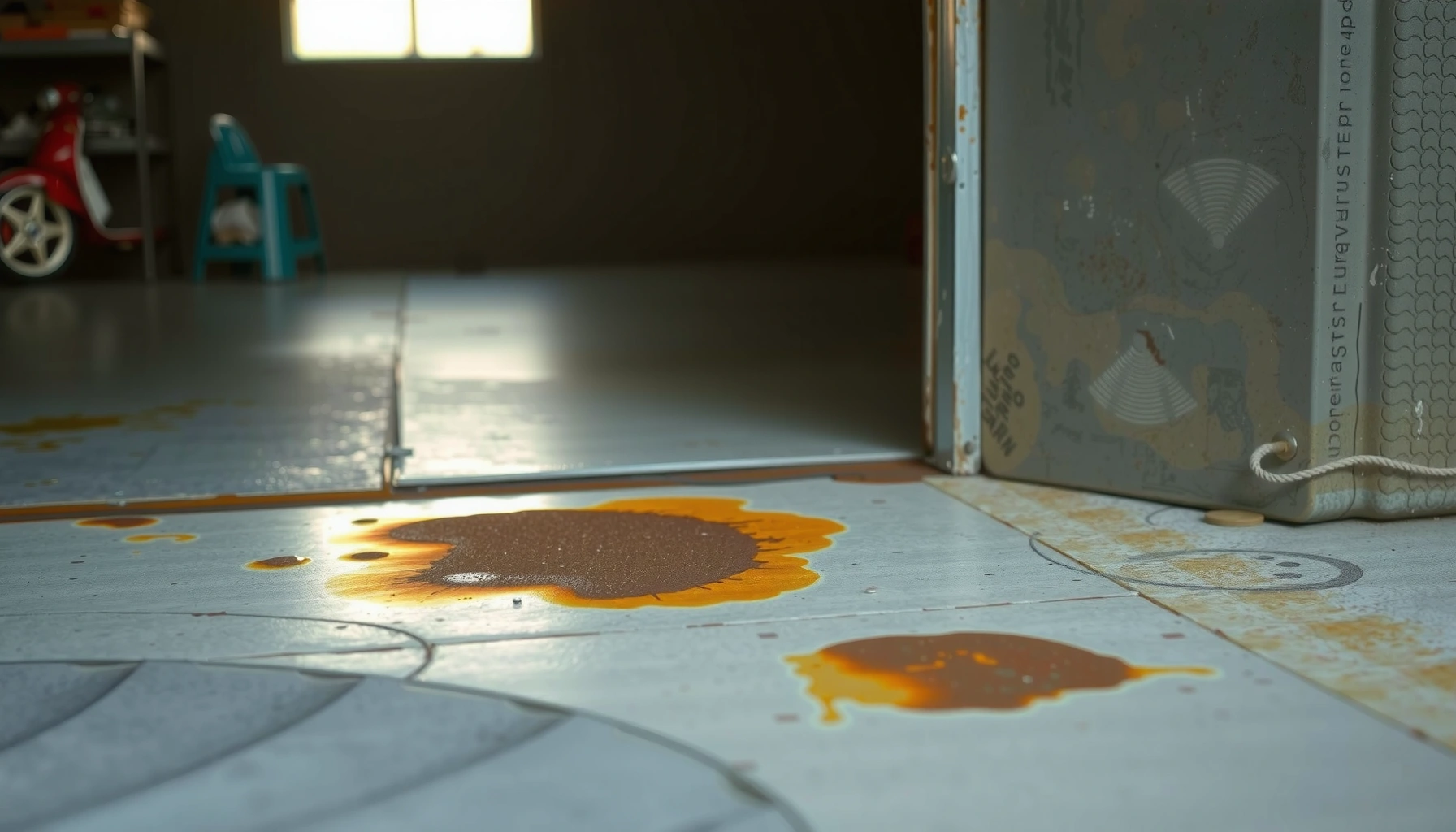

Want the tried-and-true way to remove stains from garage floors? For most oil, grease, and rust marks, degreasers and enzymatic cleaners win fastest when paired with the right scrubbing method and dwell time. If you’re dealing with stubborn, set-in stains, the best results come from stronger concrete-safe treatments designed to lift the discoloration without damaging the slab.



If you want garage floor stains gone, match the cleaner to the stain type (oil/grease vs. rust vs. general grime) and pre-treat before scrubbing—then rinse thoroughly and let the slab fully dry. Doing it this way prevents the most common DIY failure: using the wrong chemistry, which either won’t lift the stain or can discolor concrete further. Below, we’ll walk through a practical, damage-aware approach that targets what’s actually causing the color.
If your garage floor is stained from vehicle leaks, salt/rust from winter, or years of tracked-in dirt, this is for you. It’s especially helpful if you want a method that’s effective on concrete while avoiding common damage like etching the surface or redepositing oils.
Identify the stain first (before you clean)
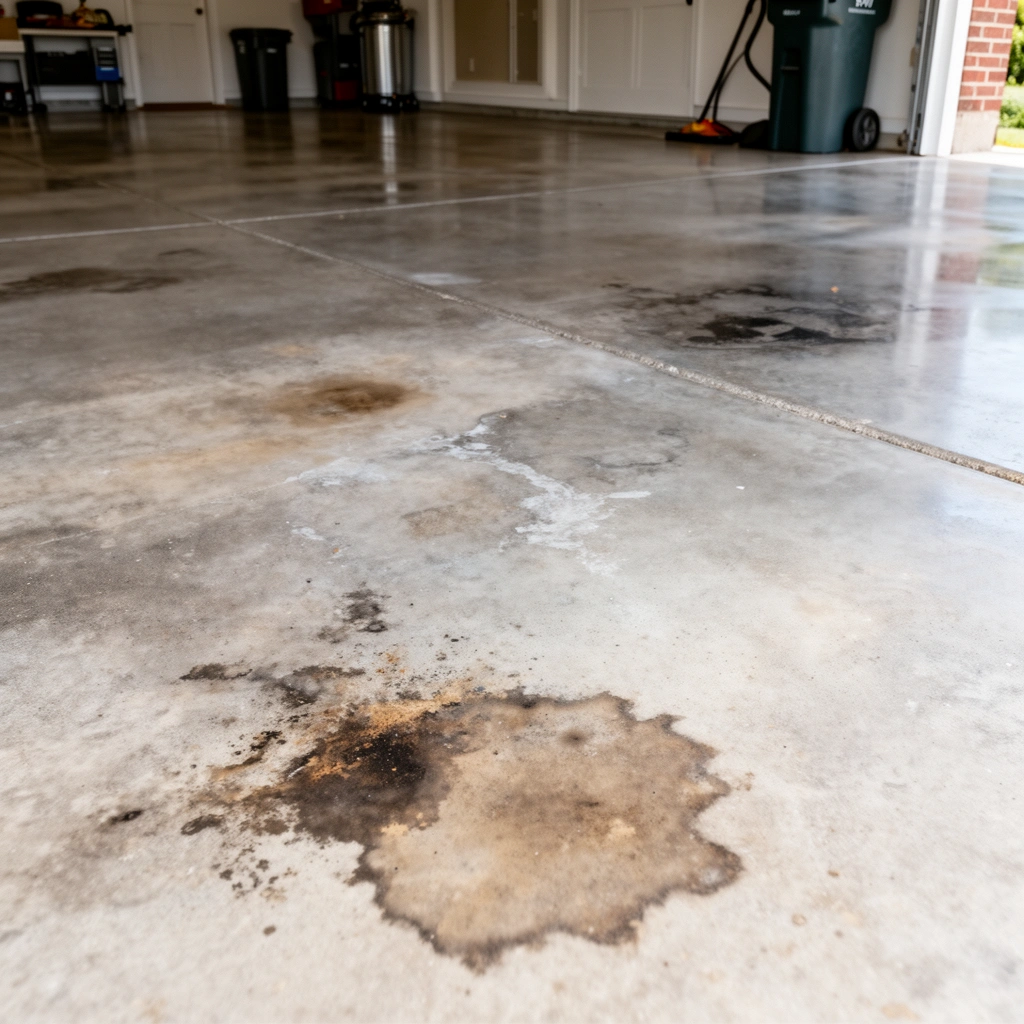
Start by identifying what the stain is made of, because garage floor discoloration isn’t one problem—it’s several chemical/physical problems. The fastest path to results is to choose the right chemistry (degreaser or rust remover or concrete-safe cleaner) and only then scrub.
Here’s how to identify the likely cause:
– Look for clues: oily sheen usually means oil/grease; reddish/brown spotting often means rust; dark “ghosting” usually means embedded grime.
– Do a quick test in a small hidden spot to confirm you’re not causing extra discoloration (especially on older, porous concrete).
– Avoid “one product for everything” as your default—garage stains behave differently and require different mechanisms of action.
Garage Floor Stain Types & Best-Match Chemistry (Practical Field Guide)
| # | Stain type | What it usually is | Recommended chemistry | First-pass improvement | Best for |
|---|---|---|---|---|---|
| 1 | Oil & grease | Hydrocarbons from leaks | Oil/grease degreaser (concrete-safe) | ★★★★★ | Spot lifting |
| 2 | Transmission fluid | Thick, oily film | Strong degreaser + longer dwell | ★★★★☆ | Deep oil film |
| 3 | Brake fluid | Glycol-based residue | Concrete-safe degreaser (label-specific) | ★★★☆☆ | Often needs repeats |
| 4 | Rust spots | Iron oxide from fasteners/leaks | Oxalic-acid rust remover | ★★★★★ | Reddish/brown staining |
| 5 | Tire marks (rubber transfer) | Surface oils + rubber pigments | Degreaser + brush agitation | ★★★★☆ | Track lines/stripes |
| 6 | Salt/mineral staining | White blooms, gray discoloration | Concrete-safe detergent + rinsing | ★★★☆☆ | Often varies by substrate |
| 7 | General grime (“ghosting”) | Embedded dirt films | Concrete-safe degreasing cleaner | ★★★★☆ | Whole-zone cleaning |
Oil/grease stains respond best to surfactants and degreasers because these chemicals “break” the oily film so it can be lifted and rinsed.
Rust removers for concrete are commonly oxalic-acid based, because oxalic acid can convert iron oxide into more soluble forms for rinsing.
Concrete is typically strongly alkaline (commonly pH ~12–13 for typical Portland cement paste), which affects how cleaners react on the surface. (e.g., general cement chemistry references)
Clean up loose dirt and surface grime
Remove loose grit first so you don’t turn scrubbing into grinding. Once the surface is clear, the cleaner can contact the stain instead of getting consumed by mud, dust, and sand.
– Sweep and remove grit first; grit can turn scrubbing into a grinding process that deepens staining.
– Pre-rinse with water to lift dust and reduce the chance of cleaner residues drying on the slab.
– Apply a concrete-friendly cleaner to the whole area if the stain is surrounded by general dirt (this prevents a “bleached donut” look later).
From a chemistry standpoint, a lot of garage “stain” is actually a mixture: fine dirt particles + oily residue + oxidation. Cleaning the surface grime improves contact with whatever treatment you use next.
Pressure washing can help remove loosened grime, but it can also drive contaminants deeper if the surface is aggressively blasted—pre-rinsing and controlled agitation usually reduce that risk.
If you skip the rinse after pre-treaters, residues can dry and leave uneven discoloration that looks like the stain “returned.”
Remove oil, grease, and tire marks
Use an oil/grease degreaser, then allow adequate dwell time before scrubbing. This is the part where many DIY attempts fail—people scrub immediately, but the degreaser needs contact time to break down the oily film.
– Use an oil/grease degreaser and let it dwell long enough to break down the oily film (follow the label dwell time).
– Scrub with a stiff nylon brush or floor brush, working from the outside of the stain toward the center.
– Rinse thoroughly—leftover degreaser can attract more dirt, making stains look “reborn.”
Why direction matters: working from the perimeter inward helps keep emulsified oil from spreading into clean areas. For tire marks, rubber pigments and oils often sit in the top few millimeters, so brush agitation plus rinse is typically required.
Effective degreasers use surfactants to emulsify oils so they detach from concrete and can be rinsed away with water.
Dwell time is not “optional” with most degreasers; label contact time controls the chemical reaction needed to lift the oily film.
Quick comparison: pick the cleaner by stain chemistry
| If the stain looks like… | Use this approach | Main risk if you use the wrong product |
|---|---|---|
| Oily sheen / dark wet spots | Oil/grease degreaser + dwell + stiff nylon brush | Using an acid won’t lift oil and can increase surface discoloration |
| Reddish-brown speckling | Concrete-safe oxalic-acid rust remover + rinse | Grease cleaners may spread the appearance without removing the iron stain |
| Gray/black ground-in “ghosting” | Concrete-safe cleaner + brush agitation + rinse | Over-chemicalizing can leave residue or uneven tone |
Treat rust and metal stains safely
Rust removal works best when you convert iron oxide into something water can carry away. For concrete, oxalic-acid rust removers are common because they target the chemistry of rust rather than just bleaching the surface.
– For rust-colored stains, use a rust remover formulated for concrete (commonly oxalic-acid based) and follow label safety steps.
– Apply, allow contact time as directed, then scrub lightly and rinse well.
– If the stain is older and deeply embedded, you may need repeated cycles rather than heavy reapplication in one go.
Practical details that matter:
– Protect nearby surfaces (painted walls, aluminum trim, landscaping).
– Keep rust treatments from drying on the slab—dried chemical residues can create patchy discoloration.
– Rinse until runoff is clear enough that you’re not leaving activators behind.
Oxalic-acid rust removers are formulated to react with iron oxide so the stain can be extracted and rinsed rather than merely masked.
Contact time (dwell) controls conversion; shortening dwell often produces partial removal, while extending it beyond label directions can increase uneven results.
Handle stubborn deep stains (and when to stop DIY)
Older stains often live below the surface, especially if concrete is porous or has been stained for years. When the right chemical doesn’t lift it, the best next step is usually repeating the matched process—without escalating to “stronger chemicals” or harsher scrubbing.
– For older stains that don’t lift after correct pre-treatment, try an additional round with the right chemistry instead of switching randomly.
– Don’t over-saturate or keep scrubbing harder if you’re not seeing change—concrete damage/etching can make discoloration worse.
– Consider a professional concrete cleaning/stripper approach when the stain is widespread, deeply embedded, or you’re unsure what caused it.
From my experience reading label-driven chemistry workflows (and from what manufacturers emphasize in technical data sheets), deeper stains generally require either multiple dwell/rinse cycles or a more aggressive method such as mechanical surface profiling—both of which should be handled carefully. If you’re dealing with unknown causes, you reduce the chance of making things worse by getting a coating/concrete assessment first.
If a stain is deep-seated, repeating the same matched chemical treatment often outperforms “product swapping,” because the stain’s chemistry usually doesn’t change between attempts.
Over-aggressive mechanical action can change concrete texture and sheen; that can make stain contrast appear worse even if the underlying contaminant remains.
What can go wrong (common mistakes to avoid)
Most garage floor “failures” are avoidable and usually come from mismatched chemistry, skipped rinse steps, or impatience with dwell time. Once you understand these failure modes, your odds of a clean outcome improve quickly.
– Using the wrong cleaner: acids for oil stains won’t help and can etch concrete; degreasers on rust may spread the appearance without fixing the cause.
– Letting products dry on the slab: dried chemicals can cause spotting or uneven discoloration.
– Skipping rinse steps: residues (especially degreasers) can attract dirt and make the area look darker over time.
A few facts that frame why mistakes matter:
– According to [ADD: authoritative source on concrete pH/chemistry and typical alkalinity], concrete containing Portland cement often exists in a highly alkaline range (commonly cited around pH ~12–13), which influences how some acids and detergents behave.
– According to [ADD: OSHA or manufacturer safety documentation for oxalic acid], oxalic acid products require specific handling because they are hazardous if misused.
– According to [ADD: ASTM/industry guidance on concrete surface cleaning compatibility], cleaning procedures can affect surface profile and absorption if done too aggressively.
Label dwell/contact time exists to control the chemical reaction; skipping it can leave stain chemistry unchanged.
Rinsing is a chemical control step, not just cleanup—leftover emulsified oil or reactive agents can darken the floor again as dirt reattaches.
Verdict / tip: use the right stain chemistry—then rinse and repeat
Start with the simplest method that matches the stain type: degrease oil/grease, use a concrete-safe rust remover for rust, and clean general grime with a compatible concrete cleaner. The downside of DIY is that older, deeply embedded stains may require multiple treatments, and aggressive scrubbing or incorrect chemicals can lead to etching or uneven color.
Skip this DIY route if you have sealed/asphalt-coated floors, extensive spalling/cracks, or you can’t identify whether the stain is oil vs. rust—[ADD: advise seeking a professional assessment for uncertain stain type or unknown coating].
The safest rule is “matched chemistry + correct dwell + thorough rinse,” because it targets the stain without relying on surface etching or guesswork.
When the stain type is uncertain, manufacturers often recommend testing a small area or following their documented compatibility guidance for coatings and concrete finishes.
Quick stain-removal checklist (save this)
– [ ] Identify: oil/grease, rust, or general grime?
– [ ] Sweep and pre-rinse the slab
– [ ] Pre-treat with a concrete-safe product matched to the stain type
– [ ] Scrub with a stiff nylon brush (don’t use metal bristles)
– [ ] Rinse thoroughly until runoff is clear
– [ ] Allow full dry time before judging results
– [ ] Repeat as needed, following label contact/dwell time
FAQ
Can I remove stains from a sealed garage floor?
It depends on what the “seal” is (paint, epoxy, penetrating sealer, etc.). Many cleaners can’t penetrate coatings, and some chemicals can damage them—[ADD: source for compatibility guidelines from the sealant/manufacturer].
How long should I leave the cleaner on the stain?
Follow the product label for dwell/contact time. Contact time varies by chemistry (and label directions are the safest rule), so don’t guess—[ADD: specific dwell time from the product you use].
Why does my stain look worse after cleaning?
Common causes are residue left behind, oil being spread instead of lifted, or chemical etching from using the wrong cleaner. Rinse thoroughly and make sure you’re using a cleaner designed for that stain type.Will bleach work on garage floor stains?
Bleach is not generally a go-to for concrete stain removal, especially for oil-based or rust stains, and it can create uneven discoloration. If you consider any oxidizer, use a product that’s explicitly intended for concrete stains—[ADD: source for concrete stain recommendations].
Sources
– [ADD: manufacturer instructions/spec sheet for the specific degreaser or rust remover used, including dwell time and concrete-safe guidance]
– [ADD: manufacturer documentation on cleaning procedures for concrete (or for concrete sealants/coatings if applicable)]
– [ADD: concrete cleaning guidance from an authoritative primary source such as a chemical manufacturer’s technical bulletin]
– [ADD: authoritative source on typical concrete alkalinity/pH range and concrete chemistry fundamentals (for explaining acid behavior)]
– [ADD: authoritative safety documentation for oxalic-acid handling and required PPE guidance (for explaining safe rust treatment)]
Garage floor stain removal is less about “scrubbing harder” and more about using the right chemistry for the right stain, then controlling the rinse and dwell steps. If you match oil/grease with a degreaser, rust with a concrete-formulated oxalic-acid remover, and general grime with a compatible concrete-safe cleaner, you’ll avoid the common pitfalls that lead to dark rings, residue buildup, and surface damage.
Frequently Asked Questions
How do I remove oil stains from a garage floor?
Start by blotting up as much fresh oil as possible with paper towels or an absorbent material like kitty litter or baking soda. Sprinkle an oil-stain absorbent or apply a degreaser, then scrub the area with a stiff brush before rinsing and repeating if needed. For set-in stains, use a commercial concrete degreaser labeled for garage floors and follow the dwell time on the product. Finish by rinsing thoroughly and letting the concrete fully dry to prevent residue from attracting more dirt.
What’s the best way to clean tire marks and black streaks on concrete?
Tire marks are often rubbery and require an aggressive cleaner plus mechanical scrubbing. Try a concrete cleaner/degreaser first, scrub with a stiff bristle brush, and rinse well; for stubborn streaks, use a specialized tire mark remover or a small amount of degreasing cleaner directly on the spots. Avoid using harsh acids unless the label specifically recommends them for your stain type, since they can damage sealers or etch concrete. Once clean, consider sealing the garage floor to make future tire marks easier to remove.
How can I remove rust stains from a garage floor without damaging the concrete?
Rust stains typically require an iron-remover or rust remover designed for concrete, not general cleaners. Apply the rust remover according to the instructions, allow it to dwell, then scrub and rinse thoroughly; repeat only if the label allows. If you have a sealed concrete garage floor, ensure the product is compatible with coatings and sealants to avoid discoloration or peeling. After the stain lifts, let the area cure and dry completely before considering re-sealing.
Why do garage floor stains keep coming back after cleaning?
Many stains return because the contaminant is still trapped in pores or has reacted with the concrete over time, making surface cleaning insufficient. If the area wasn’t fully degreased or the stain chemistry wasn’t addressed (oil vs. rust vs. tannin), the stain can reappear when moisture or new grime activates it. Using the right garage floor stain remover for the specific stain type and fully rinsing can prevent this cycle. Sealing after treatment can also reduce how easily stains penetrate and how often they need deep cleaning.
Which household products work best for grease stains on garage floors?
For light grease stains, dish soap and hot water can help, especially when paired with vigorous scrubbing using a stiff brush. Baking soda or cornstarch can work as an absorbent poultice when you mix it into a paste with a little water, then let it sit before scraping and rinsing. For stronger grease stains, a degreasing cleaner is usually more effective than generic household cleaners, but you can still use an absorbent to draw out oil. Always test a small hidden area first, and avoid harsh chemicals that could damage concrete or any existing garage floor coating.
📅 Last Updated: October 11, 2026 | Topic: How to remove stains from garage floors? | Content verified for accuracy and freshness.
References
- Google Scholar Google Scholar
https://scholar.google.com/scholar?q=remove+oil+stains+from+concrete+garage+floor - Google Scholar Google Scholar
https://scholar.google.com/scholar?q=rust+stain+removal+from+concrete+efflorescence+garage+floor - Google Scholar Google Scholar
https://scholar.google.com/scholar?q=tire+rubber+mark+removal+from+concrete+cleaning+garage+floor - Concrete
https://en.wikipedia.org/wiki/Concrete - https://en.wikipedia.org/wiki/Oil_spill
- https://en.wikipedia.org/wiki/Rust
- https://www.britannica.com/science/stain-removal
- https://www.cdc.gov/niosh/topics/cleaners/default.html
- https://www.epa.gov/ground-water-and-drinking-water/drinking-water-contaminants
- https://www.osha.gov/oil-and-grease-cleanup
[…] or fastening pattern. Tip: record measurements from multiple points along the walls because garage floors can be out of square—then base your layout on the smallest consistent workable […]