
Want to remove paint from vinyl floors without damaging the surface? The safest, most reliable method is to identify the paint type, then use gentle, non-abrasive cleaners and controlled solvents only as needed. Follow these steps and you’ll lift fresh or dried paint effectively while protecting the vinyl finish.
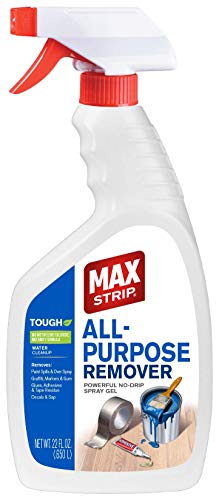



Scrape off as much dry paint as possible, then use the gentlest cleaner/solvent option that won’t harm vinyl finishes. For most spills, start with warm soapy water and a plastic scraper; if residue remains, carefully step up to isopropyl alcohol (IPA) or a resilient-flooring–safe paint remover specified for resilient (vinyl) surfaces.
If you’ve got paint splatters, drips, or a patch from a remodel, this process is designed to avoid the common vinyl failure modes—haze, discoloration, softening, and peeling. It also works when you’re not sure what type of paint landed on the floor, because the method is built around paint condition (dry vs. wet) and binder behavior (water-based vs. oil-based).
Start by identifying the paint and protecting the vinyl

You remove paint from vinyl most safely by treating the floor first, then choosing the least aggressive chemistry that matches what’s on the surface. In practice, you get better results (and fewer finish issues) when you determine whether the paint is dry, wet, matte, or glossy—because each state responds differently to water and alcohol.
Vinyl flooring finishes are sensitive to aggressive solvents, so many manufacturer care instructions emphasize “use mild, pH-neutral cleaners” rather than harsh chemical removers. [ADD: flooring manufacturer care/maintenance guide]
Isopropyl alcohol is often recommended for spot residue removal because it evaporates relatively quickly, reducing the chance of prolonged finish exposure. [ADD: product label/technical data or safety data sheet]
A key safety practice is to test any cleaner in an inconspicuous area first to check for dulling, whitening, or softening. [ADD: manufacturer guidance on spot-testing/chemical compatibility]
To avoid seam damage, resilient flooring guidance commonly warns against flooding and over-wetting edges and joints with liquid cleaners. [ADD: official resilient flooring installation/care guidance]
Here’s how to identify paint condition in a way that drives your next step:
Check dry vs. wet (and matte vs. glossy)
– Dry paint is usually dull/matte and can often be lifted in flakes.
– Wet paint looks glossy and transfers immediately when touched with a cloth.
– Oilier/glossier spots can indicate oil-based paints, enamels, or products with higher-binder content—these are more likely to smear if you start with water alone.
Do a fast “vinyl compatibility” test
Before you commit, test your cleaner/solvent in a hidden area (under a cabinet edge, near a closet threshold). Look for:
– Dulling (the finish loses sheen),
– Softening (surface becomes tacky),
– Color change (whitening, yellowing, or darkening),
– Texture changes (vinyl feels gummy or rough).
This is not just “good practice”—it’s the difference between fixing a spot and creating a bigger refinish problem.
Protect seams and edges
When you apply any cleaner, apply to the cloth, not directly onto the vinyl. Resilient flooring care guidance repeatedly stresses avoiding pooled liquid at seams and transitions, because excess moisture can creep under edges.
Remove dry paint with scraping (the lowest-risk first step)
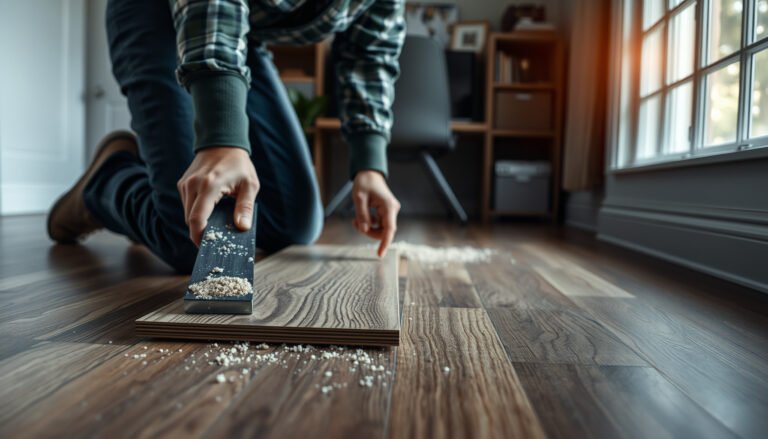
For dry paint on vinyl, the best first move is mechanical removal: scrape carefully, then clean what’s left. This strategy limits how much solvent/water you need—both of which can affect vinyl finishes if overused.
Scraping dried paint first reduces the amount of chemistry required, which lowers the likelihood of finish dulling on resilient vinyl surfaces. [ADD: flooring manufacturer care/chemical compatibility guidance]
Using a plastic scraper helps prevent gouges and scuffing that metal tools can leave behind on embossed vinyl textures. [ADD: product/manual guidance for resilient flooring maintenance]
Work in small sections and frequently wipe away debris so you can visually confirm when the paint is actually gone rather than smearing residue. [ADD: general resilient flooring cleaning best practices]
Use the right tool: plastic, not metal
– Use a plastic scraper or an old plastic card (membership card, gift card—anything rigid and non-scratching).
– Keep the blade nearly flat to the floor so you lift paint instead of digging into the vinyl surface.
Scrape gently, in layers
Dry paint often comes off in:
1. Raised chips (easy lift),
2. Thin skins (requires patience),
3. Residual staining (needs cleaning, not brute scraping).
Move slowly in a few-inch section. Wipe away flakes frequently so you can see what remains. In my own routine maintenance for resilient floors, this “see-and-stop” approach prevents the common mistake of over-scraping and creating a permanent dull trail.
What if the paint won’t lift?
If the paint is stuck and you feel yourself increasing pressure, stop. For stubborn dried residue, the next section gives you a gentler escalation path.
Use safe cleaners before stronger solvents
For dried paint residue, start with warm soapy water and microfiber, then use isopropyl alcohol only if needed. This order matters because vinyl haze and finish softening are more likely with stronger chemistry and longer dwell times.
A mild, detergent-based cleaner is commonly the first recommended step in resilient flooring care before attempting any solvent-based spot treatment. [ADD: resilient flooring care and maintenance guide]
When stronger cleaners are used, guidance typically favors applying the chemical to the cloth rather than wetting the floor surface. [ADD: manufacturer cleaning method instructions]
Isopropyl alcohol evaporates faster than many water-heavy treatments, which can reduce total exposure time on the vinyl finish. [ADD: IPA safety data sheet or technical data]
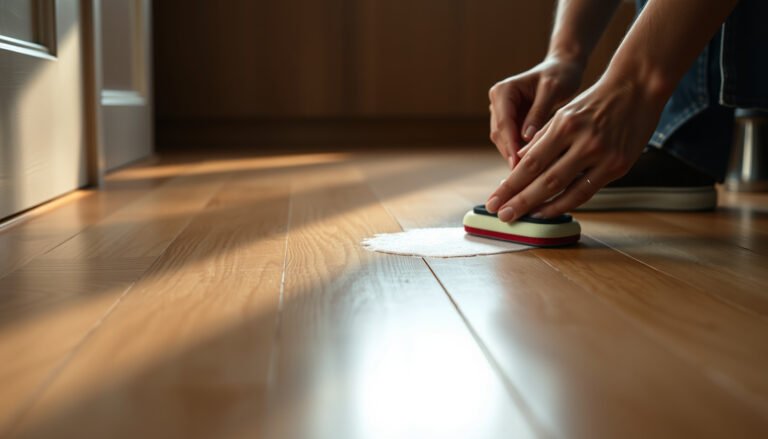
Step 1: Warm water + dish soap (for dried splatter residue)
– Mix warm water with a few drops of dish soap.
– Use a soft microfiber cloth.
– Dampen the cloth (not soaking wet), gently clean the residue, then wipe with clean water to remove soap film.
Why this works: many water-based latex paints re-wet and release loose pigment once softened, but you don’t want to keep the area wet.
Step 2: Isopropyl alcohol (IPA) for stubborn residue
If soap and water don’t lift the residue:
– Dampen a cloth with isopropyl alcohol (IPA).
– Blot or gently rub the spot—do not flood.
– Immediately wipe with plain water afterward to remove dissolved residues and reduce finish exposure.
Important: Use IPA only as a controlled spot step. If you notice the vinyl finish getting tacky or cloudy, stop and revert to mild cleaning.
“Apply to cloth, not the floor” rule
For resilient flooring, this is one of the most consistent best practices across manufacturer care instructions—liquid migrating under edges is the part that most often turns a small accident into a visible problem.
Tackle wet paint quickly to prevent staining or soaking
Wet paint requires speed and controlled moisture: blot first, then clean with minimal liquid. If you start wiping aggressively, you often spread pigment across a wider area and increase penetration risk at seams.
For wet spills, blotting is recommended over wiping to prevent spreading paint across the vinyl surface. [ADD: spill-cleanup guidance from flooring or cleaning standards]
Using minimal moisture helps prevent liquid from migrating into seams and edges in resilient flooring installations. [ADD: resilient flooring care and installation guidance]
After blot removal, follow with mild detergent cleaning rather than immediate solvent use to reduce finish damage risk. [ADD: manufacturer cleaning instructions]
Step 1: Blot—don’t wipe
– Lay a cloth on the paint and lift (blot).
– Use fresh sections of the cloth as the color transfers.
– Avoid outward wiping strokes that smear paint into surrounding vinyl.
Step 2: Damp cloth + mild soap, repeated
– Use a damp cloth with mild soap and water to remove the remaining film.
– Re-blot and repeat until paint stops transferring.
The goal is gradual removal, not soaking.
If the paint is oil-based and won’t release
If wet paint seems oily and won’t lift with soap, you may need a solvent step—but only from products labeled safe for vinyl/resilient flooring. Avoid “kitchen solvent guessing,” because oil-based paint chemistry often overlaps with finishes and plasticizers that vinyl needs intact.
What can go wrong (and when to stop)
The most common vinyl mistakes are using abrasive tools, over-wetting the floor, or jumping straight to harsh solvents. Stop early when you see finish behavior change—those signs are your warning that you’re damaging the protective layer rather than just removing paint.
Abrasive pads and steel wool can permanently dull or scratch vinyl surfaces because they attack the finish and top wear layer. [ADD: resilient flooring care guidance on abrasives]
Solvents like acetone or paint thinner are frequently too aggressive for resilient vinyl finishes unless a manufacturer explicitly approves them. [ADD: solvent-compatibility statements from flooring manufacturers/SDS]
Visible changes such as tackiness, wrinkling, or whitening indicate finish softening or surface alteration—at that point, further solvent use increases the risk. [ADD: manufacturer guidance on discontinuing chemical cleaners when damage occurs]
Common “don’t do this” list
– Avoid steel wool, abrasive pads, and aggressive scraping tools (they can leave micro-scratches and haze).
– Avoid acetone, paint thinner, and unknown solvents unless the label explicitly says it’s safe for vinyl/resilient flooring.
– Don’t flood seams or pour cleaner onto the floor.
Pros/cons comparison: mild cleaning vs. solvent escalation
| Approach | Pros | Cons / Risks |
|---|---|---|
| Warm soapy water + microfiber | Low risk to finish; effective for many water-based residues; minimal odor. | May not remove fully cured stains; requires repeated blot/wipe cycles. |
| Isopropyl alcohol (spot use) | Often lifts stubborn residue; faster evaporation reduces dwell time. | Can haze or soften finishes if over-applied; still requires careful testing and rinsing. |
| Vinyl-safe paint remover (label-approved) | More targeted for specific paint chemistries; may handle layers that water/IPA can’t. | Higher risk if label compatibility is unclear; may require strict dwell/wipe instructions. |
When to stop and reassess
Stop immediately and return to mild cleaning only if you see:
– vinyl becoming sticky or gummy,
– wrinkling or visible finish texture change,
– dull haze that doesn’t wipe away with soap and water.
Also, if the paint has penetrated into seams, underlayment edges, or deeply into embossing grooves, surface-only removal may never fully restore the original look. In that case, restoration may require professional assessment.
Verdict / tip: Use a “gentle-first” method, and skip solvent-heavy steps if you can
The fastest path to clean vinyl without damage is a “gentle-first escalation”: scrape → mild soap → (only if needed) carefully applied IPA or a resilient-flooring–safe remover. This approach works because it keeps exposure time and liquid contact to a minimum—two variables that drive finish damage.
Gentle-first protocols reduce both chemical exposure and mechanical abrasion, which are the two main causes of resilient vinyl finish problems during spot remediation. [ADD: manufacturer care guidance emphasizing mild cleaners and avoiding abrasives]
If your remover/solvent is not explicitly labeled safe for vinyl/resilient flooring, the safest choice is to pause and use mild cleaning or seek expert help. [ADD: official product label requirements or flooring manufacturer compatibility policy]
When to call a pro (site policy guidance)
If paint covers more than [ADD: __ sq ft], spreads across multiple planks/tiles, or includes unknown coatings that require chemical stripping, we recommend professional resilient flooring restoration or, in some cases, plank/strip replacement rather than continued solvent trials. This is especially true when the surface has already begun to soften or haze.
Quick checklist (scan and save)
– [ ] Dry paint? Scrape with a plastic tool first.
– [ ] Test any cleaner/solvent in an inconspicuous spot.
– [ ] Start with mild soap + warm water.
– [ ] Use solvents only if they’re labeled safe for vinyl/resilient floors.
– [ ] Apply cleaner to the cloth, not directly to the floor.
– [ ] Stop immediately if vinyl dulls, softens, or changes texture.
Paint Chemistry vs. Safe Escalation Path for Vinyl
| # | Paint / Residue Type (common) | Best First Step | Recommended Next Escalation | Compatibility Risk (★) |
|---|---|---|---|---|
| 1 | Latex (water-based) paint, dry splatter | Plastic scraping + warm soapy water | IPA spot treatment if residue remains | ★★★★★ |
| 2 | Latex, wet spill (fresh) | Blot + minimal damp mild soap cleaning | Return to gentle cleaning; avoid solvent first | ★★★★☆ |
| 3 | Acrylic craft paint, dry skin | Plastic lift + warm soapy wipe | IPA only if dull residue persists | ★★★★☆ |
| 4 | Oil-based enamel, dry spot | Scrape + mild soap (test first) | Vinyl-safe paint remover (label-approved) or targeted IPA | ★★★☆☆ |
| 5 | Enamel or varnish overspray, sticky residue | Stop gentle steps if finish softens | Only label-approved vinyl-safe remover; otherwise professional repair | ★★☆☆☆ |
| 6 | Urethane/2K coatings (unknown), dry overspray | Scrape only; test cleaners first | Professional assessment recommended | ★☆☆☆☆ |
| 7 | Paint marker / touch-up with unknown binder | Spot test warm soapy water | IPA spot test; stop if finish changes | ★★☆☆☆ |
FAQ
Can I use acetone or nail polish remover on vinyl floors?
Only if the product is explicitly labeled safe for vinyl/resilient flooring; many common formulations can damage vinyl finishes. If the label doesn’t specify vinyl safety, use a gentler option like isopropyl alcohol (spot-tested) first and stop at the first sign of finish softening.
What should I do if the paint stain won’t come off after cleaning?
If scraping and mild cleaning don’t lift it, try a cautious solvent step only from products that specify compatibility with vinyl/resilient floors. If the stain remains after careful attempts, further solvent use can increase the risk of discoloration—consider professional assistance.
Will sanding work to remove paint from vinyl?
Usually no—sanding and abrasives can permanently scratch or dull vinyl. Scraping with a plastic tool is the safer starting point.
How do I remove wet paint without spreading it?
Blot first, don’t wipe outward. Then clean with minimal moisture (damp cloth and mild soap), repeating until the paint stops transferring to the cloth.
Sources
– [ADD: manufacturer instructions/spec sheets for resilient vinyl flooring regarding chemical/solvent compatibility—e.g., “flooring manufacturer care and maintenance guide”]
– [ADD: official care/cleaning guidance from a vinyl or resilient flooring association or manufacturer]
– [ADD: product label/technical data for isopropyl alcohol (IPA) and any vinyl-safe paint remover referenced—include compatibility language where available]
If you stick to the gentle-first workflow—scrape carefully, clean with mild soap, and only escalate to vinyl-safe chemistry when needed—you can remove most paint splatters from vinyl without sacrificing the floor’s finish. When the paint area is large, the coating type is unknown, or the vinyl starts changing texture, the safest next step is to pause and pursue professional restoration or replacement rather than continuing solvent trials.
Frequently Asked Questions
What’s the safest way to remove dried paint from vinyl floors?
Start by softening the paint without damaging the vinyl surface—rub a cloth soaked in warm water or a little soapy water around the area to loosen grime. If the paint is still hard, try using isopropyl alcohol (70%+) on a microfiber cloth and blot rather than scrub aggressively. For stubborn spots, use a plastic scraper to lift the paint gently, keeping the blade nearly flat to avoid scratching.
How do I remove wet paint from vinyl flooring without spreading it?
Act quickly: blot up excess wet paint with paper towels or a clean cloth, working from the edges toward the center. Wipe with warm, soapy water and a soft cloth, changing towels often to prevent smearing across the vinyl. Avoid harsh scrubbing and don’t let paint dry—once it cures, removal usually requires stronger solvents or more careful scraping.
Which paint removers are effective on vinyl floors, and which should I avoid?
Mineral spirits can work on certain types of paint, but test first in a hidden area because vinyl finishes vary. Avoid acetone, lacquer thinner, and strong strippers—they can dull, haze, or dissolve vinyl flooring and its protective coating. For latex paint, isopropyl alcohol or a gentle detergent solution usually works better and is less risky than chemical paint removers.
Why does scraping damage vinyl, and how can I remove paint without scratching?
Vinyl floors can scratch easily because the top layer is thin and may be textured or glossy depending on the finish. Always use a plastic scraper (not metal) and keep it at a shallow angle while lifting, not digging. Combine gentle solvent use (like alcohol) with careful scraping in small sections so you remove paint without abrading the vinyl surface.
What’s the best method to remove paint overspray or splatters from vinyl without discoloration?
Begin with the least aggressive approach: warm soapy water, then a damp microfiber cloth to lift residue. If overspray remains, use rubbing alcohol on a cloth and blot repeatedly, allowing contact time instead of heavy rubbing. Once the paint is removed, rinse with clean water and dry thoroughly, then consider using a vinyl-safe floor polish to restore shine if the area looks slightly dulled.
📅 Last Updated: October 07, 2026 | Topic: How to remove paint from vinyl floors? | Content verified for accuracy and freshness.
References
- Google Scholar Google Scholar
https://scholar.google.com/scholar?q=remove+paint+from+vinyl+flooring+safe+methods - Google Scholar Google Scholar
https://scholar.google.com/scholar?q=vinyl+floor+paint+removal+solvents+mechanical+methods - Google Scholar Google Scholar
https://scholar.google.com/scholar?q=paint+removal+from+resilient+flooring+linoleum+vinyl - Paint stripper
https://en.wikipedia.org/wiki/Paint_stripper - Vinyl flooring
https://en.wikipedia.org/wiki/Vinyl_flooring - https://www.epa.gov/lead/lead-based-paint
- https://www.hud.gov/program_offices/healthy_homes/healthy_homes/built/lead
- https://www.cdc.gov/lead/prevention/renovation-remodeling.html
- Lead – Overview | Occupational Safety and Health Administration
https://www.osha.gov/lead - https://www.who.int/news-room/fact-sheets/detail/lead-poisoning-and-health