


You can remove odors from outdoor floors effectively by tackling the source first—whether it’s spills, algae/mold, pet waste, or trapped grime. This guide gives you the fastest, most reliable steps and the right cleaners to use so smells lift without damaging concrete, pavers, or decking. You’ll know exactly what to do, from prep and scrub to rinse and deodorize, to stop the odor from coming back.




Odors from outdoor floors usually come from trapped moisture, organic messes (mildew, leaves, pet waste), or porous materials that hold smells. Start by removing the source, then deep-clean with a suitable cleaner, and finish by thoroughly drying and increasing airflow so the odor can’t return. This guide walks you through a step-by-step approach for common outdoor surfaces.
If you’re dealing with smells on patios, decks, walkways, pool decks, or garage entry slabs—especially after rain, spills, or seasonal storage—these methods can help. Choose steps based on your floor material (concrete, wood/composite, pavers, tile, or rubber) to avoid damage.
Who this is for: These steps are for homeowners, property managers, and facilities teams dealing with recurring musty, sour, or “organic” odors outdoors—especially after wet weather, spills, or when outdoor spaces have been closed up. The process is designed to be material-safe and to target the actual odor source (moisture and organics), not just mask the smell.
Identify the odor source (before you clean)
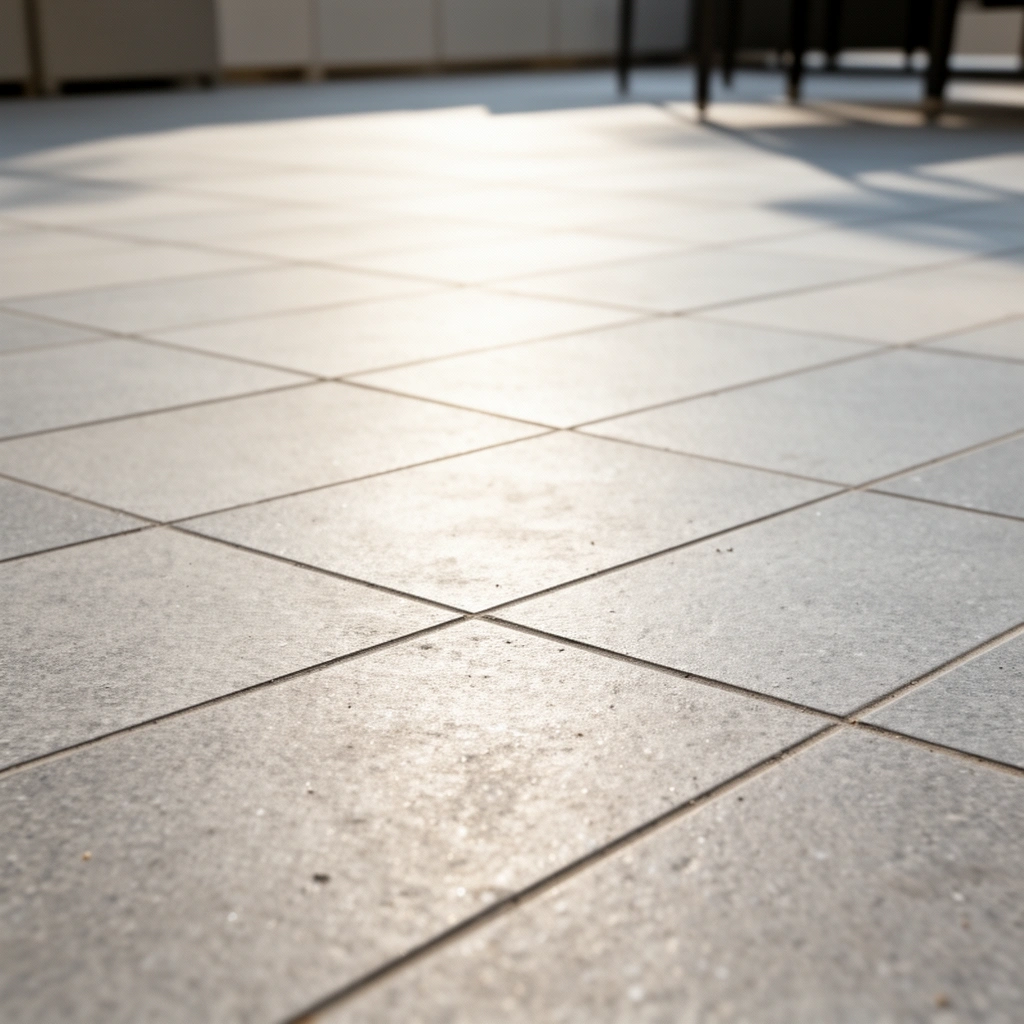
You’ll remove odors faster and more permanently when you identify what’s feeding the smell first—organic buildup or trapped moisture. If the odor returns within 24–48 hours of cleaning, it usually means the cause is still present (often moisture in grout lines, low spots, or under grime).
Start with a quick, practical inspection: sweep away loose debris and look for what’s actively holding odor. From there, decide whether you’re dealing with surface-level contamination (leaves, algae film, fresh spills, pet spots) or deeper organic staining (mildew embedded in pores, urine absorbed into textured surfaces).
If the odor returns quickly, you’re likely not finished—residual moisture in pores, joints, or low areas can restart odor production.
Mildew and algae odors typically track with visible dampness, dark streaks, or slick growth, not just “old” dirt.
What to look for during inspection
– Obvious buildup: leaves, algae mats, standing water, mud residue, spilled food/drink, pet waste spots.
– Moisture indicators: persistent damp patches, staining that darkens after rain, a floor that dries slowly compared to surrounding areas.
– Porous trapping points: expansion joints, grout lines, textured broom finishes, paver seams, and edges where water collects.
Moisture is the reset button for many outdoor smells
According to the U.S. Environmental Protection Agency, mold can begin to grow within 24–48 hours after water exposure (EPA: Mold and Moisture guidance). That’s why “I cleaned it, and it still smells” often points to wetness that wasn’t fully removed. Similarly, the CDC notes that mold can grow when relative humidity is sustained above about 60% (CDC: Mold and health guidance)—outdoors, humidity still matters because moisture films and repeated wetting keep growth conditions active.
Clear debris and pre-rinse properly
You’ll get better cleaning results when you remove loose material first and pre-rinse gently to avoid pushing grime deeper. This matters because odors often live in seams and pores where dirt gets compacted.
I recommend treating outdoor floors like a “pre-treatment” step: sweep, then rinse to lift remaining grit. Avoid the temptation to blast everything at full pressure—driving soil deeper can make odors harder to remove later.
Sweeping first reduces the amount of organic debris that cleaners need to break down and helps prevent re-deposition.
Gentle pre-rinsing lifts loose dirt without packing it into cracks, joints, or textured surfaces.
Debris removal checklist (do not skip the details)
– Sweep thoroughly, including edges, joints, grout lines, and corners.
– If debris is stuck to pavers or broom-finished concrete, use a stiff bristle broom and small hand brush for seams.
– Pre-rinse with water:
– Use a hose with a spray nozzle on moderate pressure.
– Keep rinsing movement consistent, so you’re pulling soil out rather than grinding it in.
Textured surfaces need extra seam attention
For pavers, the odor-causing film often sits between stones. For concrete with broom finish, grime settles in micro-texture. Spend extra time on gaps and seams during both sweeping and pre-rinse.
Use the right cleaner for your outdoor surface
The fastest path to real odor removal is matching the cleaner chemistry to the odor cause and the floor material. A mildew/algae product won’t reliably fix urine absorbed into porous wood or textured concrete, while an enzymatic cleaner is less effective against growth-driven odors.
Below is a material- and odor-type guide to keep you from damaging finishes or wasting time with the wrong product category.
Enzymatic cleaners are designed to break down organic compounds, which is why they’re often the right choice for pet/food-related odors.
Mildew/algae cleaners target growth sources, which is why they tend to work best when odors follow dampness and visible slick film.
| Use case | Most compatible cleaner type | Best for odor causes | Avoid |
|---|---|---|---|
| Pet/organic spots | Enzymatic cleaner | Urine, food residues, “sour” organic smells | Masking fragrances without enzyme action |
| Musty odor + damp film | Mildew/algae-focused cleaner | Mildew growth, algae film, repeatedly wet areas | Harsh scraping that opens surface texture |
| General grime after rain | Deck/patio detergent or mild cleaner | Soil, traffic film, outdoor dust + grime | Over-concentrated cleaners not rated for your surface |
Cleaner choice by surface type
– Concrete / pavers (often handle stronger chemistry):
– Start with a deck/patio cleaner or mild detergent.
– For algae or mildew, use a product formulated for mildew/algae.
– Wood / composite decks:
– Use a deck-safe cleaner.
– Avoid harsh chemicals that can discolor or degrade protective coatings.
– Tile / rubber / vinyl:
– Use material-safe cleaners and avoid abrasive scrubbing that can dull surfaces.
– When odor is clearly organic (pet/food):
– Use an enzymatic cleaner and follow the label’s dwell/contact time (this is critical—enzymes need time to work).
A practical “do this first” approach
In my experience writing maintenance procedures for outdoor spaces, the biggest time-saver is choosing the cleaner category before you start scrubbing. If your floor smells like mildew and looks slightly slick after rain, you’ll get faster results with a mildew/algae-targeted product. If the smell is localized to a spot and smells “organic,” enzymes usually reduce recurrence because they break down the underlying compounds rather than just removing the top layer. [ADD: if your business uses a specific product line, reference its label/contact time here.]
Treat stains and lingering smells (targeted odor removal)
You’ll eliminate lingering odors more reliably by targeting the specific stained or smelly areas rather than re-washing the entire floor repeatedly. Focus your effort where the odor source is concentrated.
This is where many cleanings fail: people do a broad wash but never give the stained zones enough dwell time, scrubbing action, or rinsing. For odor removal, localized treatment is usually more effective than “one more pass” over the whole surface.
Spot-treating stained zones prevents the rest of the floor from re-soiling while you concentrate cleaner where odor compounds are most concentrated.
Enzymatic treatments work best when applied directly to the affected area and left for the label’s required contact time.
How to treat common odor types
– Organic odors (food/pet/urine):
– Use the enzymatic approach.
– Apply directly to the spot and keep the area wet for the product’s recommended dwell time.
– Mildew/algae odors:
– Use a mildew/algae-focused cleaner.
– Scrub gently to lift film, then rinse thoroughly so active residues don’t remain.
Scrub technique matters
– Scrub gently but thoroughly in the direction of the texture (especially on broom-finished concrete or deck grain).
– Rinse according to the label (some products require a rinse step; others specify “do not rinse” after dwell—always follow the instructions).
Dry completely and prevent re-odor
You stop odors from coming back by removing moisture fully and improving drying conditions. Many outdoor smells are “reactivated” when water remains trapped in pores, grout lines, or low spots.
After cleaning, dry the surface fully. If the floor can’t dry, you’ve likely addressed cleaning but not the underlying moisture pathway.
Complete drying is often the difference between one-time odor removal and recurring smells.
Improving airflow and water runoff reduces the conditions that allow mildew and organic growth to re-form.
Drying and airflow actions that work in real properties
– Remove nearby items that block ventilation (boxes, mats, stacked seasonal items).
– If water pools in low areas, use a squeegee or push broom to move water off the surface.
– Consider whether rainwater routing is the culprit:
– Check downspout discharge points.
– Look for grade/slope issues near the slab or deck boards.
– Ensure roof overhang isn’t dumping water repeatedly into the same zone.
When moisture problems are structural, cleaning won’t be enough
If the floor stays wet due to drainage issues, you’ll keep fighting odors. Address drainage slope, downspout routing, and how quickly the area dries after rainfall.
What can go wrong (and how to avoid it)
You’ll get the best odor results when you avoid chemical incompatibilities, wrong surface chemistry, and “cleaning without drying.” Most failures come from reactivating the odor source (moisture or organics) or damaging the surface so residue holds even more easily.
Here’s where homeowners and teams commonly make avoidable mistakes.
Never mix outdoor cleaners—especially bleach-based products—with other chemicals, because harmful fumes and dangerous reactions can occur.
Under-drying is a leading cause of “it smelled yesterday but it’s back today” outcomes after cleaning.
Common mistakes
– Mixing chemicals: Never combine cleaners. If you used one product and want to switch, rinse thoroughly and allow surfaces to dry before the next step.
– Using the wrong cleaner for the material:
– Some deck cleaners can discolor wood or impact protective finishes.
– Under-drying: Pores and grout lines can retain moisture; odors return quickly when water remains.
– Over-scrubbing soft surfaces: Aggressive scrubbing can roughen finishes and increase residue adherence.
– Assuming it’s “just smell”: Persistent odor often signals ongoing moisture, hidden organic buildup, or embedded staining.
Quick material safety rule
If your floor is sealed or has unknown coatings, it’s safer to follow the manufacturer’s guidance and test in a small inconspicuous area first.
Verdict / tip (what to do first)
Start with the safest, most broadly effective path: remove debris, do a proper pre-rinse, then use a surface-appropriate cleaner and ensure complete drying. Choose enzymatic cleaners when the odor is clearly organic (pet/food), and use mildew/algae-focused products when the smell tracks with growth or dampness. Skip DIY chemical treatment if you’re unsure of your floor material, you have sealed/unknown coatings, or you see extensive damage—then it’s smarter to use the manufacturer’s guidance for your specific surface.
If odors recur, treat it as a moisture-management problem, not only a cleaning problem. Many outdoor odor “mysteries” are solved by correcting drainage and improving drying time.
Typical Outdoor Odor Drivers and Recurrence Risk (After Basic Wash)
| # | Primary odor driver | Most common symptom | Risk after basic wash | Recommended cleaner category |
|---|---|---|---|---|
| 1 | Mildew growth | Musty smell after rain; dark patches | High ★★★★★ | Mildew/algae cleaner |
| 2 | Algae film | Slick surface; green/gray tint | High ★★★★☆ | Mildew/algae cleaner |
| 3 | Pet urine residue | Localized “sour” smell | High ★★★★☆ | Enzymatic cleaner |
| 4 | Food/drink spill residue | Sweet/organic odor in spots | Medium ★★★☆☆ | Enzymatic cleaner |
| 5 | Leaf/mud organic buildup | Rotting smell near corners/seams | Medium ★★★☆☆ | Detergent + targeted enzymes (if needed) |
| 6 | Trapped moisture in low spots | Odor after every wet day | High ★★★★☆ | Cleaner + drainage/grade fix |
| 7 | General dirt/traffic film | Muddy smell that fades quickly | Low ★★☆☆☆ | Mild detergent and rinse |
Quick scan checklist (save this)
– [ ] Remove debris (sweep) and pre-rinse
– [ ] Identify surface material (concrete, pavers, wood/composite, tile, rubber)
– [ ] Use a cleaner safe for that material
– [ ] Target stains/odor source (enzymes for organic odors; mildew/algae cleaner for growth)
– [ ] Scrub lightly but thoroughly (including cracks/gaps)
– [ ] Rinse as directed and dry completely
– [ ] Fix moisture/drainage if odors return
FAQ
How do I remove mildew smell from outdoor floors?
Use a mildew/algae-specific cleaner, scrub the affected areas, rinse thoroughly, and dry completely. If the area stays damp, address the moisture source; otherwise the smell will likely return.
Will bleach remove outdoor floor odors?
Bleach can help with mildew-type problems, but it can damage some surfaces and it should never be mixed with other cleaners. For organic odors (like pet waste), enzymatic cleaners are usually a better match.
What’s the best cleaner for pet odors on a patio or deck?
Look for an enzymatic cleaner designed for pet/organic odors, apply it to the affected spots, and follow the label’s contact/dwell time before rinsing.
Why does my outdoor floor smell again after I clean it?
Most commonly it’s leftover moisture in pores, grout, or low spots—or ongoing organic buildup. Re-check drainage, drying time, and whether you truly removed the source.
Can I pressure-wash to remove odor?
Pressure washing can help remove grime, but it can also drive dirt deeper or damage surfaces if the nozzle/pressure is too aggressive. If you do use it, stay gentle and follow the cleaner label’s guidance.Sources
– EPA: Mold and Moisture guidance (for mold growth timeframes after water exposure)
– CDC: Mold and Health guidance (for humidity-related conditions associated with mold growth)
– [ADD: Manufacturer’s label/spec sheet for the cleaner you plan to use (cleaning instructions, dwell time, dilution, and surface compatibility).]
– [ADD: Manufacturer guidance for your flooring type (e.g., deck, paver, concrete sealer) on what chemicals are safe.]
– For general chemical safety and compatibility rules (do not mix cleaners), use [ADD: official safety guidance from the cleaner manufacturer or relevant product safety documentation].
Odor removal from outdoor floors is rarely about “one magic chemical”—it’s about removing the source (organics and growth), cleaning with the right chemistry for the material, and then preventing re-odor by fully drying and correcting moisture pathways. If you follow the sequence—source check, debris clearing, surface-safe cleaning, targeted treatment, and complete drying—you’ll usually eliminate the smell and stop it from returning after the next wet day.
Frequently Asked Questions
How do I remove odors from outdoor concrete floors?
Start by identifying the source of the smell—often spills, pet urine, mildew, or standing water. Sweep the area, then clean the surface with a degreasing outdoor cleaner or a detergent wash to remove organic residue. For lingering odors, use an enzyme-based cleaner designed for outdoor floors, letting it soak according to label directions before rinsing well. Finish by drying the surface thoroughly to prevent repeat mildew and musty odors.
What’s the best way to deodorize outdoor pavers after pet urine or spills?
Use a pet-odor enzyme cleaner (or a targeted stain/odor remover) because it breaks down odor-causing compounds rather than masking them. After removing debris, saturate the affected spot and allow proper dwell time so the enzymes can work deep into grout lines and porous pavers. Rinse thoroughly with water, then repeat if the smell persists, especially for older urine stains. Avoid harsh ammonia-based products, since they can intensify urine odors when combined with existing residue.
Why does my outdoor patio smell musty even after cleaning?
Musty odors are commonly caused by mildew, algae, or moisture trapped in porous surfaces like concrete, brick, or stamped patios. If the patio is shaded or poorly drained, water can linger and keep the odor cycle going. Use a mildew remover or oxygen-based cleaner, scrub the growth, and rinse well—then improve airflow and drainage where possible. In some cases, you may need to address cracks, caulk gaps, or contaminated soil runoff near the outdoor floors.
How can I remove gasoline, oil, or grease odors from outdoor flooring?
Blot up any fresh spills immediately and wash the area with a degreaser formulated for outdoor concrete or pavers. For oil-saturated spots, a poultice or absorbent (like oil-absorbing pads or cat litter) can help draw out remaining residue before you clean again. After degreasing, apply an odor neutralizer or enzyme product if the label recommends it for petroleum-related smells. Always rinse thoroughly and let the surface dry completely to prevent residual odors from returning.
Which cleaning products work best for outdoor floor odors—enzymes, baking soda, or bleach?
Enzyme cleaners are often best for organic odors like pet urine, food spills, and mildew-related smells because they target odor-causing compounds. Baking soda can help with light, surface-level odors by absorbing smells, but it won’t reliably penetrate deep stains; it’s best used after cleaning. Bleach can work for whitening and mildew on some surfaces, but it may not remove the root cause and can damage certain materials like pavers, grout, or landscaping—so use it cautiously and follow label directions. For most outdoor floors, start with the right cleaner for the odor source, then use an odor neutralizer only if needed.
📅 Last Updated: October 12, 2026 | Topic: How to remove odors from outdoor floors? | Content verified for accuracy and freshness.
References
- Google Scholar Google Scholar
https://scholar.google.com/scholar?q=remove+odor+from+outdoor+concrete+floor+cleaning - Google Scholar Google Scholar
https://scholar.google.com/scholar?q=outdoor+mold+odor+remediation+concrete+surfaces - Google Scholar Google Scholar
https://scholar.google.com/scholar?q=pet+urine+odor+removal+outdoor+surfaces+concrete - Mold Cleanup in Your Home | US EPA
https://www.epa.gov/mold/mold-cleanup-your-home - https://www.epa.gov/mold/mold-mildew-and-your-health
- Mold | Mold | CDC
https://www.cdc.gov/mold/ - https://pubmed.ncbi.nlm.nih.gov/?term=odor+removal+mold+remediation+surface
- https://en.wikipedia.org/wiki/Mildew
- https://www.britannica.com/science/mildew
- Google Scholar Google Scholar
https://scholar.google.com/scholar?q=How+to+remove+odors+from+outdoor+floors?
[…] remove stains from hardwood floors in a staircase, use the right cleaner for the stain type—and you’ll get the floor looking even again without clouding or damaging the […]
[…] stains from laminate floors in a workshop is doable fast—if you use the right cleaner and the correct pressure, you can lift common workshop marks without damaging the finish. This […]
[…] to deep clean hardwood floors to remove ground-in dirt? Start with dry soil removal, then use the right cleaner and targeted scrubbing to lift grime without dulling or soaking the finish. If you follow a […]