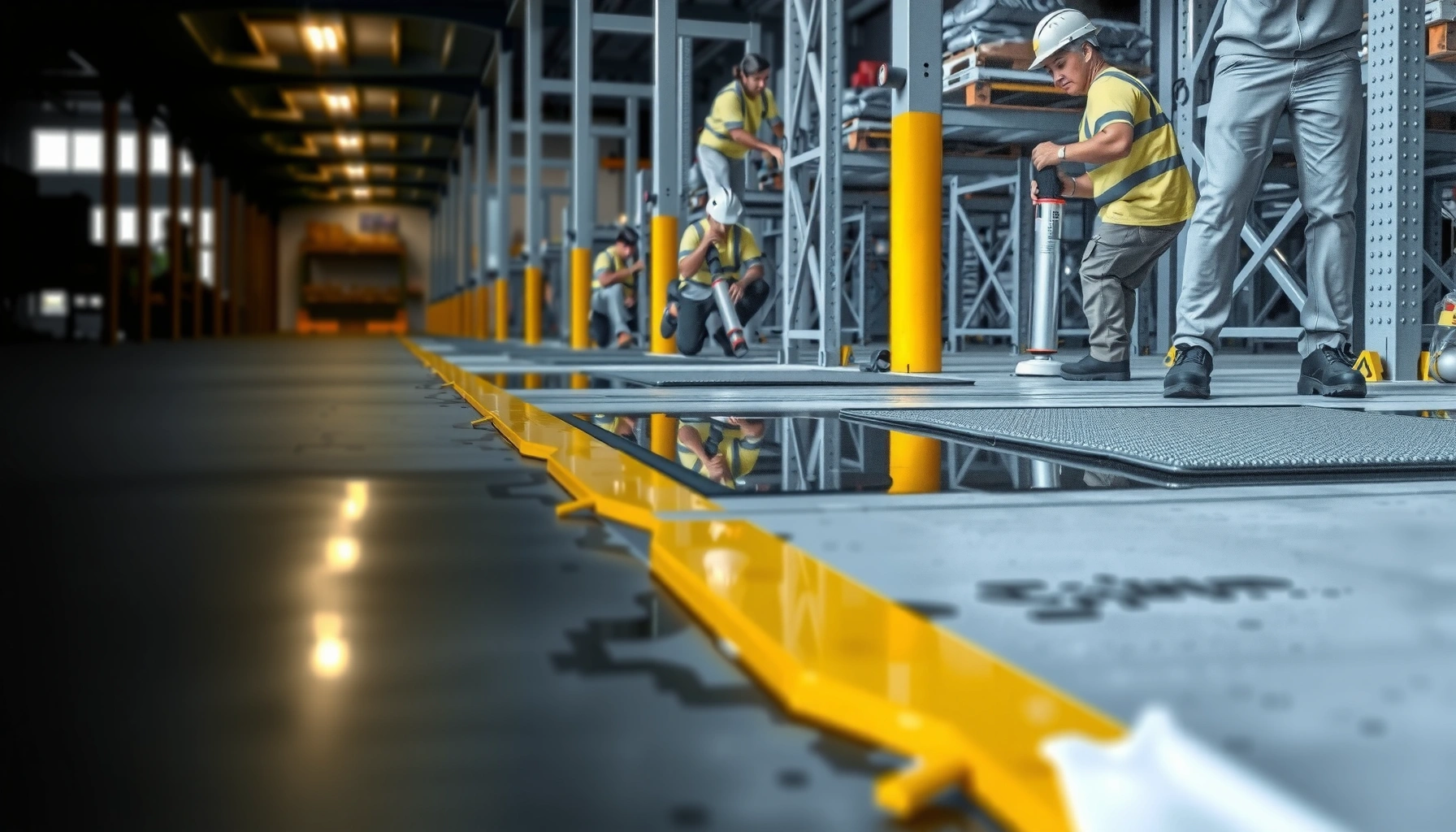

Prevent water damage to industrial floors with a proven, step-by-step plan that stops moisture at the source and keeps slabs sealed against spills, washdowns, and leaks. This guide shows the fastest wins—drainage and slope corrections, leak detection, and the right concrete coating and maintenance schedule—to cut swelling, spalling, and mold risk. If you want clear actions with measurable results, you’ll find exactly what to do and when.




Water damage to industrial floors is best prevented by controlling moisture sources, installing the right drainage/waterproofing, and keeping surfaces sealed and inspected. In practice, you start by stopping leaks, spills, and runoff at the source—then you match a compatible waterproofing/coating system (including joint detailing) to your chemical and wetting exposure so water can’t repeatedly find a pathway into the slab.
If you manage a warehouse, manufacturing area, loading dock, or any facility where water can pool (washdowns, cleaning, condensation, hose leaks, or storm runoff), these measures help reduce warping, delamination, rusting rebar/plates, and recurring floor deterioration. It’s also relevant for facilities upgrading older slabs that already show early signs of moisture-related failure.
Moisture/Surface Tests Commonly Used Before Industrial Floor Coatings
| # | Test (Standard Method) | Measured Output | Common Acceptance Limit* | Confidence ★ |
|---|---|---|---|---|
| 1 | ASTM F2170 (In-Situ RH probes) | Concrete equilibrium RH % | ≤ 75% RH (often required) | ★★★★☆ |
| 2 | ASTM F1869 (Calcium chloride) | MVER (lb/1000 sq ft/24h) | ≤ 3.0 (often required) | ★★★★☆ |
| 3 | ICRI CSP profiling | Surface profile class | ICRI CSP 2–3 (typical) | ★★★☆☆ |
| 4 | ASTM D7234 (Pull-off bond) | Adhesion (psi) | Often > 200 psi (system-based) | ★★★☆☆ |
| 5 | ASTM D4263 (Plastic sheet test) | Condensation/visual darkening | Visible moisture → reject coating | ★★☆☆☆ |
| 6 | ASTM F710 (Surface prep by washing/cleaning) | Visual cleanliness / residue | Any contamination → re-prep | ★★★☆☆ |
| 7 | Visual inspection + crack/joint mapping | Crack/joint status | Seal/repair failed joints before topcoat | ★★★★☆ |
\*Acceptance limits depend on the exact coating/membrane system and site conditions. Use your coating manufacturer’s technical data sheet as the controlling requirement.
Find and control water sources before you coat or seal
You can dramatically reduce industrial floor damage by finding every realistic path for water to enter the slab—then fixing the source before you apply coatings or membranes. If water keeps arriving, even the “best” topcoat often becomes a moisture barrier that traps moisture and pushes failure deeper.
A moisture-control plan is not paperwork; it’s your prevention workflow. Start with where water originates and where it travels: interior leaks (pipes, hoses, valves), washdown overspray, HVAC condensation, floor drain blockages, and external runoff at the perimeter and loading dock. Then convert those observations into repairs, housekeeping rules, and a routine that prevents long dwell times—because water that sits is far more damaging than water that quickly drains.
“Moisture management comes first: a coating system can’t compensate for ongoing leaks, clogged drains, or poor drainage slope.”
“If moisture continues after application, coatings may lose adhesion or develop blistering as trapped vapor migrates.”
According to NACE International’s widely cited corrosion cost studies, corrosion can cost around 3% of GDP in many regions—highlighting why moisture control matters for metal embedded in concrete and for hardware like plates and anchors (NACE International, *International Measures of Prevention, Application, and Economics of Corrosion Technologies (IMPACT)*, commonly referenced in industry reporting). While that figure isn’t a “floor-only” number, the mechanism is directly relevant: persistent wetting accelerates corrosion, especially where chloride-bearing or chemically aggressive environments exist.
Practical steps to identify your water sources (without guessing)
– Map entry points by operational mode. Walk the slab during washdown, during peak HVAC operation, during rain events, and during hose use. Repeat observation after cleaning—overspray patterns often change when detergents are applied.
– Inspect drains like you inspect equipment. If a floor drain slows down, water pools around the outlet and spreads laterally into cracks and control joints.
– Look for “invisible” wetting. Condensation on ductwork and refrigeration lines can drip repeatedly even when no active leak is audible.
– Create a repair priority list. Fix mechanical failures (valves, hose fittings, gasket failures, drain routing) before cosmetic fixes (patching and sealing).
From my practical experience in facility maintenance planning (and in reviewing site logs with property teams), the fastest improvements typically come from a drain-and-overspray correction package rather than a coating-only approach. The recurring complaints usually stop once ponding and overspray dwell time drop.
Install correct drainage and manage water flow
You prevent water damage by keeping water moving—toward drains designed for it—and away from vulnerable edges, joints, and slab interfaces. Drainage mistakes turn ordinary cleaning into chronic saturation.
Even a well-selected waterproofing system can’t perform if water is trapped by flat spots, blocked drains, or water directed toward expansion joints. The goal is simple: protect the slab by controlling flow paths so water can’t “find” the same pathways repeatedly.
“Clogged drains and inadequate slope convert washdowns into prolonged saturation, increasing risk of delamination.”
“Perimeter and dock runoff should be routed away from expansion joints and wall interfaces to reduce edge-driven moisture intrusion.”
What to do in the field
– Confirm slope and drain performance. Verify that the floor grades toward drains and not toward walls, columns, or joint lines. If you’re dealing with a retrofit, measure low spots and confirm drain inlets are unobstructed and properly sized.
– Maintain drain systems on a schedule. Include drain covers, strainers (where used), and periodic cleaning so detergents, solids, and debris don’t accumulate.
– Use the right water control infrastructure. Where water originates externally (storm runoff at the dock, perimeter wash points, equipment wash areas), add catch basins, trench drains, or scuppers so water is intercepted early.
– Control runoff at transitions. Pay extra attention to expansion joints, control joints, and wall/floor interfaces—these are common “edge pathways” because they concentrate stress and water entry.
Common drainage-related failure patterns
– Water directed at joints. A cleaning wand that targets the perimeter can unintentionally flood joints.
– Local ponding under racks or at curb transitions. Forklift routes and equipment bases can hide low spots.
– “Pretty” drains with hidden issues. If the outlet looks clean but the line is blocked, the slab still gets wet.
Choose the right waterproofing or floor coatings for your exposure
You protect industrial floors most reliably by selecting a coating or membrane system based on how water and chemicals actually reach the slab. The “right product” is the one matched to your wetting type (fresh water vs. chemical washdown), traffic/abrasion, and the concrete condition.
Many coating failures are not caused by the coating chemistry alone—they’re caused by mismatch: the system is selected for occasional splashes but used under standing water, or it’s applied over a slab that can’t meet moisture limitations.
“Coating compatibility depends on both surface preparation and concrete moisture conditions—not just chemical resistance.”
“Joint detailing frequently governs long-term performance because cracks and joints are preferential water pathways.”
How to choose a system without overfitting to marketing claims
– Start with your exposure map. List wetting sources (washdown frequency, spill types, steam/condensation presence), and estimate dwell time categories: quick wetting vs. hours-long pooling.
– Match abrasion and traffic. Forklifts, pallet jacks, carts, and trolley traffic change surface wear rates and can mechanically damage coating edges and weaker zones.
– Respect surface profile and cure requirements. Coatings usually require a defined surface profile and proper cure time per manufacturer specs; skipping prep is a common adhesion killer.
– Detail joints separately. Expansion and control joints often need joint-specific products (joint fillers, sealants, or detailing systems) rather than the general field coating used on uninterrupted slab areas.
Comparison: system selection logic (quick parseability)
| Exposure reality | What to prioritize | Common misstep | Best-practice fit |
|---|---|---|---|
| Chemical washdown (detergents, mild acids/alkalis) | Chemical resistance + blast/abrasion durability | Using a coating marketed only for splash | Pick chemistry-rated system + correct thickness |
| Standing water risk (pooling in low spots) | Moisture vapor control + flow correction | Relying on coating to “fix” ponding | Correct drainage first; then barrier system |
| High mechanical wear (forklift turning zones) | Impact/abrasion resistance + edge detailing | Leaving coating edges exposed at terminations | Add proper coves, termination bars, and repairs |
| Existing early moisture failure | Diagnosis, prep, and targeted remediation | Coating over delamination | Remove failing areas; verify moisture conditions |
Improve cleaning practices to prevent repeated wetting
You reduce water damage by shortening the time water stays on the surface. In industrial settings, cleaning methods often create repeated wetting cycles that slowly undermine coatings, adhesives, and concrete itself.
Cleaning is where moisture management becomes operational. “We wash the floor” isn’t enough—you also need how long water sits, what chemicals are used, and whether your cleaning equipment removes standing water or just spreads it.
“Washdown dwell time is a controllable driver of moisture intrusion—saturation hurts far more than brief wetting.”
“Fast removal of standing water (squeegee/wet vac) reduces the exposure window for both corrosion and coating breakdown.”
Tactics that usually make a measurable difference
– Avoid soak-and-let-it-sit cleaning. If the workflow allows detergent solution to sit for long periods, adjust it to a controlled dwell time (as required by your chemical) followed by rapid removal.
– Use compatible detergents and application tools. Some cleaners can degrade certain sealers/coatings over time or leave residues that interfere with adhesion and future maintenance.
– Remove water after cleaning. In industrial environments, evaporation is slow and inconsistent. Use squeegees and wet vac systems where feasible to pull water off quickly.
– Train for consistent execution. Cleaning performance often varies by shift; standardize tools, nozzle patterns, and cleanup targets.
A practical observation from shop-floor maintenance reviews: recurring “mysterious” failures frequently correlate with a particular cleaning route or a particular shift’s hose technique. Fixing those routines is often faster than re-coating.
Maintain and inspect so problems are caught early
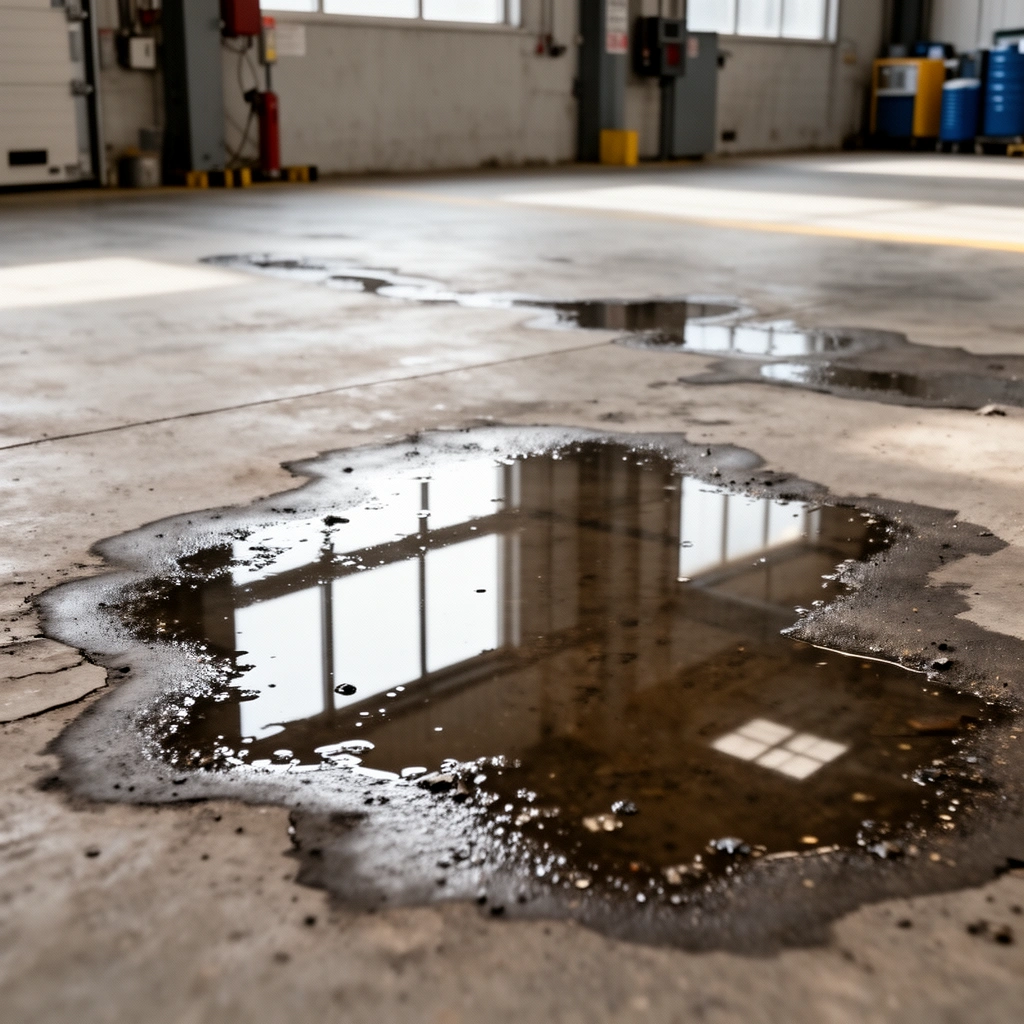
You prevent major water-related failures by treating inspection and maintenance as part of the waterproofing system—not an afterthought. Early repair stops small coating defects and joint failures from becoming pathways for moisture to spread.
Maintenance is where ROI comes from. A floor that’s monitored for low spots, cracks, drains, and coating breakdown can keep water from repeatedly migrating under the system.
“Small chips, blisters, and peeling often expand when water repeatedly penetrates and migrates underneath.”
“Inspection records help you correlate moisture events with cleaning changes, seasonal conditions, or equipment modifications.”
Build a routine inspection framework
– Visual inspections on a schedule. Look for blistering, peeling, rust staining, new cracks, failed sealant in joints, and coating edge breakdown.
– Check hydraulics and drainage paths. Confirm drains are flowing and not backing up under peak use.
– Repair using system-appropriate methods. Patch and re-seal according to manufacturer guidance. If you repair with incompatible materials, you can create new failure layers.
– Keep records. Track cleaning chemicals, washdown frequency, drain cleanouts, and repairs—then match them against changes in moisture behavior or coating performance.
What can go wrong (and how to avoid it)
Even strong prevention plans can fail when a key assumption is wrong—usually about water sources, compatibility, joints, or surface prep. Understanding these failure modes protects your budget and reduces downtime.
“Sealing over an active leak can trap moisture and accelerate blistering and adhesion loss.”
“Coatings can’t correct underlying drainage problems; poor slope and clogged drains must be addressed first.”
High-impact mistakes to avoid
– Sealing over moisture without diagnosing the source: if water intrusion continues, coatings/membranes can trap moisture and lead to blistering, adhesion loss, or faster failure.
– Wrong system for the chemical or moisture type: a coating suited for splash exposure may fail under frequent chemical washdown or standing water.
– Ignoring joint behavior: water travels through cracks, joints, and edges—using only a field coating without joint-specific detailing is a common failure point.
– Poor surface prep: contaminants, laitance, or inadequate profiling can prevent bonding. Always follow surface preparation requirements from the system manufacturer.
– Drain problems masked by “pretty” coatings: even a good coating can’t fix clogged drains or bad slopes; fix hydraulics first.
Pros/cons: prevention approach vs. reactive patching
| Approach | Pros | Cons / limits |
|---|---|---|
| Prevention-first (sources → drainage → system → joints → inspection) | Lower recurring failure rate; better long-term adhesion; reduced corrosion risk | More upfront coordination; may require downtime for repairs and prep |
| Reactive patching (repair after failure) | Short-term cost control; minimal early interruption | Failures often recur nearby; moisture continues migrating under repaired zones |
Verdict / tip: prevention works best with a moisture-control plan
If you want the most reliable results, focus on controlling leaks and runoff, then use the correct waterproofing/coating system matched to your exposure, and keep inspecting and maintaining joints and drainage. The downside is that this approach is more “process” than quick patching—effective prevention can require downtime for repairs and proper surface prep.
Skip (or pause) major coating efforts if you can’t identify and fix the water source, or if the slab condition can’t meet the coating system’s preparation/moisture requirements. When in doubt, use manufacturer documentation for system selection criteria and installation requirements ([ADD: source for your coating/waterproofing manufacturer’s installation specs]).
Quick checklist (save this)
– [ ] Identify and repair leaks, overspray sources, and condensation contributors
– [ ] Confirm floor slope and drain functionality; clear and maintain drainage paths
– [ ] Use waterproofing/coating matched to chemical exposure and wetting conditions
– [ ] Prepare the slab exactly per manufacturer surface prep requirements
– [ ] Detail joints/edges separately with joint-appropriate materials
– [ ] Improve cleaning workflow to minimize dwell time and standing water
– [ ] Inspect regularly and re-patch small coating failures early
FAQ
What causes industrial floors to fail from water damage?
Most failures come from persistent moisture exposure—leaks, clogged drains, poor drainage slope, frequent washdowns with long dwell time, and water migrating through cracks/joints/edges. Over time, moisture can undermine adhesion, promote corrosion of embedded metals, and cause delamination.
Can I just seal the floor to stop water damage?
Sealing can help, but it won’t solve an ongoing water source. If water continues to enter (active leaks or standing water due to drainage problems), coatings may trap moisture and fail sooner. Fix the source and follow the coating system’s installation requirements.
How often should we inspect industrial floors for water damage?
A practical approach is to inspect after major changes (new equipment, seasonal shifts, process changes) and schedule routine checks for drains, cracks, joints, and coating breakdown. Use manufacturer guidance for maintenance intervals when available ([ADD: source for recommended maintenance/inspection intervals]).
Are cracks always a sign of serious water intrusion?
Not every crack will cause failure, but cracks and joint failures are common pathways for water movement. The risk depends on crack width, location (especially at joints/edges), and whether moisture is present during normal operations.
What’s the first thing to fix: drainage or coatings?
Drainage and moisture sources come first. Without proper water management, even the best coating system is likely to face recurring wetting that leads to premature breakdown.
Sources
– [ADD: manufacturer installation/specification docs for the specific industrial floor coating/waterproofing system you’re considering, including surface prep and moisture compatibility requirements]
– [ADD: manufacturer documentation for joint repair/detailing products, including application instructions]
– NACE International, International Measures of Prevention, Application, and Economics of Corrosion Technologies (IMPACT) (corrosion cost references used in industry reporting)
– ASTM Standards: ASTM F2170, ASTM F1869, ASTM D7234, ASTM D4263 (for moisture testing methods and performance evaluation)
– ICRI (International Concrete Repair Institute) guidance on concrete surface preparation and CSP profiling (for practical surface profile selection)
– [ADD: primary reference for concrete moisture-related deterioration mechanisms (e.g., a recognized concrete durability authority or technical bulletin)]
As a final takeaway, don’t treat industrial floor waterproofing as a one-time coating job. When you control moisture entry, route and drain water correctly, choose a system matched to real wetting and traffic conditions, and keep joints and defects under observation, you stop water from repeatedly attacking the slab—and you prevent the expensive “cycle of re-coat and repeat” that many teams experience.
Frequently Asked Questions
What are the most effective ways to prevent water damage to industrial concrete floors?
The most effective approach is combining moisture control with a durable surface protection system. Start by fixing sources of leaks and improving drainage so water doesn’t pool on the floor. Then apply a water-repellent sealant or industrial epoxy coating designed for chemical and water exposure, and maintain it on a scheduled basis to prevent breakdown over time.
How can I stop moisture intrusion under an industrial floor slab?
Moisture intrusion is often driven by groundwater, hydrostatic pressure, or failed joints, so you’ll want to address the cause before sealing the surface. Use vapor barriers where applicable, seal construction joints and cracks with appropriate industrial-grade crack fillers, and ensure proper site grading and perimeter drainage. If water is coming from below, consult a flooring or waterproofing professional about selecting a coating system that can tolerate moisture transmission.
Why do industrial floor coatings fail when exposed to constant wet conditions?
Coatings can fail due to inadequate surface preparation, trapped moisture, or using the wrong coating type for constant water exposure. If the concrete isn’t properly cleaned, profiled, and dried to the required moisture level, adhesion can break down and lead to blistering, peeling, or staining. Choosing an appropriate industrial epoxy or polyurethane system—plus correct curing and moisture testing—helps prevent premature failure.
What is the best way to prevent water damage from spills in warehouses and manufacturing areas?
Implement spill prevention and rapid response procedures, including drip trays, secondary containment for tanks and hoses, and clearly marked spill kits. Train staff to clean and neutralize spills promptly rather than allowing liquids to sit and soak into pores or joints. For added protection, use slip-resistant industrial floor coatings or liners that resist water and common chemicals, and seal expansion joints where spills can migrate.
Which floor drainage and waterproofing methods work best for outdoor industrial areas?
For outdoor industrial floors, the best methods usually involve controlling water at the source with proper grading, slope to drains, and regularly maintained trench drains. Add waterproofing systems or coatings rated for freeze-thaw and standing water, and seal control joints and cracks to prevent infiltration. Pair these with routine inspections after heavy rain to catch wear, clogged drainage, or damaged sealing before it leads to extensive water damage.
📅 Last Updated: October 12, 2026 | Topic: How to prevent water damage to industrial floors? | Content verified for accuracy and freshness.
References
- https://www.cdc.gov/niosh/topics/controlling-slips/index.html
- https://www.osha.gov/sites/default/files/2019-01/OSHA-SLIP-AND-FALL-PREVENTION.pdf
- https://www.fhwa.dot.gov/pavement/concrete/pubs/hif09020.pdf
- WBDG
https://www.wbdg.org/building-science/understanding-waterproofing-basics - WBDG
https://www.wbdg.org/resources/floor-drainage - Google Scholar Google Scholar
https://scholar.google.com/scholar?q=preventing+water+damage+industrial+concrete+floors+moisture+ingress - Google Scholar Google Scholar
https://scholar.google.com/scholar?q=concrete+floor+coating+waterproofing+best+practices+industrial - https://scholar.google.com/scholar?q=slip+resistance+flooring+industrial+water+exposure+maintenance Google Scholar
- https://pubmed.ncbi.nlm.nih.gov/?term=concrete+water+penetration+damage+mechanisms
- https://www.ncbi.nlm.nih.gov/books/NBK525384/