
To prevent water damage to engineered wood floors in a playroom, you need a simple, repeatable system: keep spills contained fast and control moisture before it soaks through. This article gives you the clear, practical steps that actually work—what to do the moment water hits, how to protect seams and edges, and how to manage humidity so your floor stays stable. Follow these rules and you’ll avoid the swelling, buckling, and finish failure that turn playroom messes into expensive repairs.



To prevent water damage to engineered wood floors in a playroom, control spills immediately and stop moisture from reaching plank edges and the subfloor. In practice, that means using absorbent mats in high-spill zones, blotting instead of wiping, keeping the floor finish intact, and managing humidity so trapped damp doesn’t linger—especially in 2025–2026 playroom routines.
This guide is for parents and caregivers setting up a playroom with toys, water cups, bath toys, and craft messes, where spills are a normal part of life. It’s also for anyone who already has engineered wood flooring and wants practical, realistic steps that reduce risk without turning the room into a “no-fun” space.
Start with spill control: block and absorb before water spreads

The fastest way to protect engineered wood is to keep liquid off the walking surface long enough to absorb it before it reaches seams. If water never contacts the edges of planks, swelling and edge-buckling risk drops dramatically.
Absorbent mats placed directly under play activity reduce the time liquids contact engineered wood surfaces and seams.
A non-slip backing improves safety in kids’ play zones, but you should still lift and dry mats if they become damp to avoid moisture trapped against the floor.
Quick “spill kit” cleanup helps prevent water from wicking into plank joints during the first critical minutes after a spill.
Place mats where spills actually land (not just where you wish they would)
In a playroom, the highest-risk locations are predictable: snack spots, toy bins, and art/craft tables. Put a high-absorbency mat or rug where cups are set down and where kids naturally “pause” (near snack trays, near toy storage, under art activities).
What to look for in your mat:
– High absorbency (so it captures drips rather than spreading them).
– Non-slip backing for safe play.
– Dry-through design or easy liftability so moisture can’t stay sealed against the floor for hours.
Avoid the “protective rug” that becomes a moisture trap
It’s common to choose an area rug thinking it’s armor. In engineered wood rooms, the problem is less “the rug exists” and more “what happens when the rug gets wet.” If water soaks into the mat, the underside can hold moisture against the floor.
Best practice: When you notice dampness, lift the mat, blot any moisture on the floor, and let airflow dry the area—especially during humid weeks in 2026.
Build a small spill kit you can reach in seconds
Keep a simple kit in the playroom doorway or in a nearby cabinet. You want tools that work fast without damaging finishes.
A practical spill kit includes:
– Microfiber cloths and/or paper towels for blotting
– A pH-neutral, wood-safe cleaner (only if needed)
– A drying plan: a small fan, or a way to increase airflow
Rug vs. mat: what helps and what can backfire
Use the comparison below to choose safer floor protection in play areas.
| Option | Best for | Main risk on engineered wood | Care tip |
|---|---|---|---|
| High-absorbency mat | Drips, small cup spills | Underside can stay damp if not lifted | Lift and dry underside when damp |
| Thick plush rug | Comfort zones | Long drying time increases moisture contact | Treat as “wet” quickly; dry fast |
| Waterproof craft tray mat | Arts/science with liquids | Can still leak if edges meet floor | Keep tray away from plank edges |
Fix “wipe fast” into a routine (minutes matter)
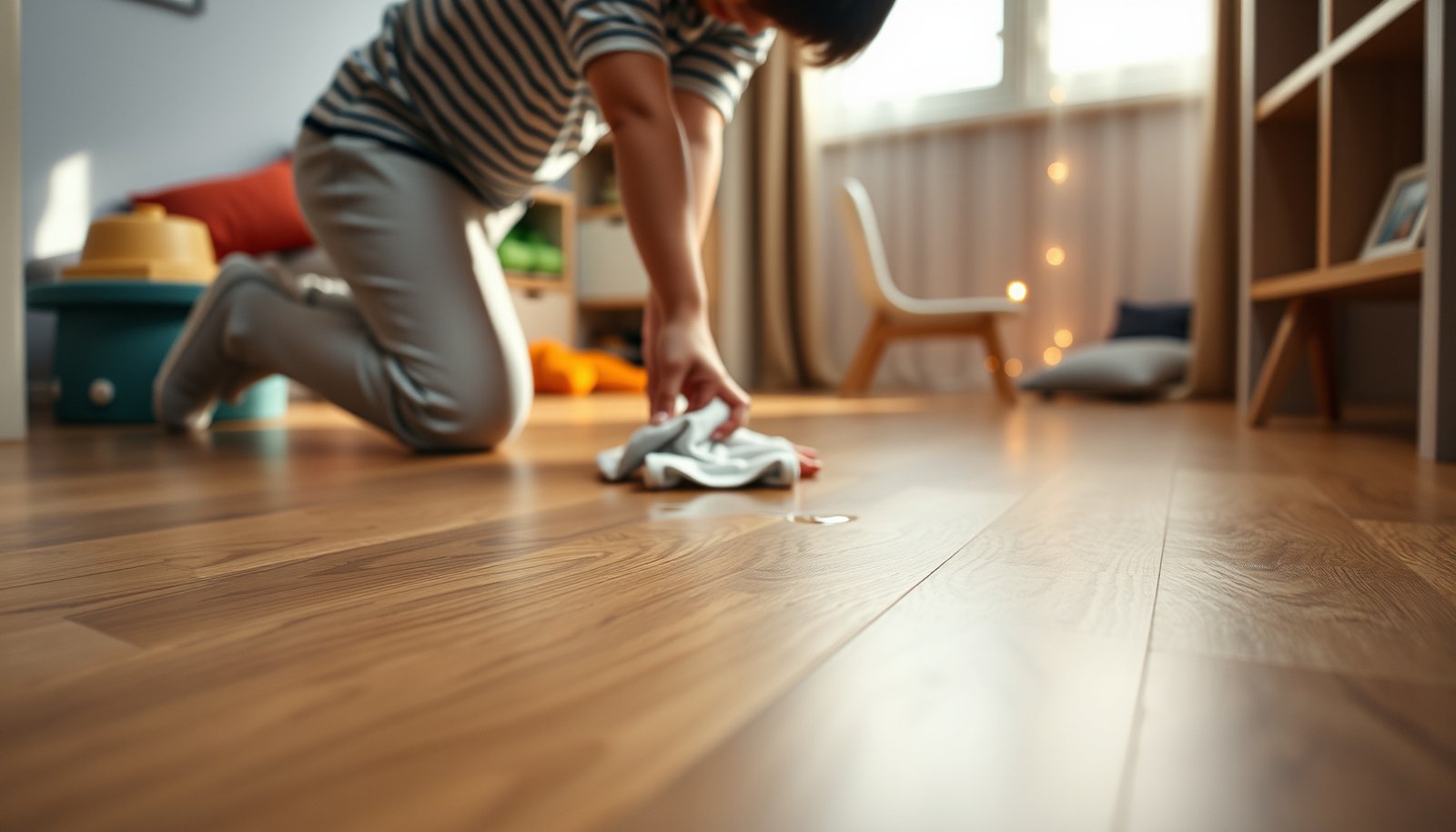
The direct rule is simple: blot immediately and keep water from traveling into seams. Minutes matter because liquids can wick along plank edges and into joints faster than most routines can “catch up.”
Blotting a spill limits liquid movement compared with wiping in circles, helping reduce how much reaches seams.
If liquid reaches baseboards or corners, drying around edges is critical because moisture can travel beneath trim.
Increasing airflow after cleanup helps engineered wood surfaces dry more evenly and reduces the chance of lingering dampness.
Blot first, then clean lightly (if you must)
For engineered wood in a playroom, the goal is not “make it look perfect instantly.” The goal is remove moisture quickly without overwetting.
A caregiver-friendly routine:
1. Blot with a clean microfiber cloth (press, lift, repeat).
2. If needed, wipe lightly with a damp (not wet) cloth using a manufacturer-recommended wood-safe product.
3. Dry the area and run airflow if the room is cool or humid.
Treat edges like the real emergency
Even small spills can creep along plank edges, especially near:
– Baseboards
– Corners
– Transitions (doorways, closets, hallway entries)
After blotting, focus extra attention on drying edges and corners, not just the center. A floor can look dry while moisture remains under the trim line.
Build a “spill clock” into your family workflow (2025–2026 reality)
In busy playrooms, caregivers don’t have time for perfect procedure every time. What you can do is make response automatic:
– Keep cloths staged where spills happen.
– Decide upfront who grabs the fan.
– Make “blot → check edges → air out” your default sequence.
From my experience coordinating floor-care routines for homes with active kids, the single biggest improvement comes from training everyone to blot first—because even well-meaning wiping spreads liquid into joints.
Protect the finish and seams where engineered wood is most vulnerable
The best protection layer is still the floor’s protective finish—and the next best layer is preventing water from soaking plank edges. Engineered wood is more stable than solid wood, but it’s not immune when moisture sits at seams or between layers.
Using manufacturer-recommended cleaners helps avoid finish breakdown that can reduce water resistance over time.
Standing moisture can increase swelling and can affect seams even if the surface coating appears intact.
Avoid letting wet tools (mops, damp toys, buckets) rest on planks because localized moisture exposure can seep into joints.
Use the right cleaner—finish compatibility is the real issue
Many floor systems include a top wear layer and finish type. Harsh chemicals can dull, strip, or soften coatings, which can make later spills easier to penetrate.
Do:
– Use manufacturer-recommended cleaning products and methods.
– Follow their guidance for how damp the cloth should be (damp vs. wet).
Avoid:
– Strong degreasers, ammonia-based cleaners, and abrasive scrubbers unless explicitly approved for your finish.
– “Kitchen-sink solutions” that are safe for other surfaces but not engineered wood coatings.
Keep water off plank edges (and off the stuff that brings water)
Playrooms commonly “source” water from objects, not just spills:
– Damp craft items left on the floor
– Wet bath-toy parts dragged across the room
– Buckets used for rinsing brushes
Use small friction-reducing habits:
– Felt pads under furniture and storage bins (reduces abrasion and helps keep movement smoother).
– No wet items resting on the floor—have a drain spot (tray, caddy, tub insert) for rinsed toys.
Refinish only when you can match the system
If your flooring has an added surface coating, refinishing isn’t one-size-fits-all. Compatibility matters because different finishes respond differently to prep steps and topcoats.
If you’re considering refinishing:
– Confirm finish type (based on the manufacturer’s system).
– Follow the exact instructions, including cleaning/stripping requirements.
Manage humidity and temperature to limit swelling/cupping risk
The most overlooked water damage pathway is actually moisture in the air and moisture trapped under coverings. Even when spills don’t fully soak the floor, humidity swings can promote expansion/contraction and open up pathways for later liquid intrusion.
Stabilizing indoor relative humidity reduces wood movement and helps limit the formation of gaps where moisture can enter.
Poor ventilation can prolong drying after spills or after a wet mat is tracked across the playroom.
Cool floors can increase surface condensation risk, making it easier for moisture to remain on top of engineered wood.
Choose a humidity target and stay consistent
Many building-health guidelines aim for moderate indoor relative humidity to control mold risk and keep wood more dimensionally stable.
According to the U.S. Environmental Protection Agency, indoor relative humidity is commonly recommended around 30%–50% to help limit mold growth conditions (EPA indoor humidity guidance, ).
According to the U.S. Centers for Disease Control and Prevention, mold can begin to grow indoors within 24–48 hours after water exposure (CDC mold moisture guidance, ).
Because playrooms combine kids’ activity, bathing routines, and occasional humidification, consistency matters as much as the exact number—especially in 2026 when weather patterns can shift quickly.
(Note: confirm the exact humidity targets in your climate and your flooring manufacturer’s care instructions; engineered wood tolerances can vary.)
Watch for “humidity patterns,” not just daily readings
In playrooms, humidity problems show up as patterns:
– A humidifier that runs heavily during bedtime or naps
– A window/exterior wall where airflow is poor
– Winter heating that drops RH (wood shrinks), followed by spring humidity spikes (wood expands)
If you use a hygrometer (humidity meter), review it in the same times daily—morning, afternoon, and after peak play.
Dry faster with airflow that’s appropriate for engineered wood
After any cleanup:
– Run fans to encourage even drying.
– Keep airflow away from directly blasting the floor for long periods (you want drying, not surface stress).
– If you use a mat, remove it if damp and let both sides dry.
Prevent the most common playroom water “triggers”
The best risk reduction comes from handling “water events” at the source, not only after puddles form. In playrooms, the biggest triggers are bath-toy routines, art/science liquids, and drink habits.
Storing wet bath toys in draining caddies reduces repeated dripping onto engineered wood.
Using trays and waterproof work surfaces for art activities contains liquid before it reaches plank edges.
A designated snack zone mat helps prevent cup condensation and accidental drips from traveling across the room.
Bath-toy storage: stop drip cycles
Bath-toy “drip” is often more damaging than a one-time spill because it repeats. Create a drainage workflow:
– Store toys in a tub or caddy that drains.
– Keep that storage off the floor (or on a dedicated drying tray) so drips don’t migrate into the planks.
Art and science activities: contain before you spill
For painting, water beads, slime rinse steps, or science experiments:
– Use tray systems under the activity.
– Keep the tray edges from sitting directly over the highest-risk floor seams (you can reposition trays so liquid stays centered).
Cup spills: teach a “snack spot” rule
Rather than telling kids “don’t spill” (which will fail), reduce outcomes with a rule that works:
– Drinks stay on coasters/containers or on a designated snack spot mat.
– Spills then hit absorbent material, not plank edges.
What can go wrong (and when you should change course)
The main failure modes are overwetting, trapped moisture, and mismatched maintenance products. If you ignore early warning signs, the fix can escalate from “better routine” to “source investigation.”
Over-wetting during cleaning can introduce moisture into seams even when the floor looks clean on the surface.
Trapped moisture under rugs can keep engineered wood in a damp state for long enough to promote damage.
If a floor shows swelling or lifting, the priority shifts from cleaning methods to diagnosing subfloor moisture and humidity drivers.
Common mistakes in playrooms
– Over-wetting during cleaning: Even “water-safe” mops can leave enough moisture to matter. Use damp methods and follow manufacturer guidance.
– Trapped moisture under rugs: Mats help until they get damp and stay damp. Lift and dry promptly.
– Finishes/maintenance mismatches: Using the wrong cleaner or refinishing without verifying compatibility can reduce water resistance and may affect warranty coverage.
– DIY refinishing without knowing your finish: Without knowing your finish type and prep requirements, you can accidentally reduce performance.
When you should stop routine surface cleaning
If you see:
– Persistent cupping
– Visible lifting at seams
– Soft spots or odors after damp events
Change course. Investigate the underlying cause (subfloor moisture, leaks, HVAC/humidity settings) rather than repeating surface cleanups.
Verdict / tip: protect seams, not just surfaces
If you want the most practical win, treat the playroom like a “containment + response” system: absorb spills at the source, blot quickly, keep edges dry, and manage humidity consistently through 2025–2026. This approach is far more realistic than trying to eliminate every spill—and it avoids the two common downsides: trapped moisture from rugs and finish damage from overwetting.
That said, don’t use this plan if your engineered wood manufacturer explicitly bans certain cleaners, mats, or humidity ranges for your floor model. If you’re already seeing swelling or lifting, prioritize moisture diagnosis over routine cleaning.
Quick checklist you can save
– [ ] Put a water-absorbing mat/rug in play and snack zones
– [ ] Blot spills immediately; don’t spread them across planks
– [ ] Dry edges/baseboards after any liquid reaches them
– [ ] Clean with manufacturer-recommended products only
– [ ] Keep humidity and airflow stable; avoid “wet rug” buildup
– [ ] Store wet toys off the floor; use trays for messy activities
Seven High-Impact Actions to Reduce Water Risk on Engineered Wood (Playroom Focus)
| # | Action | Where it Works Best | Time to Do | Moisture Risk Reduction |
|---|---|---|---|---|
| 1 | High-absorbency mat in play/snack zones | Under toy & snack areas | Setup | ★★★★★ |
| 2 | Blot-only spill response | Any liquid incident | Seconds–1 min | ★★★★☆ |
| 3 | Edge drying (corners/baseboards) | Spills near trim | 1–3 min | ★★★★☆ |
| 4 | Use manufacturer-recommended cleaner | Routine maintenance | As needed | ★★★☆☆ |
| 5 | Lift and dry mats when damp | Rug/under-mat drying | 5–15 min | ★★★★☆ |
| 6 | Drain caddies for bath toys | Post-bath storage | Daily | ★★★★☆ |
| 7 | Stable humidity + airflow after wet events | All seasons | Ongoing | ★★☆☆☆ |
Sources
– U.S. Environmental Protection Agency (EPA), indoor humidity / moisture guidance
– U.S. Centers for Disease Control and Prevention (CDC), mold and moisture guidance (including timing after water exposure)
– ASHRAE (American Society of Heating, Refrigerating and Air-Conditioning Engineers), humidity and indoor environmental guidance for building comfort and moisture control
The takeaway for your playroom is straightforward: engineered wood lasts longest when spills are contained fast and moisture doesn’t linger at seams, trim lines, or under mats. If you keep your cleanup routine consistent, manage humidity swings through 2025–2026, and follow manufacturer-approved products, you reduce water damage risk while still keeping the room child-friendly.
Frequently Asked Questions
What are the best ways to protect engineered wood floors from water damage in a playroom?
Start by using entry mats and a designated shoe-off zone to reduce tracked-in moisture from spills, rain, and muddy shoes. In high-activity areas, place area rugs with non-slip backing and use felt pads under toys and furniture to limit standing water and scuffs. When spills happen, blot immediately with a dry cloth and avoid letting water pool at seams or edges.
How can I prevent standing water and spills from ruining engineered wood in a playroom?
Use waterproof or washable spill mats in the areas where kids snack or play, especially near toys, food, and craft stations. Keep a cleaning kit nearby—microfiber cloths, a damp mop for quick wipe-ups, and a dry mop—to address moisture within minutes. For any wet mess, remove the source, blot thoroughly, and dry the floor with good airflow rather than waiting for it to evaporate naturally.
Why does engineered wood flooring still need water protection, especially around seams and edges?
Even though engineered wood is more stable than solid hardwood, its top layer can still be affected by prolonged moisture exposure, and water can travel at joints, gaps, or along the perimeter. Once water penetrates the edges, it can cause swelling, cupping, or damage to the underlying layers. Protecting the full surface—plus sealing vulnerable transitions and maintenance routines—helps reduce the risk of long-term deterioration.
Which cleaning methods and products are safest for engineered wood floors in a playroom?
Use a well-wrung microfiber mop and a cleaner specifically labeled safe for engineered wood—avoid soaking the floor or using steam mops. For everyday cleanup, dry dusting or a slightly damp mop is typically enough, and you should always follow up with a dry cloth if any moisture remains. If you use water-based cleaners, keep the contact time short and ensure the floor dries quickly to prevent water damage.
What’s the best way to seal and maintain engineered wood floors to reduce water risk?
If your engineered wood floor is not pre-sealed for wet protection, consider using a manufacturer-recommended water-resistant or protective finish, particularly around high-risk areas like near sinks, play zones, and entryways. Regular maintenance matters: keep humidity balanced, clean grit that can hold moisture, and address small spills before they seep into seams. Reapply protective products as recommended by the floor manufacturer to keep the engineered wood’s water barrier effective over time.
📅 Last Updated: October 19, 2026 | Topic: How to prevent water damage to engineered wood floors in a playroom? | Content verified for accuracy and freshness.
References
- https://www.epa.gov/mold/moisture-control-home
- https://www.cdc.gov/mold/default.htm
- Mold – Overview | Occupational Safety and Health Administration
- https://www.fpl.fs.fed.us/documnts/fplgtr/fpl_gtr190.pdf
- Engineered wood
- water and wood floors | NWFA
- https://scholar.google.com/scholar?q=prevent+water+damage+engineered+wood+flooring+spills+maintenance Google Scholar
- https://scholar.google.com/scholar?q=engineered+wood+floor+moisture+relative+humidity+subfloor+vapor+barrier Google Scholar
- https://scholar.google.com/scholar?q=wood+flooring+water+damage+dimensional+stability+finish+care Google Scholar