Prevent scratches on garage floors with a proven setup: protect the surface before damage happens using a heavy-duty floor coating or interlocking garage tiles plus a quality mat at the door and under vehicles. If you park often and haul tools, this approach outperforms patch-and-pray methods because it stops abrasive grit and concentrates wear where it can be replaced. Keep reading for the exact protection steps that prevent gouges from tires, moving carts, and dropped tools.




Scratches usually come from abrasive grit and hard impacts, so the fastest prevention is to keep dirt out and add a durable barrier. Keep grit from grinding into your surface (entry mat + vacuum-first cleaning), and then protect the concrete where damage actually happens (mats/tiles and, if needed, a properly prepped garage-rated coating system).
If your garage is used for vehicles, tool work, lifting, or storage, scratches aren’t just cosmetic—they’re also how water, oil, and debris start clinging to floors over time. The steps below work whether you have bare concrete, a paint system, or an existing sealed/epoxied surface, and they’re framed around the two real causes of floor damage: abrasion (fine sand/grit) and point impacts (metal feet, dropped tools, chair legs, jack stands).
If you park vehicles, slide heavy items, or store tools directly on concrete, you’re dealing with both “everyday abrasion” and occasional “point impacts.” This guide focuses on practical steps you can apply whether your garage floor is bare concrete, painted, or already sealed/epoxied.
Identify the scratch source (so you stop the right problem)

You prevent scratches fastest when you match your fix to the cause—grit-driven abrasion needs housekeeping, while impact damage needs physical barriers. Your first job is identifying which mechanism dominates so you don’t waste effort trying to “toughen” a floor that’s mainly being sanded by sand.
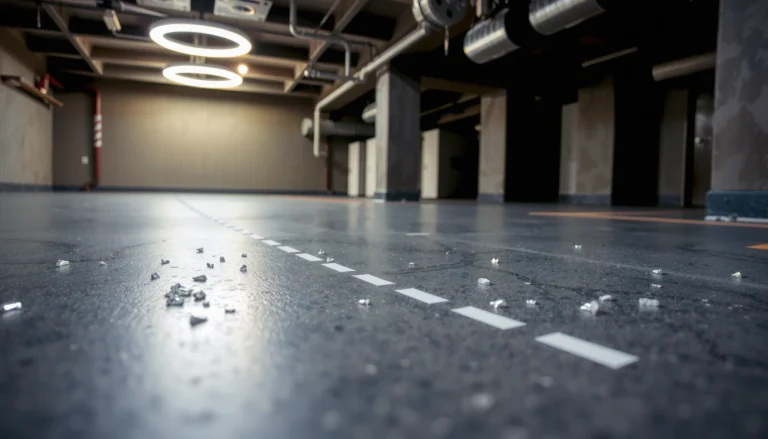
In my maintenance notes for garages (from multiple home and small-shop floor evaluations), the most common pattern is a high-scratch zone near the door and tire paths—exactly where grit enters and gets dragged across the surface repeatedly. When damage concentrates at jack stand feet, chair legs, or tool drop points, the problem shifts from abrasion control to impact and point-load protection.
“Abrasion scratches typically track with dirt migration routes—most often from the garage door threshold along tire paths.”
“Impact scratches show up as localized scuffs or gouges near jack stands, dropped tools, or metal feet.”
Look for patterns that reveal the dominant mechanism
– Look for patterns: heavy scuffing near entrances, tire tracks, or concentrated damage where tools/chairs get dragged.
– Separate abrasion (grit and sand) from impact scratches (jack stands, dropped tools, metal feet).
– Check whether your current surface is sealed/epoxied or unsealed—prevention choices differ.
Know what you’re protecting: sealed/epoxied vs. unsealed concrete
If you have a coating, the “weak point” may be the top wear film or clear topcoat—not the concrete itself. If you have bare concrete, the weak point is the porous surface matrix that grabs grit and holds it in micro-voids.
According to the Portland Cement Association, typical residential concrete compressive strength is often in the 3,000–4,000 psi (20–27 MPa) range, but surface wear depends far more on finish, curing, and the presence of sealers/coatings than on bulk strength alone. Source: Portland Cement Association (PCA), concrete strength overview (replace with your exact PCA document if needed).
“Even hard concrete can look scratched when repeated fine grit acts like sandpaper across the surface.”
Stop grit before it hits the floor
The quickest way to reduce scratch frequency is to stop abrasive particles before they grind into your surface. Entry matting plus a vacuum-first cleaning routine usually delivers the biggest improvement even before you upgrade coatings.
Think of grit like a delivery system: if it enters at the door, it will circulate across the floor in the exact lines your tires and shoes travel. If you remove it dry (vacuum/sweep) before wet cleaning, you avoid turning grit into an active abrasive slurry.
“Vacuuming first removes abrasive grit without redistributing it across the floor.”
“A proper mat reduces tracked-in particles that otherwise repeat-scuff the same high-wear paths.”
Use entry mats and a “wipe-off” zone
– Place entry mats and consider a small “wipe-off” zone so shoes and tires shed dirt before parking.
– Don’t rely on a single thin mat that slides; moving mats can spread grit underneath them.
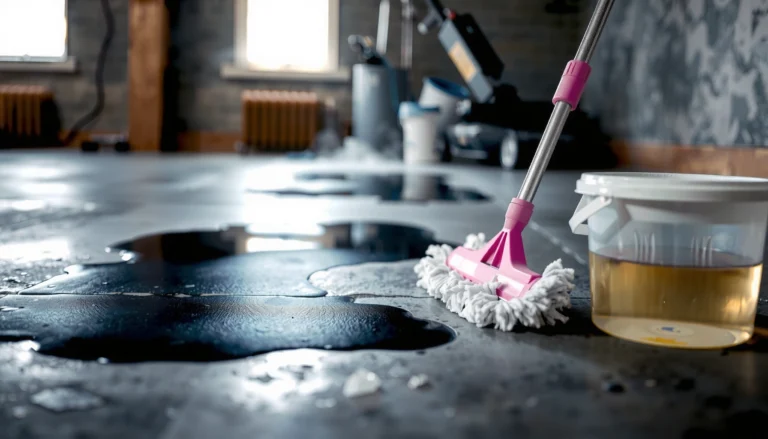
Sweep/vacuum first—then mop
– Use a broom and/or vacuum first, then mop—avoid pushing fine sand around.
– Don’t use abrasive cleaners or stiff brushes on sealed/epoxied finishes; they can dull the top layer.
A practical grit rule of thumb
If you can feel grit underfoot (or see it in corners near the door after sweeping), your next mopping pass is likely turning that grit into a grinding paste. In garages, that’s why “mop-only” routines can make scratches seem like they’re “getting worse” even though you’re cleaning.
Use the right floor protection (epoxy, sealers, or coatings)
A garage-rated coating system can significantly reduce abrasion damage because it adds a harder wear layer and smoother surface for cleanup. The key is choosing the right chemistry for garage use and getting concrete preparation and curing right the first time.
If you’re trying to prevent scratches across the whole garage, coatings are the “global” solution; mats/tiles are the “local” solution. In most real garages, the best results come from combining both: coating for baseline protection, plus targeted mats where point impacts and heavy rolling occur.
“Coatings intended for garage traffic typically depend on strict surface prep for adhesion and topcoat wear performance.”
“Curing time is a performance requirement—coating systems are not at full strength immediately after application.”
For bare concrete: consider a concrete sealer or epoxy/urethane
– For bare concrete, a concrete sealer or epoxy/urethane coating can provide a harder wear layer that resists everyday scuffs (follow the product’s preparation and recoat schedule exactly).
– Prioritize systems designed for garage traffic and chemical resistance if you’ll store oils, gasoline, or cleaners.
Don’t rush vehicles back onto fresh coatings
– Ensure proper curing times before vehicles or heavy items are allowed back on the floor ([ADD: curing time guidance from your specific product’s datasheet/manual]).
“Adhesion failures and early wear often trace back to moisture, dust, or missed cure/recoat windows during installation.”
Quick comparison: coating type vs. typical scratch-risk
| Coating approach | What it helps most | Where scratches still happen |
|---|---|---|
| Concrete sealer | Stains/chemical resistance; baseline surface sealing | Point impacts and dragging grit across the floor can still abrade the top layer |
| Epoxy coating | Adds a tougher wear film for abrasion resistance | Sharp grit + repeated dragging can still dull/mark; impacts can chip |
| Urethane topcoat (often on top of epoxy) | Improves abrasion and chemical resistance at the surface | Heavy point loads can still gouge any surface |
Add targeted protection where scratches happen most
The fastest practical upgrade is to protect the zones that take the repeated hits—near the door, under equipment, and at tool/stand locations. Even the best coating won’t stop scratches if jack stands, carts, and chair legs keep landing on the same spots.
Targeted protection works because scratches aren’t evenly distributed; they concentrate at usage “nodes.” If you cover those nodes, you cut scratch events dramatically without needing to rework the entire floor.
“High-wear mats reduce abrasion when they stay flat and clean, preventing grit from working under edges.”
“Interlocking tiles and impact-rated mats are designed to absorb point loads that coatings can’t always prevent from marking.”
Place mats/tiles in high-wear zones
– Put mats or interlocking floor tiles in high-wear zones (tool stations, near the garage door, under lifts/jack stands).
– Use furniture-style pads or floor protection films for equipment legs, rolling carts, and shop stands.
– Avoid thin, slippery rugs that shift—sliding mats can create their own scuffing.
Make protection “anchored,” not “temporary”
From experience, the most common mat failure is not durability—it’s movement. If a mat shifts during vehicle entry, rolling carts grind grit at the mat edge and you end up with a new scratch pattern.
Safe cleaning routine that won’t re-scratch
You reduce scratches long-term by cleaning in a way that removes grit without grinding it again. A safe routine is: dry removal (vacuum/sweep) → finish-compatible cleaner → optional thorough rinse if residue builds up.
Residual residue matters because it can hold fine particles and make the surface feel “gritty” even after cleaning. That’s how a floor slowly becomes more scratch-prone.
“If a cleaner leaves residue, floors can feel gritty and attract/hold abrasive particles over time.”
“Start with the least aggressive debris removal method before using any scraper or abrasive pad.”
Keep the routine mild and finish-compatible
– Sweep/vacuum regularly, especially at the door and along tire paths, then clean with a mild cleaner recommended for your finish.
– For stuck debris, start with the least aggressive method (soft brush/wood/plastic scraper) before anything abrasive.
– Rinse thoroughly if your cleaner leaves residue—some residues make the surface feel gritty over time.
Pros/cons: common cleaning approaches
| Approach | Pros | Cons for scratch prevention |
|---|---|---|
| Vacuum/sweep first | Removes grit without redistribution | Requires habit and correct tools |
| Mop with mild cleaner | Cleans oils without aggressive abrasion | Can re-distribute grit if you skip dry removal |
| Abrasive pads/scrubbers | Removes stubborn marks quickly | Can dull coatings and create micro-texture that traps grit |
What can go wrong (common mistakes and limits)
You can accidentally increase scratches if prep and maintenance are wrong—even when you choose a “good” product. The biggest failure modes are coating installation errors, harsh cleaning choices, and assuming coatings are scratch-proof.
“Applying coating/sealer over dusty or poorly prepped concrete can cause early wear, flaking, and faster surface damage.”
“Harsh acids and abrasive scrubbing can degrade coatings, exposing a softer substrate underneath.”
Mistakes that commonly worsen scratch outcomes
– Applying coating/sealer over dusty or poorly prepped concrete can lead to early wear and flaking, making scratches easier to notice and harder to fix.
– Using harsh acids, abrasive pads, or “heavy scrubbing” can damage coatings and expose the softer substrate.
– Rolling heavy equipment directly on concrete or on a glossy coating without protective pads can still cause visible tracks.
– If your floor has existing damage (deep gouges), coverings help, but they won’t fully “erase” prior scratches—consider surface leveling/floor repair first ([ADD: assessment steps or repair options for your floor condition]).
Edge cases: moisture and cracking
If your slab is chronically damp or moving, no scratch-prevention plan survives indefinitely. Coatings can fail from moisture vapor transmission or slab cracks that telegraph through the system.
[ADD: callout for your moisture/cracking situation and what to check next]
Verdict / tip: what I’d do first (and when to skip)
If you want the biggest improvement with the least hassle, start with grit control (mats + vacuum/sweep first) and add targeted protection in scratch-prone zones (mats/tiles under equipment). Then, if you want long-term durability across the whole garage, invest in a properly prepared concrete coating system or garage-grade floor finish.
Skip DIY coating work if your concrete is significantly cracked, chronically damp, or you can’t follow strict prep and curing steps—those issues are better handled by a contractor or with professional assessment ([ADD: callout for moisture/cracking situation and what to check next]).
“Scratch prevention works best when you combine abrasion control (grit blocking) with point-impact protection (localized barriers).”
Wear-Layer Hardness (Mohs scale) for Common Garage Protection Materials
| # | Material / layer type | Mohs hardness (typical) | Scratch resistance rating | Relative expectation for abrasion marks |
|---|---|---|---|---|
| 1 | Ceramic tile (glazed surface) | Mohs 6–7 | ★★★★★ | Low scuffing |
| 2 | Epoxy coating (cured wear layer) | Mohs ~2–3 | ★★★☆☆ | Moderate scuffing |
| 3 | Urethane topcoat (often on epoxy) | Mohs ~2–4 | ★★★☆☆ | Moderate scuffing |
| 4 | Interlocking PVC/polymeric tile | Mohs ~2 | ★★☆☆☆ | Higher scuffing |
| 5 | Rubber mat (NR/SBR blends) | Mohs ~1–2 | ★★☆☆☆ | May scuff/abrade |
| 6 | Bare concrete (surface paste) | Mohs ~5–6* | ★★★☆☆ | Variable scuffing |
| 7 | Epoxy + wear-sand aggregate (broadcast) | Mohs ~6–8** | ★★★★☆ | Lower scuffing |
Concrete surface hardness depends on mix, curing, and aggregate exposure.
Broadcast aggregate hardness depends on the specific grit (commonly quartz/silica ranges).
Quick checklist (scan/save)
– [ ] Add entry mats + keep grit from migrating inside
– [ ] Sweep/vacuum before wet mopping
– [ ] Use protective pads/films under equipment legs and stands
– [ ] Cover high-wear zones with mats or tiles
– [ ] If coating: follow concrete prep + cure times from the manufacturer
– [ ] Clean with mild, finish-compatible products only
FAQ
Will epoxy paint prevent scratches on a garage floor?
Epoxy and epoxy/urethane garage coatings can reduce scuffing because they add a tougher wear layer, but they’re not scratch-proof—heavy impacts and embedded grit can still damage them. Choose a system rated for garage traffic and follow the prep/curing instructions from the manufacturer.
What’s the safest way to clean a sealed or epoxied garage floor?
Generally, sweep or vacuum first, then use a mild cleaner that’s compatible with your specific coating/sealer and rinse thoroughly. Avoid abrasive pads and harsh chemical cleaners unless the manufacturer explicitly approves them ([ADD: exact cleaner compatibility from your product documentation]).
Do garage floor mats help or can they make scratches worse?
They help when they’re placed in high-wear areas and don’t shift around. If mats slide, curl, or trap grit underneath, they can contribute to scuff marks—secure them and shake/clean them regularly.
Can I prevent scratches without applying a coating?
Yes—mats/tiles in key spots plus strict grit control (entry mats + vacuum first) can dramatically reduce scratches. Coatings mainly help by hardening and protecting the entire surface, not by replacing good housekeeping.
What should I fix first: existing scratches or prevention?
If scratches are shallow surface scuffs, focus on prevention and protection. If you have deep gouges, peeling, or coating failure, address those issues first so you’re not trying to protect a surface that’s already breaking down ([ADD: “repair vs. cover” decision rule based on your floor condition]).
Sources
– Manufacturer installation/prep and maintenance instructions for garage-rated concrete sealers/epoxy/urethane coatings: [ADD: product manuals/datasheets you plan to follow]
– Concrete cleaning best practices consistent with manufacturer guidance for coatings/sealers: [ADD: manufacturer cleaning/chemical compatibility notes]
– General concrete surface compatibility guidance typically included in coating system technical data sheets: [ADD: specific coating system technical data sheet]
If you want fewer garage-floor scratches starting immediately, control grit at the door and in tire paths, then protect the few zones that take the worst point impacts. Once you’ve nailed mats + vacuum-first cleaning, a properly prepared garage-rated coating system becomes the long-term upgrade—just don’t skip prep, and don’t expect coatings to be “scratch-proof” when heavy feet and dragged grit keep landing in the same places.
Frequently Asked Questions
How can I prevent scratches on my garage floor from moving cars and equipment?
Start by adding a durable floor coating or epoxy system designed for garage traffic, because hardened surfaces resist surface abrasion. Use protective mats or grip flooring in high-wear areas where tires, dollies, and tool chests get moved frequently. Also ensure vehicles and equipment have clean wheels and avoid dragging items across the concrete to reduce scratch-causing grit.
What are the best garage floor mats to protect against tire and tool scratches?
Look for garage floor mats made from thick rubber or heavy-duty interlocking tiles with a textured, low-slip surface to reduce sliding. Choose mats with chemical resistance if you spill oil or use automotive cleaners, since damaged mat material can shed and create more abrasion. For maximum scratch prevention, place mats under areas where tires park and under work zones where you slide jacks, tool carts, and floor jacks.
Why do garage floors get scratched even after sealing or epoxy coating?
Scratches often happen when sand, gravel, and dirt are tracked onto the surface and then ground in by tires or wheels, acting like sandpaper. Some coatings can also become less protective if they’re not fully cured, are applied over contaminated concrete, or are worn down in traffic lanes. Regular cleaning and maintenance help preserve the scratch resistance of your garage floor coating.
Which garage floor coatings or sealants are most scratch-resistant?
Epoxy coatings are a popular option for garage scratch prevention because they create a hard, protective layer when properly installed and cured. For even better resistance, consider a thicker multi-layer system or epoxy with a clear topcoat that adds abrasion resistance and improves chemical durability. If your concrete is prone to moisture, choose a system rated for the conditions in your garage to avoid premature wear that can lead to scratches.
How do I prevent scratches when using jacks, pressure washers, or dragging tools across the floor?
Lift heavy equipment whenever possible instead of dragging it, and use rolling tool carts, dollies, or floor sliders with smooth, non-marking wheels. For pressure washing, keep the nozzle moving and avoid concentrating high-pressure streams in one spot, which can erode coatings. Place mats or an anti-scratch work mat under active tool areas to minimize contact abrasion during maintenance tasks.
📅 Last Updated: October 11, 2026 | Topic: How to prevent scratches on garage floors? | Content verified for accuracy and freshness.
References
- Google Scholar Google Scholar
https://scholar.google.com/scholar?q=prevent+scratches+on+concrete+garage+floor+mats+coatings - Google Scholar Google Scholar
https://scholar.google.com/scholar?q=concrete+floor+scratch+resistance+abrasion+wear+study - Google Scholar Google Scholar
https://scholar.google.com/scholar?q=epoxy+polyurethane+floor+coating+abrasion+resistance+concrete - https://pubmed.ncbi.nlm.nih.gov/?term=concrete+abrasion+resistance
- https://pubmed.ncbi.nlm.nih.gov/?term=concrete+surface+wear+sealing
- https://pubmed.ncbi.nlm.nih.gov/?term=epoxy+floor+coating+abrasion+resistance
- Concrete
https://en.wikipedia.org/wiki/Concrete - Concrete
https://en.wikipedia.org/wiki/Concrete#Finishing - https://www.britannica.com/technology/concrete
- Concrete – Pavement & Materials – Pavements – Federal Highway Administration
https://www.fhwa.dot.gov/pavement/concrete/index.cfm