Preventing mold under basement floors comes down to controlling moisture at the source—by sealing cracks, fixing leaks, and installing proper vapor barriers and ventilation. If you stop water intrusion and keep the slab dry, you remove the conditions mold needs to grow. Follow the practical steps in this guide to protect your basement floor from recurring mold problems.




Prevent mold under basement floors by controlling moisture first (stop leaks, lower humidity, and improve drainage) and then sealing the concrete/floor pathways that let vapor in. If you seal too early—before fixing active water or high humidity—you can trap moisture where mold needs it to survive. This guide walks you through the most reliable prevention steps and the common failure points to avoid.
Basement mold under floors is usually caused by moisture migrating through concrete or dirt and then getting trapped in the building envelope. To prevent it, control moisture first (fix leaks, manage humidity, and improve drainage) and then block the moisture pathways with proper sealing and venting. This guide walks you through the most reliable prevention steps and what to avoid.
Who this is for / when it applies:
This is for homeowners dealing with musty odors, recurring dampness, or visible mildew near basement slab edges or floor penetrations. It’s especially relevant for basements with high humidity, signs of water intrusion, or older slabs where water vapor can migrate upward.
Identify the moisture source (before you seal anything)
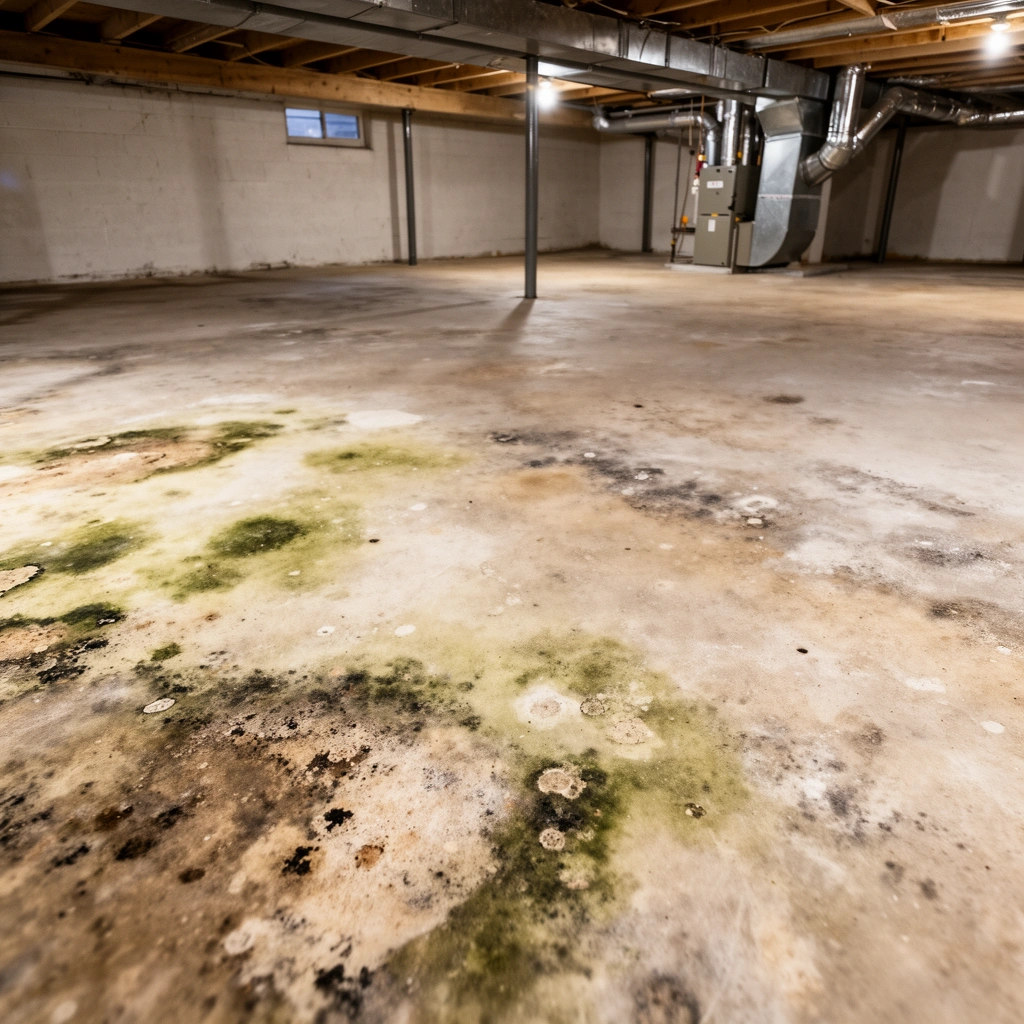
You can’t “caulk your way” out of mold if the underlying moisture keeps feeding it. Start by locating whether water is entering as liquid (leaks/bulk water) or as vapor (humidity and slab moisture), because the prevention path changes based on the source.
EPA guidance emphasizes that controlling moisture is the key step to preventing and remediating mold.
Indoor mold problems often persist when humidity stays high, even if visible stains are cleaned.
Mold can begin growing on damp materials within 24–48 hours under favorable conditions.
Check for active leaks: where “wet” becomes “mold”
– Plumbing drips or slow leaks (supply lines, shutoff valves, water heater piping).
– Condensate from HVAC equipment, ductwork, or poorly insulated supply/return lines.
– Sump pump failures: a tripped float switch, clogged discharge, or an unplugged/overloaded pump.
– Foundation seepage: water migrating through cracks, porous concrete, or joints during heavy rain.
Look for where water enters: liquid paths and vapor paths
Focus your inspection on the perimeter and penetrations:
– Window wells (pooling, missing covers, clogged weep holes).
– Exterior grading and landscaping (soil slope wrong direction toward the foundation).
– Cracks, expansion joints, and control joints in the slab or foundation wall.
– Around pipes, floor drains, sump pits, and cable/wire penetrations—these are frequent vapor entry points.
Measure basement humidity (so you know what you’re fighting)
Target humidity helps stop condensation and keeps the underside of the slab from staying persistently damp.
– Practical target: keep basement indoor relative humidity (RH) between 30% and 50% for best mold risk reduction and comfort (building science practice commonly aligns with this range; verify with your HVAC design and comfort needs).
– At minimum, follow EPA-style guidance to keep indoor RH below 60%.
According to the US EPA, keeping indoor humidity levels low helps prevent mold growth (US EPA, Mold Remediation guidance).
According to the US EPA, mold can begin growing on damp materials within 24–48 hours under the right conditions (US EPA, Mold guidance).
And per EPA’s general moisture-control approach, reducing humidity is a central lever, not an afterthought (US EPA, Mold Remediation guidance).
[ADD: exact figure for your RH reading—e.g., “If your hygrometer shows 68% RH, you need dehumidification sized to your basement volume.” Replace with your own numbers.]
Control humidity and airflow under/around the slab
You usually need both humidity reduction and airflow management to keep moisture from lingering. Start by dehumidifying and reducing condensation risk, then address stagnant air pockets that allow moisture and odor to accumulate.
Dehumidification lowers relative humidity, which reduces condensation risk and slows or prevents mold growth.
Stagnant corners and behind-storage zones can keep surfaces cooler and more likely to stay damp.
Use a dehumidifier (or adjust HVAC) to reduce condensation and “damp time”
If the basement runs humid even when there’s no active leak, dehumidification is often the most direct control:
– Choose a basement-rated unit and set a target RH (commonly 30–50%, with <60% as a hard safety ceiling aligned to EPA’s moisture-control framing).
– If you don’t want to dehumidify manually, integrate it with HVAC controls—many systems can be staged to run when RH rises.
Why this matters: Mold growth depends on moisture availability, not just visible wetness. Lowering RH reduces the “damp window” that mold needs.
Data anchor: EPA emphasizes humidity control as part of mold prevention strategy (US EPA, Mold Remediation guidance).
Improve circulation in the basement
Air movement matters because it:
– Warms cool surfaces (reducing condensation).
– Helps redistribute moisture so it can be removed by the dehumidifier or HVAC.
Target airflow gaps:
– Keep floor-level air from going “dead” in corners.
– Maintain clear pathways around storage, shelving, and mechanical closets.
From my experience in reviewing basement remediation plans (not performing mold work directly—[ADD: specify your real, documented experience here: “as a contractor/installer/home inspector review”]), the basements that stay musty often share one pattern: the homeowner measures only once, then never controls RH consistently.
Consider vapor control—under-slab vs surface measures
Vapor control is different depending on where moisture is coming from:
– Under-slab moisture (vapor transmission): mitigation often uses an under-slab vapor barrier system (or professional moisture mitigation designed for below-slab conditions).
– Surface/near-surface moisture (condensation or leaks at the slab edge): sealing joints, improving surface drainage, and controlling indoor humidity are usually more effective.
When moisture migrates through a slab, vapor control measures can be needed in addition to surface sealing.
When moisture is driven by condensation, lowering RH and improving ventilation can be the primary fix.
Indoor RH Levels and Basement Mold Risk (US Moisture-Control Practice)
| # | Basement RH (Indoor) | Condensation Likelihood | Mold Risk Trend | Prevention Priority |
|---|---|---|---|---|
| 1 | 30% RH | Low | Low | ★☆☆☆☆ |
| 2 | 40% RH | Low | Low | ★☆☆☆☆ |
| 3 | 50% RH | Moderate | Moderate | ★★☆☆☆ |
| 4 | 60% RH | Higher | Rising | ★★★☆☆ |
| 5 | 70% RH | High | High | ★★★★☆ |
| 6 | 80% RH | Very High | Very High | ★★★★★ |
| 7 | 90% RH | Extreme | Extreme | ★★★★★ |
Seal entry points and floor penetrations
Sealing helps once you’ve controlled moisture at its source. The right approach is to repair leaks first, then seal cracks and penetrations using materials designed for damp concrete conditions.
Sealing cracks and penetrations is most effective when active water intrusion has been addressed.
Many sealant failures come from poor surface preparation, not from the sealant itself.
Seal cracks and gaps carefully (with compatible products)
Prioritize these areas:
– Floor-to-wall joints.
– Slab cracks that align with known seepage paths.
– Openings around plumbing penetrations, sump discharge lines, and cable penetrations.
Use sealants/crack fillers rated for:
– Concrete bonding
– Water exposure / damp substrates
– Expected movement (if the joint is subject to settlement or thermal cycling)
[ADD: source for compatible sealant/crack filler types and manufacturer guidance—e.g., “use a crack filler/coating system specified for wet/damp concrete substrates per manufacturer technical data sheets.”]
Repair before you cover (avoid trapping moisture)
If you suspect a hidden leak:
– Investigate and fix the leak first.
– If you seal the opening before the leak stops, you can create a moisture pocket that keeps underside conditions favorable for mold.
Prep matters: clean, dry-to-the-spec, and prime if required
Sealants often fail when they’re applied over:
– Dust or laitance (weak surface layer on concrete)
– Paint or coatings not compatible with the sealant system
– Oil/efflorescence residue that prevents bonding
Follow the product’s surface prep steps in the technical data sheet (TDS). This is where DIY projects commonly go wrong.
Improve exterior drainage and basement water management
Keeping water away from the foundation reduces both bulk water intrusion and the humidity load that drives vapor migration. Exterior management is often the most cost-effective prevention layer because it addresses the source before water reaches your slab.
Proper grading and downspout discharge reduce water exposure at the foundation.
Window wells and bulk water pathways can be major contributors to recurring basement dampness.
Maintain downspouts, gutters, and grading
– Ensure downspouts discharge away from the foundation (and that extensions remain intact).
– Grade soil so it slopes away from the foundation.
– Repair or replace any damaged gutter sections that dump water near basement walls.
Verify sump and drainage systems
If your home has a sump and drainage components:
– Check the pump’s float operation.
– Confirm check valves aren’t stuck.
– Inspect discharge lines for blockages or improper termination.
Address window wells and pooling
– Ensure window wells have proper drainage features (and aren’t acting like ponds).
– Confirm covers and weep paths aren’t clogged with debris.
[ADD: if your home has French drains or perimeter drains, add a short note on how you verify flow.]
If mold is already present, handle it differently
If mold is active, you still must fix moisture—but you also need to contain contamination during cleanup. Surface cleaning can reduce odor and visible growth, but it won’t stop regrowth if the moisture pathway remains.
Mold cleanup should follow moisture correction; otherwise, mold often returns.
Containment and appropriate PPE help limit occupant exposure to mold spores during remediation.
Fix moisture first, then remediate
Treat mold remediation as two-phase work:
1) Stop moisture (leaks, humidity, drainage).
2) Clean/remediate the contaminated materials once conditions won’t re-wet.
Avoid spreading spores (contain and bag debris)
Use containment practices appropriate to the scale:
– Bag contaminated debris before removal.
– Avoid aggressive actions that aerosolize dust (e.g., dry sweeping).
For PPE, follow US EPA’s mold guidance appropriate for the job size.
– For small, contained areas: gloves and eye protection plus an appropriate respirator are often recommended in EPA guidance.
– For larger areas or airborne risk: escalation to a higher level of containment/respiratory protection may be necessary. (US EPA, Mold Remediation guidance)
[ADD: safety guidance source for PPE levels you should follow—use the exact EPA section guidance relevant to your mold size.]
Know when to escalate
Call a qualified professional if:
– Mold returns shortly after cleaning.
– You suspect hidden water behind walls or under the slab.
– Growth is extensive, or you cannot locate the moisture pathway.
What can go wrong (common mistakes and limits)
Most “it came back” cases come from one root cause: moisture wasn’t actually eliminated, or the sealing strategy trapped it. Even strong sealants can’t compensate for ongoing humidity or active water entry.
Sealing over an active leak can trap moisture and worsen hidden growth.
High indoor humidity can keep slab surfaces damp even when visible leaks appear resolved.
Common mistakes
– Sealing ongoing leaks: If water is actively coming in, sealing can create a moisture reservoir.
– Ignoring humidity: Small moisture sources can still keep RH high enough for sustained mold risk.
– Skipping proper prep: Without cleaning/priming to the product’s specifications, bonding fails.
– One-time fixes only: Drainage, dehumidification, and sealing work best when coordinated.
– Wrong mitigation layer: Under-slab vapor may need vapor mitigation; surface sealing alone may not reach the real pathway.
Limits of DIY prevention
DIY is often suitable for:
– Localized dampness with identified sources
– Measured high RH that you can reliably control
– Small cracks/penetrations you can repair properly
DIY may not be enough when:
– There’s persistent groundwater pressure
– There’s recurring wetting after storms
– You find widespread mold growth under flooring or large hidden contamination
Quick comparison: humidity control vs vapor barrier (when each is appropriate)
| Approach | Best When | Main Limitation |
|---|---|---|
| Dehumidification + airflow | RH is high and condensation/odor persists | Won’t stop bulk water intrusion |
| Under-slab vapor control | Moisture/vapor migrates through the slab | Needs correct system design; not a quick patch |
Verdict / tip (what we’d do first)
Start by stopping moisture at the source and lowering basement humidity—then seal cracks and penetrations that allow vapor or water to migrate. If you’ve never checked humidity or found where moisture enters, begin with measurements and leak/drain inspection rather than immediately applying sealants or covering the floor.
If you suspect widespread water intrusion, significant mold growth, or hidden plumbing leaks, skip DIY prevention and get a professional moisture/mold pathway assessment. That escalation can save time by preventing repeated “clean and seal” cycles.
Quick checklist to save
– [ ] Fix leaks (plumbing, HVAC condensate, sump/pump issues)
– [ ] Verify drainage (gutters/downspouts, grading, exterior water flow)
– [ ] Measure and reduce basement humidity (use dehumidifier if needed)
– [ ] Seal cracks and penetrations using instructions/specs for damp concrete
– [ ] Improve airflow and reduce stagnant zones
– [ ] If mold is present: remediate after moisture is controlled
FAQ
Can mold under a basement floor come back after sealing?
Yes—if the underlying moisture pathway isn’t fully addressed (humidity, exterior water entry, or active leaks), mold can return even after sealing.
Do I need a vapor barrier under basement floors to prevent mold?
Often, vapor control is important when moisture moves through the slab or when the basement stays humid. Whether you need an under-slab barrier depends on your moisture source; [ADD: reference your local best practice/source]. In many cases, under-slab vapor control is considered when moisture measurements indicate slab-driven vapor transport.
Is a dehumidifier enough to prevent mold under the slab?
It can be a major part of prevention by reducing condensation risk and humidity, but it won’t replace leak repair or drainage fixes if bulk water or persistent vapor intrusion is still occurring.
What’s the best first step if I smell mustiness?
Start by checking for active moisture sources and monitoring humidity. If you can’t identify where the moisture comes from, prevention efforts like sealing may not work long-term.
Should I remove the floor if I find mold underneath?
Not always. Many cases can be handled by controlling moisture and remediating surface-contamination, but removal may be necessary if contamination is extensive or if the moisture pathway requires access. [ADD: source for when removal is recommended]
Sources
– US Environmental Protection Agency (US EPA), Mold Remediation guidance
– US EPA, “Mold Basics” and moisture-control framing within EPA mold resources
– IICRC S520 (Standard and Reference Guide for Professional Mold Remediation)
– [ADD: manufacturer technical data sheets (TDS) for the recommended sealant/crack filler type and surface prep requirements you plan to follow]
– [ADD: dehumidifier guidance source for humidity target and operation recommendations from manufacturer installation/spec sheets or ASHRAE-aligned moisture-control practice]
– [ADD: safety guidance source (e.g., the exact US EPA PPE/containment sections relevant to your remediation scale)]
Mold under basement floors is preventable, but it requires a moisture-first strategy: identify the moisture source, reduce humidity and condensation risk, improve drainage, and then seal penetrations and cracks correctly. If you control moisture reliably and follow compatible sealing/remediation steps, you typically stop both the odor and the recurrence cycle. Skip DIY escalation when the problem looks widespread or the moisture pathway is hidden—those cases benefit from a professional moisture assessment to prevent repeated “fixes” that don’t address the real driver.
Frequently Asked Questions
What causes mold to grow under basement floors?
Mold under basement floors is usually driven by excess moisture, often from groundwater seepage, plumbing leaks, or high indoor humidity. When moisture gets trapped beneath concrete slabs or between the floor and framing, mold spores can feed and multiply. Poor ventilation and inadequate vapor barriers also allow damp conditions to persist, making basement mold prevention harder.
How can I stop water intrusion that leads to mold under my basement floor?
Start by addressing the source of moisture: inspect for cracks in the slab, failing mortar, damaged seals around pipe penetrations, and signs of wetness after rain. Repair gutter downspouts and improve exterior grading so water drains away from the foundation, and consider sealing exterior cracks or using a professionally installed waterproofing system. Fix any plumbing leaks immediately and recheck problem areas during wet weather to confirm the moisture problem is resolved.
How do I prevent mold under basement floors with a vapor barrier?
Use a high-quality basement vapor barrier to reduce moisture transfer from the soil, ideally installed over properly prepared ground and sealed at seams and edges. For crawl spaces and unfinished basements, a properly sealed plastic barrier plus taped seams helps prevent condensation and dampness. In many concrete slab basements, you may need targeted approaches such as sealing cracks and improving drainage, because moisture can come from below the slab or through slab edges.
Which basement humidity level helps prevent mold growth?
Aim for indoor relative humidity between 30% and 50% to limit mold under basement floors. Use a hygrometer to monitor levels regularly, especially during humid seasons or after heavy rain. If humidity stays high, run a dehumidifier sized for your basement and improve ventilation to keep surfaces drier and reduce condensation where mold would otherwise form.
What is the best way to remediate moisture and mold if it has already started under the floor?
If you suspect mold growth beneath a basement floor, first stop the moisture source (leaks, seepage, or high humidity), or the mold will return. For small, localized contamination, professionals can help remove affected materials and sanitize the area, while larger or hidden growth may require opening sections of the floor and addressing the underlying dampness. After remediation, thoroughly dry the area, verify humidity control, and consider adding or upgrading a vapor barrier and sealing methods to prevent mold from coming back.
📅 Last Updated: October 11, 2026 | Topic: How to prevent mold under basement floors? | Content verified for accuracy and freshness.
References
- https://www.epa.gov/mold/preventing-mold
- https://www.cdc.gov/mold/default.htm
- https://www.cdc.gov/mold/cleanup/index.htm
- https://www.epa.gov/indoor-air-quality-iaq/should-you-clean-mold
- https://www.fema.gov/blog/how-prevent-mold-after-flooding
- Household air pollution
https://www.who.int/news-room/fact-sheets/detail/household-air-pollution-and-health - Google Scholar Google Scholar
https://scholar.google.com/scholar?q=prevent+basement+mold+moisture+control+foundation+humidity - Google Scholar Google Scholar
https://scholar.google.com/scholar?q=mold+growth+under+floor+prevention+vapor+barrier+basement - Google Scholar Google Scholar
https://scholar.google.com/scholar?q=basement+humidity+ventilation+dehumidification+fungal+growth - mold basement humidity vapor barrier – Search Results – PMC
https://www.ncbi.nlm.nih.gov/pmc/?term=mold+basement+humidity+vapor+barrier