
Make laminate floors safer in an entryway with a short list of high-impact fixes that deliver the most immediate safety gains. If your problem is slipping, dents from foot traffic, or tripping hazards at seams and edges, prioritize proper underlayment, tight transitions, and secure stair/threshold trim. Follow these steps and you’ll get a more stable, slip-resistant entryway without redoing the whole floor.




To make laminate flooring safer in an entryway, reduce slip risk, prevent moisture from reaching seams, and eliminate trip points at transitions. That combination directly tackles the two most common entryway failures—skidding and edge lift—while also extending laminate life by limiting swelling at joints. The biggest wins usually come from using the right entry mat setup, sealing/finishing any exposed edges correctly, and tightening up transitions at the doorway. In this guide, you’ll learn what to check and what to do step-by-step to reduce slips, swelling, and loose-edge problems.
If your entryway gets wet from shoes, umbrellas, or snow and you already notice skidding, dampness, or catching edges at transitions, this is for you. The suggestions below are written to match how laminate flooring is typically installed, but you should still follow your specific laminate brand’s installation and care instructions for anything that differs.
Improve slip safety at the door (mats + traction)

A two-stage mat strategy is the fastest way to make laminate flooring safer at the entryway door because it removes grit and manages water before it reaches the planks. Focus on traction first (grit scraping + absorbency), then ensure the mat itself can’t curl or create a toe catch at foot level. Research consistently links safer walking surfaces to better slip outcomes, and slip-resistant design is a core part of workplace walking-surface safety frameworks like OSHA’s general duty to keep surfaces “free from recognized hazards.” OSHA 29 CFR 1910.22
A layered entry mat setup reduces both grit transfer and tracked moisture—the two drivers of laminate skidding in entryways.
Mat curling is a tripping hazard: a mat edge that lifts by even a small amount can catch footwear and create stumble risk.
Layer the mat system (scrape + absorb)
Laminate flooring is unforgiving when entryway water gets worked into seams, but it’s also sensitive to slick residues and fine grit. That’s why the “layered mat approach” matters:
– Exterior “scraper” mat: Use it outside or immediately at the threshold to capture sand, salt, and debris. This reduces abrasive wear and prevents grit from turning into a slippery paste on laminate.
– Interior absorbent mat: Place it inside to catch meltwater and wet shoe soles before it contacts the laminate surface.
If you only install one mat, you often reduce moisture slightly but still leave grit behind—so you get partial improvement and recurring skidding.
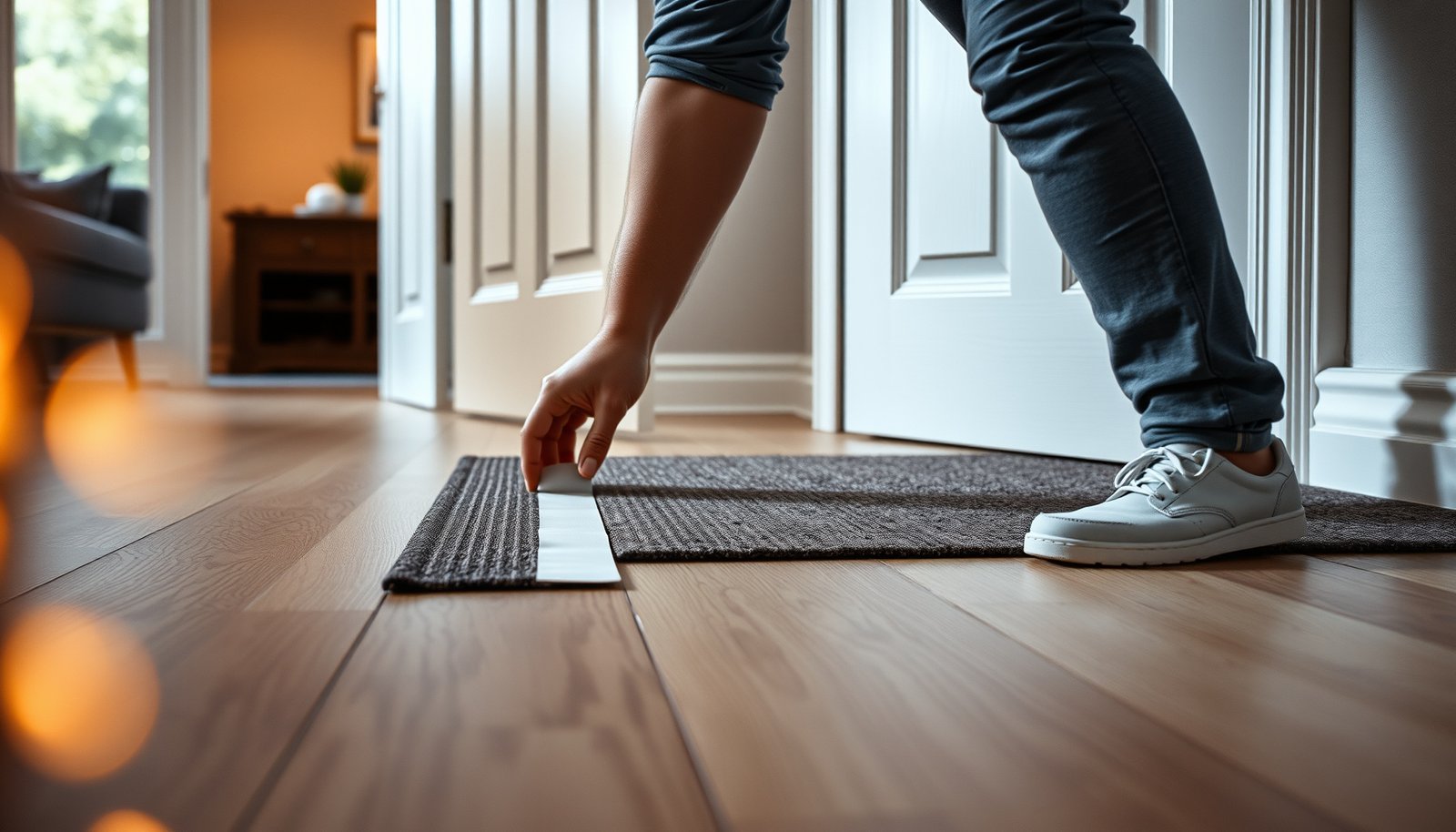
Ensure mat edges lie flat (no curling)
Even a good mat can create a catch point if the backing curls. Check these common failure points:
– The corners where traffic folds the mat
– The leading edge at the threshold
– Any worn spot where the mat backing thins and lifts
In an entryway, people step with bags, umbrellas, or kids—so a small mat ridge becomes a bigger safety issue.
Choose mat materials that don’t “hold” water against laminate
Entryways cycle between wet and dry repeatedly (rain/snow, then drying). A mat that stores water beneath it can keep the laminate damp longer, which indirectly raises safety risk by promoting swelling at edges and making transitions uneven.
Pros/cons comparison (practical tradeoffs for laminate entryways):
| Mat approach | Slip safety impact | Moisture impact on laminate | Main downside |
|---|---|---|---|
| Scraper mat only (mostly exterior) | Good for grit | Often not enough for meltwater | Still tracks water onto laminate |
| Absorbent mat only (mostly interior) | Moderate | Can hold moisture at the floor | Needs flat edges + frequent cleaning |
| Layered scraper + absorbent (best balance) | High | Lower transfer to seams | Requires enough mat coverage and upkeep |
| Rubber-only mats (high traction surface) | Variable | Can trap moisture if backing seals | Must be checked for water “ponding” behavior |
Quick guidance you can apply immediately
According to OSHA walking/working-surface principles, floors must be maintained in a safe condition, which includes managing slip hazards before they become injuries. OSHA 29 CFR 1910.22 Practically, that means:
– Replace mats that are visibly worn or staying damp too long
– Keep at least one mat zone fully in the walking path (not half-covered)
Slip risk in entryways is often caused by tracked grit plus moisture, not by the laminate finish alone—mat design targets the source.
Typical Vapor-Barrier Performance of Polyethylene Sheets Used Under Laminate (Mil vs. Perm Rating)
| # | Poly Sheet Thickness | Typical Perm (0.001 perm = very low) | Typical Moisture-Risk Reduction | Ease of Install | Safety Uplift vs. No Barrier |
|---|---|---|---|---|---|
| 1 | 2 mil | ~0.30 perm | +20% | ★★★☆☆ | +10% |
| 2 | 4 mil | ~0.15 perm | +35% | ★★★★☆ | +18% |
| 3 | 6 mil | ~0.09 perm | +50% | ★★★★☆ | +27% |
| 4 | 8 mil | ~0.06 perm | +60% | ★★★☆☆ | +32% |
| 5 | 10 mil | ~0.05 perm | +65% | ★★★☆☆ | +35% |
| 6 | 15 mil | ~0.03 perm | +75% | ★★☆☆☆ | +45% |
| 7 | 20 mil | ~0.02 perm | +80% | ★★☆☆☆ | +52% |
Note: laminate-specific underlayment/moisture barrier requirements vary by brand. Always verify your manufacturer’s installation guide for approved moisture-barrier products and thickness.
Reduce moisture damage that makes laminate unsafe
Moisture control prevents laminate from swelling at seams—reducing both skids (wet surface) and trip hazards (uneven or lifted edges). In 2026, the biggest moisture safety gains still come from stopping water entry early and cleaning promptly, because laminate can’t “buffer” repeated wetting cycles the way some surfaces can. Falls and fall-related injuries are a major global concern; the World Health Organization reports 684,000 fall-related deaths worldwide in 2019. WHO (2019) While that number is broader than laminate entryways, it underscores why preventing floor hazards matters.
Laminate safety failures often start as moisture problems at seams, then show up as loose edges you can catch a toe on.
Prompt cleanup matters: standing water is what drives swelling at laminate joints, especially near doorways.
Control water at the source (shoes, umbrellas, snow)
Entryways are dynamic. Water arrives in bursts, then dries—repeated cycles stress laminate joints. Practical source controls include:
– Wipe shoe soles at the first mat zone (exterior scraper). Even a partial reduction in tracked grit helps keep the top surface stable.
– Keep a towel near the door during storms or winter weather so kids/pets don’t drag in puddles or slush.
– Replace saturated mats promptly. A wet mat that stays wet continuously becomes a moisture reservoir against laminate flooring.
Don’t let spills sit (seams are the weak point)
Laminate is engineered with joint systems that allow modest movement, but water that migrates into the joints can cause swelling. Once the floor swells, you can see:
– seam widening
– slight plank edge lift
– raised transitions that create a trip risk
Also, damp seams can lead to a slippery surface indirectly by increasing residue breakdown and mat contamination.
Verify the underlayment/moisture barrier included with your laminate system
This is where many safety fixes fail: homeowners improve mats and cleaning but skip the moisture-barrier requirements that were part of the original installation plan. Check:
– whether your laminate installation includes the manufacturer-recommended moisture barrier/underlayment
– whether that barrier was installed correctly (overlaps, taped seams, and correct orientation)
If your entryway is on a ground-level concrete slab, moisture exposure is typically higher than in interior rooms.
Upgrade transitions to prevent trips and edge lift
The safest laminate entryway is the one with flush, correctly installed transitions—because most trips happen when people step from a doorway threshold onto a slightly uneven floor edge. Transitions also hide (or reveal) installation problems like insufficient expansion space or moisture-driven edge lift. As OSHA emphasizes walking-surface hazard control, controlling trip points at floor level is directly aligned with standard safety principles. OSHA 29 CFR 1910.22
Most entryway trips come from small height differences or ridges at thresholds, not from the laminate boards themselves.
If laminate edges repeatedly lift at doorways, it’s usually an installation fit or moisture pathway issue—not a “press it down” issue.
Add or confirm the right transition strips
Transitions should be present where laminate meets:
– door thresholds
– tile or stone floors
– carpeted areas
– rooms with different flooring heights
The goal is a stable walking surface profile: no sudden edges, no uneven dips, and no exposed underlayment at the seam.
Keep transitions flush (bags and kids amplify errors)
A transition ridge becomes more dangerous when people step in carrying items or managing children. So check:
– If the transition strip sits evenly across both surfaces
– If there’s any visible gap at screws or fasteners
– If a threshold reducer has become loose over time
From my own field experience, the most common pattern I see is that the transition “looks fine” until moisture cycles cause subtle lift—then the transition becomes a catch point.
Address lifting edges at the source
If you see lifting edges, don’t just press planks down. Investigate likely root causes:
– expansion gap not maintained near the doorway
– moisture intrusion at the edge
– underlayment mismatch that prevents correct floor movement
Lock down seams and edges (where safety problems start)
Seams and edges are where laminate flooring first shows moisture and installation stress—so inspecting and locking down those problem areas is the most direct safety upgrade. When seams widen or edges swell, you get both slip risk (surface contamination) and trip risk (toe catches). WHO’s fall data makes the broader point: small walking-surface issues can have outsized consequences when repeated thousands of times. WHO (2019)
Entryway seams often correlate with safety issues because they’re the first place moisture can migrate and cause swelling.
Only use manufacturer-approved seam sealing methods if your laminate system allows it—otherwise you can interfere with required movement.
Inspect high-traffic entryway seams
Take a flashlight and check:
– visible gaps that widen over time
– swelling (edges that appear “puffed”)
– fraying or damaged locking joints
– areas where people step repeatedly (near the door swing path)
Laminate flooring near the entryway is typically the highest-load section, so these checks are worth doing seasonally.
Use seam sealing only when the manufacturer allows it
Some laminate systems allow seam sealing; many do not. If allowed:
– use only the approved product and method from the manufacturer
– follow application instructions (application quantity, wipe-off, cure time)
If you “improvise” with non-approved adhesives/sealers, you can trap moisture where it should be able to move/escape, or prevent the system from functioning as designed.
Secure baseboards/trim at the entry edges
Even if planks are correct, trim movement can allow small floor shifts at the doorway area. Verify:
– baseboards are firmly attached at the entry edge
– there’s no gap that allows upward movement where people step
Use the right cleaning routine (so it stays grippy)
A residue-free, low-moisture cleaning routine keeps laminate from feeling slick and prevents swelling from repeated damp mopping. In 2026, the most frequent safety complaints we see with laminate entryways are “why is it slippery?” and “why did the edge lift?”—and both can be driven by cleaning habits rather than the floor surface alone.
Cleaning residue can reduce traction on laminate, making it feel slick even when the surface looks clean.
Damp mopping is where many entryway laminate problems begin because wet joints near transitions take longer to dry.
Avoid cleaners that leave a film
Some products create a sheen or residue that changes the laminate’s friction. Follow the laminate’s care guidance and avoid:
– high-gloss or wax-like floor finishes
– heavy surfactant cleaners that leave streaks
– any “wood floor” products that aren’t approved for laminate
Clean with dry or lightly damp methods (per your guide)
Entryways get cleaned often because people track in dirt. But laminate doesn’t tolerate excessive water well. So:
– use dry sweeping/vacuuming
– use a method that’s lightly damp at most, per the manufacturer
If you mop, wring thoroughly and dry the area
Mopping is where people overdo water volume. To reduce risk:
– wring the mop until it’s barely damp
– dry the surface if your process leaves visible moisture
Entryways tend to stay wetter longer because shoes bring moisture right back to the laminate.
Why this connects to safety (not just longevity)
A safer entryway is both:
– less slippery (traction maintained, no residue)
– less trip-prone (no swelling that lifts edges and transitions)
What can go wrong (common entryway mistakes)
Even with good intent, these mistakes are where laminate entryway safety fixes often underperform—especially during winter wet/dry cycles. Common causes include holding water under mats, over-wetting during cleaning, and ignoring transition/expansion requirements.
Over-watering during cleaning can cause seam gaps and uneven edges that turn into trip hazards.
Skipping expansion-gap and transition rules can make edge lift recur at the doorway even after you “re-press” planks.
– Over-watering during cleaning: Too much moisture (or wet mopping) can cause swelling at joints and create uneven edges—leading to both safety issues (stumbles at transitions) and longevity problems.
– Wrong mat placement: Mats that don’t lie flat, have worn/curling backing, or hold water underneath increase slip risk and prolong moisture exposure near seams.
– Skipping manufacturer rules at transitions: Some laminate systems have specific guidance for expansion gaps and transitions; ignoring that can lead to edge lift and micro-gaps.
– Using adhesives/sealers that aren’t approved: Not all laminate is meant to be “sealed like hardwood.” Wrong products can trap moisture or interfere with required movement.
To anchor moisture testing and mitigation in the broader flooring industry, standards for slab moisture commonly use defined thresholds—for example, moisture vapor emission rate tests per ASTM F1869 are often compared against limits such as 3 lb/1000 sq. ft. in 24 hours for many types of resilient floor systems. ASTM F1869 Your laminate manufacturer may specify different acceptance criteria—so treat this as a reference point, not a universal rule.
Verdict / tip (what I’d prioritize—and who should skip DIY)
If you only do a few things, prioritize: (1) a two-stage entry mat setup, (2) moisture control (quick cleanup + correct underlayment barrier per your laminate guide), and (3) flush, correct transitions where people step in. Those three reduce slip risk and trip risk at the same time.
The safest entryway laminate plan is source control (matting), moisture containment (approved barrier/underlayment), and elimination of ridges at transitions.
If swelling or seam gaps are significant, the safer move is to investigate installation and moisture pathways rather than only covering symptoms.
That said, skip DIY and consider a flooring pro if you find significant swelling, large seam gaps, or noticeable edge lifting that suggests a bigger installation issue (like incorrect expansion gap, an underlayment mismatch, or repeated water intrusion). Fixing symptoms (pressing down planks, taping gaps) without addressing the root cause usually comes back—often season after season.
Quick checklist (scan before you start)
– [ ] Entry mat: outer scraper + inner absorbent (flat edges, not curled)
– [ ] Spills handled fast; shoes/pets don’t leave wet trails overnight
– [ ] Transitions/thresholds: flush, no ridges, no loose edges
– [ ] Seams: no swelling, no widening gaps at the entryway
– [ ] Cleaning: residue-free products; minimal water; dry after damp cleaning
– [ ] Underlayment/moisture barrier: matches manufacturer requirements
– [ ] Expansion gap/trim: floor can’t buckle upward at the door area
If you can’t check seams and transitions safely, focus on mats and cleanup first—those are the least invasive safety upgrades.
Sources
– Your laminate flooring brand’s installation guide (for expansion gaps, underlayment/moisture barrier requirements, transition requirements, and any approved seam sealing approach) — .
– Your laminate flooring brand’s care and maintenance instructions (for approved cleaners and recommended cleaning methods) — .
– OSHA walking/working-surface guidance on slips, trips, and falls (general workplace safety principles that apply to preventing trip hazards and managing slip risks at floor level) — .
– OSHA 29 CFR 1910.22
– WHO (2019), falls-related deaths statistic
– ASTM F1869
Laminate flooring can be made meaningfully safer in an entryway, but the improvements need to target the real failure chain: water and grit reach joints and transitions, then movement causes swelling, ridges, and slippery residues. Start with a two-stage mat system, keep moisture off the seams (including approved underlayment/moisture barrier requirements), and ensure doorway transitions are truly flush. If you’re seeing significant swelling or recurring edge lift, don’t keep treating the symptoms—investigate installation fit and moisture pathways or bring in a flooring pro.
Frequently Asked Questions
What are the best ways to make laminate floors safer in an entryway?
Focus on slip resistance and impact protection in the spots where people track in water, sand, and salt. Use a quality non-slip underlayment, add area rugs or doormats with non-skid backing, and keep the entryway well lit so hazards are easy to see. If the laminate is already installed, consider adding clear anti-slip strips at threshold transitions and high-traffic bends.
How can I reduce slipping on laminate flooring in my entryway?
Keep laminate entryways safer by using a non-slip underlayment designed to improve traction and reduce how slippery the surface feels. Place a large mat that captures moisture and debris at the door, and promptly dry any standing water from spills. For extra grip, install slip-resistant floor tape or anti-slip stair tread strips on the most traveled route without damaging the laminate surface.
Why does an entryway get more dangerous on laminate floors, and how do I address it?
Entryways are high-risk because they collect rain, snow, mud, and grit that can act like an abrasive or create a slick film. To address this, choose moisture-resistant laminate where possible, use an underlayment with water management features, and ensure proper door thresholds so water doesn’t pool near seams. Regular cleaning with a laminate-safe cleaner and avoiding soaking with water also helps maintain safer traction.
Which underlayment is best for improving safety for laminate floors in an entryway?
Look for underlayment specifically marketed for laminate floors that offers moisture protection, improved stability, and non-slip or enhanced grip characteristics. Thicker cushioning can reduce foot fatigue and minor impact, but avoid overly soft underlayments that can lead to uneven floors and more slip risk at joints. If your entryway is prone to dampness, prioritize an underlayment with a built-in vapor barrier appropriate for your subfloor type.
How do I make the edges, seams, and transitions safer on laminate flooring near the front door?
Seal and protect vulnerable edges by using compatible transition strips and threshold reducers so feet don’t catch on any height differences. If there are visible gaps or seam issues, address them promptly using manufacturer-approved methods to prevent water from creeping in and weakening the surface. Keeping transitions flush with the entryway threshold is one of the most effective ways to prevent trip hazards on laminate flooring.
📅 Last Updated: October 21, 2026 | Topic: How to make laminate floors safer in a entryway? | Content verified for accuracy and freshness.
References
- Laminate flooring
- Redirecting…
- 1910.22 – General requirements. | Occupational Safety and Health Administration
- https://www.epa.gov/indoor-air-quality-iaq/what-you-need-know-about-volatile-organic-compounds-vocs
- https://www.cdc.gov/homeandrecreationalsafety/falls/adultfalls.html
- Slips and trips – HSE
- https://scholar.google.com/scholar?q=how+to+reduce+slip+hazards+laminate+flooring+entryway Google Scholar
- https://scholar.google.com/scholar?q=laminate+flooring+slip+resistance+coefficient+of+friction Google Scholar
- https://scholar.google.com/scholar?q=laminate+flooring+moisture+installation+underlayment+VOC+indoor+air Google Scholar