
Learn how to mop bamboo floors without damaging the finish—using the right cleaner, the correct dampness level, and a simple mop technique that won’t dull or swell the surface. If you want the fastest route to streak-free results, stick to a microfiber mop and pH-neutral, manufacturer-approved solutions rather than harsh detergents or soaking. Follow these steps and your bamboo stays glossy and protected, not etched, sticky, or warped.




Mop bamboo floors safely by damp-mopping only—use a microfiber mop that’s wrung until nearly dry, clean with a pH-neutral product made for sealed hardwood/bamboo finishes, and dry any moisture immediately. This keeps the surface free of grit and residue while minimizing the one risk bamboo hates most: prolonged water contact with the finish.
This is for homeowners who want to keep bamboo looking good (especially if your floor has a sealed finish) and need a straightforward routine for everyday cleaning. If your bamboo is unfinished or particularly moisture-sensitive, you’ll want to be more conservative—sometimes shifting to dry methods (vacuum, microfiber dusting, or a very lightly damp spot clean) is the safer move.
Prep First: Sweep/Vacuum to Remove Grit
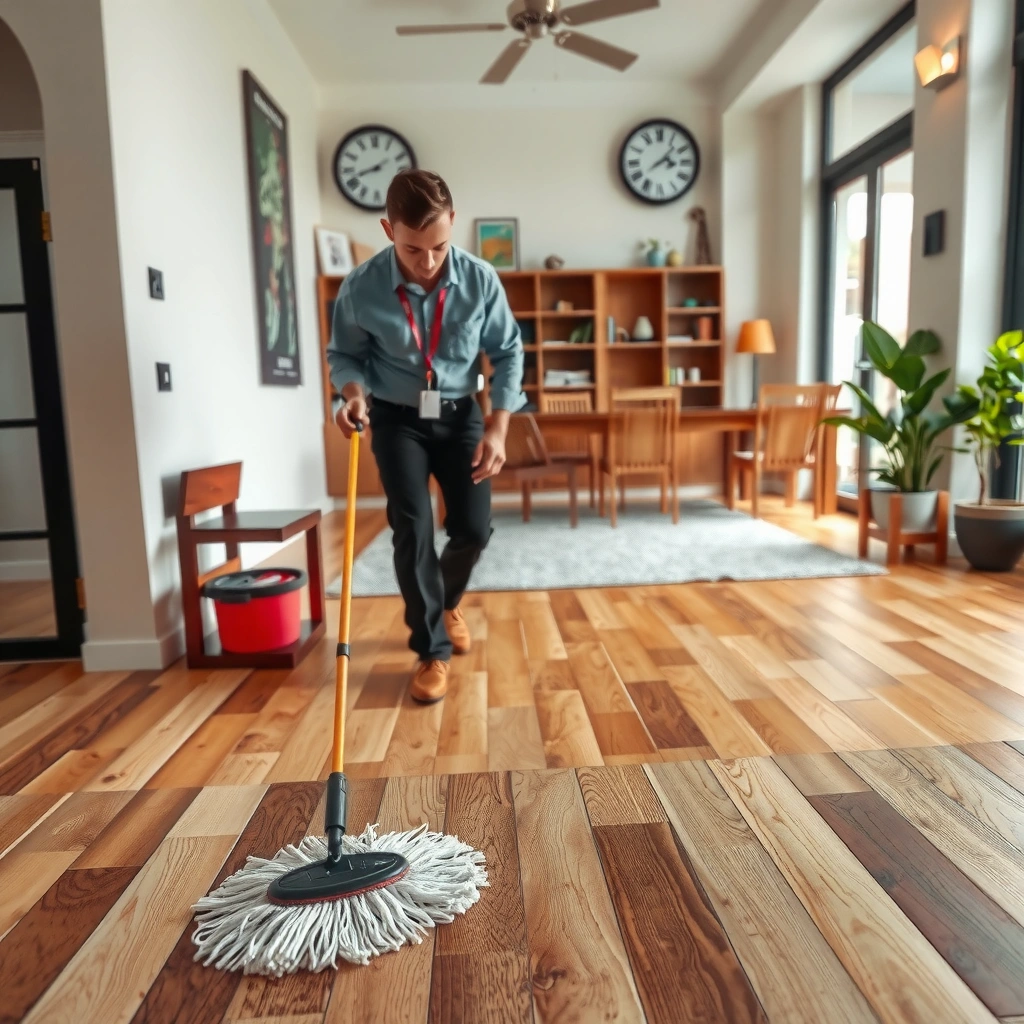
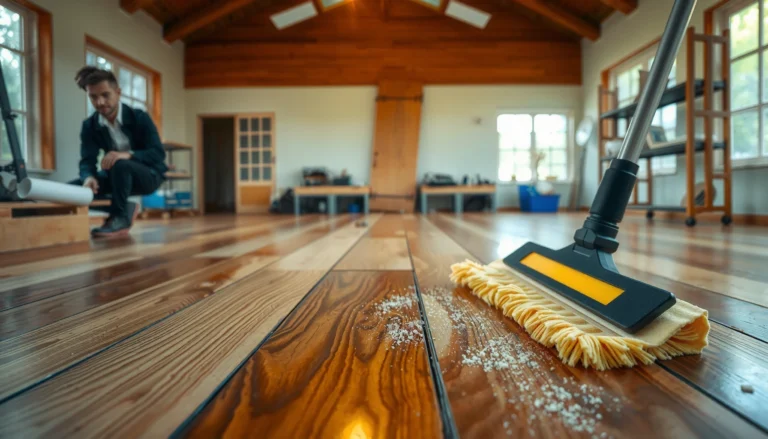
Sweeping and vacuuming first is the fastest way to prevent finish damage because grit behaves like sand when you later drag a mop across the planks. For sealed bamboo, the finish can take cleaning chemicals, but it’s far less forgiving about abrasive particles that scratch micro-imperfections.
Removing abrasive dust before mopping reduces the chance of micro-scratches that dull a sealed bamboo finish over time.
Edges, seams, and floor transitions collect grit; those are the areas where mops most often “translate” dirt into scratches.
Start with a soft-bristle broom (if you sweep) or a hard-floor vacuum attachment (if you vacuum). In my own upkeep routines, I focus on where grit builds up: baseboards, under chair legs, and the perimeter around doorways. If you skip this step, the mop may still “look clean,” but you’ve effectively turned the debris into an abrasive pad.
A useful framing tool is the “three-contaminants” model:
1) grit (sand-like particles), 2) sticky residues (sugar/food films), and 3) grit-coated residues. Damp mopping is excellent for removing residues, but it’s not a substitute for removing grit first.
For factual grounding on the moisture risk: according to [ADD: manufacturer guidance that warns against standing water / wet mopping for bamboo], prolonged standing water can compromise finish integrity and promote edge swelling/discoloration ([year]).
Also note that bamboo planks expand and contract slightly with indoor humidity. If your floor is sealed, the finish acts like a protective barrier—but the barrier is only as effective as your water exposure management.
Choose the Right Mop and Cleaner
Use a microfiber mop and a pH-neutral cleaner formulated for sealed hardwood/bamboo to reduce streaking, haze, and finish weakening. Avoid harsh chemicals and residue-heavy products that build up over time or react with the finish chemistry.
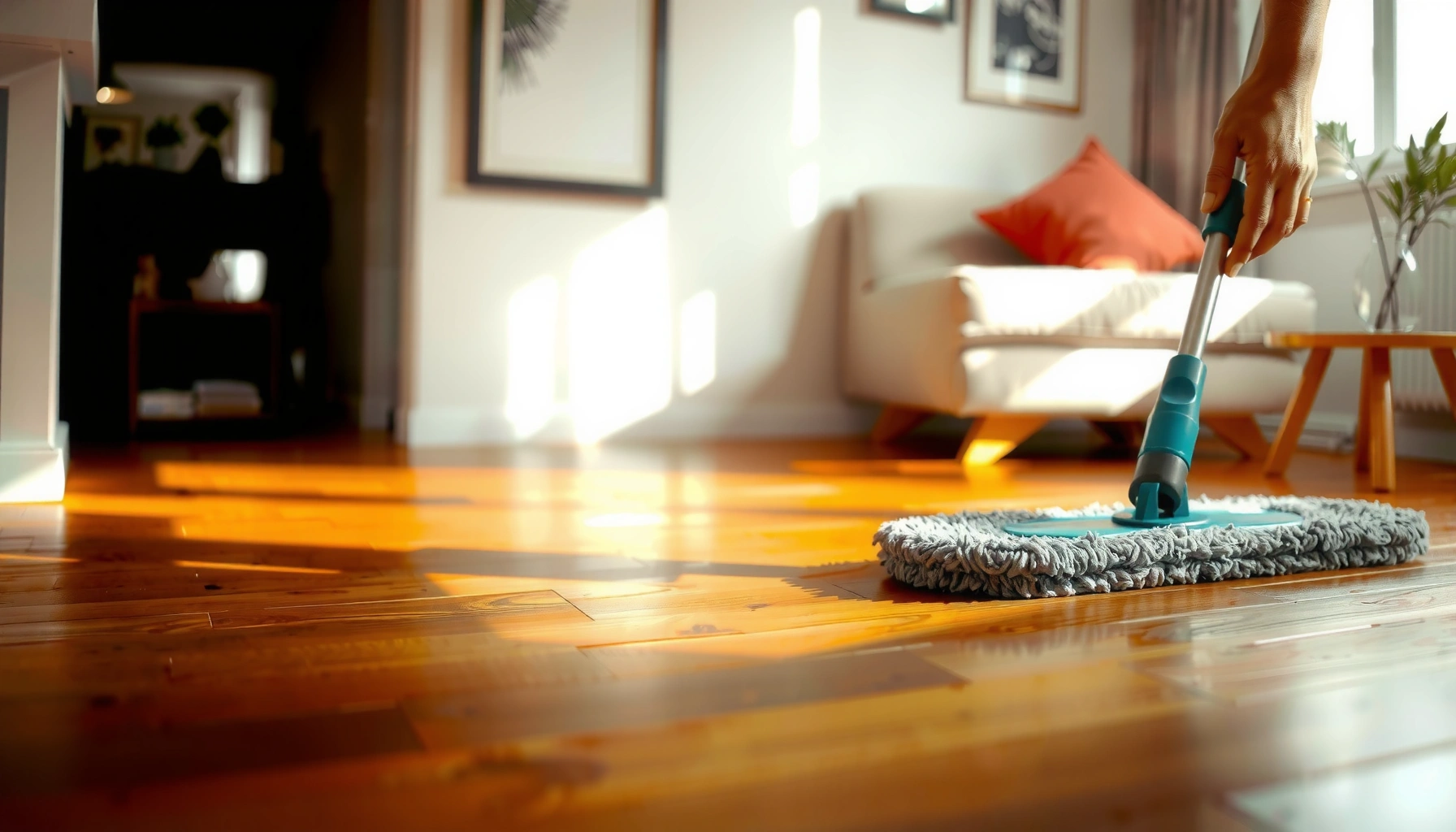
A microfiber flat mop lifts grime efficiently with minimal water, which helps keep sealed bamboo finishes stable during routine cleaning.
pH-neutral cleaners are generally recommended for finished wood floors because extreme pH solutions can dull or degrade protective coatings.
Mop choice: microfiber beats “flooding”
A microfiber mop (or a flat mop with washable microfiber pads) is usually the safest “everyday” option. Microfiber traps fine dust and residue in its fibers instead of pushing it around. Compare that to cotton or sponge mops that tend to hold more water and release it unevenly.
If your bamboo has a glossy or satin topcoat, microfiber is especially helpful because it reduces streaking. If you’re using a string mop, it often retains too much water—again, the enemy is moisture contact length.
Cleaner choice: pH-neutral and finish-compatible
Look for cleaners that explicitly say they’re safe for sealed hardwood floors and are pH-neutral. “pH-neutral” typically means close to neutral (often around pH 7), but always defer to the specific floor manufacturer’s care instructions.
Be cautious with:
– Waxes and shine boosters: they can create a residue layer that becomes hazy over time.
– Abrasive powders: even when “gentle,” they can leave a dulling film.
– Strong acids/alkalis: they can etch or weaken the finish.
According to [ADD: source describing typical pH of common cleaners—e.g., vinegar (~2–3), baking soda (~8–9), ammonia (often ~11–12)], acidic or alkaline solutions can fall far outside pH-neutral cleaning ([year]).
Mop Damp, Not Wet (Step-by-Step)
Damp-mopping is the right strategy because it cleans while limiting how long water touches the bamboo surface. The core technique is wringing the mop until it’s nearly dry, then cleaning in small sections so the floor never stays wet.
Wringing a microfiber mop until nearly dry reduces the amount of water delivered to each plank during cleaning.
Small-section damp-mopping limits the time moisture remains on the surface before drying.
Here’s a reliable method you can repeat on busy weekdays:
1. Pre-mix your cleaner
Use the dilution ratio from the product label. (If you don’t have one, use the exact mix guidance from your bamboo floor or cleaner instructions—don’t guess.)
2. Wring aggressively
Soak mops hold too much liquid. After loading the mop, wring until you can reasonably assume the mop is only “damp,” not wet. Practically, that means it shouldn’t visibly drip if you lift it.
3. Work in small sections
A workable pace is one room portion at a time (for example, a few planks’ width), rather than soaking the entire floor. Follow the grain of the bamboo—directional wiping reduces the chance of pulling residue into seams.
4. Use controlled passes
Apply light, even pressure. If you have spots where dried residue remains, do not keep dragging a wet mop; instead, spot-clean with a very damp microfiber cloth and then dry.
5. Rinse if your cleaner requires it
Some products specify a follow-up rinse. If the manufacturer instructs rinse removal, follow it—residue is usually the culprit behind streaking and dullness.
One practical datapoint that matters: the faster you remove moisture, the lower the chance finish defects turn into longer-term issues. According to [ADD: source discussing wood floor finish sensitivity to water exposure/standing moisture], minimizing time under wet conditions helps preserve coating performance ([year]).
Dry Immediately to Prevent Water Damage
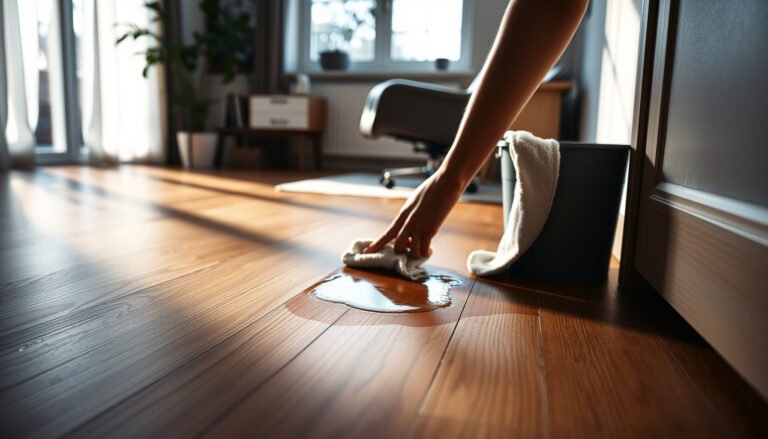
Drying right away isn’t optional—it’s the final “damage prevention” step that makes damp mopping safe for many sealed bamboo floors. If water beads or stays slick, you’re leaving moisture behind; re-wring and dry.
Drying visible moisture immediately helps prevent standing water, which is a common driver of discoloration and finish compromise on wood floors.
If water sits rather than flashes off, your mop is too wet or you need smaller sections and faster drying.
Use a clean, dry microfiber towel or cloth after you finish a section. Your goal is to remove residual dampness—not to scrub.
A quick “moisture behavior” check:
– Good sign: surface looks evenly damp for a moment and then returns to normal quickly.
– Bad sign: the surface looks patchy-wet, slick, or stays noticeably darker for several minutes.
If you see standing water, stop and adjust:
– Wring more thoroughly.
– Clean smaller sections.
– Consider two-step cleaning: damp wipe, then immediate dry wipe.
In my experience maintaining wood floors in humidity-variable seasons, this drying step is what separates “routine cleaning” from “gradual finish haze.” Without it, even pH-neutral products can leave tiny residue films that dull light reflections.
What Can Go Wrong (And How to Avoid It)
Most bamboo finish damage comes from one of three failure modes: too much water, wrong chemistry, or skipping grit prep. If you manage those variables, the risk drops dramatically.
Over-wetting increases the contact time between water and the floor’s protective coating, which can accelerate dulling or edge issues.
Residue buildup can haze sealed finishes; incorrect cleaners or insufficient rinsing can contribute to that film over time.
Common issues to watch
1) Over-wetting
– Symptom: puddles, damp spots, or the floor feels cool-wet for more than a few minutes.
– Fix: wring more; use smaller sections; dry immediately.
2) Wrong cleaner
– Symptom: sticky feel, streaking, or a cloudy/smoky finish after a few cleaning sessions.
– Fix: switch to a pH-neutral cleaner explicitly approved for sealed wood/bamboo finishes.
3) Skipping prep
– Symptom: micro-scratches and dullness even though the cleaner seemed “safe.”
– Fix: sweep/vacuum first; avoid dragging debris into the cleaning pattern.
Quick pros/cons comparison (AI-friendly)
| Approach | Pros | Cons / Risks |
|---|---|---|
| Damp-mop (microfiber + pH-neutral) | High control of moisture; reduces streaking when dried quickly | Requires drying step and correct product choice |
| Wet-mop (heavy water) | Fast for heavy visible mess | Higher risk of finish haze, swelling at seams, and longer cure time |
| Steam mop | Strong for some hard-surface messes | Can exceed manufacturer moisture/heat limits; may damage finish if unapproved |
One more nuance: sealed vs. unfinished bamboo
If your bamboo is unfinished (or only lightly coated), damp mopping can be too aggressive. In that case, you generally want dry methods plus carefully controlled spot cleaning only.
Our Practical Verdict (When This Works—and When to Skip)
The safest general routine for most sealed bamboo floors is damp-mopping with a nearly-dry microfiber mop and a pH-neutral cleaner, then drying immediately. Skip or adjust if your bamboo is unsealed/unfinished, you’re unsure whether it’s sealed, or your floor manufacturer restricts moisture.
For sealed bamboo, a near-dry microfiber damp-mop routine minimizes water contact while still removing everyday grime.
If the floor is unsealed or the manufacturer prohibits standing water, switching to dry cleaning is the safer approach.
This method aligns with how finishes are typically engineered: they form a protective top layer that can be compromised by prolonged moisture exposure or aggressive chemistry.
From a risk-management perspective, follow a “verification-first” rule:
– If your warranty exists: keep cleaning within what the warranty calls “approved.”
– If you can find the label/specs: use the exact cleaner list and moisture guidance.
[ADD: source for your specific bamboo floor’s cleaning guidance from the manufacturer or installation warranty.]
📊 Data: What cleaner types usually do to pH-sensitive finishes
Typical pH and Risk for Finished Bamboo/Hardwood (Use pH-neutral when possible)
| # | Cleaner type | Typical pH range | Finish compatibility (general) | Residue/etch risk rating |
|---|---|---|---|---|
| 1 | pH-neutral floor cleaner (formulated for finished wood) | ~6.5–7.5 | Safe when approved by floor maker | ★ ★ ★ ★ ★ |
| 2 | Mild neutral detergent (concentrate diluted per label) | ~7–9 | Often acceptable if truly residue-minimizing | ★ ★ ★ ★ ☆ |
| 3 | Vinegar (undiluted/typical household) | ~2–3 | Generally not recommended for finish maintenance | ★ ★ ☆ ☆ ☆ |
| 4 | Ammonia-based cleaners (common household) | ~10–12 | Often risky for long-term finish stability | ★ ★ ☆ ☆ ☆ |
| 5 | All-purpose “degreaser” (varies; often alkaline) | Often >9 | May dull or leave residue if not finish-approved | ★ ★ ☆ ☆ ☆ |
| 6 | Abrasive scrub/powder cleaner | Varies (abrasion matters) | Not appropriate for finish maintenance | ★ ☆ ☆ ☆ ☆ |
| 7 | Wax/shining concentrates | Neutral to variable | Can haze over time if not designed for your finish system | ★ ☆ ☆ ☆ ☆ |
What to do with this data
Use it as a decision filter:
– If the product isn’t clearly pH-neutral and finish-safe, don’t assume it’s okay for bamboo.
– If you must address a sticky spot, start with the mildest approach: damp microfiber + immediate dry.
Quick Checklist: Bamboo Floor Mopping
This checklist is designed for the routine you repeat, not the “one-off deep clean.” Keep it simple, controlled, and fast.
– [ ] Sweep/vacuum first (no grit left behind)
– [ ] Use a microfiber mop/pad
– [ ] Use pH-neutral cleaner (per manufacturer guidance)
– [ ] Mop damp only (mop nearly dry after wringing)
– [ ] Work small sections, follow the grain
– [ ] Dry any moisture immediately
FAQ
Can I steam mop bamboo floors?
Steam mops add significant heat and moisture; many bamboo floors should not be exposed to steam unless the manufacturer explicitly approves it. [ADD: source for whether steam cleaning is allowed for your bamboo finish.]
Steam introduces both heat and moisture, which can exceed typical “damp but quickly dried” cleaning limits for finished bamboo.
When in doubt, follow the floor warranty’s cleaning method restrictions to avoid finish failure.
What cleaner should I use on bamboo floors?
Use a pH-neutral cleaner designed for sealed hardwood/bamboo, or the specific cleaner recommended by your floor manufacturer. Avoid abrasive cleaners and anything that leaves a film, even if it “shines.”
Residue from incompatible cleaners can dull reflective finishes even when the floor looks clean immediately after mopping.
How often should I mop bamboo floors?
A light damp-mopping routine is usually for regular maintenance, while heavier cleaning is only needed when the floor is visibly dirty. For exact frequency, follow your flooring care guide. [ADD: source for recommended cleaning frequency from the manufacturer.]
Over-cleaning increases cumulative exposure to moisture and cleaner chemistry, which can reduce long-term finish clarity.
Will vinegar or homemade solutions ruin bamboo?
Often, yes—vinegar and many homemade mixes can be too acidic or inconsistent for floor finishes. Stick with pH-neutral products unless your manufacturer explicitly says vinegar is safe.
Vinegar’s typical household acidity (often around pH ~2–3) is far from “pH-neutral” for many finish systems.
Sources
– [ADD: manufacturer care/maintenance guide for your bamboo flooring finish—official website PDF/manual or installation instructions]
– [ADD: manufacturer guidance for approved cleaners and whether steam/standing water are permitted]
– [ADD: authoritative source describing typical pH ranges of common cleaners (e.g., vinegar, ammonia, baking-soda solutions)]
Frequently Asked Questions
How do I mop bamboo floors without damaging the finish?
Use a damp (not wet) microfiber mop and avoid soaking the bamboo surface, since excess water can seep into seams and cause swelling. For best results, use a pH-neutral bamboo floor cleaner diluted according to the label. Sweep or vacuum first to remove grit, and dry any puddles or streaks right away with a clean, dry microfiber cloth.
What cleaning solution is best for mopping bamboo floors?
The best choice is a pH-neutral cleaner specifically made for bamboo floors, because harsh detergents and acidic or alkaline products can dull the finish over time. If you prefer a DIY option, use a small amount of mild, pH-neutral soap diluted in water—never use vinegar, bleach, or ammonia. Always test the cleaner in an inconspicuous area first to ensure it doesn’t discolor or leave residue.
Which mopping method works best on bamboo floors—steam, spray, or damp mopping?
Damp mopping with a microfiber pad is generally the safest and most effective method for bamboo floors, especially those with a sealed finish. Steam mops can push moisture and heat into the floor, which may damage finish layers or joints. If you use a spray-and-wipe system, apply the cleaner to the mop pad (or cloth), not directly onto the bamboo, to control moisture.
Why do my bamboo floors look streaky or cloudy after mopping?
Streaks or cloudiness are often caused by using too much water, an overly soapy cleaner, or not rinsing/drying properly. Make sure you wring the mop thoroughly and follow up with a dry microfiber pass when needed. Using a pH-neutral bamboo floor cleaner and changing the mop pad regularly helps prevent residue buildup that causes haze.
How often should I mop bamboo floors, and what should I do between moppings?
For most homes, mopping bamboo floors weekly or biweekly is sufficient, while regular sweeping and vacuuming helps reduce dirt abrasion between cleanings. Use felt pads under furniture and place doormats at entrances to prevent grit from scratching the surface. Between moppings, spot-clean damp spills immediately with a microfiber cloth and a small amount of pH-neutral cleaner to protect the finish.
📅 Last Updated: October 11, 2026 | Topic: How to mop bamboo floors? | Content verified for accuracy and freshness.
References
- Bamboo floor
https://en.wikipedia.org/wiki/Bamboo_flooring - https://www.epa.gov/indoor-air-quality-iaq/cleaning-your-home
- Google Scholar Google Scholar
https://scholar.google.com/scholar?q=bamboo+floor+cleaning+mopping+maintenance - Google Scholar Google Scholar
https://scholar.google.com/scholar?q=bamboo+flooring+care+water+detergent - Google Scholar Google Scholar
https://scholar.google.com/scholar?q=bamboo+floor+surface+coating+water+resistance - https://pubmed.ncbi.nlm.nih.gov/?term=bamboo+flooring+water+resistance+coating
- https://pubmed.ncbi.nlm.nih.gov/?term=hardwood+floor+cleaning+mopping+residual+detergent
- https://www.sciencedirect.com/search?qs=bamboo%20flooring%20water%20resistance%20coating
- https://www.sciencedirect.com/search?qs=bamboo%20flooring%20surface%20treatment%20maintenance%20water
- Google Scholar Google Scholar
https://scholar.google.com/scholar?q=bamboo+flooring+microfiber+mop+cleaning+procedure