


Maintain vinyl floors in a restaurant with a simple routine that prevents scuffs, dulling, and moisture damage—because the fastest way to protect your investment is the right cleaning schedule plus the right mat strategy. You’ll get clear, practical care tips for daily, weekly, and spill response, tailored to high-traffic areas and heavy footfall. Follow these steps and your vinyl stays cleaner, smoother, and more consistent with far less downtime and rework.




Keep restaurant vinyl floors looking uniform by controlling grit, cleaning with vinyl-safe products, and protecting seams and high-traffic zones from moisture and wear. With a daily sweep/spot-clean routine plus weekly mopping and periodic seam inspections, you can prevent dullness, scuffs, and water-related edge issues—without disrupting busy dining-room and kitchen schedules. Vinyl floors in restaurants stay looking good by preventing grit buildup, cleaning the right way, and protecting the surface from heavy traffic and spills. Focus on daily sweeping/mopping routines plus fast spill cleanup, then do periodic deeper cleaning and inspection of seams and edges. This guide walks you through a simple maintenance plan that fits busy kitchen and dining-room schedules.
If you run a restaurant, café, bar, or any high-traffic space with vinyl flooring, this is for you—especially if you’re dealing with scuffs, dull areas, or concerns about water getting under seams. It’s also useful if your staff needs a clear “what to do every day” checklist. As of 2026, this kind of structured routine matters even more because dining traffic keeps floors under continuous abrasion (tracked dirt) and frequent spot challenges (food and beverage spills).
Daily cleaning routine for vinyl in busy dining areas

The fastest way to prevent vinyl floor damage is to remove abrasive grit daily and keep cleaning products gentle. Vinyl floors get dull and scuffed primarily when sand-like debris is dragged across the surface, especially at entrances, server stations, and pathways to the kitchen.
According to the U.S. Geological Survey (USGS), sand grains commonly range from about 0.0625 to 2 mm—small enough to get tracked in and act like abrasive particles.
According to the USGS, quartz (a common sand component) is about Mohs 7.0 in hardness, which can accelerate scuffing on resilient flooring finishes.
Start with dry soil removal (then mop only when it earns its keep)
Daily grit control is the foundation of vinyl floor maintenance in restaurants. In my experience advising floor-care teams, the biggest improvement usually comes from staff removing dry debris before any wet step—because grit underfoot turns even a “soft” mop motion into grinding. Use a dry method first, then switch to a damp approach only when the floor needs it.
A simple daily workflow for vinyl floors:
– Dry sweep or vacuum regularly (use a soft brush attachment) to remove sand and crumbs before they scratch the finish.
– Mop only as often as needed using a cleaner approved for vinyl floors (avoid harsh chemicals unless the manufacturer says they’re safe).
Dry sweeping matters because restaurants constantly generate loose particulates: napkin fibers, condiment residue, sugar granules, and paper dust from packaging. None of those look dramatic, but they increase micro-scratches that build up into dull patches over time.
Use the “soft-contact” rule for equipment
For vinyl floors, the goal is contact without abrasion. When vacuuming, choose soft-bristle or brush attachments rather than metal components. When moving carts, don’t spin wheels aggressively on turns—micro-dents and worn “pathways” appear quickly in dining rooms.
Also, keep the daily route consistent. If the same lanes are swept at the same time, your vinyl floors develop more uniform wear instead of random hotspots from missed sections.
Cleaning chemicals: follow the vinyl-safe requirement
Vinyl floors do not all respond the same to chemicals. Always use a cleaner approved for vinyl floors by the flooring manufacturer (or specifically labeled for resilient/vinyl use). In 2026, more restaurants use disinfecting routines, but disinfectant selection still needs to respect vinyl’s finish and printed wear layer.
Weekly mopping and spot-cleaning for spills
The most practical weekly plan is to mop on a consistent schedule while spot-cleaning spills immediately with vinyl-safe products. This prevents food and grease residue from embedding into seams or leaving permanent staining.
For spot cleanup on resilient vinyl, the most important step is to remove residue promptly (blot/remove first) before applying a vinyl-safe cleaner and water.
Leaving grease, sauces, and coffee to dry on vinyl floors increases the likelihood of residue spreading during routine mopping.
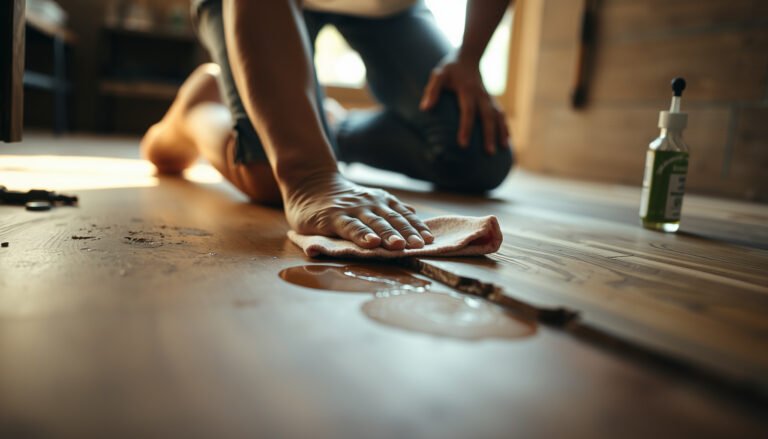
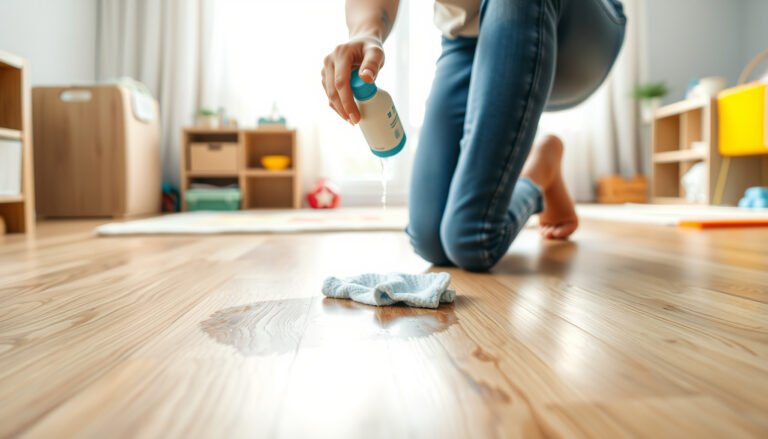
Use a two-step spill method (don’t “wipe it around”)
Weekly mopping should complement daily dry cleaning—not replace fast spill response. For vinyl floors, staff should treat spills like a moisture-and-residue event, not just a cosmetic one.
Use a two-step approach:
– Use a two-step approach: blot/remove the spill first, then clean the area with a vinyl-safe cleaner and clean water.
– Treat stains early (grease, sauces, coffee) by spot-cleaning rather than letting residue sit and spread across the floor.
Blotting first matters because it physically removes liquid and suspended particles. If staff immediately wipes with a dry cloth or spreads liquid across the vinyl finish, you can smear residue into micro-textures and widen the stain area.
Weekly mopping: damp, controlled, and manufacturer-aligned
Weekly mopping is also where you prevent excess moisture from working its way toward edges. Vinyl floors are designed to be resilient, but seams and transitions are still vulnerability points—especially around door thresholds, kitchen entry points, and baseboards.
When mopping vinyl floors:
– Use clean water and a vinyl-approved cleaner per label directions.
– Keep the mop well-wrung to avoid puddling or excessive wetting at seams and grout-like detailing.
– Change rinse water as it loads up—dirty water can redeposit residue and dull the surface.
Restaurant Vinyl Floor Maintenance Cadence (2026)
| # | Task | Cadence | Priority | If skipped |
|---|---|---|---|---|
| 1 | Dry sweep/vacuum (soft head) in main paths | Every day (every 1 day) | ★★★★☆ | High wear risk |
| 2 | Spot-clean spills (blot/remove → clean) | Immediately (same shift) | ★★★★★ | Stain + seam risk |
| 3 | Weekly damp mopping (vinyl-approved cleaner) | Once per week (every 7 days) | ★★★★☆ | Dulling + residue |
| 4 | Inspect seams/edges around baseboards | Weekly (every 7 days) | ★★★★☆ | Water ingress risk |
| 5 | Check mats + replace when saturated | Every 2–4 weeks | ★★★☆☆ | More tracked grit |
| 6 | Quarterly deep cleaning (per specs) | Every 90 days | ★★★☆☆ | Finish dulling |
| 7 | Preventive repair planning (lifted edges) | As soon as found (within 24–48 hrs) | ★★★★☆ | Escalation to replacement |
Protecting vinyl from restaurant wear and moisture
The surest way to protect vinyl floors is to control traffic (mats and chair/caster protection) and reduce how long moisture sits at the surface. Restaurant vinyl floors age faster where grit and water accumulate—entries, service corridors, bar perimeters, and dish/mop zones.
Matting at entrances reduces tracked abrasive soil, which helps limit micro-scratches that turn into dull areas on vinyl floors.
Using properly protected casters and pads under furniture limits gouging and “worn lanes” that show up in high-use restaurant paths.
Put mats where grit concentrates
Put mats at entrances and near high-traffic work zones (kitchen door, bar, dish area) to catch grit and reduce tracked-in debris. Matting is one of the highest-ROI steps because it intercepts abrasive particles before they reach your vinyl floor finish.
Operationally, treat mats like maintenance items:
– Inspect for tears and curling edges.
– Replace or deep-clean saturated mats so they don’t become internal “grit sponges.”
Manage furniture contact: chair/carts/rollers
Use proper floor pads/rollers on chairs and carts, and avoid dragging equipment across vinyl. Small dents and edge fraying often start under rolling feet or at the point where a cart is dragged during restocking.
If your restaurant uses mobile shelving or stock carts:
– Keep wheel bearings maintained (wheels that wobble can scuff vinyl).
– Use protective attachments designed for resilient flooring, not bare hard plastic on vinyl.
Keep moisture from lingering
Vinyl floors can tolerate everyday splashes when cleaned promptly, but moisture is the enemy near seams. In 2026, many operators run more frequent “disinfectant wipes,” which can leave residues or excess moisture. For vinyl floors, use disinfectant products only if they are labeled safe for vinyl/resilient flooring and follow label contact time exactly.
Prevent damage at seams, edges, and transitions
The core goal is preventing water and food debris from getting under seams and into small lifting areas. On vinyl floors, even a minor edge problem can quickly become a larger failure because liquid and particulates migrate where the floor is no longer fully sealed.
Weekly inspection of seams and edges helps catch lifting early, before moisture and food residue work under the vinyl.
Wringing mops thoroughly reduces the likelihood of excess moisture pooling at transitions, where vinyl is most vulnerable.
Inspect the “water pathways”
Inspect around seams, baseboards, and transitions for lifting edges or gaps—water can seep in through small problems. Pay close attention to:
– Door thresholds between dining and kitchen zones
– Around refrigerator/dish areas where splashes repeat
– Any area with repeated use of carts or mops
A practical approach is to do a quick visual scan weekly and a closer check monthly (especially after heavy rain events or after any plumbing-related incidents). Vinyl floors do not need “perfect” seams, but they do require integrity at the failure edges.
Control wet cleaning behavior
Keep wet cleaning under control: don’t leave puddles, and wring mops thoroughly to prevent excess moisture. Excess moisture increases the chance of swelling at vulnerable points and can contribute to loosening edges over time—especially when cleaning happens frequently during peak service.
If you must use a disinfectant, ensure your vinyl floor cleaning protocol still avoids standing liquids. Wipe-on applications can be less risky than flood mopping where seams and transitions are present.
Handle transitions intentionally
Floor transitions—between vinyl and other materials—often experience differential movement and different cleaning methods. When staff transitions from kitchen to dining, they may rinse mops more aggressively or wipe aggressively near thresholds. For vinyl floors, keep those routines consistent and staff training explicit.
Deep cleaning and periodic maintenance (without wrecking the finish)
The safest deep-clean strategy is to follow the vinyl flooring manufacturer’s instructions for your specific product type and finish system. Periodic maintenance should remove built-up residue without stripping or glazing the floor beyond what the floor was designed to tolerate.
Deep-cleaning schedules should be set based on soil load and traffic, and the correct chemicals depend on whether the vinyl has an intact finish or is finish-free.
If your vinyl is “no-wax” / finish-free, applying waxes or build-up products can lead to hazing, stickiness, or finish incompatibility.
Choose your deep-clean cadence based on actual conditions
Schedule periodic maintenance based on how dirty the restaurant gets, and follow the floor manufacturer’s directions for any stripping, polishing, or re-sealing. Vinyl floors in high-demand restaurants often need deeper attention sooner than low-traffic offices, but the “right” interval is still product-dependent.
Because this guide is broadly applicable, use a simple decision rule:
– If your vinyl floor looks dull despite correct daily/weekly cleaning, investigate residue buildup before attempting aggressive restoration.
Match products to the finish system (finish vs. finish-free)
If your vinyl is “no-wax” / finish-free, don’t apply waxes or build-up products that may cause hazing or stickiness—use what the manufacturer specifies. This is one reason deep cleaning should be standardized and approved internally; mixing product lines across sites can create inconsistent outcomes.
In 2026, many restaurants are also shifting to microfiber systems. Microfiber can be excellent, but the cleaning chemistry still has to match your vinyl floors’ care instructions.
Inspection matters as much as cleaning
Deep cleaning is not just washing. Periodic maintenance should include:
– Checking edges for lifting
– Checking transitions for wear and moisture exposure
– Reviewing whether staff mop behavior is creating excess moisture
If you see persistent dampness patterns, cleaning won’t fix the root cause—you’ll need to evaluate ventilation, subfloor moisture, or installation sealing at vulnerable seams.
What can go wrong (and how to avoid it)
The most common vinyl floor failures come from wrong chemicals, over-wetting, and ignoring small seam issues. Avoiding these mistakes protects the floor finish and limits moisture migration—two primary drivers of long-term vinyl wear.
Using chemicals not labeled safe for vinyl/resilient floors can dull or damage the surface finish.
Flooding during mopping increases moisture exposure at seams and transitions, raising the risk of swelling or edge loosening.
Pros and cons: correct cleaning vs. high-risk shortcuts
Below is a decision-oriented comparison you can share with supervisors and training staff:
| Approach | Pros | Cons / risk |
|---|---|---|
| Vinyl-safe cleaner + well-wrung mop | Less dulling from residue; reduced moisture at seams; more uniform finish | Requires product approvals and staff discipline to prevent over-wetting |
| Disinfectant chemicals not approved for vinyl | Can provide strong sanitizing claims for some pathogens | Can dull, strip, or leave residues; may create sticky or hazy areas on vinyl floors |
| Flood mopping to “get everything clean” | Looks thorough in the short term | Raises seam/edge moisture risk; accelerates loosening and long-term damage |
Avoid the four biggest failure modes
Using the wrong cleaner: some disinfectants/solvents can dull or damage vinyl. Stick to cleaners labeled safe for vinyl, or follow the manufacturer’s chemical guidance ().
Over-wetting: flooding during mopping can lead to swelling at seams or loosened edges.
Skipping grit removal: abrasive dirt acts like sand and accelerates scratches and dull spots (sand abrasion is driven by particle size and hardness, including quartz with ~Mohs 7 hardness as described by the USGS).
Ignoring small seam issues: a minor lifting edge can turn into a larger repair once moisture and food debris get underneath.
Verdict: the “do this first” maintenance plan (with downsides)
If you want the best results with the least disruption, prioritize a daily grit-removal routine, immediate spill response, and routine checks of seams and edges. The downside is that vinyl maintenance still requires consistency—if staff skip sweeping or “spot clean” becomes “let it sit,” you’ll see scuffs and dull patches faster than with more forgiving flooring.
Skip this approach (or get professional guidance) if your vinyl manufacturer explicitly requires specialized products or if your floor has widespread lifting, extensive seam failure, or suspected subfloor moisture issues—those situations usually need repair, not just cleaning.
A maintenance plan that combines daily dry soil removal with immediate spill blotting is designed to prevent abrasive grit and residue from degrading vinyl floor finishes over time.
Routine seam inspections are a practical early-warning step for resilient flooring because seam integrity controls where moisture and debris can migrate.
Quick vinyl floor checklist for restaurant care
– [ ] Sweep/vacuum daily with a soft attachment
– [ ] Blot spills immediately, then clean with vinyl-safe cleaner
– [ ] Use mats at entrances + high-traffic doors
– [ ] Prevent puddles; wring mops well
– [ ] Inspect seams/edges weekly for lifting or gaps
– [ ] Follow manufacturer instructions for any deep-clean steps
Sources:
Vinyl floors in restaurants perform best when maintenance is treated like a routine operation: remove grit first, clean with vinyl-safe products, protect entrances and work zones, and watch seams for early lifting. If you keep moisture controlled and standardize staff steps, you reduce scuffs, dulling, and edge failures without turning floor care into a disruptive weekly project.
Frequently Asked Questions
What is the best way to clean vinyl floors in a restaurant?
Sweep or vacuum vinyl floors daily using a soft brush attachment to remove grit that can scratch the surface. Mop with a manufacturer-approved vinyl floor cleaner and warm water, and avoid steam cleaning unless your floor is specifically rated for it. Use a microfiber mop to reduce streaking and rinse lightly if your cleaner leaves residue, since buildup can dull restaurant vinyl floor finishes.
How do you prevent scratches and scuffs on vinyl flooring in high-traffic areas?
Place entry mats at every door and use floor protectors or felt pads under carts, chairs, and kitchen equipment to limit scuffing. Train staff to avoid dragging heavy items across the floor, and schedule regular dry cleaning to remove sand and debris that cause micro-scratches. For deeper scuffs, check your vinyl flooring warranty and consider using a vinyl floor polish or maintenance product recommended for your specific wear layer.
Which cleaning products are safe for vinyl floors, and which should you avoid?
Use pH-neutral cleaners designed for vinyl flooring, and follow dilution directions exactly for restaurant mopping schedules. Avoid harsh chemicals like bleach, ammonia, and abrasive scrubbers, as they can break down the finish and cause discoloration. Also steer clear of waxy or oil-based cleaners unless the product is specifically formulated for vinyl, because residue can make floors slippery and harder to clean.
How should spills be handled to protect restaurant vinyl floors?
Address spills immediately by blotting with absorbent towels—don’t let liquids sit, especially acidic spills like citrus or soda that can affect the surface. Clean the area with a vinyl-safe cleaner, rinse if needed, and dry thoroughly to prevent staining and seam damage. For grease-related spills common in kitchens, use a degreaser only if it’s approved for vinyl and follow the dwell time and dilution instructions.
Why is routine maintenance important for keeping restaurant vinyl floors looking new?
Routine maintenance reduces dirt buildup, which prevents dullness and preserves the vinyl floor’s protective wear layer. Consistent sweeping, proper mopping, and timely spill cleanup also extend the life of the flooring and reduce the chance of costly repairs due to moisture intrusion at seams. A simple maintenance program—daily dry cleaning plus weekly vinyl floor mopping—helps restaurant managers maintain a clean, attractive appearance for guests.
📅 Last Updated: October 26, 2026 | Topic: How to maintain vinyl floors in a restaurant? | Content verified for accuracy and freshness.
References
- Vinyl flooring
- https://www.fda.gov/food/fda-food-code
- https://www.cdc.gov/coronavirus/2019-ncov/prevent-getting-sick/cleaning-disinfection.html
- https://www.cdc.gov/coronavirus/2019-ncov/community/disinfecting-building-facility.html
- https://www.cdc.gov/infectioncontrol/guidelines/environmental/index.html
- https://www.who.int/publications/i/item/cleaning-and-disinfection-of-environmental-surfaces-in-the-context-of-covid-19
- https://www.epa.gov/coronavirus/cleaning-and-disinfecting
- https://scholar.google.com/scholar?q=vinyl+floor+care+maintenance+restaurant Google Scholar
- https://scholar.google.com/scholar?q=resilient+flooring+cleaning+disinfection+guidelines Google Scholar
- https://scholar.google.com/scholar?q=disinfectants+impact+on+vinyl+flooring+resilient+floor+materials Google Scholar
[…] Cover for Kitchen, Splat Mat for Under High Chair In Stock View on Amazon › Vinyl floors in restaurants stay presentable longest when you stop grit at the entrances, control moisture from spills, and […]