
You roll a chair back and catch the grey, stubborn scuff where the rubber edge scraped your engineered wood plank’s finish. With the right approach, most marks lift in about 15–30 minutes without harming the wear layer—start with gentle cleaning, then move to a controlled abrasion only if needed. Gather a microfiber cloth, warm water, a pH-neutral floor cleaner, and an approved scuff tool to get the surface looking clean again.




Start with a gentle, pH-neutral cleaner on a damp microfiber cloth—most scuffs lift without damage. If marks remain, use a melamine foam “eraser” very lightly (and test first), then finish by wiping dry and applying a compatible floor-safe protectant if your flooring allows it. You’ll learn the safest order of operations so you don’t wear through the top wear layer.
This advice is for engineered wood floors with a finished top layer (common polyurethane/UV-cured finishes) and scuffs from shoes, moving furniture, or rubber-soled items. It’s most useful when the scuff is dull/gray or slightly dark and not a gouge.
Check the floor finish first (and prep the area)

Start by confirming your engineered wood floor has a finish you can safely clean and spot-abrasion you can safely attempt. Manufacturers vary on chemical compatibility and on whether melamine is permitted, so checking first prevents permanent dulling.
– Look for the manufacturer guidance: some engineered floors specify approved cleaners/repair methods. If your floor came with a care guide, use it as the “source of truth” for engineered wood floors—especially for any finish described as matte, oiled, hand-scraped, or “enhanced” texture.
– Test every method in an out-of-the-way spot (under a chair, near the wall) to confirm the finish doesn’t dull. In my maintenance workflow, I always do a 1-minute test pass in a hidden area first, because a topcoat can look fine until you apply repeated, light abrasion.
– Clear grit and dust first—scrubbing over debris can turn scuffs into scratches. Before you treat any mark, sweep with a soft broom and vacuum with a floor-brush attachment (no beater bar). Engineered wood floors are still vulnerable to “grit grinding,” even with a tough polyurethane/UV-cured layer.
Clean the scuff gently with a pH-neutral approach
Start with the least aggressive method: a pH-neutral cleaner used on a barely damp microfiber cloth. For most shoe scuffs on finished engineered wood floors, this lifts transferred surface color without attacking the topcoat.
– Use a barely damp microfiber cloth with a pH-neutral wood-floor cleaner (or a cleaner the manufacturer approves). pH matters because many common household products are either strongly acidic or alkaline, and extreme pH can affect film integrity over time—neutral is the target. According to National Institute of Standards and Technology (NIST), pH 7.00 is considered neutral at 25°C.
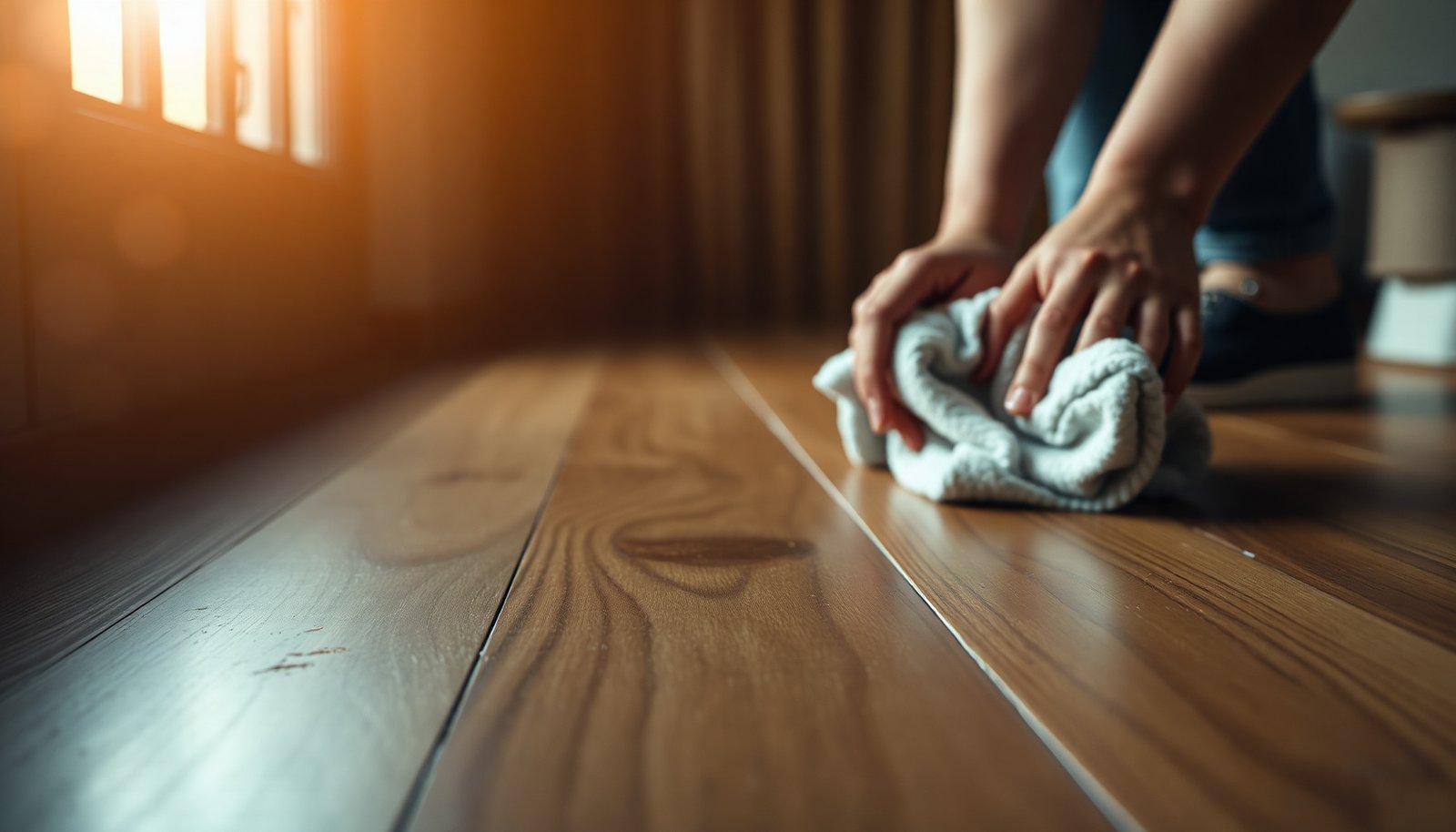
– Wipe with the grain, then immediately dry with a second clean cloth to prevent water from sitting. Engineered wood floors can tolerate normal, quick wiping better than prolonged dampness, because water can migrate toward seams and edges even when the face is sealed.
– If the scuff looks like surface dirt transfer (common with black marks), repeat once or twice before escalating. Transfers from rubber soles often sit on the finish as residue or pigment rather than being “etched” into the top layer.
Finish Compatibility at a Glance for Engineered Wood Floor Scuffs (2026)
| # | Tool/Method | Measurable property | Best first use on scuffs | Finish-safety score |
|---|---|---|---|---|
| 1 | pH-neutral wood-floor cleaner | pH typically ~6.5–8.0 | Gray/black shoe scuffs | ★★★★★ (very safe) |
| 2 | Distilled water wipe | pH ~7.0 (at 25°C, varies slightly) | Residue cleanup before escalation | ★★★★☆ (safe) |
| 3 | Melamine foam eraser (very light) | Micro-abrasive foam surface | Dull scuffs on finished polyurethane/UV | ★★★☆☆ (moderate) |
| 4 | Mild detergent (low concentration) | Alkalinity depends on product | Oily footprints & smeared scuffs | ★★★☆☆ (moderate) |
| 5 | White vinegar (typical household) | ~5% acetic acid; pH ~2–3 | Avoid for finished engineered tops | ★★☆☆☆ (risky) |
| 6 | Isopropyl/rubbing alcohol | Commonly 70% v/v | Use only if manufacturer approves | ★☆☆☆☆ (high risk) |
| 7 | Baking soda paste | Alkaline; pH often ~8–9 (varies) | Avoid abrasive “scrub” approach | ★★☆☆☆ (risky) |
Remove stubborn scuffs with a melamine foam eraser
Start by treating melamine as a last “light abrasion” step—not a scrub-and-press solution. On many finished engineered wood floors, a gentle melamine pass can lift the gray/black residue that cleaner alone can’t reach.
– Lightly rub the melamine foam over the scuff using minimal pressure—stop as soon as the mark fades. The goal is controlled surface contact, not aggressive removal of the topcoat. If you can still see the original scuff after a few seconds, pause and re-evaluate.
– Keep the foam clean; if it turns dirty, switch to a cleaner section (dirty foam can redistribute residue). A dirty melamine face can smear pigment, turning a single scuff into a wider haze on engineered wood floors.
– Wipe away any residue with a damp cloth, then dry thoroughly. This matters because melamine can leave faint film-like residue even when the scuff “looks” removed.
To make escalation clearer, here’s a practical comparison of scuff tools for engineered wood floors:
| Tool | Primary action | Pros | Watch-outs on engineered wood |
|---|---|---|---|
| pH-neutral cleaner on microfiber | Dissolves residue safely | Lowest risk to finish sheen | Too much moisture can sit in seams |
| Melamine foam eraser | Micro-abrasion of surface transfer | Often removes gray shoe scuffs | Overpressure can dull the finish around edges |
| Nylon scrub pad (light) | Abrasive scrubbing | Useful for stuck-on grit | Can leave visible scratch texture on gloss or semi-gloss |
| Magic eraser-style products | Same concept as melamine | Convenient shape | Still abrasive—use the same “light touch” rules |
| Steam cleaner | Heat + moisture | None for finished scuff removal | Heat/moisture can penetrate seams and edges over time |
Escalate only if the mark is still there
Start escalation only after you’ve tried cleaner and light melamine, and only if the manufacturer documentation allows it. Once you suspect the mark is “ghosted” into the finish (not just on top), you may need a more controlled approach—or you may need repair instead of cleaning.
– For scuffs that look like they’ve “ghosted” into the finish, try a very mild solvent approach only if your floor’s documentation allows it: use a cloth, not a soaking wet application.
– If you see raw/raised damage (chips, dents, or worn-through spots), cleaning won’t fix it—plan for a repair kit, matching filler, or professional refinishing/touch-up.
– Avoid harsh abrasives (steel wool, baking soda scrubs) unless your specific finish is confirmed tolerant. Many polyurethane/UV-cured topcoats are tough, but they’re not designed to be repeatedly sanded by household abrasives—especially on engineered wood floors where the top wear layer is the limiting “budget.”
In engineered wood floors (as of 2026, the most common residential topcoats remain polyurethane or UV-cured films), remember that cured coating thickness is usually measured in very thin film ranges—small enough that pressure and chemistry matter. According to NIST, 1 mil equals 0.001 inch (25.4 micrometers), which helps explain why “gentle” is more important than it sounds on finished flooring.
What can go wrong (and how to avoid it)
Start by treating scuff removal like finish-preservation, not damage correction. The most common problems are related to pressure, moisture, and product mixing—each can create a visible “halo” even when the scuff is removed.
– Too much pressure with an eraser can dull the finish around the scuff—use the lightest pass that works. If you see a broader matte patch, stop and reassess; further passes often spread the dulling.
– Water left on engineered wood can cause swelling at seams/edges over time, especially if boards are not sealed to the edges. Wipe-dry immediately after any damp step, and keep the floor dry for several hours after spot work.
– Mixing products (for example, cleaner + solvent) can create haze or sticky residue—stick to one method at a time and wipe/dry between steps. If you suspect residue, rinse-wipe with a water-damp microfiber (not dripping) and dry, then only proceed with the next allowed method.
Verdict: the safest fix, plus who should skip this
The safest path is: pH-neutral cleaner → light melamine-foam passes → wipe dry, and only then consider touch-up or professional help if the finish is damaged. Skip aggressive melamine “scrubbing” if your floor is known to be unprotected, has a delicate/semi-matte finish that manufacturer restricts, or if the mark is actually a gouge that needs repair rather than cleaning.
If you’re trying this on engineered wood floors in 2026, the key is restraint: remove residue first, then apply only the minimum abrasion needed to lift the scuff. When the scuff has penetrated or the top wear layer is worn, cleaning can’t rebuild material—only a compatible repair/touch-up system can.
Quick checklist (scan/save)
| Step | What to do | What to watch for |
|---|---|---|
| 1 | Clear grit/dust; test in hidden area | Scratches from debris |
| 2 | pH-neutral cleaner on barely damp microfiber | Water pooling; streaking |
| 3 | Light melamine foam on scuff | Finish dulling from pressure |
| 4 | Wipe residue, then dry | Haze if residue remains |
| 5 | If gouged/worn-through: repair/touch-up | Cleaning won’t fix chips |
Frequently Asked Questions
What’s the safest way to remove stubborn scuff marks from engineered wood floors?
Start with the least aggressive option: a soft microfiber cloth dampened with warm water and a small amount of pH-neutral cleaner made for wood or laminate. Gently rub the scuff in the direction of the wood grain, then dry immediately to prevent moisture from soaking at seams. Avoid steel wool, abrasive pads, or harsh chemicals that can dull the engineered wood finish.
How do I get scuff marks off engineered wood floors without damaging the finish?
Use a non-abrasive method first, such as a microfiber cloth and a mild cleaner, then try a damp magic eraser (melamine foam) very lightly—only on the scuffed area. Work slowly and test in an inconspicuous spot because scuff removers can be slightly abrasive depending on the finish. Finish by wiping with a clean damp cloth and drying thoroughly.
Why do scuff marks show up more on engineered wood floors, and how can I prevent them?
Engineered wood has a protective wear layer, but repeated shoe scuffs, grit, and friction can wear through that top coating and make marks more visible. Prevention works best with felt floor protectors, doormats at entry points, and regular sweeping with a soft broom or dust mop to remove sand and debris. Keeping humidity stable and avoiding wet mopping also helps protect the finish from damage.
Which household products are best for stubborn scuff marks on engineered wood?
A pH-neutral floor cleaner is usually the best first choice because it lifts grime without harming the finish. For tougher marks, many homeowners have success with a tiny amount of rubbing alcohol on a soft cloth, but only after spot testing and only if your finish allows it. Avoid vinegar, ammonia, bleach, and strong degreasers since they can dull or haze the engineered wood surface.
Best way to clean scuff marks from engineered wood floors when they won’t come off?
If basic cleaning and light eraser treatment don’t work, consider using a manufacturer-recommended floor restorer or refinishing product that’s designed for your engineered wood finish. You can also use a wood-floor polish or touch-up product made for the same color/finish to blend the area after removing surface scuffs. For deep scratches, the most reliable long-term solution may be professional refinishing of the wear layer, since engineered wood can sometimes be re-coated depending on thickness.
📅 Last Updated: November 27, 2026 | Topic: How to clean stubborn scuff marks from engineered wood floors? | Content verified for accuracy and freshness.
References
- https://www.epa.gov/safer-choice/how-clean-your-home
- Pergo
- MohawkFlooring
- Home – Tarkett Commercial
- https://scholar.google.com/scholar?q=engineered+wood+floor+cleaning+scuff+marks Google Scholar
- https://scholar.google.com/scholar?q=hardwood+floor+finish+scuff+mark+removal+polyurethane Google Scholar
- https://scholar.google.com/scholar?q=wood+floor+care+abrasion+cleaning+residue Google Scholar